Illnesses: enfermedades comunes en inglés. Vocabulario y ejemplos
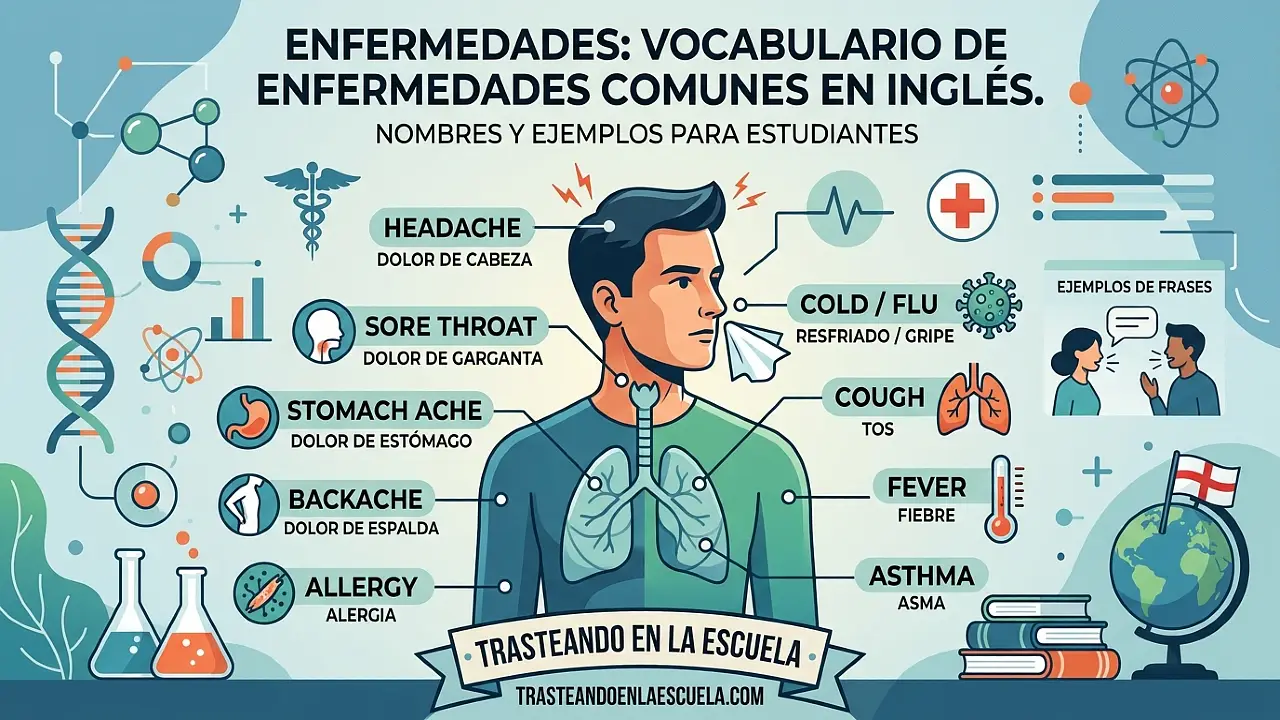
Illnesses: Enfermedades comunes en inglés
Saber comunicar cómo te sientes o qué te duele es una de las habilidades más importantes cuando aprendes un idioma. Imagina que estás de viaje y necesitas ayuda médica: ¿sabrías decir «I have a headache» o «I feel dizzy»? En este post vamos a aprender el vocabulario esencial sobre illnesses (enfermedades) en inglés, acompañado de ejemplos reales, expresiones útiles y ejercicios prácticos.
🎯 En este post aprenderás: Los nombres de las enfermedades más comunes (cold, flu, allergy, etc.), cómo describir síntomas básicos, diferencias entre «ache», «pain» y «hurt», frases para explicar tu estado de salud y más de 30 ejemplos en contexto. Además, encontrarás 5 ejercicios interactivos para comprobar tu progreso. Si quieres ampliar, no te pierdas nuestras guías sobre Symptoms: síntomas en inglés y At the doctor’s: en el médico.
🔍 ¿Qué son las illnesses? Diferencia entre illness, disease y sickness
📚 Illness, Disease o Sickness: ¿son lo mismo?
Aunque a menudo se usan como sinónimos, hay matices importantes:
- Illness: Se refiere al estado de sentirse enfermo. Es el término más general y cotidiano. «He missed work due to an illness.»
- Disease: Es una condición médica concreta, a menudo más grave o crónica. «Heart disease runs in his family.»
- Sickness: Se usa mucho para náuseas o malestar general, también para referirse a enfermedades contagiosas. «Motion sickness is common on boats.»
En la vida diaria, usa illness para la mayoría de situaciones. Cuando visites al médico, te recomendamos revisar el vocabulario de Hospital: vocabulario hospitalario para emergencias.
💡 Dato clave: Para quejas menores (dolor de cabeza, resfriado) usa «I have a + illness». Para algo más vago: «I feel sick» o «I’m ill».
📋 Lista completa: Enfermedades comunes en inglés (con pronunciación guiada)
Aquí tienes la tabla más completa con las enfermedades que escucharás en consultas médicas, conversaciones cotidianas y series de televisión. Incluye su traducción y un ejemplo práctico.
| English (Illness) | Español | Example sentence |
|---|---|---|
| Cold | Resfriado | I’ve had a cold for three days, and I can’t stop sneezing. |
| Flu (Influenza) | Gripe | The flu left me with a high fever and body aches. |
| Headache | Dolor de cabeza | She took a painkiller for her headache. |
| Migraine | Migraña | His migraine was so severe that he had to lie down in a dark room. |
| Stomachache | Dolor de estómago | Don’t eat so much candy or you’ll get a stomachache. |
| Toothache | Dolor de muelas | I need to see a dentist because this toothache is unbearable. |
| Backache | Dolor de espalda | Sitting all day at a computer gives me a backache. |
| Sore throat | Dolor de garganta | He lost his voice due to a sore throat. |
| Cough | Tos | A persistent cough kept her awake all night. |
| Fever | Fiebre | Check if the baby has a fever by using a thermometer. |
| Allergy | Alergia | Pollen causes my seasonal allergy to flare up. |
| Asthma | Asma | He carries an inhaler because he suffers from asthma. |
| Chickenpox | Varicela | Children usually get chickenpox once in their lifetime. |
| Measles | Sarampión | Vaccination has made measles less common. |
| Mumps | Paperas | Mumps cause swelling in the salivary glands. |
| Food poisoning | Intoxicación alimentaria | We all got food poisoning after eating at that seafood restaurant. |
| Ear infection | Infección de oído | Swimming in dirty water can lead to an ear infection. |
| Rash | Sarpullido / Erupción | The new detergent gave me an itchy rash on my arms. |
🗣️ Cómo describir cómo te sientes: verbos y expresiones clave
🔹 HAVE + (a/an) + illness
El más común para enfermedades específicas.
I have a cold.
She has the flu.
They have a headache.
🔹 FEEL + adjective
Para sensaciones generales.
I feel sick.
He feels dizzy.
We feel exhausted.
🔹 BE + adjective
Para estados prolongados.
I am ill.
She is allergic to nuts.
He is feverish.
🔹 SUFFER FROM + illness
Para enfermedades crónicas o graves.
He suffers from asthma.
She suffers from migraines.
📌 Diferencia entre «ache», «pain» y «hurt»:
- Ache: Dolor sordo y continuo. Se combina con partes del cuerpo: headache, toothache, stomachache, backache.
- Pain: Dolor más agudo o específico. Se usa con «in»: pain in my knee, chest pain.
- Hurt: Verbo que significa «doler» o «hacer daño». My leg hurts.
Para más detalles sobre cómo describir malestares, consulta Symptoms: síntomas en inglés donde explicamos cada síntoma con ejemplos médicos reales.
🦠 Enfermedades infecciosas vs. enfermedades crónicas
🦠 Infectious diseases (Infecciosas)
Son aquellas que se transmiten de una persona a otra (contagiosas). Ejemplos:
- Cold / Flu (virus)
- Chickenpox / Measles (virales infantiles)
- Strep throat (bacterial)
«Stay home if you have an infectious disease to avoid spreading it.»
🩺 Chronic diseases (Crónicas)
Son duraderas, a menudo de por vida, y no contagiosas.
- Asthma
- Diabetes
- Arthritis
- High blood pressure
«He manages his chronic disease with medication and diet.»
💊 Tratamientos comunes y verbos relacionados
Cuando tenemos una illness, necesitamos saber qué hacer. Estos son los verbos y frases más útiles:
| Verb / Phrase | Meaning | Example |
|---|---|---|
| Take medicine | Tomar medicina | You should take medicine for your fever. |
| See a doctor | Ver a un médico | If the pain continues, see a doctor. |
| Get a prescription | Obtener receta | The doctor gave me a prescription for antibiotics. |
| Stay in bed | Quedarse en cama | The best cure for the flu is to stay in bed and rest. |
| Drink fluids | Beber líquidos | Drink plenty of fluids to avoid dehydration. |
| Get a shot / vaccine | Vacunarse | I get a flu shot every October. |
Si necesitas más vocabulario sobre medicinas, visita nuestra guía completa de Medicine: medicamentos donde explicamos las diferencias entre pills, tablets, syrup, etc.
🚨 Importante: En inglés británico se dice «go to hospital», mientras que en inglés americano se dice «go to the hospital». Ambas son correctas, pero sé consistente.
📝 Diálogos breves: usando illnesses en contexto
🗣️ Diálogo 1: Entre amigos
Anna: Hey, you look pale. What’s wrong?
Tom: I think I have the flu. I’ve got a fever and a terrible sore throat.
Anna: Oh no! Have you taken anything?
Tom: Just some tea with honey. I should probably see a doctor if it gets worse.
Anna: Rest up! And don’t forget to drink fluids.
🗣️ Diálogo 2: En la farmacia
Customer: Excuse me, I need something for a headache and a cough.
Pharmacist: Do you have a fever as well?
Customer: No, no fever. Just a bad headache and dry cough.
Pharmacist: This syrup will help with the cough, and these tablets are for the headache. Take two per day.
Customer: Thanks! Do I need a prescription?
Pharmacist: No, these are over-the-counter.
🧪 5 Ejercicios prácticos para dominar las illnesses
📝 Ejercicio 1: Elige la palabra correcta
Completa cada oración con la enfermedad adecuada: cold, flu, migraine, food poisoning, rash.
- After eating that sushi, I spent the whole night vomiting. I think I have _______________.
- She’s sneezing and has a runny nose. It’s just a _______________, not a serious illness.
- The _______________ gave him a high fever of 39°C and severe body aches.
- He can’t stand the light because his _______________ is so intense.
- The new lotion caused an itchy _______________ on my face and neck.
✅ Ver solución
- food poisoning
- cold
- flu
- migraine
- rash
📝 Ejercicio 2: Traduce al inglés
Escribe la frase en inglés usando el vocabulario de illnesses.
- Tengo dolor de muelas y necesito ir al dentista.
- Mi hijo tiene varicela, por eso no fue a la escuela.
- ¿Has tenido fiebre en los últimos tres días?
- El dolor de espalda me impide dormir bien.
- Ellos sufren de alergias estacionales en primavera.
✅ Ver solución
- I have a toothache and I need to go to the dentist.
- My son has chickenpox, that’s why he didn’t go to school.
- Have you had a fever in the last three days?
- The backache prevents me from sleeping well.
- They suffer from seasonal allergies in spring.
📝 Ejercicio 3: ¿Infecciosa o crónica?
Clasifica cada enfermedad como Infectious (I) o Chronic (C).
- Asthma
- Measles
- Diabetes
- Common cold
- Arthritis
✅ Ver solución
- C (Crónica)
- I (Infecciosa)
- C (Crónica)
- I (Infecciosa)
- C (Crónica)
📝 Ejercicio 4: Completa el diálogo
Usa las palabras del recuadro para completar la conversación entre médico y paciente: sore throat, cough, fever, prescription, flu.
Doctor: What seems to be the problem?
Patient: I have a terrible (1) _______________ and a dry (2) _______________. I also think I have a (3) _______________ because my forehead feels hot.
Doctor: It sounds like you might have the (4) _______________. I’ll give you a (5) _______________ for some antivirals and recommend lots of rest.
✅ Ver solución
- sore throat
- cough
- fever
- flu
- prescription
📝 Ejercicio 5: Crea 3 oraciones originales
Escribe tres oraciones en inglés usando las siguientes enfermedades: ear infection, stomachache, allergy. Intenta usar un verbo diferente en cada una (have, feel, suffer from).
✅ Ver solución (ejemplos)
- My daughter has an ear infection after swimming in the pool.
- I feel a terrible stomachache because I ate too much pizza.
- He suffers from a severe allergy to peanuts.
📌 Errores comunes al hablar de enfermedades en inglés
| Error frecuente | Explicación | Forma correcta |
|---|---|---|
| I have headache. | Falta el artículo «a». | I have a headache. |
| I have flu. | Con «flu» se suele usar «the». | I have the flu. |
| My head hurts me. | «Hurt» no necesita objeto indirecto aquí. | My head hurts. / I have a headache. |
| I feel headache. | «Headache» es un sustantivo, no un adjetivo. | I have a headache. / I feel bad. |
🌡️ Más allá de las enfermedades: ¿cómo prevenir?
🧼 Consejos para prevenir enfermedades (en inglés)
- ✔️ Wash your hands frequently with soap.
- ✔️ Get vaccinated against the flu every year.
- ✔️ Cover your mouth when you cough or sneeze.
- ✔️ Stay home if you feel sick to avoid contagion.
- ✔️ Eat healthy and exercise to boost your immune system.
📚 Recuerda: Si tienes que ir al hospital por una emergencia, consulta nuestro post Hospital: vocabulario hospitalario donde aprenderás palabras como «emergency room», «stretcher», «surgeon» y más.
📖 Glosario rápido: términos clave de este post
| Término | Definición |
|---|---|
| Illness | Estado general de enfermedad. |
| Disease | Condición médica específica, a menudo grave. |
| Contagious | Que se transmite por contacto. |
| Symptom | Señal o indicio de una enfermedad (fiebre, tos). |
| Over-the-counter (OTC) | Medicamento sin receta. |
| Prescription | Receta médica obligatoria. |
🎯 Resumen final y práctica diaria
📚 Serie completa: Salud y medicina en inglés
No te pierdas el resto de la serie para dominar el vocabulario de salud:
- Illnesses: enfermedades comunes – ¡Estás aquí!
- Symptoms: síntomas en inglés – Aprende a describir fiebre, mareos, inflamación.
- At the doctor’s: en el médico – Diálogos y frases para consultas.
- Hospital: vocabulario hospitalario – Urgencias, quirófano, especialistas.
- Medicine: medicamentos – Tipos de fármacos, dosis, efectos secundarios.
🏆 Reto de la semana: Cada día, escribe una frase describiendo una enfermedad o síntoma diferente usando el vocabulario que has aprendido. Por ejemplo: «On Monday, I had a sore throat. On Tuesday, I felt dizzy.» Al final de la semana, tendrás 7 frases listas para usar en cualquier conversación médica.













Publicar comentario