At the doctor’s: vocabulario y frases para ir al médico en inglés
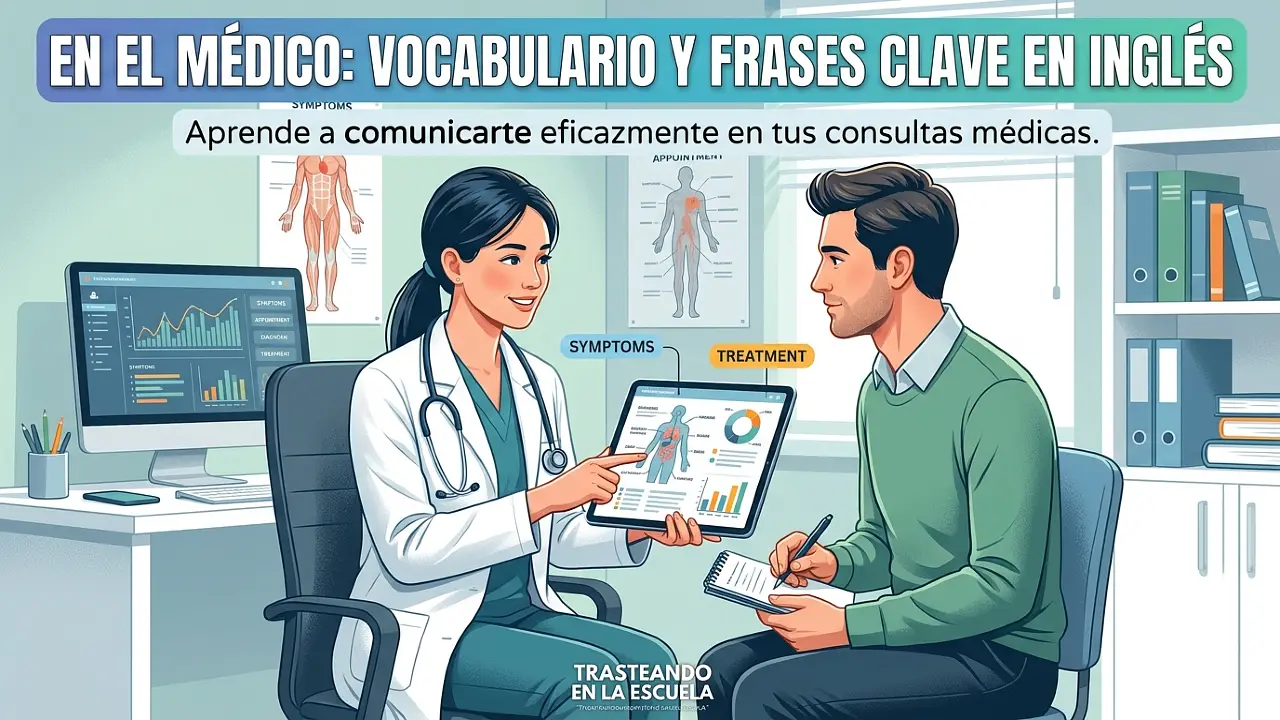
At the doctor’s: Cómo ir al médico en inglés
Saber expresarte en una consulta médica en inglés puede ser estresante si no dominas el vocabulario adecuado. ¿Cómo explicas que te duele aquí? ¿Cómo preguntas por los efectos secundarios de una medicina? En este post vas a aprender frases clave, preguntas típicas del médico y respuestas útiles para que una visita al doctor sea mucho más fácil, tanto si viajas como si vives en un país de habla inglesa.
🎯 En este post aprenderás: Las preguntas más comunes que hace el médico (What’s the matter? How long have you had these symptoms?), cómo describir tu dolor con precisión, frases para pedir recetas o bajas laborales, y 5 ejercicios prácticos con diálogos reales. Complementa este contenido con Symptoms: síntomas en inglés y Medicine: medicamentos.
🔍 Antes de entrar al consultorio: frases útiles en recepción
📋 Reception & check-in
Lo primero que harás al llegar es registrarte en recepción (reception desk). Estas son las frases típicas:
- I have an appointment with Dr. Smith at 10 AM. (Tengo una cita con el Dr. Smith a las 10 AM.)
- I don’t have an appointment. Can I see a doctor? (No tengo cita. ¿Puedo ver a un médico?)
- Is it possible to see a female doctor? (¿Es posible ver a una doctora?)
- Please fill out this form with your personal information and medical history. (Por favor, rellene este formulario con sus datos personales e historial médico.)
Si necesitas ir a urgencias, consulta nuestra guía de Hospital: vocabulario hospitalario para aprender palabras como «emergency room» o «waiting room».
🩺 El médico pregunta: preguntas típicas en una consulta
El doctor necesita entender qué te pasa. Estas son las preguntas más habituales y cómo puedes responder:
| Doctor’s question (Pregunta del médico) | Possible answer (Respuesta posible) |
|---|---|
| What’s the matter? / What’s wrong? (¿Qué te pasa?) | I have a sore throat and a cough. (Tengo dolor de garganta y tos.) |
| How long have you had these symptoms? (¿Cuánto tiempo llevas con estos síntomas?) | For about three days. / Since Monday. |
| On a scale of 1 to 10, how severe is the pain? (Del 1 al 10, ¿qué intensidad tiene el dolor?) | It’s about a 7. It’s sharp and constant. (Es como un 7, es agudo y constante.) |
| Do you have any other symptoms? Fever, chills, nausea? (¿Tienes algún otro síntoma?) | I had a fever last night, but today it’s gone. |
| Are you allergic to any medication? (¿Eres alérgico a algún medicamento?) | I’m allergic to penicillin. (Soy alérgico a la penicilina.) |
| Are you taking any regular medication? (¿Tomas alguna medicación habitual?) | Yes, I take medication for high blood pressure. |
💡 Consejo: Si no entiendes algo, puedes decir: «Could you please repeat that?» (¿Podría repetirlo, por favor?) o «Could you speak more slowly?» (¿Podría hablar más despacio?). Es totalmente normal y aceptable.
🗣️ Cómo describir el dolor con precisión
El médico necesita saber cómo es tu dolor. Aquí tienes adjetivos específicos para que te expreses como un nativo:
🔹 Tipo de dolor
- Sharp – punzante / agudo
- Dull – sordo (no agudo)
- Burning – ardiente / quemazón
- Throbbing – pulsátil (como latidos)
- Stabbing – como una puñalada
🔹 Localización
- Localized – en un punto exacto
- Radiating – que se irradia (ej: dolor que va del cuello al brazo)
- On the left/right side – en el lado izquierdo/derecho
- In the lower/upper part – en la parte inferior/superior
📌 Ejemplos completos:
- «I have a sharp, stabbing pain in my lower back.»
- «It’s a dull ache behind my eyes, like a tension headache.»
- «The burning sensation in my chest gets worse after eating.»
📝 Diálogo completo: consulta médica paso a paso
👩⚕️ Doctor: Good morning. Please come in and have a seat. What brings you in today?
🧑 Paciente: I’ve been feeling unwell for the past four days. I have a persistent cough and a sore throat.
👩⚕️ Doctor: I see. Do you have a fever?
🧑 Paciente: I had a mild fever yesterday, around 38°C, but today I don’t have a fever. However, I feel very tired and weak.
👩⚕️ Doctor: Any other symptoms? Runny nose, headache, or body aches?
🧑 Paciente: Yes, I have a mild headache and my muscles ache, especially in my legs.
👩⚕️ Doctor: Let me listen to your chest. Breathe deeply, please. It sounds like you might have a viral infection, probably the flu. I recommend rest, plenty of fluids, and over-the-counter medication for the fever and aches. If symptoms get worse or you have difficulty breathing, come back or go to the emergency room.
🧑 Paciente: Should I take antibiotics?
👩⚕️ Doctor: No, antibiotics don’t work against viruses. I’ll give you a prescription for something to relieve the cough. Take it as needed.
🧑 Paciente: Thank you, doctor. Do I need a sick note for my job?
👩⚕️ Doctor: Yes, I’ll write you a note for three days off. Get well soon.
Para practicar más situaciones médicas, visita At the doctor’s y combínalo con Illnesses.
📋 Frases útiles para el paciente (tú)
| Spanish | English |
|---|---|
| Me duele aquí cuando toco. | It hurts here when I touch it. |
| ¿Necesito alguna prueba médica? (análisis, radiografía) | Do I need any medical tests? (blood test, X-ray) |
| ¿Me puede dar una receta? | Can you give me a prescription? |
| ¿Esto es grave? | Is it serious? |
| ¿Cuánto tiempo tardaré en recuperarme? | How long will it take me to recover? |
| Necesito una baja laboral (justificante). | I need a sick note / doctor’s note. |
| ¿Puedo trabajar / hacer ejercicio? | Can I work / exercise? |
💊 Después de la consulta: en la farmacia
Con la receta (prescription) en mano, irás a la farmacia (pharmacy / chemist). Aquí tienes frases útiles:
- I’d like to get this prescription filled. (Quiero que me dispensen esta receta.)
- How many times a day should I take this? (¿Cuántas veces al día debo tomar esto?)
- Do I take it with food or on an empty stomach? (¿Lo tomo con comida o en ayunas?)
- What are the possible side effects? (¿Cuáles son los posibles efectos secundarios?)
- Can I buy this without a prescription? (¿Puedo comprar esto sin receta?)
Aprende más sobre medicamentos en Medicine: medicamentos (tipos de fármacos, dosis, contraindicaciones).
🧪 5 Ejercicios prácticos para dominar la visita al médico
📝 Ejercicio 1: Empareja la pregunta del médico con la respuesta adecuada
Une cada pregunta con su respuesta lógica:
- How long have you had these symptoms?
- On a scale of 1 to 10, how severe is the pain?
- Are you allergic to any medication?
- Do you have any other symptoms?
- What’s the matter?
Respuestas: (1) I have a rash on my arms. / (2) For about two weeks. / (3) Yes, I’m allergic to aspirin. / (4) It’s an 8. It’s throbbing. / (5) I have a bad cough and fever.
✅ Ver solución
- a → (2) For about two weeks.
- b → (4) It’s an 8. It’s throbbing.
- c → (3) Yes, I’m allergic to aspirin.
- d → (1) I have a rash on my arms.
- e → (5) I have a bad cough and fever.
📝 Ejercicio 2: Completa el diálogo con las palabras del recuadro
Palabras: prescription, symptoms, fever, chest, medication
Doctor: What (1) _______________ are you experiencing?
Patient: I have a high (2) _______________ and pain in my (3) _______________.
Doctor: I’ll give you a (4) _______________ for antibiotics. Take this (5) _______________ twice a day for seven days.
✅ Ver solución
- symptoms
- fever
- chest
- prescription
- medication
📝 Ejercicio 3: Elige la opción correcta
- To ask for time off work due to illness, you need a:
a) prescription / b) sick note / c) medical test - «It hurts when I press here» se dice:
a) It hurts when I touch here / b) I have a pressing pain / c) The pain is pressure - The doctor might say «Breathe deeply» to:
a) check your blood pressure / b) listen to your lungs / c) take your temperature - «I’m allergic to penicillin» significa:
a) Necesito penicilina / b) Soy alérgico a la penicilina / c) La penicilina me sienta bien - If the doctor says «Take this on an empty stomach», you should:
a) take it with food / b) take it before eating / c) take it after a big meal
✅ Ver solución
- b) sick note
- a) It hurts when I touch here
- b) listen to your lungs
- b) Soy alérgico a la penicilina
- b) take it before eating
📝 Ejercicio 4: Traduce al inglés
- ¿Cuánto tiempo llevas con fiebre?
- Necesito una receta para el dolor de garganta.
- El dolor es sordo y se irradia hacia mi brazo izquierdo.
- ¿Puedo trabajar o necesito reposo absoluto?
- ¿Cuáles son los efectos secundarios de este medicamento?
✅ Ver solución
- How long have you had a fever?
- I need a prescription for the sore throat.
- The pain is dull and radiates to my left arm.
- Can I work or do I need complete rest?
- What are the side effects of this medication?
📝 Ejercicio 5: Escribe un mini-diálogo
Imagina que tienes tos seca, fatiga y falta de aire desde hace 3 días. Escribe 4 líneas de diálogo entre el médico y tú (incluye al menos una pregunta sobre medicación).
✅ Ver solución (ejemplo)
Doctor: What symptoms are you having?
Patient: I’ve had a dry cough and shortness of breath for three days. I also feel very tired.
Doctor: Do you have a fever or chest pain?
Patient: No fever, but sometimes my chest feels tight. Do I need an inhaler?
📌 Errores comunes en la consulta médica
| Error frecuente | Forma correcta | Explicación |
|---|---|---|
| I have fever. | I have a fever. | «Fever» necesita artículo en singular. |
| I feel pain in my head. | I have a headache. / My head hurts. | Es más natural usar «headache». |
| Doctor, give me medicine. | Could you prescribe something for me, please? | Más educado y profesional. |
| I need a recipe. | I need a prescription. | «Recipe» es de cocina, «prescription» es médica. |
🚨 Situación de emergencia: Si es muy grave, di «I need an ambulance» o «Call 911». En el post de Hospital tienes más vocabulario para urgencias.
📖 Glosario de términos clave
| Término | Definición |
|---|---|
| Appointment | Cita médica programada. |
| Waiting room | Sala de espera. |
| Examination room | Consultorio / sala de exploración. |
| Blood test | Análisis de sangre. |
| X-ray | Radiografía. |
| Side effect | Efecto secundario. |
| Sick note (doctor’s note) | Justificante médico / baja laboral. |
🎯 Resumen y práctica diaria
📚 Serie completa: Salud y medicina en inglés
🏆 Reto de la semana: Representa un diálogo médico con un amigo o frente al espejo. Usa al menos 5 frases de este post. Grábate y escucha tu pronunciación. ¡Verás cómo ganas fluidez!












Publicar comentario