Speaking del Cambridge B1: temas y cómo prepararlo
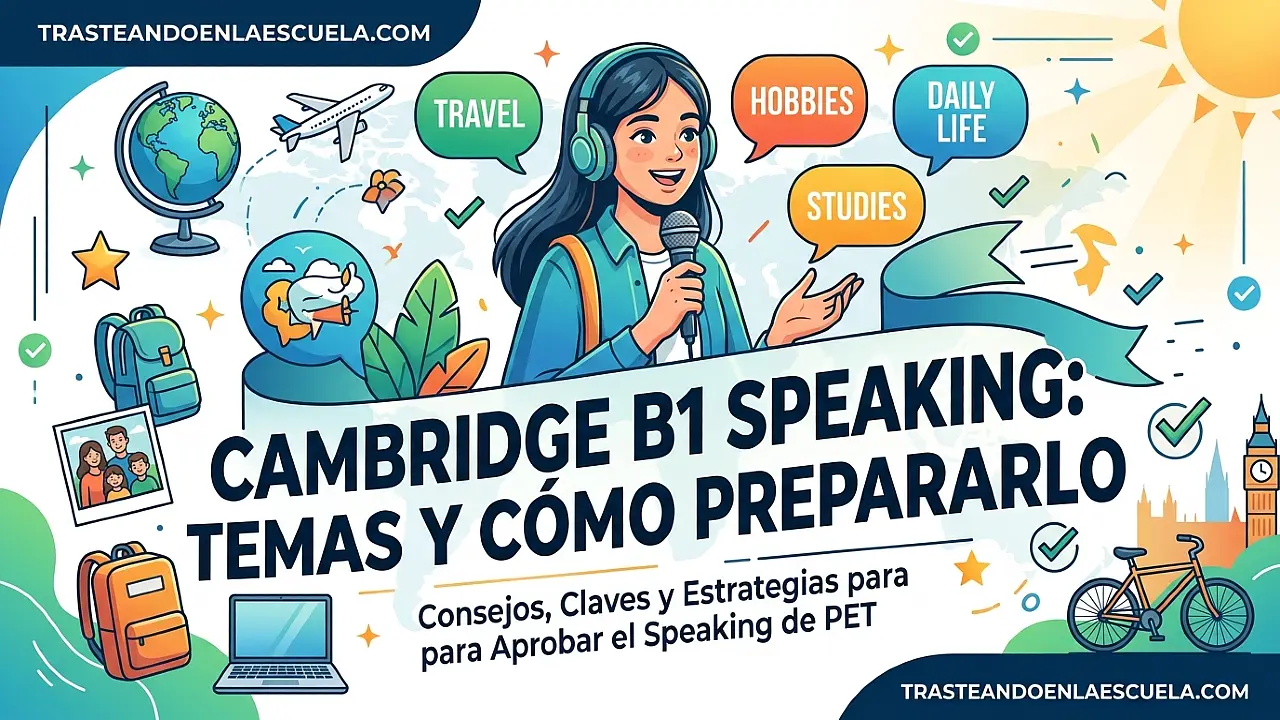
Speaking del Cambridge B1 Preliminary: temas y cómo prepararlo
El Speaking suele ser la parte que más nervios produce, pero también es la más fácil de mejorar con práctica. En esta guía te explico cómo es cada parte, qué temas son más frecuentes, expresiones útiles y estrategias para hablar con confianza.
🎯 En esta guía encontrarás: Desglose de las 4 partes del Speaking, temas comunes con ejemplos de respuestas, frases clave para cada situación, errores que debes evitar y 5 ejercicios para practicar en casa.
🔍 Estructura del Speaking B1 Preliminary
⏱️ 12-17 minutos con otro candidato
El Speaking se realiza en parejas (dos candidatos) y hay dos examinadores: uno que interactúa contigo (interlocutor) y otro que solo escucha y anota (asesor).
| Parte | Qué hacer | Interacción | Duración |
|---|---|---|---|
| Parte 1 | Responder preguntas personales | Candidato → Examinador | 2-3 minutos |
| Parte 2 | Describir una fotografía | Cada candidato habla 1 minuto | 2-3 minutos |
| Parte 3 | Colaborar para tomar una decisión | Candidato ↔ Candidato | 2-3 minutos |
| Parte 4 | Discutir temas relacionados con la Parte 3 | Todos + examinador | 3-4 minutos |
💡 Lo que evalúan: Gramática y vocabulario (range and accuracy), pronunciación, gestión del discurso (fluidez, conectores) y comunicación interactiva (escuchar y responder adecuadamente).
🗣️ Parte 1: Preguntas personales
🎯 Qué esperar
El examinador te hará preguntas sobre ti mismo: trabajo/estudios, familia, gustos, rutinas, experiencias pasadas y planes futuros.
🎯 Temas frecuentes
- Work/Study: «What do you do? Do you like your job/subject?»
- Free time: «What do you enjoy doing in your free time?»
- Family and friends: «Tell me about your family.»
- Home town: «Where are you from? What’s your city like?»
- Travel: «Do you like travelling? Where did you go last summer?»
- Future plans: «What are you going to do next weekend?»
🎯 Frases útiles para la Parte 1
Para hablar de gustos: «I really enjoy…», «I’m keen on…», «I’m not a big fan of…»
Para hablar de rutinas: «I usually…», «On weekdays I…», «Once a week I…»
Para hablar del pasado: «Last year I…», «When I was a child I used to…»
Para hablar del futuro: «I’m planning to…», «I hope to…», «Next weekend I’m going to…»
📝 Ejemplo de respuesta
Examinador: «What do you enjoy doing in your free time?»
Candidato: «In my free time, I really enjoy playing football with my friends. I usually play on Saturdays at the local park. I also like watching movies, especially comedies.»
🖼️ Parte 2: Describir una fotografía
🎯 Qué esperar
Cada candidato recibe una fotografía diferente. Tienes que describirla durante aproximadamente 1 minuto. El examinador te dará instrucciones: «Please describe this photo. What is happening? Where are the people?»
🎯 Estructura para describir una foto
- Introducción general: «In this photo, I can see… / This picture shows…»
- Qué hay en la foto (personas, objetos, lugar): «There is/there are… / At the top/bottom/left/right…»
- Qué está pasando (acción): «The people are + -ing… / They seem to be…»
- Opinión/sensación: «It looks like… / I think they are… / Probably…»
🎯 Frases útiles para la Parte 2
Para ubicar elementos: «In the foreground/background…», «On the left/right…», «At the top/bottom…», «Next to…», «Behind…»
Para describir personas: «He/She looks happy/sad/tired/excited…», «They might be friends/family…», «He is wearing…»
Para especular: «It looks like they are…», «Perhaps they are…», «I can’t tell for sure, but I think…»
📝 Ejemplo de respuesta
«In this photo, I can see a family having a picnic in a park. In the foreground, there are two children sitting on a blanket. They are eating sandwiches and laughing. In the background, I can see trees and a lake. The weather looks sunny and warm. I think they are enjoying their weekend together. It looks like a very happy moment.» (110 palabras, ~1 minuto)
🤝 Parte 3: Colaboración para decidir
🎯 Qué esperar
El examinador te muestra una imagen con varias opciones (por ejemplo, diferentes regalos, actividades, lugares). Tú y tu compañero deben discutir juntos y llegar a un acuerdo sobre la mejor opción. No hay una respuesta correcta; lo importante es la interacción.
🎯 Estructura para la Parte 3
- Iniciar la conversación: «So, what do you think? / Shall we start with this one?»
- Dar opiniones: «In my opinion, … / I think that… / From my point of view…»
- Preguntar la opinión del compañero: «What about you? / Do you agree? / What do you think about…?»
- Expresar acuerdo/desacuerdo: «I agree with you. / That’s a good point. / I see your point, but…»
- Llegar a un acuerdo: «So, we both think that… / Shall we choose…?»
🎯 Frases útiles para la Parte 3
Para hacer sugerencias: «Why don’t we consider…?», «How about + -ing…?», «Perhaps we could…»
Para preguntar: «What do you reckon?», «Do you think that’s a good idea?», «Shall we choose this one?»
Para estar de acuerdo: «Absolutely!», «That’s true.», «I was just thinking that.»
Para estar en desacuerdo (educadamente): «That’s a good point, but have you considered…?», «I see what you mean, but…»
📝 Ejemplo de diálogo
Candidato A: «So, we need to choose a gift for our teacher’s birthday. What do you think about the book?»
Candidato B: «That’s a good idea, but I think a mug might be better because she loves coffee.»
Candidato A: «That’s true. How about the flowers? They are nice too.»
Candidato B: «Yes, but flowers don’t last long. I agree with you about the mug. Shall we choose that?»
Candidato A: «Yes, I think we both agree that the mug is the best option.»
💬 Parte 4: Discusión sobre temas generales
🎯 Qué esperar
El examinador amplía el tema de la Parte 3 y hace preguntas más generales para que tú y tu compañero discutáis. Por ejemplo, si la Parte 3 era sobre regalos, la Parte 4 podría preguntar: «Is it important to give gifts? Why?»
🎯 Frases útiles para la Parte 4
Para dar tu opinión: «Personally, I believe that…», «In my experience…», «I feel strongly that…»
Para dar ejemplos: «For example…», «For instance…», «Such as…»
Para comparar: «On the one hand… on the other hand…», «Compared to…», «Similarly…»
Para expresar incertidumbre: «I’m not sure, but perhaps…», «It depends on…»
📋 Temas frecuentes en el Speaking B1
🏠 Hogar y ciudad: Describe tu casa, tu habitación, tu barrio, tu ciudad. ¿Qué te gusta? ¿Qué cambiarías?
🎓 Trabajo y estudios: ¿Qué estudias/trabajas? ¿Te gusta? ¿Por qué elegiste eso? ¿Qué te gustaría hacer en el futuro?
🎨 Tiempo libre y hobbies: ¿Qué haces en tu tiempo libre? ¿Con qué frecuencia? ¿Con quién? ¿Por qué te gusta?
👪 Familia y amigos: Describe a tu mejor amigo o un familiar. ¿Qué os gusta hacer juntos?
✈️ Viajes y vacaciones: ¿Dónde fuiste de vacaciones? ¿Con quién? ¿Qué hiciste? ¿Dónde te gustaría viajar?
🍽️ Comida y restaurantes: ¿Qué tipo de comida te gusta? ¿Sabes cocinar? ¿Cuál es tu restaurante favorito?
📱 Tecnología y medios: ¿Cuánto tiempo pasas en el móvil? ¿Prefieres ver series o leer libros?
🌍 Medio ambiente: ¿Qué haces para reciclar? ¿Crees que el cambio climático es un problema grave?
❌ Errores comunes en el Speaking B1
| Error | Cómo evitarlo |
|---|---|
| Respuestas de una sola palabra (Yes/No) | Amplía tu respuesta: da una razón o un ejemplo. |
| Quedarse en blanco | Usa frases como «Let me think…» o «That’s an interesting question…» |
| No interactuar con el compañero | Mira a tu compañero, hazle preguntas, reacciona a lo que dice. |
| Pronunciar mal palabras clave | Practica las palabras más comunes. No pasa nada si tienes acento. |
| Hablar demasiado rápido o lento | Respira, habla a un ritmo natural. |
| Usar siempre las mismas palabras | Aprende sinónimos: «good» → «great, fantastic, wonderful, nice». |
💡 Consejos de último minuto: 1) Llega temprano para conocer a tu compañero. 2) Escucha activamente. 3) No tengas miedo de pedir que repitan la pregunta: «Could you repeat the question, please?» 4) Si no sabes una palabra, descríbela: «It’s a thing you use to…»
🧪 Ejercicios prácticos para el Speaking
Ejercicio 1: Practica la Parte 1
Responde a estas preguntas en voz alta (grábate para escucharte):
- Tell me about a typical day in your life.
- What did you do last weekend?
- What are your plans for next summer?
- Who is the most important person in your life? Why?
✅ Ver ejemplo de respuesta para (a)
«On a typical day, I usually wake up at 7 AM. I have breakfast and then I go to school. Classes start at 9 and finish at 2 PM. After school, I have lunch at home and then I do my homework. In the evening, I often watch TV or play video games. I usually go to bed around 11 PM.»
Ejercicio 2: Describe esta imagen (Parte 2)
Imagina una foto de: «una familia cenando en un restaurante». Describe la foto durante 1 minuto usando la estructura aprendida.
✅ Ver ejemplo de descripción
«In this photo, I can see a family having dinner in a restaurant. There are four people: two parents and two children. In the foreground, the father is talking to the waiter. The mother is looking at the menu. The children are sitting at the table and they seem happy. In the background, I can see other people eating and some plants. It looks like a nice restaurant with warm lighting. I think they are celebrating something special.»
Ejercicio 3: Practica la interacción (Parte 3)
Con un compañero (o practica solo con dos roles), discutid: «What is the best way to spend a rainy Sunday?» Opciones: watch movies, read a book, cook something, visit a museum, invite friends over.
✅ Ver ejemplo de diálogo
A: «So, what do you think is the best way to spend a rainy Sunday?»
B: «I think watching movies is great because it’s relaxing. What about you?»
A: «That’s a good point. But I also like cooking on rainy days. It’s fun and you can eat something delicious afterwards.»
B: «Yes, that’s true. How about we choose both? Watch a movie and cook something simple?»
A: «I agree! That would be a perfect rainy Sunday.»
Ejercicio 4: Expresa acuerdo y desacuerdo
Responde a estas afirmaciones expresando acuerdo o desacuerdo (educadamente):
- «Social media is a waste of time.»
- «Everybody should learn to cook.»
- «Traveling is the best way to learn about other cultures.»
✅ Ver ejemplo para (a)
Acuerdo: «I agree to some extent. It can be a waste of time if you use it too much, but it’s also useful for staying in touch with friends.»
Desacuerdo: «I see your point, but I don’t completely agree. Social media can be educational if you follow the right people.»
Ejercicio 5: Prepara tus respuestas para la Parte 4
Escribe (y luego practica en voz alta) respuestas a estas preguntas generales:
- Is it better to live in a city or in the countryside? Why?
- Do you think people spend too much time on their phones?
- What makes a good friend?
✅ Ver ejemplo para (a)
«In my opinion, both have advantages and disadvantages. Living in a city is better for work and entertainment because there are more shops, restaurants, and activities. However, the countryside is quieter and has less pollution. Personally, I prefer the city because I like having everything close by, but I understand why some people prefer nature.»
📚 Sigue preparando tu B1 Preliminary
🗣️ El mejor consejo para el Speaking: ¡Practica en voz alta! Grábate, escúchate y mejora. Encuentra un compañero de conversación (puede ser online) y habla inglés al menos 30 minutos al día. La fluidez se gana hablando, no estudiando gramática.





Publicar comentario