Writing del Cambridge B1: email y artículo corto
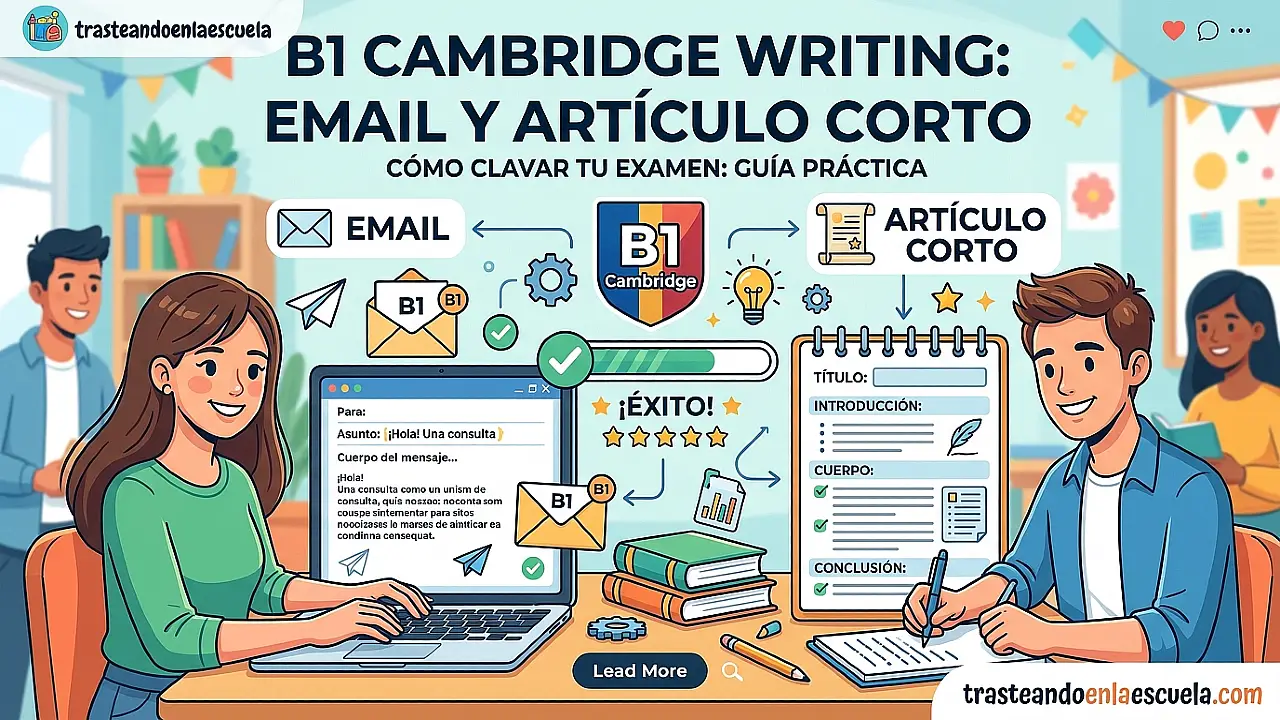
Writing del Cambridge B1 Preliminary: email y artículo corto
El Writing del B1 Preliminary puede parecer complicado al principio, pero con una buena estructura y las expresiones adecuadas, es más sencillo de lo que crees. En esta guía te enseño cómo escribir un email informal perfecto y cómo redactar un artículo corto que cumpla con los criterios de Cambridge.
🎯 En esta guía encontrarás: Estructura paso a paso para cada tarea, plantillas descargables, listas de expresiones útiles, ejemplos completos y 5 ejercicios para practicar.
🔍 Las dos tareas del Writing B1
📝 Tarea 1: Email (obligatorio)
En la Tarea 1, debes responder a un email de un amigo o familiar. El email incluye 3 puntos específicos que tienes que contestar. Es un texto informal.
📝 Tarea 2: Article o Story (a elegir)
En la Tarea 2, puedes elegir entre escribir un artículo corto para una revista o una historia corta. Ambas opciones tienen una extensión similar (unas 100 palabras).
💡 Distribución del tiempo recomendada: Escribe el email primero (20-25 minutos), luego el artículo o historia (20-25 minutos) y revisa ambos al final (5 minutos).
📧 Tarea 1: Email informal – Estructura y ejemplos
🎯 Estructura del email perfecto
1. SALUDO (Greeting)
Dear [Name], / Hi [Name],
2. APERTURA (Opening line)
Gracias por el email / Respuesta a algo que dijo.
Ej: «Thanks for your email! It was great to hear from you.»
3. CUERPO (Body)
Responde a los 3 puntos que te piden. Usa párrafos separados para cada punto.
4. CIERRE (Closing line)
Pregunta algo o despídete.
Ej: «Anyway, I have to go now. Write back soon!»
5. DESPEDIDA (Sign-off)
Best wishes, / All the best, / Love,
[Your name]
📝 Expresiones útiles para emails informales
🔹 Apertura (Opening lines):
- Thanks for your email / message.
- It was great to hear from you.
- Sorry I haven’t written for a while, but I’ve been really busy.
- How are you? I hope you’re doing well.
🔹 Responder preguntas (Answering questions):
- You asked me about… Well, …
- In answer to your question, …
- Regarding your question about… , …
🔹 Dar opiniones (Giving opinions):
- In my opinion, … / I think that …
- Personally, I believe that …
- From my point of view, …
🔹 Hacer sugerencias (Making suggestions):
- Why don’t we…? / How about + -ing?
- We could… / Perhaps we could…
- I suggest that we… / What about + -ing?
🔹 Cierre (Closing lines):
- Anyway, I have to go now.
- I’m looking forward to hearing from you soon.
- Write back soon! / Hope to hear from you soon.
- Give my love to [name].
📝 Ejemplo completo de email (Tarea 1)
Prompt del examen:
You have received an email from your English friend, Tom:
Respuesta (145 palabras):
Dear Tom,
Thanks for your email! It was great to hear from you.
You asked me what hobby you should try. In my opinion, you should try photography. I think you’re really creative and you have a good eye for detail. Plus, you can do it anywhere!
My favorite hobby is playing the guitar. I started two years ago and now I can play some of my favorite songs. It’s relaxing and fun.
Why don’t we take a photography course together? How about going to the park next Saturday to practice? I can teach you some basics with my camera.
Anyway, let me know what you think. Write back soon!
Best wishes,
[Your name]
✔️ Puntos cubiertos: 1) Qué hobby probar (photography), 2) Por qué (creative, good eye), 3) Mi hobby favorito (guitar), 4) Hacer un hobby juntos (photography course, park).
📝 Tarea 2: Article o Story – Estructura y ejemplos
📝 Opción A: Article (artículo corto)
🎯 Estructura del artículo perfecto
1. TÍTULO (Title)
Un título atractivo relacionado con el tema.
Ej: «My favourite place» / «Why I love reading»
2. INTRODUCCIÓN (Introduction)
Presenta el tema y engancha al lector.
Ej: «Have you ever thought about…?» / «In this article, I’m going to talk about…»
3. CUERPO (Body – 2 párrafos)
Desarrolla las ideas. Responde a las preguntas del prompt.
4. CONCLUSIÓN (Conclusion)
Invita a la reflexión o anima al lector a hacer algo.
Ej: «So why not give it a try?» / «I really recommend it!»
📝 Expresiones útiles para artículos
🔹 Introducción:
- Have you ever wondered…?
- Do you enjoy…? Then this article is for you.
- In my opinion, … / I believe that…
🔹 Desarrollo:
- First of all, … / Secondly, … / Finally, …
- What I like most about … is …
- Another great thing is that …
🔹 Conclusión:
- To sum up, … / In conclusion, …
- I would definitely recommend … because …
- So why not try it yourself?
📝 Ejemplo completo de artículo (Tarea 2)
Prompt del examen:
Your school magazine is asking readers to write an article about «My favourite way to relax». Write an article answering these questions: What do you do to relax? Where do you do it? Why do you recommend it?
Respuesta (110 palabras):
My favourite way to relax
Have you ever felt stressed after a long day at school? I certainly have. That’s why I want to share my favourite way to relax: reading.
What I like most about reading is that I can travel to different worlds without leaving my room. I usually read in my bedroom, on my comfortable armchair, with a cup of tea.
Another great thing is that reading reduces stress and improves concentration. In my opinion, it’s much better than watching TV or using social media.
I would definitely recommend reading to anyone who needs to disconnect. So why not pick up a book today?
✔️ Puntos cubiertos: 1) Qué hago (reading), 2) Dónde (bedroom, armchair), 3) Por qué lo recomiendo (reduces stress, improves concentration).
❌ Errores comunes en el Writing B1
| Error | Ejemplo incorrecto | Corrección |
|---|---|---|
| No responder los 3 puntos | Solo respondes 2 de las preguntas del email | Haz una lista mental de los 3 puntos antes de escribir |
| Lenguaje demasiado formal | «I would like to inquire about…» | «I want to know about…» (informal para email) |
| Extensión incorrecta | Escribes 50 palabras o 200 palabras | Apúntate a 100 palabras aproximadamente (±10) |
| Falta de conectores | Frases cortas sin conexión | Usa «and», «but», «so», «because», «also» |
| Repetir las mismas palabras | «Good, good, good» | Usa sinónimos: great, nice, fantastic, wonderful |
💡 Cómo te evalúan en el Writing: Los examinadores valoran 4 aspectos: Contenido (respondes a todo), Organización (párrafos y conectores), Lenguaje (vocabulario y gramática) y Formato (email o artículo). Cada aspecto vale 5 puntos (total 20 por tarea).
🧪 Ejercicios prácticos de Writing
Ejercicio 1: Ordena las partes del email
Ordena estas frases para formar un email coherente:
- Best wishes,
- Thanks for your email! I’m glad you’re enjoying your new job.
- Dear Sarah,
- Anyway, I have to go now. Write back soon!
- You asked me about my weekend. Well, I went to the beach on Saturday and it was amazing!
- Anna
✅ Ver solución
- c) Dear Sarah,
- b) Thanks for your email! I’m glad you’re enjoying your new job.
- e) You asked me about my weekend. Well, I went to the beach on Saturday and it was amazing!
- d) Anyway, I have to go now. Write back soon!
- a) Best wishes,
- f) Anna
Ejercicio 2: Elige la expresión correcta
Selecciona la opción más apropiada para cada situación en un email informal:
- Para empezar un email a un amigo: A) Dear Sir/Madam, B) Hi John, C) To whom it may concern,
- Para hacer una sugerencia: A) I demand that we… B) Why don’t we…? C) It is recommended that…
- Para despedirte: A) Yours faithfully, B) Write back soon! C) I remain yours sincerely,
✅ Ver solución
- a) B) Hi John, (informal, para amigo)
- b) B) Why don’t we…? (sugerencia amigable)
- c) B) Write back soon! (cierre informal)
Ejercicio 3: Corrige los errores
Encuentra y corrige los 5 errores en este email:
✅ Ver solución
- «you email» → your email
- «Is very exciting» → It is very exciting
- «I would like to inquire about» → demasiado formal → Tell me about / What are
- Falta nombre al final → añadir [Your name]
- «the ‘The Matrix'» → «The Matrix» (sin the repetido)
Ejercicio 4: Escribe la introducción de un artículo
Escribe una introducción (2-3 frases) para un artículo titulado «Why I love my city».
✅ Ver solución (ejemplo)
Ejemplo de introducción:
«Have you ever lived in a city that feels like home? I have. In this article, I’m going to tell you why I love my city, Barcelona, and why you should visit it.»
Ejercicio 5: Planifica un email
Tu amigo te ha escrito: «I’m thinking of starting a new sport. What sport do you recommend? Why? Also, tell me about a sport you do. Could we play together someday?»
Escribe los 3 puntos que debes responder en tu email.
✅ Ver solución
Punto 1: Recomendar un deporte (ej: tennis, swimming, football).
Punto 2: Explicar por qué lo recomiendas (ej: it’s fun, keeps you fit, easy to learn).
Punto 3: Hablar de un deporte que haces tú (ej: I play basketball twice a week).
Punto 4 (implícito): Proponer jugar juntos (ej: We could play tennis on Saturday).
📖 Glosario de términos del Writing
| Término | Definición |
|---|---|
| Prompt | Instrucciones o pregunta que debes responder en tu escrito. |
| Register | Nivel de formalidad (informal para email, neutral para artículo). |
| Cohesion | Uso de conectores para unir ideas (and, but, so, because). |
| Word count | Número de palabras (para B1: aproximadamente 100). |
📚 Sigue preparando tu B1 Preliminary
📌 Consejo final: Practica escribiendo al menos 2 emails y 2 artículos por semana. Pide a alguien que los revise o compáralos con modelos oficiales. La práctica constante es la clave para mejorar tu writing.




Publicar comentario