Irregular comparatives: good, bad, far – excepciones en inglés
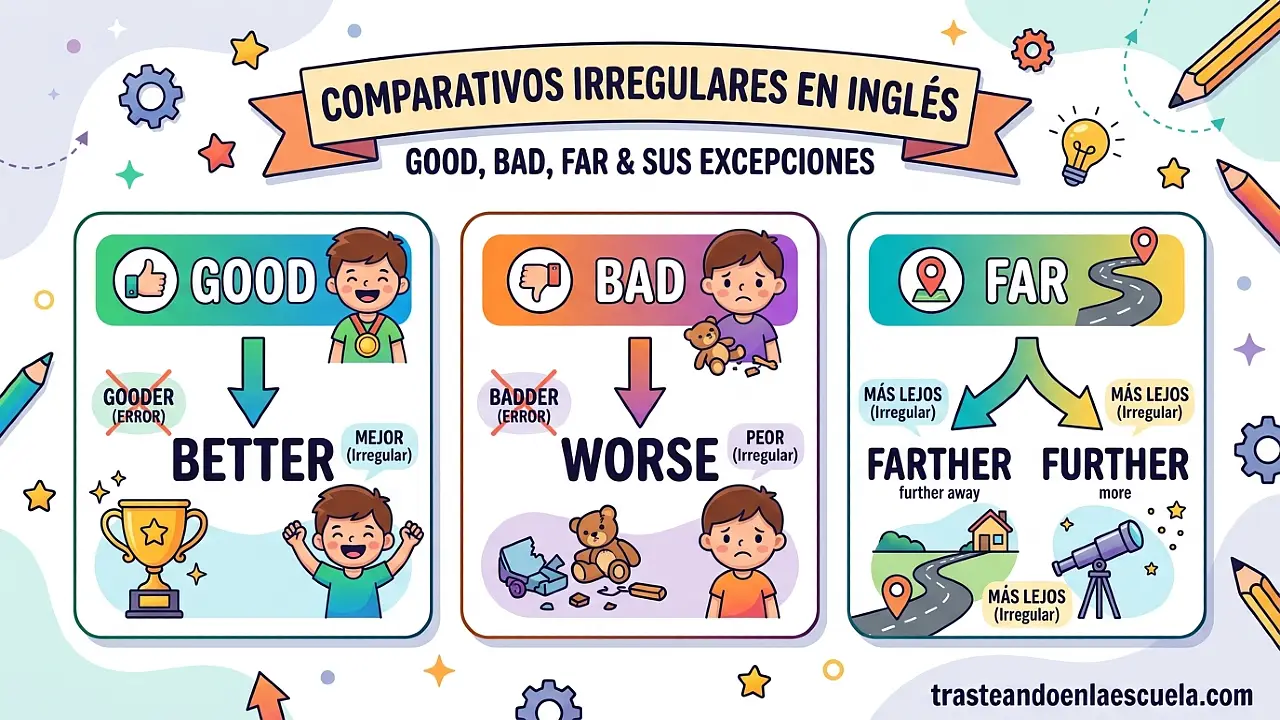
Irregular comparatives: Cuando las reglas no se aplican
Hasta ahora hemos visto reglas muy claras: añade «-er» o usa «more». Pero como en todo idioma, hay excepciones. Los adjetivos más comunes del inglés —good, bad, far, little, much/many— tienen formas comparativas y superlativas completamente irregulares. No siguen ninguna regla: hay que memorizarlas.
La buena noticia es que estas palabras son tan frecuentes que las aprenderás rápidamente con la práctica. La mala noticia es que los errores con estos irregulares son muy evidentes para un nativo. Decir «more good» en lugar de «better» delata inmediatamente a un hablante no nativo.
🎯 En este post aprenderás: La lista completa de adjetivos irregulares (good, bad, far, little, much/many, old), la diferencia entre farther y further (sutil pero importante), los comparativos y superlativos de cantidad (less/least, more/most), y 5 ejercicios prácticos para interiorizar estas excepciones fundamentales.
🔍 ¿Por qué existen formas irregulares?
📜 Palabras que vienen de antiguo
Los adjetivos irregulares en inglés son, en su mayoría, palabras muy antiguas y muy frecuentes. A lo largo de la historia del inglés, estas palabras mantuvieron sus formas antiguas mientras que los adjetivos menos comunes adoptaron las reglas regulares (-er, more). Es un fenómeno común en muchos idiomas: las palabras que más se usan son las que más resisten el cambio.
good → better → best (bueno → mejor → el mejor)
bad → worse → worst (malo → peor → el peor)
far → farther/further → farthest/furthest (lejos → más lejos → el más lejos)
little → less → least (poco → menos → el menos)
much/many → more → most (mucho → más → el más)
1️⃣ Good → Better → Best
✨ El adjetivo más importante
Good es posiblemente el adjetivo más usado en inglés. Su comparativo es better (mejor) y su superlativo es best (el mejor).
📝 Ejemplos con good/better/best
| Tipo | Ejemplo | Traducción |
|---|---|---|
| Positivo | This is a good movie. | Esta es una buena película. |
| Comparativo | This movie is better than the one we saw yesterday. | Esta película es mejor que la que vimos ayer. |
| Superlativo | This is the best movie of the year. | Esta es la mejor película del año. |
🎧 Más ejemplos con «better»:
- I feel better today than yesterday. (Me siento mejor hoy que ayer.)
- Your English is getting better and better. (Tu inglés está cada vez mejor.)
- It’s better to be safe than sorry. (Es mejor prevenir que lamentar.)
- She sings better than anyone I know. (Ella canta mejor que nadie que conozco.)
🎧 Ejemplos con «best»:
- This is the best day of my life. (Este es el mejor día de mi vida.)
- She is the best teacher I’ve ever had. (Ella es la mejor profesora que he tenido.)
- My best friend is coming to visit. (Mi mejor amigo viene de visita.)
- All the best! (¡Todo lo mejor! – expresión de despedida)
⚠️ Error común: Decir «more good» o «the most good». Esto es INCORRECTO. Siempre usa «better» y «best». También recuerda que «better» ya es comparativo, no se puede decir «more better».
2️⃣ Bad → Worse → Worst
💔 Lo opuesto a good
Bad (malo) tiene comparativo worse (peor) y superlativo worst (el peor).
📝 Ejemplos con bad/worse/worst
| Tipo | Ejemplo | Traducción |
|---|---|---|
| Positivo | The weather is bad today. | El tiempo está malo hoy. |
| Comparativo | The weather today is worse than yesterday. | El tiempo hoy está peor que ayer. |
| Superlativo | This is the worst weather of the year. | Este es el peor tiempo del año. |
🎧 Ejemplos con «worse»:
- Your behavior is getting worse and worse. (Tu comportamiento está cada vez peor.)
- Things could be worse. (Las cosas podrían ser peores.)
- I’m worse at math than my brother. (Soy peor en matemáticas que mi hermano.)
- The sequel is worse than the original movie. (La secuela es peor que la película original.)
🎧 Ejemplos con «worst»:
- That was the worst meal I’ve ever had. (Esa fue la peor comida que he tenido.)
- This is the worst case scenario. (Este es el peor escenario posible.)
- He is the worst player on the team. (Él es el peor jugador del equipo.)
- My worst fear is flying. (Mi peor miedo es volar.)
3️⃣ Far → Farther / Further → Farthest / Furthest
🗺️ La distancia física y metafórica
Far (lejos) tiene dos formas comparativas y superlativas. La diferencia es sutil pero importante.
📊 Farther vs Further: ¿Cuál usar?
| Forma | Uso | Ejemplo |
|---|---|---|
| Farther | Distancia FÍSICA (medible en km/m) | My house is farther from here than yours. (Mi casa está más lejos de aquí que la tuya.) |
| Farthest | Distancia física máxima | This is the farthest I’ve ever run. (Esta es la distancia más larga que he corrido.) |
| Further | Distancia METAFÓRICA o adicional | I need further information. (Necesito más información adicional.) |
| Furthest | Grado máximo (abstracto) | This is the furthest I can go with this project. (Esto es lo más lejos que puedo llegar con este proyecto.) |
💡 Regla práctica: Si puedes reemplazar «farther» por «more miles/kilometers», usa «farther». Si puedes reemplazar por «more» o «additional», usa «further». En el inglés moderno, mucha gente usa «further» para todo, especialmente en contextos abstractos.
🎧 Ejemplos con «farther/farthest»:
- We walked farther than we planned. (Caminamos más lejos de lo que planeamos.)
- Which city is farther from Madrid: Barcelona or Seville? (¿Qué ciudad está más lejos de Madrid: Barcelona o Sevilla?)
- This is the farthest point north we have reached. (Este es el punto más al norte que hemos alcanzado.)
🎧 Ejemplos con «further/furthest»:
- I need further details before making a decision. (Necesito más detalles antes de tomar una decisión.)
- We will investigate further. (Investigaremos más a fondo.)
- This is the furthest I can go with this argument. (Esto es lo más lejos que puedo llegar con este argumento.)
- Without further ado… (Sin más preámbulos… – expresión fija)
4️⃣ Little → Less → Least
📉 Cantidades pequeñas
Little (poco) se usa para cantidades NO contables. Su comparativo es less (menos) y su superlativo least (el menos).
📝 Ejemplos con little/less/least
| Tipo | Ejemplo | Traducción |
|---|---|---|
| Positivo | I have little money. | Tengo poco dinero. |
| Comparativo | I have less money than you. | Tengo menos dinero que tú. |
| Superlativo | She has the least money of all. | Ella tiene la menor cantidad de dinero de todas. |
⚠️ ¡Cuidado! «Less» se usa para INCONTABLE (water, money, time). «Fewer» se usa para CONTABLE (apples, books, people). Error común: «less people» → correcto: «fewer people».
5️⃣ Much / Many → More → Most
📈 Cantidades grandes
Much (incontable) y many (contable) comparten el mismo comparativo y superlativo: more (más) y most (el más).
📝 Ejemplos con much/many/more/most
| Tipo | Incontable | Contable |
|---|---|---|
| Positivo | I have much water. | I have many books. |
| Comparativo | I have more water than you. | I have more books than you. |
| Superlativo | She has the most water. | She has the most books. |
💡 Nota: En inglés hablado, «much» y «many» se usan más en frases negativas y preguntas. En afirmativas, a menudo se prefiere «a lot of». Pero «more» y «most» son universales y muy comunes.
➕ Adjetivo: Old → Older / Elder → Oldest / Eldest
Old tiene una forma alternativa para miembros de la familia: elder/eldest.
| Forma | Uso | Ejemplo |
|---|---|---|
| older / oldest | Cualquier cosa (personas, objetos, ideas) | This building is older than that one. / This is the oldest tree in the park. |
| elder / eldest | SOLO para miembros de una familia (hijos, hermanos) | She is my elder sister. / He is the eldest of three brothers. |
⚠️ Importante: «Elder» y «eldest» NO se usan con «than». No se puede decir «She is elder than me». Se dice «She is older than me» o «She is my elder sister».
📋 Tabla resumen: Todos los irregulares
| Positivo | Comparativo | Superlativo | Traducción |
|---|---|---|---|
| good | better | best | bueno – mejor – el mejor |
| bad | worse | worst | malo – peor – el peor |
| far (físico) | farther | farthest | lejos – más lejos – el más lejos (distancia) |
| far (abstracto) | further | furthest | lejos – más lejos – el más lejos (adicional) |
| little | less | least | poco – menos – el menos |
| much / many | more | most | mucho – más – el más |
| old (general) | older | oldest | viejo – más viejo – el más viejo |
| old (familia) | elder | eldest | mayor – el mayor (hermanos) |
🧪 5 Ejercicios prácticos con irregulares
Ejercicio 1: Completa con la forma correcta (good/better/best)
- This restaurant is __________ than the one we went to last week.
- That was __________ pizza I’ve ever eaten!
- My English is getting __________ and __________.
- She is a __________ singer, but her sister is even __________.
- This is __________ day of my life!
✅ Ver solución
- better
- the best
- better, better
- good, better
- the best
Ejercicio 2: Completa con la forma correcta (bad/worse/worst)
- The weather today is __________ than yesterday.
- That was __________ movie of the year.
- Things are getting __________ and __________.
- This is __________ case scenario.
- I’m __________ at cooking than my mother.
✅ Ver solución
- worse
- the worst
- worse, worse
- the worst
- worse
Ejercicio 3: Elige «farther» o «further»
- We need to travel __________ to reach the border.
- I need __________ information before deciding.
- This is __________ than I expected to walk.
- Without __________ delay, let’s begin.
- Which is __________: London or Paris from Madrid?
- We will discuss this matter __________ in the meeting.
✅ Ver solución
- farther / further (ambas válidas para distancia física)
- further (información adicional)
- farther / further (distancia física)
- further (expresión fija: without further ado)
- farther (distancia física entre ciudades)
- further (discutir más a fondo)
Ejercicio 4: Completa con less/least o more/most
- I have __________ time than you to finish this project.
- This is __________ interesting book of all.
- She has __________ experience than her colleague.
- He is __________ talented musician in the band.
- We need __________ sugar in this recipe.
- That was __________ exciting match I’ve ever seen (negativo).
- This route takes __________ time than the other one.
✅ Ver solución
- less
- the least
- less
- the most
- less
- the least
- less
Ejercicio 5: Traduce al inglés (atención a los irregulares)
- Este es el mejor día de mi vida.
- Este examen es peor que el anterior.
- Necesito más información antes de decidir.
- Ella es la hermana mayor (en la familia).
- Mi casa está más lejos que la tuya.
- Él tiene menos dinero que yo.
- Esta es la peor película que he visto.
- Cada día hablo inglés mejor.
✅ Ver solución
- This is the best day of my life.
- This exam is worse than the previous one.
- I need further information before deciding.
- She is the elder / eldest sister.
- My house is farther/further than yours.
- He has less money than me.
- This is the worst movie I’ve ever seen.
- Every day I speak English better.
❌ Errores comunes con los irregulares
| Error | Ejemplo incorrecto | Corrección |
|---|---|---|
| «more good» | This is more good. | This is better. |
| «more better» | This is more better. | This is better. |
| «gooder» | This is gooder. | This is better. |
| «badder» | This is badder. | This is worse. |
| «more worse» | This is more worse. | This is worse. |
| «more far» | It’s more far. | It’s farther/further. |
| «elder than» | She is elder than me. | She is older than me / She is my elder sister. |
📚 Serie completa: Comparativos y superlativos
- Comparatives: reglas y ejemplos – Comparativos regulares.
- Superlatives: el más, el mejor – Superlativos regulares.
- Irregular comparatives: good, bad, far – ¡Estás aquí!
- As… as: comparaciones de igualdad – Tan… como.
- Ejercicios comparativos y superlativos – Práctica integrada.
🏆 Reto de la semana: Escribe una frase por día usando cada uno de los irregulares: Monday (good/better/best), Tuesday (bad/worse/worst), Wednesday (far/farther/further), Thursday (little/less/least), Friday (much/many/more/most). El sábado, revisa todas tus frases. El domingo, intenta mantener una conversación corta usando al menos 5 de estos irregulares. ¡La práctica diaria convierte las excepciones en hábitos!






Publicar comentario