Comparatives in English: reglas, ejemplos y cómo formar comparativos
Comparatives in English: Cómo comparar como un nativo
Comparar cosas es una de las funciones más básicas y útiles del lenguaje. «Mi casa es más grande que la tuya», «Este libro es más interesante que el otro», «María corre más rápido que Juan». En inglés, los comparativos son esenciales para expresar diferencias, hacer elecciones y describir el mundo que nos rodea.
La buena noticia es que las reglas de los comparativos en inglés son bastante sistemáticas. La mala noticia es que hay tres sistemas diferentes dependiendo del adjetivo: añadir «-er», usar «more», o formas completamente irregulares. Pero no te preocupes: hay reglas claras para saber cuándo usar cada uno.
🎯 En este post aprenderás: La estructura básica del comparativo de superioridad (more…than), las reglas para adjetivos cortos (-er), las reglas para adjetivos largos (more), los cambios ortográficos (y → ier, consonante doble), y 5 ejercicios prácticos para dominar todas las formas regulares.
🔍 ¿Qué es un comparativo y cómo se forma?
📏 Comparativo de superioridad: más… que
Juan is taller than María. (Juan es más alto que María.)
This book is more interesting than that one. (Este libro es más interesante que aquel.)
She runs faster than me. (Ella corre más rápido que yo.)
Analogía de la balanza: Imagina que pones dos objetos en una balanza. El comparativo inclina la balanza hacia un lado: este es MÁS alto, MÁS rápido, MÁS interesante. La palabra «than» (que) conecta los dos elementos de la comparación.
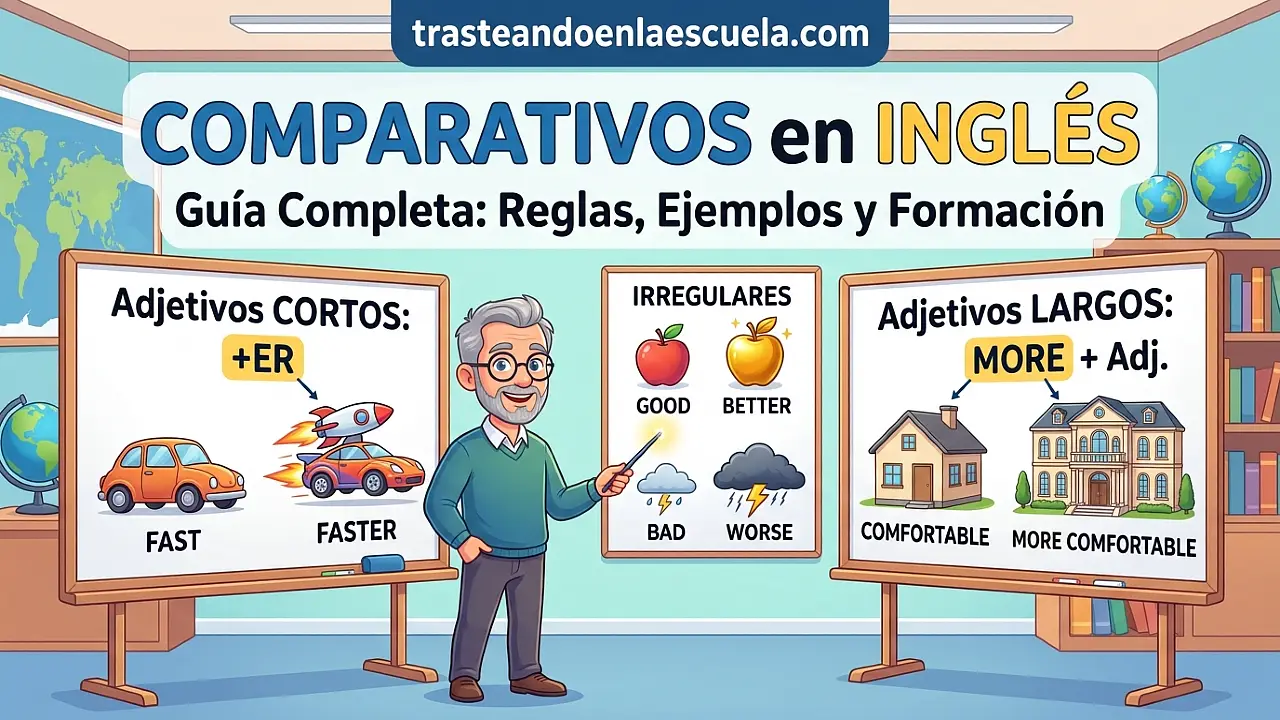
📋 Regla 1: Adjetivos cortos (1 sílaba) → -er
🎯 La regla de oro
Los adjetivos de una sílaba forman el comparativo añadiendo -er al final. Luego usamos than para introducir el segundo elemento.
📝 Tabla de adjetivos cortos
| Adjetivo | Comparativo | Ejemplo |
|---|---|---|
| tall (alto) | taller (más alto) | My brother is taller than me. |
| small (pequeño) | smaller (más pequeño) | This house is smaller than ours. |
| fast (rápido) | faster (más rápido) | A cheetah is faster than a lion. |
| slow (lento) | slower (más lento) | Turtles are slower than rabbits. |
| cheap (barato) | cheaper (más barato) | This phone is cheaper than that one. |
| rich (rico) | richer (más rico) | He is richer than his neighbor. |
💡 Truco: Si puedes decir el adjetivo de una sola vez sin respirar (ej: «tall», «fast», «cheap»), probablemente es de 1 sílaba y usa -er. Si el adjetivo tiene más de una sílaba (ej: «beautiful», «expensive», «interesting»), necesitas «more».
✍️ Reglas ortográficas para añadir -er
Cuando añadimos -er, a veces tenemos que modificar la escritura del adjetivo. Aquí están las tres reglas principales:
1. Adjetivos terminados en -e: solo añadir -r
| Adjetivo | Comparativo | Ejemplo |
|---|---|---|
| nice (agradable) | nicer (más agradable) | This hotel is nicer than the other. |
| large (grande) | larger (más grande) | My garden is larger than yours. |
| wide (ancho) | wider (más ancho) | The river is wider here. |
2. Adjetivos terminados en consonante + vocal + consonante (CVC): doblar la última consonante
| Adjetivo | Comparativo | Ejemplo |
|---|---|---|
| big (grande) | bigger (más grande) | This apple is bigger than that one. |
| hot (caliente) | hotter (más caliente) | Summer is hotter than spring. |
| thin (delgado) | thinner (más delgado) | She is thinner than her sister. |
| fat (gordo) | fatter (más gordo) | My cat is fatter than yours. |
⚠️ Cuidado: Esto solo aplica si el adjetivo termina en consonante – VOCAL – consonante Y la sílaba está acentuada. «Big» (BIG) → «bigger». «Warm» tiene dos consonantes al final (rm) → «warmer» (no se dobla).
3. Adjetivos terminados en -y: cambiar la -y por -ier
| Adjetivo | Comparativo | Ejemplo |
|---|---|---|
| happy (feliz) | happier (más feliz) | I am happier today than yesterday. |
| easy (fácil) | easier (más fácil) | This exercise is easier than the last one. |
| funny (gracioso) | funnier (más gracioso) | This comedian is funnier than the other. |
| heavy (pesado) | heavier (más pesado) | The suitcase is heavier than I thought. |
📋 Regla 2: Adjetivos largos (2+ sílabas) → more + adjetivo
🎯 La regla de oro
Los adjetivos de dos o más sílabas (que no terminan en -y) forman el comparativo con more + adjetivo.
📝 Tabla de adjetivos largos
| Adjetivo | Comparativo | Ejemplo |
|---|---|---|
| beautiful (bonito) | more beautiful (más bonito) | The sunset is more beautiful than the sunrise. |
| expensive (caro) | more expensive (más caro) | This car is more expensive than that one. |
| interesting (interesante) | more interesting (más interesante) | This book is more interesting than the movie. |
| comfortable (cómodo) | more comfortable (más cómodo) | My new bed is more comfortable than the old one. |
| difficult (difícil) | more difficult (más difícil) | Math is more difficult than history for me. |
| dangerous (peligroso) | more dangerous (más peligroso) | Swimming alone is more dangerous than swimming with a friend. |
💡 Excepción importante: Los adjetivos de dos sílabas terminados en -y se consideran «cortos» y usan -ier (happy → happier, easy → easier). Los terminados en -le, -er, -ow a veces admiten ambas formas (polite → politer o more polite), pero la forma con «more» es más segura.
📋 Regla 3: Adjetivos de 2 sílabas con reglas mixtas
Algunos adjetivos de dos sílabas pueden usar AMBAS formas. Aquí tienes los más comunes:
| Adjetivo | Comparativo con -er | Comparativo con more |
|---|---|---|
| quiet (tranquilo) | quieter | more quiet |
| polite (educado) | politer (menos común) | more polite |
| simple (simple) | simpler | more simple |
| common (común) | commoner (raro) | more common |
Regla práctica: Si tienes dudas, usa «more». Nunca es incorrecto. «More polite» es siempre correcto; «politer» es aceptable pero menos común.
📋 Comparativos negativos: less + adjetivo
Para decir «menos… que», usamos less (opuesto de «more»). Esta regla funciona para TODOS los adjetivos, sin excepción.
| Adjetivo | Comparativo negativo | Ejemplo |
|---|---|---|
| interesting | less interesting | This movie is less interesting than the book. |
| expensive | less expensive | This restaurant is less expensive than that one. |
| tall | less tall (poco común, se prefiere «shorter») | He is less tall than his brother (menos común que «shorter»). |
⚠️ Nota: Para adjetivos cortos, es más natural usar el adjetivo opuesto. En lugar de decir «less tall» (menos alto), di «shorter» (más bajo). «Less» es más común con adjetivos largos que no tienen un opuesto claro.
📝 Ejemplos completos por tipo de adjetivo
📏 1 sílaba (-er)
- old → older (más viejo)
- young → younger (más joven)
- strong → stronger (más fuerte)
- weak → weaker (más débil)
- bright → brighter (más brillante)
- dark → darker (más oscuro)
- soft → softer (más suave)
- hard → harder (más duro)
- near → nearer (más cerca)
- far → farther/further (más lejos – irregular)
🔤 2+ sílabas (more)
- modern → more modern (más moderno)
- famous → more famous (más famoso)
- exciting → more exciting (más emocionante)
- relaxing → more relaxing (más relajante)
- peaceful → more peaceful (más pacífico)
- powerful → more powerful (más poderoso)
- careful → more careful (más cuidadoso)
- helpful → more helpful (más útil)
- useful → more useful (más útil)
- hopeful → more hopeful (más esperanzado)
🟡 Terminados en -y (-ier)
- crazy → crazier (más loco)
- busy → busier (más ocupado)
- pretty → prettier (más bonito)
- ugly → uglier (más feo)
- noisy → noisier (más ruidoso)
- lucky → luckier (con más suerte)
- healthy → healthier (más sano)
- wealthy → wealthier (más rico)
- tidy → tidier (más ordenado)
- messy → messier (más desordenado)
🧪 5 Ejercicios prácticos para dominar los comparativos
Ejercicio 1: Elige la forma correcta (-er o more)
Completa con la forma comparativa del adjetivo entre paréntesis.
- My house is __________ (big) than yours.
- This exercise is __________ (difficult) than the previous one.
- She is __________ (happy) today than yesterday.
- The weather today is __________ (good) than yesterday. (irregular)
- This phone is __________ (expensive) than that one.
- He runs __________ (fast) than his brother.
- This movie is __________ (interesting) than the book.
- Her hair is __________ (long) than mine.
- My grandmother is __________ (old) than my grandfather.
- A train is __________ (comfortable) than a bus for long trips.
✅ Ver solución
- big → bigger
- difficult → more difficult
- happy → happier
- good → better (irregular)
- expensive → more expensive
- fast → faster
- interesting → more interesting
- long → longer
- old → older
- comfortable → more comfortable
Ejercicio 2: Escribe la forma comparativa correcta
Completa la tabla con el comparativo de cada adjetivo.
| Adjetivo | Comparativo |
|---|---|
| young | ___________ |
| beautiful | ___________ |
| thin | ___________ |
| easy | ___________ |
| dangerous | ___________ |
| nice | ___________ |
| hot | ___________ |
| famous | ___________ |
| funny | ___________ |
| simple | ___________ |
✅ Ver solución
- young → younger
- beautiful → more beautiful
- thin → thinner
- easy → easier
- dangerous → more dangerous
- nice → nicer
- hot → hotter
- famous → more famous
- funny → funnier
- simple → simpler o more simple
Ejercicio 3: Reescribe la frase usando un comparativo
Transforma estas frases para expresar la misma idea con un comparativo.
- This cake is delicious. The other cake is not so delicious. → This cake is ____________________.
- Maria is 25 years old. Juan is 30 years old. → Juan ____________________.
- My old phone cost 200€. My new phone cost 500€. → My new phone ____________________.
- A cheetah runs at 120 km/h. A lion runs at 80 km/h. → A cheetah ____________________.
- Exercise A is easy. Exercise B is also easy. → Exercise A is ____________________ Exercise B.
✅ Ver solución
- This cake is more delicious than the other cake.
- Juan is older than María.
- My new phone is more expensive than my old phone.
- A cheetah runs faster than a lion.
- Exercise A is as easy as Exercise B. (comparación de igualdad)
Ejercicio 4: Corrige los errores
Encuentra y corrige el error en cada frase.
- This book is more interesting that the movie.
- My car is more faster than yours.
- She is more happy than her sister.
- This problem is more easy than the last one.
- He is tall that his father.
- This restaurant is expensiver than that one.
- My room is more tidy than my brother’s room.
- Today is more hot than yesterday.
✅ Ver solución
- This book is more interesting than the movie. (that → than)
- My car is faster than yours. (more faster → faster)
- She is happier than her sister. (more happy → happier)
- This problem is easier than the last one. (more easy → easier)
- He is taller than his father. (tall that → taller than)
- This restaurant is more expensive than that one. (expensiver → more expensive)
- My room is tidier than my brother’s room. (more tidy → tidier)
- Today is hotter than yesterday. (more hot → hotter)
Ejercicio 5: Traduce al inglés
Traduce las siguientes frases al inglés usando comparativos.
- Mi perro es más grande que tu gato.
- Este examen es más difícil que el anterior.
- Ella es más feliz ahora que antes.
- El tren es más cómodo que el autobús.
- Yo soy más joven que mi hermana.
- Este teléfono es más barato que ese.
- Mi casa es más antigua que la tuya.
- Esta película es menos interesante que el libro.
✅ Ver solución
- My dog is bigger than your cat.
- This exam is more difficult than the previous one.
- She is happier now than before.
- The train is more comfortable than the bus.
- I am younger than my sister.
- This phone is cheaper than that one.
- My house is older than yours.
- This movie is less interesting than the book.
❌ Errores comunes con los comparativos
| Error | Ejemplo incorrecto | Corrección |
|---|---|---|
| Confundir «that» con «than» | She is taller that me. | She is taller than me. |
| Usar «more» con adjetivos cortos | This is more big. | This is bigger. |
| Usar «-er» con adjetivos largos | This is beautifuller. | This is more beautiful. |
| No doblar la consonante | This is biger. | This is bigger. |
| No cambiar -y por -ier | She is happyer. | She is happier. |
| Olvidar «than» | She is taller me. | She is taller than me. |
📖 Resumen visual de las reglas
📊 ¿Cómo formar el comparativo?
¿El adjetivo tiene 1 sílaba? → SÍ → Añade -er (tall → taller)¿El adjetivo termina en -y? → SÍ → Cambia -y por -ier (happy → happier)
¿El adjetivo tiene 2+ sílabas (y no termina en -y)? → SÍ → Usa more + adjetivo (beautiful → more beautiful)
¿Es irregular? → SÍ → good → better, bad → worse, far → farther/further
📚 Serie completa: Comparativos y superlativos
Continúa aprendiendo sobre comparaciones en inglés:
- Comparatives: reglas y ejemplos – ¡Estás aquí!
- Superlatives: el más, el mejor – El grado máximo de comparación.
- Irregular comparatives: good, bad, far – Las excepciones que hay que memorizar.
- As… as: comparaciones de igualdad – Tan… como.
- Ejercicios comparativos y superlativos – Practica todo lo aprendido.
🏆 Reto de la semana: Durante los próximos 7 días, cada vez que quieras comparar dos cosas, hazlo en inglés (mental o en voz alta). Compara tu comida con la de ayer, el clima de hoy con el de mañana, tu nivel de inglés con el de la semana pasada. La práctica constante es la clave para interiorizar las reglas.






Publicar comentario