Hard vs Hardly: la diferencia que cambia el significado
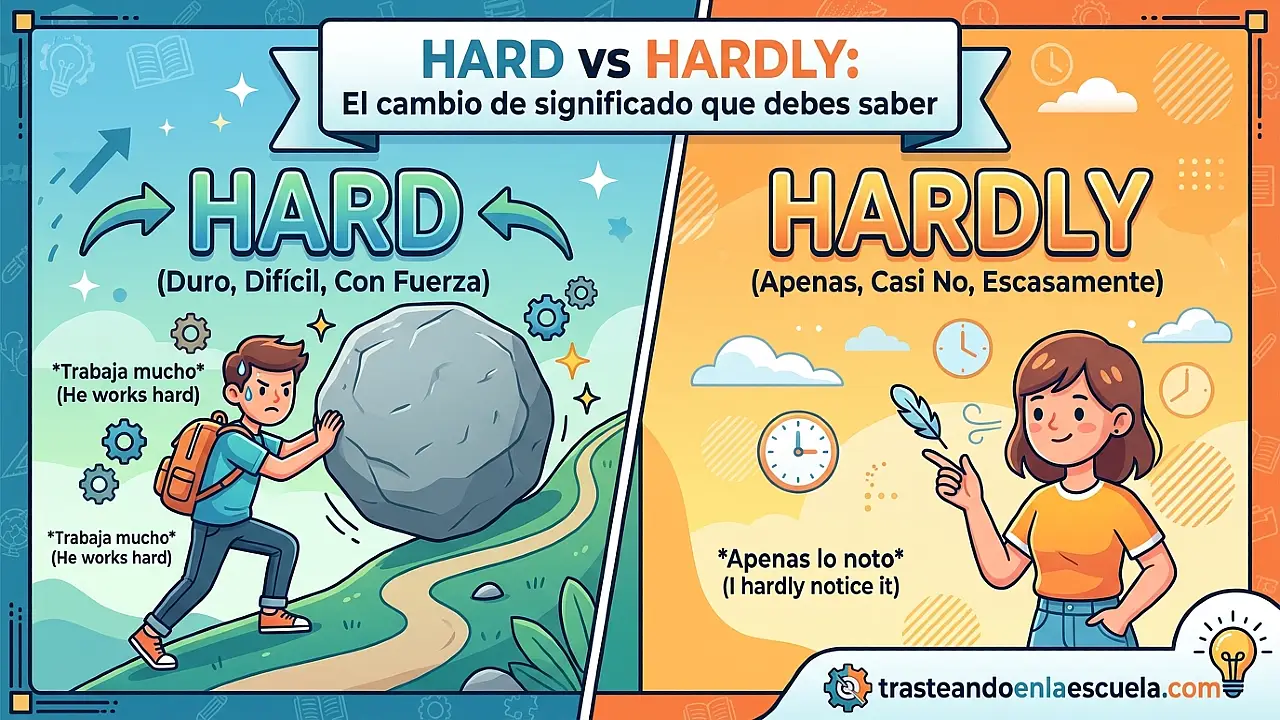
Hard vs Hardly: ¡Que no te engañe la apariencia!
¿Alguna vez has querido decir «trabajo duro» y has dicho «I work hardly»? ¡Cuidado! «Hardly» no significa «duramente», sino «casi no». Este es uno de los errores más comunes entre los estudiantes de inglés, porque «hard» y «hardly» parecen estar relacionados (como «quick» y «quickly»), ¡pero su significado es completamente diferente!
🎯 En este post aprenderás: La diferencia crucial entre «hard» (duro, mucho, intensamente) y «hardly» (casi no, apenas), cuándo usar cada uno, ejemplos contrastados, trucos para no olvidar la diferencia, otros pares de adverbios traicioneros (late/lately, near/nearly, etc.), y 5 ejercicios para dominar esta distinción de una vez por todas.
🔍 La diferencia clave de un vistazo
⚠️ Dos palabras que parecen iguales… pero no lo son
🟡 HARDLY: adverbio de grado → significa «casi no», «apenas»
Ejemplo clave:
✅ He works hard. → Él trabaja duro (mucho esfuerzo).
✅ He hardly works. → Él casi no trabaja (trabaja muy poco).
¡El significado es casi opuesto!
Analogía: Imagina que «hard» es como un atleta esforzándose al máximo, sudando y dando el 100%. «Hardly» es como una persona que apenas se mueve, haciendo el mínimo esfuerzo o casi nada. Son opuestos en intensidad.
📊 Comparativa visual: Hard vs Hardly
🔴 HARD
Mucho esfuerzo
100% de intensidad
Ejemplo:
«I work hard»
(Trabajo duro)
🟡 HARDLY
Casi nada
5-10% de intensidad
Ejemplo:
«I hardly work»
(Casi no trabajo)
📋 ¿Cuándo usar HARD?
«Hard» puede ser tanto adjetivo (describe un sustantivo) como adverbio (describe un verbo). En su forma adverbial, es uno de los pocos adverbios de modo que NO termina en «-ly».
🔴 Usos de HARD como adverbio
- Con esfuerzo, con dedicación: He works hard to support his family. (Él trabaja duro para mantener a su familia.)
- Con intensidad, fuertemente: It was raining hard. (Estaba lloviendo fuertemente.)
- Con fuerza física: She hit the ball hard. (Ella golpeó la pelota fuerte.)
- Con concentración: Think hard before you answer. (Piensa bien/detenidamente antes de responder.)
- Con verbos de estudio/esfuerzo: Study hard for the exam. (Estudia duro para el examen.)
🔴 Usos de HARD como adjetivo
- Difícil: This is a hard question. (Esta es una pregunta difícil.)
- Duro (textura): The bread is hard. (El pan está duro.)
- Duro (persona): He is a hard man. (Es un hombre duro.)
📋 ¿Cuándo usar HARDLY?
«Hardly» es un adverbio de grado (como «almost not») que significa «casi no», «apenas», «escasamente». Siempre va ANTES del verbo principal (o después del verbo TO BE).
🟡 Usos de HARDLY
- Casi no, muy poco: I hardly know him. (Casi no lo conozco.)
- Apenas, por poco: I could hardly hear her. (Apenas podía oírla.)
- Con cantidades mínimas: There is hardly any food left. (Casi no queda comida.)
- Con tiempo mínimo: We hardly ever see each other. (Casi nunca nos vemos.)
- Hardly + when (apenas… cuando): I had hardly sat down when the phone rang. (Apenas me había sentado cuando sonó el teléfono.)
💡 «Hardly ever» = casi nunca
«Hardly ever» es una expresión muy común que significa «casi nunca». Es más enfática que «rarely».
✅ I hardly ever eat fast food. (Casi nunca como comida rápida.)
✅ She hardly ever arrives late. (Ella casi nunca llega tarde.)
📊 Tabla comparativa: Hard vs Hardly
⚠️ Otros pares de adverbios traicioneros
«Hard/Hardly» no es el único par de palabras que causa confusión. Aquí tienes otros ejemplos importantes:
| Palabra base | Significado normal | Con -ly | Significado con -ly |
|---|---|---|---|
| late | tarde | lately | recientemente, últimamente |
| She arrived late. (Llegó tarde.) | I haven’t seen her lately. (No la he visto últimamente.) | ||
| near | cerca | nearly | casi |
| The station is near. (La estación está cerca.) | I nearly missed the train. (Casi pierdo el tren.) | ||
| high | alto | highly | muy, altamente |
| The bird flew high. (El pájaro voló alto.) | It is highly recommended. (Está muy recomendado.) | ||
| most | más, la mayoría | mostly | principalmente |
| Most people agree. (La mayoría de la gente está de acuerdo.) | The students are mostly Spanish. (Los estudiantes son principalmente españoles.) |
💡 Regla de oro: No asumas que añadir «-ly» a un adverbio crea una palabra con significado similar. En muchos casos, el significado cambia drásticamente. Siempre verifica el significado del adverbio con «-ly» antes de usarlo.
❌ Errores comunes con Hard y Hardly
| Error | Ejemplo incorrecto | Corrección | Explicación |
|---|---|---|---|
| Usar «hardly» para decir «duramente» | I work hardly every day. | I work hard every day. | «Hardly» significa «casi no», no «duramente». |
| Usar «hard» como adverbio de grado | I hard know him. | I hardly know him. | «Hard» no se usa para decir «apenas». |
| Confundir «hard» con «difficult» | This exercise is hard. | ✅ ¡Correcto! «Hard» puede significar «difícil». | Como adjetivo, «hard» sí puede significar «difícil». |
| Posición incorrecta de «hardly» | I know hardly him. | I hardly know him. | «Hardly» va ANTES del verbo principal. |
| Usar «hardly» con «not» (doble negación) | I don’t hardly know him. | I hardly know him. | «Hardly» ya tiene sentido negativo. No uses «don’t» con «hardly». |
| Confundir «hardly» con «hard» en significado | He hardly tried (él casi no intentó) vs He tried hard (él intentó con fuerza) | Son significados opuestos. ¡Cuidado! | |
🚫 La regla de la negación: «Hardly», «rarely», «scarcely», «never» son palabras con sentido negativo. No se pueden usar con «don’t», «doesn’t», «didn’t» en la misma oración.
✅ I hardly know him.
❌ I don’t hardly know him.
🎧 Frases de ejemplo para practicar
💬 15 frases comparativas: Hard vs Hardly
- Hard: He works hard to achieve his goals. (Él trabaja duro para lograr sus metas.)
- Hardly: He hardly works; he’s very lazy. (Él casi no trabaja; es muy vago.)
- Hard: It’s raining hard. Don’t forget your umbrella. (Está lloviendo fuerte. No olvides tu paraguas.)
- Hardly: It’s hardly raining; just a few drops. (Casi no está lloviendo; solo unas gotas.)
- Hard: She hit the ball hard and scored a home run. (Ella golpeó la pelota fuerte y anotó un jonrón.)
- Hardly: She hardly ever exercises. (Ella casi nunca hace ejercicio.)
- Hard: Think hard before making a decision. (Piensa bien/detenidamente antes de tomar una decisión.)
- Hardly: I could hardly believe my eyes. (Apenas podía creer lo que veían mis ojos.)
- Hard: This math problem is hard to solve. (Este problema de matemáticas es difícil de resolver.)
- Hardly: There is hardly any sugar left. (Casi no queda azúcar.)
- Hard: She pushed the door hard, but it wouldn’t open. (Empujó la puerta con fuerza, pero no se abría.)
- Hardly: I hardly slept last night. (Apenas dormí anoche.)
- Hard: Study hard if you want to pass the exam. (Estudia duro si quieres aprobar el examen.)
- Hardly: She hardly ever visits her parents. (Ella casi nunca visita a sus padres.)
- Hard: He tried hard to win the race. (Él intentó con fuerza ganar la carrera.)
🧪 5 Ejercicios prácticos para dominar Hard vs Hardly
📝 Ejercicio 1: Elige la opción correcta
Selecciona «hard» o «hardly» para completar cada oración.
- He works very __________ to support his family. (hard / hardly)
- I __________ know my neighbors. (hard / hardly)
- It was raining __________ all night. (hard / hardly)
- She __________ ever eats meat. (hard / hardly)
- Think __________ before you answer. (hard / hardly)
- I could __________ hear what she said. (hard / hardly)
- This exam is __________. (hard / hardly)
- There is __________ any milk left. (hard / hardly)
- She pushed the door __________, but it didn’t move. (hard / hardly)
- He __________ tried to help, but it wasn’t enough. (hard / hardly)
✅ Ver solución
- He works very hard to support his family. (Trabaja duro)
- I hardly know my neighbors. (Apenas conozco a mis vecinos)
- It was raining hard all night. (Llovió fuerte toda la noche)
- She hardly ever eats meat. (Casi nunca come carne)
- Think hard before you answer. (Piensa bien antes de responder)
- I could hardly hear what she said. (Apenas podía oír lo que dijo)
- This exam is hard. (Este examen es difícil)
- There is hardly any milk left. (Casi no queda leche)
- She pushed the door hard, but it didn’t move. (Empujó la puerta con fuerza)
- He hardly tried to help, but it wasn’t enough. (Casi no intentó ayudar) / O «He tried hard» (Él intentó con fuerza) – dependiendo del significado deseado.
📝 Ejercicio 2: Corrige los errores en estas oraciones
Algunas oraciones usan «hard» o «hardly» incorrectamente. Corrígelas.
- I work hardly every day.
- She hardly hit the ball. (Significa «casi no golpeó la pelota» – ¿es lo que quieres decir?)
- He is a hardly worker.
- I could hard believe it.
- This exercise is hardly. (¿Difícil o casi no?)
- She hardly ever is late.
- There is hard any food left.
- He tried hardly to win.
- I don’t hardly know him.
- She works very hardly.
✅ Ver solución
- I work hard every day. (Trabajo duro todos los días)
- Si quieres decir «golpeó la pelota con fuerza»: She hit the ball hard. Si quieres decir «casi no golpeó la pelota»: She hardly hit the ball. (¡Ambas son correctas pero significan cosas diferentes!)
- He is a hard worker. (Es un trabajador duro – «hardly» no se usa como adjetivo)
- I could hardly believe it. (Apenas podía creerlo)
- This exercise is hard. (Este ejercicio es difícil) – o cambia la frase: There is hardly any exercise. (Casi no hay ejercicio)
- She is hardly ever late. (Ella casi nunca llega tarde – «hardly ever» va después del verbo TO BE)
- There is hardly any food left. (Casi no queda comida)
- He tried hard to win. (Intentó con fuerza ganar)
- I hardly know him. (No se usa doble negación)
- She works very hard. («Hardly» no significa «duramente»)
📝 Ejercicio 3: Completa con HARD o HARDLY según el contexto
Lee cada frase y decide si el contexto requiere «hard» o «hardly».
- She studied __________ for the final exam because she wanted to pass.
- He __________ knows how to cook; he always orders takeout.
- It’s __________ to learn a new language, but it’s worth it.
- I could __________ see anything in the dark.
- She works __________ and never complains.
- We __________ ever go to the cinema because tickets are expensive.
- The boxer hit his opponent __________ and won the match.
- There is __________ any time left to finish the project.
- Think __________ about your future before making a decision.
- He __________ slept last night because he was worried.
✅ Ver solución
- She studied hard for the final exam because she wanted to pass. (Estudió duro)
- He hardly knows how to cook; he always orders takeout. (Apenas sabe cocinar)
- It’s hard to learn a new language, but it’s worth it. (Es difícil)
- I could hardly see anything in the dark. (Apenas podía ver)
- She works hard and never complains. (Trabaja duro)
- We hardly ever go to the cinema because tickets are expensive. (Casi nunca vamos)
- The boxer hit his opponent hard and won the match. (Golpeó fuerte)
- There is hardly any time left to finish the project. (Casi no queda tiempo)
- Think hard about your future before making a decision. (Piensa bien)
- He hardly slept last night because he was worried. (Apenas durmió)
📝 Ejercicio 4: Traduce al inglés usando HARD o HARDLY
Traduce las siguientes frases al inglés eligiendo la palabra correcta.
- Él trabaja duro todos los días.
- Casi no conozco a mis vecinos.
- Estuvo lloviendo fuerte toda la noche.
- Ella casi nunca come carne.
- Piensa bien antes de responder.
- Apenas podía oír lo que ella dijo.
- Este examen es difícil.
- Casi no queda leche en el refrigerador.
- Ella empujó la puerta con fuerza, pero no se abrió.
- Apenas dormí anoche porque estaba preocupado.
✅ Ver solución
- He works hard every day.
- I hardly know my neighbors.
- It was raining hard all night.
- She hardly ever eats meat.
- Think hard before you answer.
- I could hardly hear what she said.
- This exam is hard.
- There is hardly any milk left in the refrigerator.
- She pushed the door hard, but it didn’t open.
- I hardly slept last night because I was worried.
📝 Ejercicio 5: Crea oraciones contrastantes
Para cada par de situaciones, escribe dos oraciones: una usando «hard» y otra usando «hardly».
- (Trabajo mucho) vs (Casi no trabajo)
- (Llueve fuerte) vs (Casi no llueve)
- (Conozco bien a alguien) vs (Apenas conozco a alguien)
- (Estudió con mucho esfuerzo) vs (Casi no estudió)
- (Golpeó la pelota con fuerza) vs (Apenas golpeó la pelota)
✅ Ver solución (ejemplos)
Posibles respuestas:
- Hard: I work hard every day to support my family.
Hardly: I hardly work because I’m on vacation. - Hard: It’s raining hard. Take an umbrella.
Hardly: It’s hardly raining; just a few drops. - Hard: I know her hard? ❌ No se dice. Mejor: I know her very well.
Hardly: I hardly know him; we just met yesterday. - Hard: She studied hard for the exam and got an A.
Hardly: She hardly studied for the exam and failed. - Hard: She hit the ball hard and scored a home run.
Hardly: She hardly hit the ball; it barely moved.
🌍 Aplicaciones en el mundo real
🗣️ En el ámbito laboral
- «Our team works hard to meet deadlines.» (Nuestro equipo trabaja duro para cumplir plazos.)
- «She hardly ever misses a day of work.» (Ella casi nunca falta al trabajo.)
- «It’s hard to find good employees.» (Es difícil encontrar buenos empleados.)
📚 En el ámbito académico
- «You need to study hard if you want to pass.» (Necesitas estudiar duro si quieres aprobar.)
- «He hardly attended any classes this semester.» (Él casi no asistió a clases este semestre.)
- «This assignment is hard, but not impossible.» (Esta tarea es difícil, pero no imposible.)
🏡 En conversaciones cotidianas
- «I hardly slept last night. I’m exhausted.» (Apenas dormí anoche. Estoy agotado.)
- «She tries hard to be friendly, but people don’t respond.» (Ella se esfuerza mucho por ser amable, pero la gente no responde.)
- «There’s hardly any sugar left. Can you buy some?» (Casi no queda azúcar. ¿Puedes comprar?)
📖 Glosario de términos
| Término | Definición | Ejemplo |
|---|---|---|
| Hard (adverbio) | Con mucho esfuerzo, intensamente, con fuerza | He works hard. |
| Hard (adjetivo) | Difícil, duro (textura o carácter) | This is a hard question. |
| Hardly | Casi no, apenas, escasamente | I hardly know him. |
| Hardly ever | Casi nunca | She hardly ever smokes. |
| Adverb of degree | Adverbio que expresa la intensidad o grado de una acción | hardly, nearly, almost, very, quite |
| Adverb of manner | Adverbio que expresa cómo se realiza una acción | hard, quickly, slowly, carefully |
📚 Serie completa: Adverbios en inglés
Continúa aprendiendo sobre los adverbios en inglés con el resto de la serie:
- 📊 Adverbs of frequency: always, never, sometimes – Los adverbios de frecuencia en detalle.
- 📍 Posición de los adverbios – Aprende a colocar correctamente los adverbios en la frase.
- 🏃 Adverbs of manner: quickly, slowly, carefully – Los adverbios de modo.
- ⚠️ Hard vs hardly: cuidado con la diferencia – ¡Estás aquí! El par más confuso.
- 📝 Ejercicios de adverbios – Practica todo lo aprendido en el clúster.
🏆 Truco final para nunca olvidar la diferencia:
Recuerda esta frase: «If you work HARD, you will HARDLY ever fail.» (Si trabajas DURO, casi NUNCA fracasarás.)
Esta frase contiene ambos adverbios con sus significados correctos: «hard» como «con esfuerzo» y «hardly ever» como «casi nunca». ¡Memorízala y tendrás la diferencia clara para siempre!










Publicar comentario