Adverbs of Manner: quickly, slowly, carefully, well
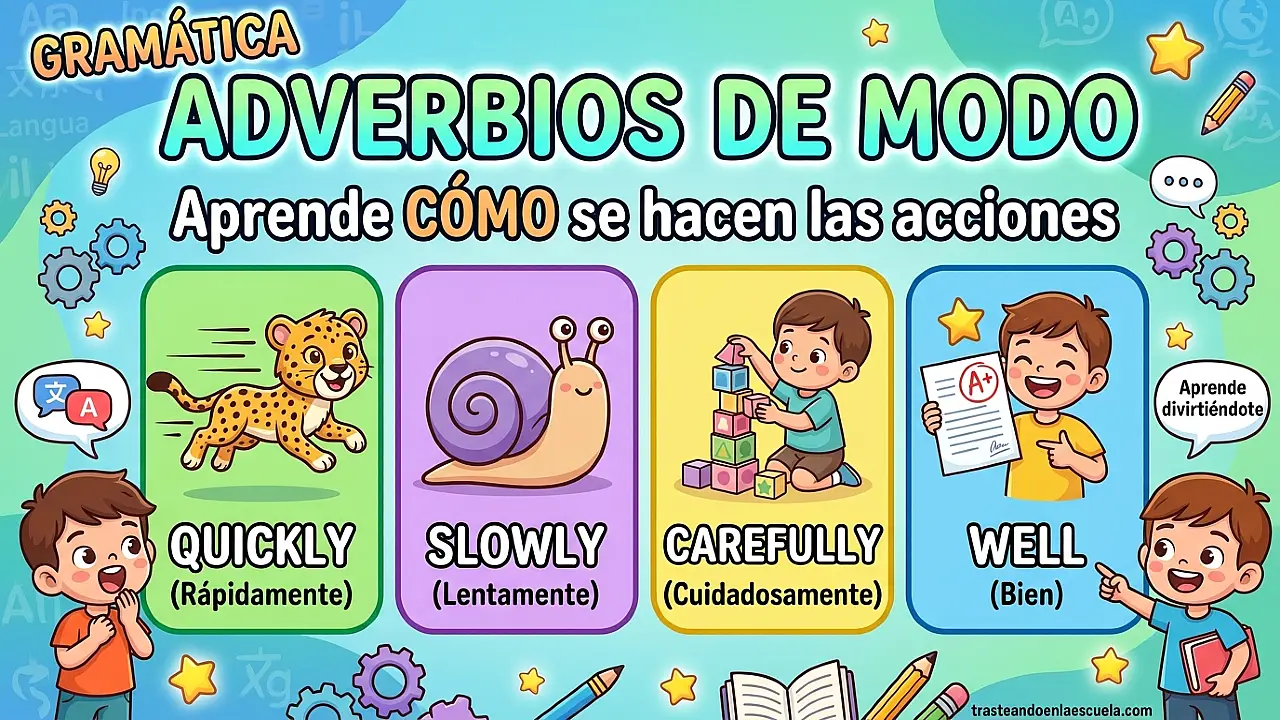
Adverbs of Manner: Describe CÓMO se hacen las cosas
¿Alguna vez has querido decir «corro rápidamente» en inglés y has dudado entre «quick» y «quickly»? ¿O has confundido «good» con «well»? Los adverbs of manner (adverbios de modo) son las palabras que usamos para describir cómo se realiza una acción. Son esenciales para añadir detalle y precisión a tus frases.
🎯 En este post aprenderás: Cómo formar adverbios de modo a partir de adjetivos (regla general: adjetivo + -ly), la lista de adverbios más comunes (quickly, slowly, carefully, well, badly), su posición correcta en la frase, la diferencia crucial entre adjetivos y adverbios, las excepciones más importantes (fast, hard, good/well), y 5 ejercicios para dominarlos por completo.
🔍 ¿Qué son los Adverbs of Manner?
🏃 Responden a la pregunta: ¿CÓMO se realiza la acción?
✅ She sings beautifully. (¿Cómo canta? → bellamente)
✅ He drives carefully. (¿Cómo conduce? → con cuidado)
✅ They speak English well. (¿Cómo hablan? → bien)
Diferencia clave con adjetivos:
📝 Adjetivo: Describe un SUSTANTIVO → She is a beautiful singer.
🎤 Adverbio: Describe un VERBO → She sings beautifully.
Analogía visual: Si el verbo es la acción (p.ej., «correr»), el adverbio de modo es la «pegatina» que le añade color a la acción: «correr» + «rápidamente» = una imagen mental más vívida. El adjetivo, en cambio, pega sobre el sustantivo: «corredor» + «rápido».
🎨 Adjetivo vs Adverbio: El pintor y el pincel
Imagina que el adjetivo es como el color de una pared: describe cómo ES la pared (la pared es azul). El adverbio, en cambio, es como la técnica con la que pintas: describe CÓMO pintas (pintas rápidamente, cuidadosamente, etc.). El primero describe un objeto (sustantivo), el segundo describe una acción (verbo).
ADJETIVO
- She is a quick runner. (Ella es una corredora rápida.)
- He is a careful driver. (Él es un conductor cuidadoso.)
- It was a beautiful performance. (Fue una actuación hermosa.)
ADVERBIO
- She runs quickly. (Ella corre rápidamente.)
- He drives carefully. (Él conduce cuidadosamente.)
- She performed beautifully. (Ella actuó hermosamente.)
📋 Regla general: Cómo formar adverbios de modo
La regla más común para formar adverbios de modo es: adjetivo + -ly. Sin embargo, hay algunas variaciones ortográficas importantes.
| Regla | Adjetivo | Adverbio | Ejemplo |
|---|---|---|---|
| Adjetivo + -ly (general) | quick, slow, careful, bad, beautiful, perfect, powerful, efficient, fluent, silent, real, serious, complete | quickly, slowly, carefully, badly, beautifully, perfectly, powerfully, efficiently, fluently, silently, really, seriously, completely | She runs quickly. He drives carefully. |
| Adjetivos terminados en -y → cambia -y por -ily | easy, happy, lucky, angry, noisy, heavy | easily, happily, luckily, angrily, noisily, heavily | He passed the test easily. She laughed happily. |
| Adjetivos terminados en -le → cambia -le por -ly | terrible, horrible, comfortable, probable, gentle | terribly, horribly, comfortably, probably, gently | He sings terribly. She treated him gently. |
| Adjetivos terminados en -ic → añade -ally | dramatic, automatic, specific, scientific | dramatically, automatically, specifically, scientifically | The situation changed dramatically. |
| Adjetivos terminados en -ue → quita la -e y añade -ly | true, due | truly, duly | I am truly sorry. |
💡 Excepción importante: «good» → «well»
El adjetivo «good» se convierte en el adverbio «well». No decimos «goodly» (esa palabra existe pero significa «considerablemente», no es el adverbio de «good»).
✅ She is a good singer. (Adjetivo → describe a «singer»)
✅ She sings well. (Adverbio → describe cómo canta)
❌ She sings good. (Incorrecto en inglés estándar)
📚 Lista completa de Adverbs of Manner (los más comunes)
Esta tabla incluye los adverbios de modo más utilizados en inglés, organizados por categorías.
| Adverbio | Adjetivo original | Significado | Ejemplo |
|---|---|---|---|
| quickly | quick | rápidamente | She finished the test quickly. |
| slowly | slow | lentamente | He walked slowly because of his injury. |
| carefully | careful | cuidadosamente | She placed the vase carefully on the table. |
| well | good | bien | I speak English well. |
| badly | bad | mal | He performed badly in the interview. |
| easily | easy | fácilmente | She easily solved the problem. |
| happily | happy | felizmente | They happily accepted the invitation. |
| beautifully | beautiful | hermosamente | She sings beautifully. |
| fluently | fluent | con fluidez | He speaks French fluently. |
| efficiently | efficient | eficientemente | The team worked efficiently. |
| silently | silent | silenciosamente | She left the room silently. |
| gently | gentle | suavemente | He touched her arm gently. |
| perfectly | perfect | perfectamente | She speaks English perfectly. |
| terribly | terrible | terriblemente | I slept terribly last night. |
| completely | complete | completamente | I completely forgot about the meeting. |
📏 Posición de los adverbios de modo en la frase
La posición de los adverbios de modo es una de las dudas más comunes. Aquí tienes las reglas claras con ejemplos.
📌 REGLA 1: Normalmente, DESPUÉS del verbo (o después del objeto)
She sings beautifully.
He drives the car carefully.
- She speaks English fluently. ✅
She fluently speaks English.❌ (menos común, aunque posible en algunos contextos)- They finished the project quickly. ✅
📌 REGLA 2: A veces ANTES del verbo para dar énfasis
- Slowly, he opened the door. (Énfasis en la lentitud)
- She quickly ran to the store. (Posible, pero menos común)
- He carefully placed the glass on the shelf. (Aceptable, especialmente en escritura)
Nota: En inglés hablado cotidiano, la posición más natural es después del verbo u objeto.
📌 REGLA 3: Con verbos de movimiento, ambas posiciones son posibles
- He slowly walked to the door. (énfasis en cómo caminó desde el principio)
- He walked to the door slowly. (énfasis en la acción completa)
⚠️ Errores comunes con los adverbios de modo
| Error | Ejemplo incorrecto | Corrección | Explicación |
|---|---|---|---|
| Usar adjetivo en lugar de adverbio | She sings beautiful. (❌) | She sings beautifully. (✅) | Necesitamos un adverbio para describir el verbo «sings». |
| Usar «good» en lugar de «well» | I speak English good. (❌) | I speak English well. (✅) | «Good» es adjetivo; «well» es el adverbio. |
| Confundir «fast» (rápido) | He runs fastly. (❌ – «fastly» no existe) | He runs fast. (✅) | «Fast» es tanto adjetivo como adverbio. |
| Confundir «hard» (duro) | He works hardly. (❌ – «hardly» significa «casi no») | He works hard. (✅) | «Hard» es adverbio de modo. «Hardly» es otro adverbio con significado diferente. |
| Colocar el adverbio entre verbo y objeto | She eats quickly her breakfast. (❌) | She eats her breakfast quickly. (✅) | El adverbio va después del objeto. |
🚫 Los adverbios de modo NO se usan con verbos de estado (stative verbs):
Verbos como «be», «seem», «look» (en el sentido de «parecer»), «feel» (sentir una emoción), «taste», «smell» → se usan con ADJETIVOS, no con adverbios.
✅ She looks happy (no «happily»).
✅ The food tastes good (no «well»).
✅ I feel bad about it (no «badly»).
🎧 Frases de ejemplo para practicar
💬 15 frases esenciales con adverbs of manner:
- She sings beautifully. (Ella canta hermosamente.)
- He drives carefully on rainy days. (Él conduce cuidadosamente en días lluviosos.)
- They finished the race quickly. (Ellos terminaron la carrera rápidamente.)
- I speak English well, but not perfectly. (Hablo inglés bien, pero no perfectamente.)
- She performed badly in the audition. (Ella actuó mal en la audición.)
- He easily passed the exam. (Él aprobó el examen fácilmente.)
- She walked slowly through the park. (Ella caminó lentamente por el parque.)
- He gently placed the baby in the crib. (Él colocó suavemente al bebé en la cuna.)
- She speaks French fluently. (Ella habla francés con fluidez.)
- They worked efficiently to meet the deadline. (Trabajaron eficientemente para cumplir con la fecha límite.)
- He silently left the room so as not to wake anyone. (Salió silenciosamente de la habitación para no despertar a nadie.)
- I completely forgot about our appointment. (Olvidé completamente nuestra cita.)
- She happily accepted the job offer. (Ella aceptó felizmente la oferta de trabajo.)
- He angrily slammed the door. (Él cerró la puerta con enojo.)
- The children played noisily in the backyard. (Los niños jugaron ruidosamente en el patio trasero.)
🧪 5 Ejercicios prácticos para dominar los Adverbs of Manner
📝 Ejercicio 1: Convierte el adjetivo en adverbio
Completa la tabla convirtiendo cada adjetivo en su forma adverbial.
| Adjetivo | Adverbio |
|---|---|
| quick | ___________ |
| careful | ___________ |
| easy | ___________ |
| happy | ___________ |
| terrible | ___________ |
| gentle | ___________ |
| fluent | ___________ |
| bad | ___________ |
| good | ___________ |
| perfect | ___________ |
| silent | ___________ |
| dramatic | ___________ |
✅ Ver solución
| Adjetivo | Adverbio |
|---|---|
| quick | quickly |
| careful | carefully |
| easy | easily |
| happy | happily |
| terrible | terribly |
| gentle | gently |
| fluent | fluently |
| bad | badly |
| good | well |
| perfect | perfectly |
| silent | silently |
| dramatic | dramatically |
📝 Ejercicio 2: Elige la opción correcta (adjetivo o adverbio)
Selecciona la palabra correcta para completar cada oración.
- She is a ___________ singer. (good / well)
- She sings ___________. (good / well)
- He is a ___________ driver. (careful / carefully)
- He drives ___________. (careful / carefully)
- This is ___________ easy. (real / really)
- She spoke ___________. (quiet / quietly)
- He works ___________. (hard / hardly)
- I feel ___________. (bad / badly) – (verbo de estado)
- She looked at me ___________. (angry / angrily)
- The soup tastes ___________. (good / well)
✅ Ver solución
- good (She is a good singer. – Adjetivo describe «singer»)
- well (She sings well. – Adverbio describe «sings»)
- careful (He is a careful driver. – Adjetivo)
- carefully (He drives carefully. – Adverbio)
- really (This is really easy. – Adverbio modifica a «easy»)
- quietly (She spoke quietly. – Adverbio)
- hard (He works hard. – «Hard» es adverbio de modo aquí. «Hardly» significa «casi no»)
- bad (I feel bad. – Con «feel» como verbo de estado, usamos adjetivo)
- angrily (She looked at me angrily. – Adverbio describe la acción de mirar)
- good (The soup tastes good. – «Tastes» es verbo de estado, usamos adjetivo)
📝 Ejercicio 3: Coloca el adverbio en la posición correcta
Reescribe cada oración colocando el adverbio entre paréntesis en la posición adecuada.
- She sings. (beautifully)
- He drives his car. (carefully)
- They finished the project. (quickly)
- She speaks English. (fluently)
- He walked to the door. (slowly)
- She placed the vase on the table. (gently)
- He left the room. (silently)
- I forgot about the meeting. (completely)
- She accepted the invitation. (happily)
- He slammed the door. (angrily)
✅ Ver solución
- She sings beautifully.
- He drives his car carefully.
- They finished the project quickly. / They quickly finished the project.
- She speaks English fluently.
- He walked to the door slowly. / He slowly walked to the door.
- She placed the vase gently on the table. / She placed the vase on the table gently.
- He left the room silently. / He silently left the room.
- I completely forgot about the meeting. / I forgot about the meeting completely.
- She accepted the invitation happily. / She happily accepted the invitation.
- He slammed the door angrily. / He angrily slammed the door.
📝 Ejercicio 4: Corrige los errores en estas oraciones
Algunas oraciones tienen errores con los adverbios de modo. Corrígelas.
- She sings beautiful.
- He drives very careful.
- I speak English good.
- She runs fastly.
- He works hardly every day.
- She eats quickly her breakfast.
- He is a well singer.
- She looked happy at me. (Cambia el significado – «looked at me» vs «looked happy»)
- The food tastes well.
- She performed bad in the play.
✅ Ver solución
- She sings beautifully.
- He drives very carefully.
- I speak English well.
- She runs fast. («fastly» no existe)
- He works hard every day. («Hardly» significa «casi no»)
- She eats her breakfast quickly.
- He is a good singer. («Well» no se usa como adjetivo con «singer»)
- She looked at me happily. (Si quieres decir que ella me miró de manera alegre) / O «She looked happy» (Ella parecía feliz – diferente significado)
- The food tastes good. («Tastes» es verbo de estado)
- She performed badly in the play.
📝 Ejercicio 5: Traduce al inglés usando adverbs of manner
Traduce las siguientes frases al inglés usando el adverbio de modo adecuado.
- Ella canta maravillosamente.
- Él conduce su coche cuidadosamente.
- Ellos terminaron el examen rápidamente.
- Ella habla inglés con fluidez.
- Él caminó lentamente hacia la puerta.
- Ella colocó el jarrón suavemente sobre la mesa.
- Él salió de la habitación silenciosamente.
- Olvidé completamente nuestra cita.
- Ella aceptó felizmente la oferta de trabajo.
- Él cerró la puerta con enojo.
✅ Ver solución
- She sings beautifully.
- He drives his car carefully.
- They finished the exam quickly.
- She speaks English fluently.
- He walked to the door slowly.
- She placed the vase gently on the table.
- He left the room silently.
- I completely forgot about our appointment.
- She happily accepted the job offer.
- He slammed the door angrily.
🌍 Aplicaciones prácticas en el mundo real
🗣️ En conversaciones cotidianas
- «Could you speak more slowly, please?» (¿Podrías hablar más despacio, por favor?)
- «She did really well on her exam.» (A ella le fue realmente bien en su examen.)
- «He drives so carefully. I feel safe with him.» (Él conduce tan cuidadosamente. Me siento seguro con él.)
- «I completely forgot your birthday. I’m so sorry!» (Olvidé completamente tu cumpleaños. ¡Lo siento mucho!)
📝 En escritura académica y profesional
- «The data was carefully analyzed before reaching a conclusion.» (Los datos fueron analizados cuidadosamente antes de llegar a una conclusión.)
- «She fluently speaks three languages, which is a great asset for the company.» (Ella habla tres idiomas con fluidez, lo cual es un gran activo para la empresa.)
- «The team efficiently completed the project ahead of schedule.» (El equipo completó eficientemente el proyecto antes de lo previsto.)
- «He dramatically improved his performance after receiving feedback.» (Él mejoró dramáticamente su rendimiento después de recibir retroalimentación.)
🏃 En descripciones de habilidades y deportes
- «She runs incredibly fast.» (Ella corre increíblemente rápido.)
- «He plays the guitar amazingly well.» (Él toca la guitarra increíblemente bien.)
- «The swimmer moved gracefully through the water.» (El nadador se movía con gracia a través del agua.)
- «They defended their goal fiercely.» (Defendieron su portería ferozmente.)
📖 Glosario de términos
| Término | Definición | Ejemplo |
|---|---|---|
| Adverb of manner | Palabra que describe la manera en que se realiza una acción | quickly, slowly, well, badly |
| Adjective | Palabra que describe un sustantivo | quick, careful, good, beautiful |
| -ly ending | Terminación típica de los adverbios de modo en inglés | quickly, carefully, beautifully |
| Stative verb | Verbo que describe un estado, no una acción (se usa con adjetivos) | be, seem, look, feel, taste, smell |
| Position after the verb | Posición típica del adverbio de modo: después del verbo u objeto | She sings beautifully. He drives the car carefully. |
📚 Serie completa: Adverbios en inglés
Continúa aprendiendo sobre los adverbios en inglés con el resto de la serie:
- 📊 Adverbs of frequency: always, never, sometimes – Los adverbios de frecuencia en detalle.
- 📍 Posición de los adverbios – Aprende a colocar correctamente los adverbios en la frase.
- 🏃 Adverbs of manner: quickly, slowly, carefully – ¡Estás aquí! Los adverbios de modo.
- ⚠️ Hard vs hardly: cuidado con la diferencia – El par de adverbios más confuso del inglés.
- 📝 Ejercicios de adverbios – Practica todo lo aprendido en el clúster.
🏆 Reto final: Describe tu rutina matutina
Escribe un párrafo de 5-6 oraciones describiendo cómo realizas tus actividades matutinas usando al menos 5 adverbs of manner diferentes. Luego léelo en voz alta.
Ejemplo:
«I wake up slowly and stretch gently. I brush my teeth carefully and then make breakfast quickly because I’m always in a hurry. I eat my breakfast happily while listening to music. Finally, I leave the house quietly so as not to wake my family.»
¡Ahora escribe el tuyo!












Publicar comentario