Posición de los adverbios: guía completa con ejemplos
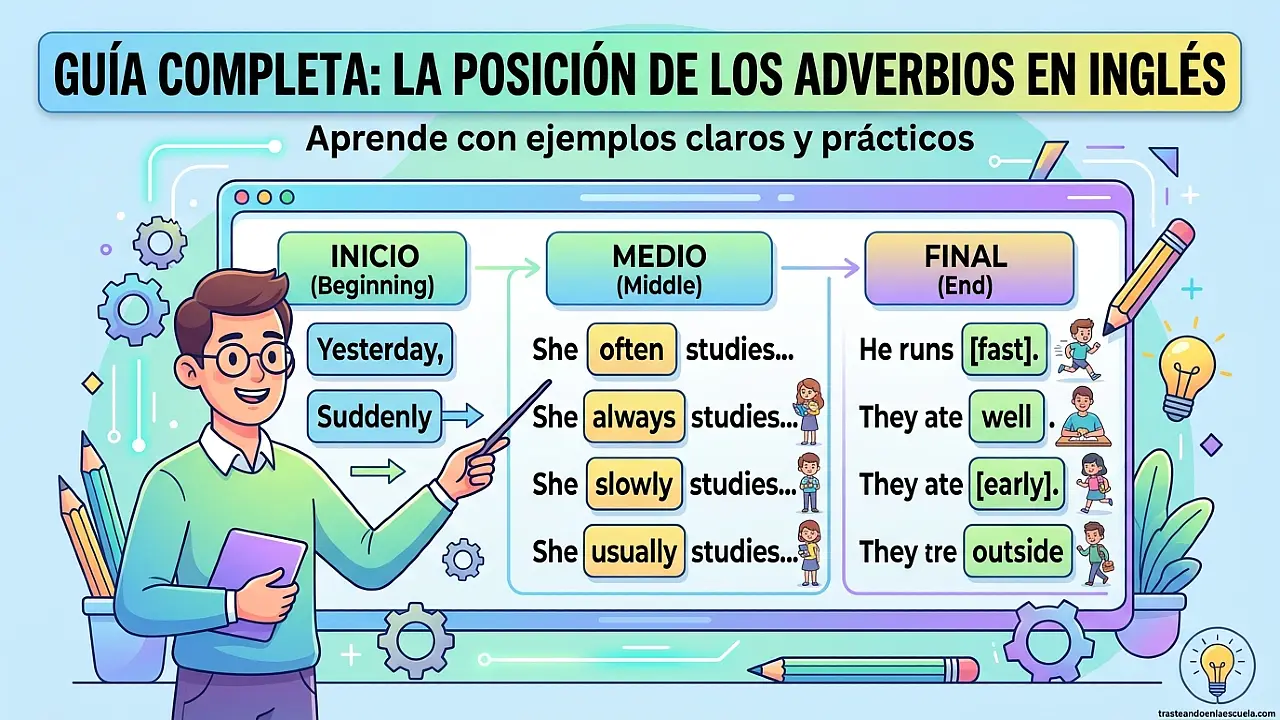
Posición de los adverbios: ¿Dónde va cada uno?
¿Alguna vez te has preguntado por qué decimos «She always arrives late» (no «She arrives always late»)? ¿O por qué «He drives carefully» (no «He carefully drives»)? La posición de los adverbios en inglés sigue reglas claras que dependen del tipo de adverbio que estés usando. Si aprendes estas reglas, tus frases sonarán mucho más naturales.
🎯 En este post aprenderás: Las reglas de posición para cada tipo de adverbio (frecuencia, modo, lugar, tiempo, grado), la fórmula «Manner-Place-Time», las excepciones más comunes, cómo la posición cambia el significado, y 5 ejercicios para dominar la colocación de adverbios.
🔍 Regla general: Tipos de adverbio y su posición
📍 Cada tipo de adverbio tiene su «zona» en la frase
📊 ADVERBIOS DE FRECUENCIA: ANTES del verbo principal (después de TO BE)
🏃 ADVERBIOS DE MODO: DESPUÉS del verbo (o después del objeto)
📍 ADVERBIOS DE LUGAR: DESPUÉS del verbo (o al final de la frase)
⏰ ADVERBIOS DE TIEMPO: AL PRINCIPIO o AL FINAL de la frase
FÓRMULA MPT (Manner-Place-Time):
She sings beautifully in the shower every morning.
Analogía visual: Piensa en la frase como un tren: los adverbios de frecuencia van en los vagones delanteros (antes del verbo), los de modo y lugar en los vagones traseros (después del verbo), y los de tiempo pueden ir al principio (locomotora) o al final (furgón de cola).
📊 Tabla resumen: Posición según el tipo de adverbio
| Tipo de adverbio | Posición general | Ejemplo | Explicación |
|---|---|---|---|
| Frecuencia | ANTES del verbo principal (DESPUÉS de TO BE) |
I always eat breakfast. I am always hungry. |
Ver más en: Adverbs of frequency |
| Modo (cómo) | DESPUÉS del verbo o del objeto | She speaks quietly. He drives his car carefully. |
Ver más en: Adverbs of manner |
| Lugar (dónde) | DESPUÉS del verbo (o al final) | They live near the station. Put the book on the table. |
|
| Tiempo (cuándo) | AL PRINCIPIO o AL FINAL | Yesterday, I saw him. I saw him yesterday. |
|
| Grado (intensidad) | ANTES del adjetivo/adverbio | She is very smart. He runs quite fast. |
very, quite, too, extremely |
📍 La regla MPT: Manner → Place → Time
Cuando una frase tiene varios adverbios al final, el orden típico en inglés es: MANNER (cómo) → PLACE (dónde) → TIME (cuándo).
Excepción: El adverbio de tiempo puede ir al principio para dar énfasis: Last night, she sang beautifully at the concert.
📋 Reglas detalladas por tipo de adverbio
1. Adverbios de frecuencia (always, never, sometimes, often)
📍 Posición: ANTES del verbo principal / DESPUÉS de TO BE
- I always drink coffee (✅) /
I drink always coffee(❌) - She is always late (✅) /
She always is late(❌) - They have never been to London (✅ – entre auxiliar y participio)
- He can sometimes be annoying (✅ – después del modal)
Excepción: «Sometimes» también puede ir al principio o al final para dar énfasis.
2. Adverbios de modo (quickly, slowly, carefully, well)
📍 Posición: DESPUÉS del verbo o después del objeto (si hay objeto)
- She sings beautifully (verbo + adverbio)
- He drives the car carefully (verbo + objeto + adverbio)
- They ate quickly (verbo + adverbio – sin objeto)
Con verbos de movimiento: He slowly walked to the door (también es posible pero menos común).
3. Adverbios de lugar (here, there, inside, downstairs, near the station)
📍 Posición: DESPUÉS del verbo (generalmente al final de la frase)
- She lives downtown
- Put the keys on the table
- They went inside
- I looked everywhere
Con verbos de movimiento: He went to the store; She came here.
4. Adverbios de tiempo (yesterday, today, last week, eventually, finally)
📍 Posición: AL PRINCIPIO o AL FINAL de la frase
- Yesterday, I went to the cinema (principio)
- I went to the cinema yesterday (final)
- Eventually, she arrived / She arrived eventually
- Finally, we finished / We finished finally
Adverbios de tiempo específico (yesterday, last week) suelen ir al final. Adverbios de «secuencia» (then, next, finally) suelen ir al principio.
5. Adverbios de grado (very, quite, too, extremely, almost)
📍 Posición: ANTES del adjetivo o adverbio que modifican
- very good (antes del adjetivo)
- too fast (antes del adverbio)
- She is extremely intelligent
- He runs quite quickly
«Enough» es una excepción: va DESPUÉS del adjetivo/adverbio: big enough, fast enough.
📊 Comparativa: La misma frase con adverbios en diferentes posiciones
La posición de algunos adverbios puede cambiar el énfasis o incluso el significado de la frase.
| Adverbio | Posición | Ejemplo | Significado / Énfasis |
|---|---|---|---|
| always | Media (estándar) | I always eat breakfast. | Énfasis en la acción (siempre lo hago) |
| Principio (raro) | Always, I eat breakfast. | Énfasis en «siempre» (poco natural) | |
| sometimes | Principio | Sometimes, I feel tired. | Énfasis en «a veces» |
| Media | I sometimes feel tired. | Posición estándar | |
| Final | I feel tired sometimes. | Menos común, ligeramente informal | |
| quickly | Después del verbo | She ran quickly. | Énfasis en cómo corrió |
| Antes del verpo | She quickly ran. | Posible pero menos común | |
| yesterday | Principio | Yesterday, I saw him. | Énfasis en cuándo ocurrió |
| Final | I saw him yesterday. | Posición estándar |
⚠️ Errores comunes con la posición de los adverbios
| Error | Ejemplo incorrecto | Corrección | Explicación |
|---|---|---|---|
| Adverbio de frecuencia después del verbo principal | I eat always breakfast. | I always eat breakfast. | Los adverbios de frecuencia van ANTES del verbo principal. |
| Adverbio de modo antes del verbo | He carefully drove the car. | He drove the car carefully. | Normalmente van DESPUÉS del verbo + objeto. (Aunque a veces se permite antes para énfasis). |
| Separar verbo y objeto | She eats quickly her breakfast. | She eats her breakfast quickly. | Con verbos transitivos, el adverbio va DESPUÉS del objeto. |
| Orden MPT incorrecto | She sang at the concert beautifully last night. | She sang beautifully at the concert last night. | Orden correcto: Manner → Place → Time. |
| Confundir «hard» con «hardly» | I hardly worked yesterday (significa «casi no trabajé», no «trabajé duro») | I worked hard yesterday. | «Hard» es adverbio de modo (duro), «hardly» es adverbio de grado (casi nada). Ver: Hard vs Hardly. |
💡 Regla de oro para no equivocarte: Si tienes dudas, coloca el adverbio al final de la frase. Para la mayoría de los adverbios (modo, lugar, tiempo), la posición final es correcta. Solo ten cuidado con los adverbios de frecuencia, que tienen reglas más estrictas.
🎧 Frases de ejemplo con múltiples adverbios
💬 10 frases con adverbios en diferentes posiciones:
- She always drives her car carefully in the city. (Siempre conduce su coche con cuidado en la ciudad.)
- Yesterday, they ate quickly at the restaurant. (Ayer, comieron rápido en el restaurante.)
- He usually speaks softly in meetings. (Normalmente habla suavemente en las reuniones.)
- Eventually, we arrived safely at the airport. (Finalmente, llegamos sanos y salvos al aeropuerto.)
- She has never been there before. (Nunca ha estado allí antes.)
- I need to leave early tomorrow morning. (Necesito salir temprano mañana por la mañana.)
- He ran quickly to the store to buy milk. (Corrió rápido a la tienda a comprar leche.)
- Sometimes, I feel really tired after work. (A veces me siento realmente cansado después del trabajo.)
- They often go downtown on weekends. (A menudo van al centro los fines de semana.)
- She almost always arrives on time for her appointments. (Casi siempre llega a tiempo a sus citas.)
🧪 5 Ejercicios prácticos para dominar la posición de los adverbios
📝 Ejercicio 1: Coloca el adverbio en la posición correcta
Reescribe cada oración colocando el adverbio entre paréntesis en el lugar adecuado.
- I eat breakfast. (always)
- She is late for work. (never)
- He drives his car. (carefully)
- She sings. (beautifully)
- They live. (near the station)
- I saw him. (yesterday)
- We ate. (quickly)
- She has been to Paris. (never)
- He can solve the problem. (easily)
- I feel tired. (sometimes)
✅ Ver solución
- I always eat breakfast.
- She is never late for work.
- He drives his car carefully.
- She sings beautifully.
- They live near the station.
- I saw him yesterday. / Yesterday, I saw him.
- We ate quickly.
- She has never been to Paris.
- He can easily solve the problem. / He can solve the problem easily.
- Sometimes, I feel tired. / I sometimes feel tired. / I feel tired sometimes.
📝 Ejercicio 2: Ordena las palabras para formar oraciones correctas
Ordena las palabras para formar oraciones gramaticalmente correctas con los adverbios en su posición adecuada.
- always / breakfast / eat / I
- carefully / car / drives / his / he
- at the concert / sang / she / last night / beautifully
- never / to bed / late / I / go
- quickly / the letter / wrote / she
- yesterday / I / the store / to / went
- well / she / English / speaks
- downtown / live / they
- sometimes / tired / feel / I / after work
- the problem / could / solve / easily / he
✅ Ver solución
- I always eat breakfast.
- He drives his car carefully.
- She sang beautifully at the concert last night. / Last night, she sang beautifully at the concert.
- I never go to bed late.
- She wrote the letter quickly.
- I went to the store yesterday. / Yesterday, I went to the store.
- She speaks English well.
- They live downtown.
- I sometimes feel tired after work. / Sometimes, I feel tired after work.
- He could solve the problem easily. / He could easily solve the problem.
📝 Ejercicio 3: Corrige los errores de posición en estas oraciones
Algunas oraciones tienen el adverbio mal colocado. Corrígelas.
- She always is happy.
- I eat always breakfast at 8 AM.
- He drove carefully the car.
- She sings beautifully in the shower every morning? (¿Está bien?)
- They went last night to the cinema.
- I have wanted always to travel.
- She speaks very well English.
- He ran quickly to the store.
- We ate in the restaurant quickly dinner.
- I never have been to London.
✅ Ver solución
- She is always happy. (Con TO BE, el adverbio va después)
- I always eat breakfast at 8 AM.
- He drove the car carefully. (El adverbio va después del objeto)
- Correcta: She sings beautifully in the shower every morning. (La posición de beautifully está bien: después del verbo)
- They went to the cinema last night. / Last night, they went to the cinema.
- I have always wanted to travel.
- She speaks English very well. («Well» modifica a «speaks», «very» modifica a «well»)
- Correcta: He ran quickly to the store.
- We ate dinner quickly in the restaurant. (O: We quickly ate dinner in the restaurant)
- I have never been to London.
📝 Ejercicio 4: Traduce al inglés prestando atención a la posición de los adverbios
Traduce las siguientes frases al inglés, colocando los adverbios en la posición correcta.
- Siempre tomo café por la mañana.
- Ella conduce su coche con cuidado.
- Nunca he estado en España.
- A veces me siento cansado después del trabajo.
- Ayer fuimos al cine.
- Ella habla inglés muy bien.
- Ellos viven cerca de la estación.
- Comieron rápidamente en el restaurante.
- Normalmente llego a tiempo a las reuniones.
- Él puede resolver problemas fácilmente.
✅ Ver solución
- I always drink coffee in the morning.
- She drives her car carefully.
- I have never been to Spain.
- Sometimes, I feel tired after work. / I sometimes feel tired after work.
- We went to the cinema yesterday. / Yesterday, we went to the cinema.
- She speaks English very well.
- They live near the station.
- They ate quickly at the restaurant. / They quickly ate at the restaurant.
- I usually arrive on time to meetings.
- He can solve problems easily. / He can easily solve problems.
📝 Ejercicio 5: Añade dos adverbios a cada frase (uno de frecuencia y uno de modo)
Completa cada oración añadiendo un adverbio de frecuencia (always, never, sometimes, usually) y otro de modo (carefully, quickly, well, slowly).
- I ___________ eat breakfast ___________ .
- She ___________ drives ___________ .
- They ___________ speak English ___________ .
- He ___________ arrives ___________ .
- We ___________ finish our work ___________ .
✅ Ver posibles respuestas
Respuestas de ejemplo (tus respuestas pueden ser diferentes):
- I always eat breakfast quickly.
- She usually drives carefully.
- They sometimes speak English well.
- He never arrives late. (late es adverbio)
- We always finish our work efficiently.
Variaciones posibles:
- I never eat breakfast slowly.
- She rarely drives fast.
- They often speak English fluently.
🌍 Aplicaciones prácticas de la posición de adverbios
🗣️ En conversaciones cotidianas
- «I always forget where I put my keys.» (Siempre olvido dónde pongo mis llaves.)
- «She speaks really quickly. I can’t understand her sometimes.» (Ella habla muy rápido. A veces no la entiendo.)
- «We usually go out for dinner on Fridays.» (Normalmente salimos a cenar los viernes.)
📝 En escritura formal (ensayos, informes)
- «Furthermore, the results clearly indicate a significant correlation.» (Además, los resultados indican claramente una correlación significativa.)
- «The study was carefully designed to avoid bias.» (El estudio fue cuidadosamente diseñado para evitar sesgos.)
- «Ultimately, the committee unanimously approved the proposal.» (Finalmente, el comité aprobó por unanimidad la propuesta.)
⏰ En descripciones de rutinas y procedimientos
- «First, turn on the machine. Then, slowly add the powder.» (Primero, enciende la máquina. Luego, agrega lentamente el polvo.)
- «We always check the quality before shipping the products.» (Siempre verificamos la calidad antes de enviar los productos.)
- «She carefully reviewed each document before signing.» (Ella revisó cuidadosamente cada documento antes de firmar.)
📖 Glosario de términos
| Término | Definición | Ejemplo |
|---|---|---|
| Adverb of frequency | Indica con qué frecuencia ocurre algo | always, never, sometimes |
| Adverb of manner | Indica cómo se realiza una acción | quickly, slowly, carefully, well |
| Adverb of place | Indica dónde ocurre algo | here, there, outside, near the station |
| Adverb of time | Indica cuándo ocurre algo | yesterday, today, tomorrow, last week |
| Manner-Place-Time (MPT) | Orden típico de varios adverbios en una frase | She sang beautifully (manner) at the theater (place) last night (time) |
📚 Serie completa: Adverbios en inglés
- 📊 Adverbs of frequency: always, never, sometimes – Los adverbios de frecuencia en detalle.
- 📍 Posición de los adverbios – ¡Estás aquí! Cómo colocar los adverbios correctamente.
- 🏃 Adverbs of manner: quickly, slowly – Los adverbios de modo y su posición.
- ⚠️ Hard vs hardly: cuidado con la diferencia – El par de adverbios más confuso.
- 📝 Ejercicios de adverbios – Practica todo lo aprendido en el clúster.
🏆 Reto final: Reescribe el párrafo corrigiendo los adverbios
El siguiente párrafo tiene todos los adverbios mal colocados. Reescríbelo correctamente.
Párrafo incorrecto:
«She always is happy. She sings beautifully in the car every morning. She drives carefully her car. She never has been late to work. Yesterday, she finished her project quickly. She works hard always. She speaks very well English. Sometimes, she feels tired after work, but she always recovers quickly.»
✅ Ver corrección
Párrafo corregido:
«She is always happy. She sings beautifully in the car every morning. She drives her car carefully. She has never been late to work. Yesterday, she finished her project quickly. She always works hard. She speaks English very well. Sometimes, she feels tired after work, but she always recovers quickly.»
Cambios realizados:
- «always is» → «is always» (TO BE + adverbio)
- «drives carefully her car» → «drives her car carefully» (adverbio después del objeto)
- «never has been» → «has never been» (adverbio entre auxiliar y participio)
- «finishes quickly her project» ya estaba bien en la posición: «finished her project quickly»
- «works hard always» → «always works hard» (adverbio antes del verbo principal)
- «speaks very well English» → «speaks English very well» (objeto + adverbio)












Publicar comentario