Demostrativos con sustantivos en inglés: guía completa
Demostrativos con sustantivos: La combinación perfecta
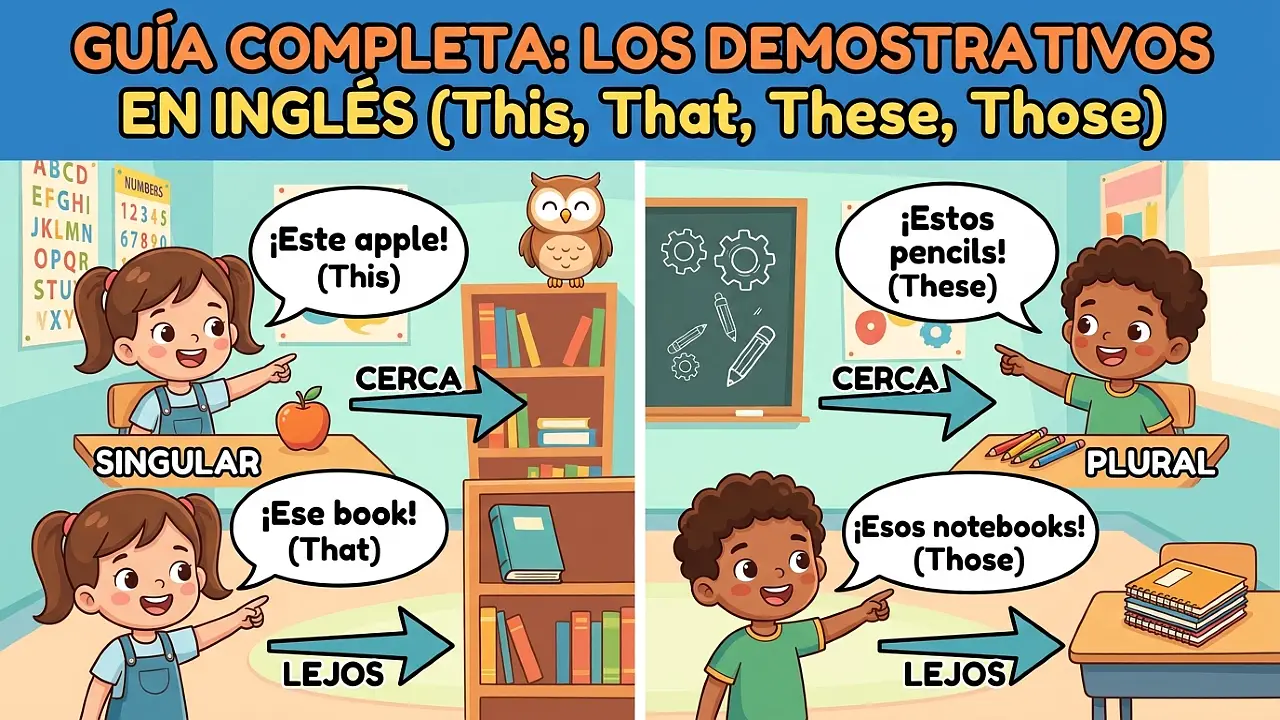
Los demostrativos en inglés (this, that, these, those) casi siempre van acompañados de un sustantivo. Decir simplemente «This is» o «Those are» está bien, pero la verdadera magia ocurre cuando los combinas con nombres para señalar cosas específicas: «This book is fascinating» o «Those people over there are my neighbors». En este post aprenderás todas las reglas para usar demostrativos con sustantivos correctamente.
🎯 En este post aprenderás: Cómo combinar this/that/these/those con sustantivos, la concordancia de número, cuándo usar o no usar el sustantivo, y ejercicios completos para dominar esta estructura.
🔍 La regla básica: Demostrativo + Sustantivo
📐 Fórmula fundamental
El demostrativo funciona como un determinante que acompaña al sustantivo. Entre el demostrativo y el sustantivo puede ir un adjetivo, pero el demostrativo siempre va primero.
Concordancia de número: La clave
| Demostrativo | Número | Ejemplo con sustantivo | Traducción |
|---|---|---|---|
| This | Singular | This car | Este coche |
| That | Singular | That house | Esa/Aquella casa |
| These | Plural | These cars | Estos coches |
| Those | Plural | Those houses | Esas/Aquellas casas |
💡 Regla de oro: El demostrativo y el sustantivo deben concordar en número. Si el sustantivo es singular, usa this o that. Si es plural, usa these o those. Nunca digas «this books» o «these book».
📋 Estructuras con demostrativos y sustantivos
1. Demostrativo + Sustantivo (estructura básica)
- This movie is boring. (Esta película es aburrida.)
- That restaurant serves great pasta. (Ese restaurante sirve pasta estupenda.)
- These shoes are too tight. (Estos zapatos están muy apretados.)
- Those clouds look like rain. (Esas nubes parecen de lluvia.)
2. Demostrativo + Adjetivo + Sustantivo
Puedes añadir uno o más adjetivos entre el demostrativo y el sustantivo para dar más información:
- This delicious chocolate cake is homemade. (Esta deliciosa tarta de chocolate es casera.)
- That tall man in the suit is the CEO. (Ese hombre alto de traje es el director general.)
- These beautiful old paintings are from the 18th century. (Estas hermosas pinturas antiguas son del siglo XVIII.)
- Those noisy children outside are from the school next door. (Esos niños ruidosos de fuera son del colegio de al lado.)
El orden siempre es: Demostrativo → Adjetivo(s) → Sustantivo.
3. Demostrativo + Sustantivo + Frase preposicional
Para ser aún más específico, puedes añadir una frase preposicional o una oración de relativo después del sustantivo:
- This book on the table is mine. (Este libro de la mesa es mío.)
- Those people from the marketing department are visiting today. (Esas personas del departamento de marketing vienen de visita hoy.)
- That car with the red doors belongs to my sister. (Ese coche de puertas rojas es de mi hermana.)
- These documents that I printed need your signature. (Estos documentos que imprimí necesitan tu firma.)
🔄 Demostrativos sin sustantivo: Cuándo omitirlo
✂️ Elipsis del sustantivo
En inglés, puedes omitir el sustantivo después del demostrativo cuando el contexto ya deja claro a qué te refieres. Esto evita repeticiones innecesarias y es muy común en conversaciones.
- A: «Which shirt do you prefer?» B: «This (one) is nicer than that (one).»
- «I don’t like these apples. Can I have those (apples) instead?»
- «Is this (pen) yours?» «No, that (pen) is mine.»
Como veremos en el próximo post sobre one y ones, a menudo se usa «one» o «ones» para sustituir al sustantivo.
📊 Tabla de usos con diferentes tipos de sustantivos
| Tipo de sustantivo | Con This/That | Con These/Those | Ejemplo |
|---|---|---|---|
| Contable singular | This apple, that chair | ❌ No usar | This apple is fresh. |
| Contable plural | ❌ No usar | These apples, those chairs | These apples are fresh. |
| Incontable | This water, that music | ❌ No usar | This water is cold. |
| Abstracto singular | This idea, that feeling | ❌ No usar | This idea is brilliant. |
| Abstracto plural | ❌ No usar | These ideas, those feelings | These ideas are interesting. |
⚠️ Atención con los incontables: Los sustantivos incontables (water, music, information, advice) solo pueden ir con demostrativos singulares (this/that), nunca con plurales (these/those). No digas «these informations», di «this information».
🗣️ Demostrativos + sustantivos en conversación
En presentaciones y saludos
- «This is my friend, Peter.» (Este es mi amigo, Peter.)
- «These are my parents.» (Estos son mis padres.)
- «Is that your sister over there?» (¿Es esa tu hermana allí?)
Al comprar o pedir algo
- «I’d like to try this dress in a size medium.» (Quisiera probarme este vestido en talla mediana.)
- «How much are those earrings in the window?» (¿Cuánto cuestan esos pendientes del escaparate?)
- «This coffee is too bitter. Could you add some sugar?» (Este café está muy amargo. ¿Podrías añadir azúcar?)
En el trabajo o la universidad
- «That report you sent yesterday was excellent.» (Ese informe que enviaste ayer era excelente.)
- «These assignments are due next Monday.» (Estas tareas son para el lunes que viene.)
- «Have you read this article about climate change?» (¿Has leído este artículo sobre el cambio climático?)
📝 Demostrativos + sustantivos con expresiones de tiempo
Los demostrativos se combinan frecuentemente con palabras de tiempo para situar acciones:
- This morning/afternoon/evening (hoy): «I saw her this morning.»
- This week/month/year (presente): «This year has been challenging.»
- These days (hoy en día): «These days, I work from home.»
- That day/night/week (pasado): «That day changed my life.»
- Those days/years (pasado nostálgico): «Those years were unforgettable.»
🧪 Ejercicios prácticos
Ejercicio 1: Completa con this, that, these o those
Completa con el demostrativo correcto según el sustantivo y la distancia:
- _________ car outside the window is blocking my driveway. (Singular, lejos)
- _________ flowers in my hand smell lovely. (Plural, cerca)
- _________ information you gave me was very useful. (Incontable, pasado)
- _________ children playing in the park are my nephews. (Plural, lejos)
- Can you see _________ star shining so brightly? (Singular, lejos)
✅ Ver solución
- That car outside the window is blocking my driveway. (Singular, lejos.)
- These flowers in my hand smell lovely. (Plural, cerca.)
- That information you gave me was very useful. (Incontable, se refiere a algo pasado/dicho por otro.)
- Those children playing in the park are my nephews. (Plural, lejos.)
- Can you see that star shining so brightly? (Singular, lejos.)
Ejercicio 2: Corrige los errores de concordancia
Identifica y corrige los errores de concordancia demostrativo-sustantivo:
- This books are very heavy.
- Those water is contaminated.
- These advices are not helpful.
- That children need help.
- This shoes are too small for me.
✅ Ver solución
- These books are very heavy. (Books es plural.)
- That water is contaminated. (Water es incontable, singular.)
- This advice is not helpful. (Advice es incontable, singular.)
- That child needs help. / Those children need help. (Concordar número.)
- These shoes are too small for me. (Shoes es plural.)
Ejercicio 3: Añade adjetivos
Completa las frases añadiendo uno o dos adjetivos entre el demostrativo y el sustantivo:
- This _________ _________ cake tastes amazing. (delicioso, casero)
- Those _________ _________ buildings are very old. (altos, grises)
- I can’t stand this _________ _________ weather. (frío, lluvioso)
- These _________ _________ shoes cost me a fortune! (italianos, de piel)
- That _________ _________ lady is my piano teacher. (amable, mayor)
✅ Ver soluciones de ejemplo
- This delicious homemade cake tastes amazing.
- Those tall grey buildings are very old.
- I can’t stand this cold rainy weather.
- These Italian leather shoes cost me a fortune!
- That kind old lady is my piano teacher.
Nota: El orden de los adjetivos en inglés suele ser: opinión → tamaño → edad → color → origen → material → propósito.
Ejercicio 4: Traducción de frases completas
Traduce al inglés prestando atención a la concordancia y al orden de las palabras:
- Este café con leche está delicioso.
- Esos estudiantes que están sentados al fondo no prestan atención.
- Esta información que me has enviado es confidencial.
- Aquellas vacaciones en la playa fueron las mejores de mi vida.
- Estas nuevas aplicaciones del teléfono son muy útiles.
✅ Ver solución
- This coffee with milk is delicious.
- Those students sitting at the back are not paying attention.
- This information (that) you sent me is confidential.
- Those beach holidays were the best of my life.
- These new phone apps are very useful.
Ejercicio 5: Diálogo para completar
Completa este diálogo usando demostrativos + sustantivos adecuados:
A: Excuse me, how much does (1)_________ cost? (Señalando una camiseta en el escaparate.)
B: (2)_________ t-shirt is €25. But (3)_________ ones over here are on sale for €15. (Señalando unas cerca.)
A: I like (4)_________ colour much better. (Tocando la que está cerca.) Can I try it on?
B: Of course. (5)_________ fitting rooms are right there. (Señalando al fondo.)
✅ Ver solución
- that shirt (Está en el escaparate, lejos.)
- That (Se refiere a la camiseta del escaparate, singular y lejos.)
- these (Están cerca, plural.)
- this (La estás tocando, la tienes cerca, singular.)
- Those (Están al fondo, lejos, plural. También podría ser «The» si no hay énfasis en la distancia.)
❌ Errores comunes con demostrativos y sustantivos
| Error | Ejemplo incorrecto | Corrección | Explicación |
|---|---|---|---|
| No concordar número | «This apples» | «These apples» | This/that + singular; these/those + plural. |
| Usar plural con incontables | «These furniture are expensive» | «This furniture is expensive» | Furniture, information, advice son incontables. |
| Olvidar el sustantivo cuando es necesario | «I like this» (sin contexto previo) | «I like this painting« | Sin contexto, el oyente no sabe a qué te refieres. |
| Añadir artículo con demostrativo | «The this book» | «This book« | Los demostrativos ya funcionan como determinantes, no llevan artículo. |
| Orden incorrecto con adjetivos | «This old beautiful house» | «This beautiful old house» | Opinión (beautiful) va antes que edad (old). |
📚 Serie completa: Demostrativos en Inglés
Continúa aprendiendo sobre los demostrativos con nuestra serie completa:
- This vs That: singular – Diferencia entre cercanía y lejanía en singular.
- These vs Those: plural – La versión plural de los demostrativos.
- Demostrativos con sustantivos – ¡Estás aquí! Cómo usar this/that/these/those con nombres.
- One vs Ones – Cómo evitar repeticiones con one y ones.
- Ejercicios de demostrativos – Práctica completa con todos los demostrativos.




Publicar comentario