Infinitivo en inglés: cuándo usar to + verbo
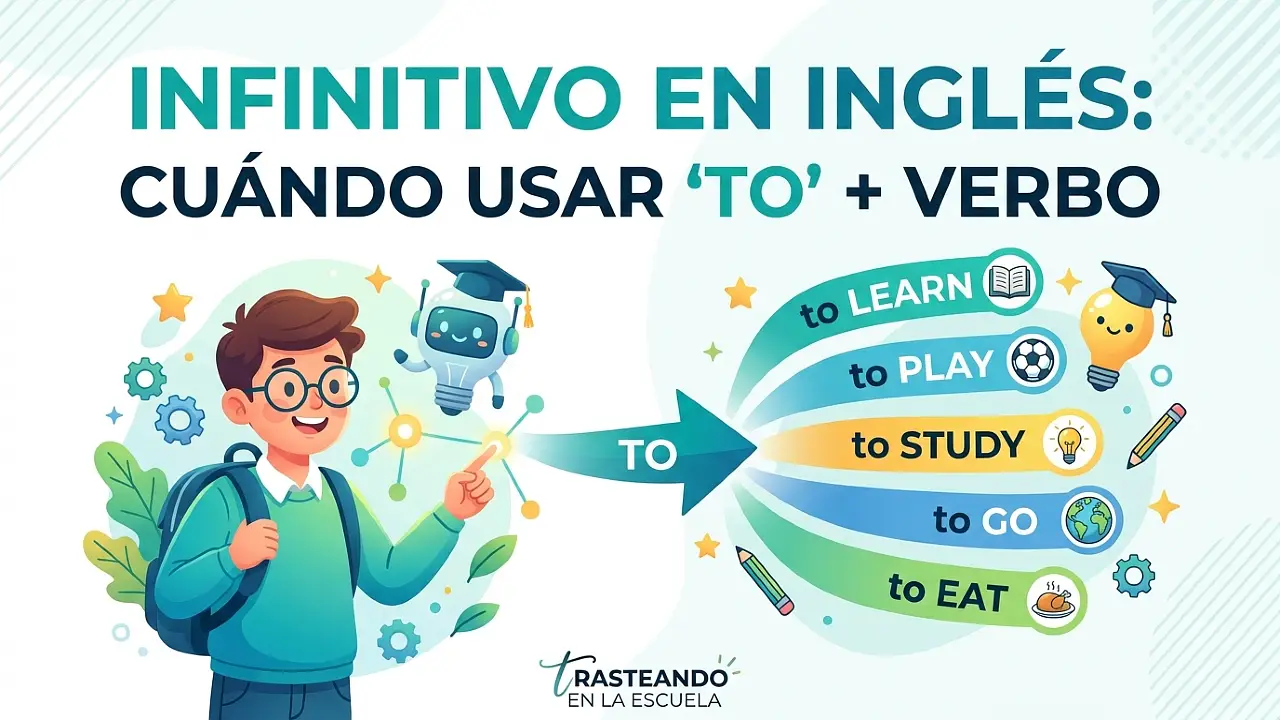
Infinitivo en inglés: la guía definitiva para usar «to + verbo»
El infinitivo en inglés (to + verbo) es una estructura esencial que aparece en todo tipo de oraciones. ¿Cuándo decimos «I want to go» y no «I want going»? ¿Por qué usamos «to learn» después de «easy»? Este post te enseñará todos los usos del infinitivo, los verbos que lo rigen, las expresiones fijas, y la diferencia clave con el gerundio.
🎯 En este post aprenderás: Los 7 usos principales del infinitivo (propósito, tras adjetivos, después de verbos como want/decide, estructuras con too/enough, etc.), la diferencia con el gerundio, más de 30 ejemplos reales, 5 ejercicios resueltos y enlaces a gerundio y verbos seguidos de infinitivo.
🔍 ¿Qué es el infinitivo?
📝 Definición y forma
El infinitivo en inglés se forma con la partícula to + la forma base del verbo. A diferencia del español, donde el infinitivo es una sola palabra (hablar, comer), en inglés siempre lleva «to» excepto en algunos casos (verbos modales o después de ciertos verbos como let, make, see).
Ejemplos: to work, to eat, to study, to be, to have
Importante: El «to» del infinitivo no es una preposición. Es parte de la estructura verbal. No debes confundirlo con «to» preposición (que va seguido de gerundio: I’m looking forward to seeing you).
📋 Los 7 usos principales del infinitivo
1. Para expresar propósito (responder a «¿por qué?»)
El uso más común del infinitivo es expresar la intención o el propósito de una acción. Responde a la pregunta «¿Para qué?» o «¿Por qué?».
- I went to the supermarket to buy some milk. (Fui al supermercado para comprar leche.)
- She is studying to become a doctor. (Está estudiando para ser médico.)
- We arrived early to get good seats. (Llegamos temprano para conseguir buenos asientos.)
💡 Alternativa: A veces puedes usar «in order to» o «so as to» para mayor formalidad: «He left early in order to catch the train.»
2. Después de adjetivos
Muchos adjetivos pueden ir seguidos de un infinitivo para expresar una opinión, emoción o valoración sobre una acción.
- It’s easy to learn Spanish. (Es fácil aprender español.)
- I’m happy to see you. (Estoy feliz de verte.)
- It’s important to be honest. (Es importante ser honesto.)
- She was surprised to find the door open. (Ella se sorprendió al encontrar la puerta abierta.)
- Is it safe to swim here? (¿Es seguro nadar aquí?)
3. Después de ciertos verbos (verbos seguidos de infinitivo)
Hay una lista amplia de verbos que exigen infinitivo después. Los más comunes: want, need, decide, hope, plan, promise, agree, refuse, learn, forget, remember, try, help, etc.
- I want to learn English. (Quiero aprender inglés.)
- She decided to move to London. (Ella decidió mudarse a Londres.)
- We hope to see you soon. (Esperamos verte pronto.)
- He promised to call me. (Él prometió llamarme.)
- Don’t forget to buy bread. (No te olvides de comprar pan.)
📚 Para una lista detallada, consulta nuestro post: Verbos seguidos de infinitivo: lista completa.
4. Después de verbos como «would like», «would love», «would prefer»
Estas expresiones de deseo o preferencia siempre van seguidas de infinitivo.
- I would like to order a coffee. (Quisiera pedir un café.)
- She would love to travel to Japan. (Le encantaría viajar a Japón.)
- We would prefer to stay at home. (Preferiríamos quedarnos en casa.)
5. En estructuras con «too + adjetivo + to» y «adjetivo + enough + to»
Estas construcciones expresan consecuencia (demasiado… para…) o suficiencia (lo suficientemente… para…).
- It’s too cold to go outside. (Hace demasiado frío para salir.)
- She is too young to drive. (Es demasiado joven para conducir.)
- He is old enough to vote. (Tiene la edad suficiente para votar.)
- The box is light enough to carry. (La caja es lo suficientemente ligera para cargarla.)
6. Después de un objeto directo (verbo + objeto + infinitivo)
Algunos verbos (ask, tell, want, expect, allow, invite, teach, etc.) necesitan un objeto antes del infinitivo.
- She asked me to help her. (Ella me pidió que la ayudara.)
- The teacher told us to be quiet. (El profesor nos dijo que estuviéramos callados.)
- I want you to come with me. (Quiero que vengas conmigo.)
- They invited us to join the party. (Nos invitaron a unirnos a la fiesta.)
7. Como sujeto formal (en contextos formales o literarios)
Aunque el gerundio es más común como sujeto, el infinitivo puede usarse como sujeto en inglés formal o escrito, especialmente con verbos como «to be».
- To err is human, to forgive divine. (Errar es humano, perdonar es divino.)
- To be or not to be, that is the question. (Ser o no ser, esa es la cuestión.)
- To learn a language requires dedication. (Aprender un idioma requiere dedicación.)
🎭 Infinitivo vs Gerundio: comparativa práctica
INFINITIVO (to + verbo)
- Propósito: I came to help.
- Tras adjetivos: It’s easy to do.
- Verbos como want, decide: I want to go.
- Estructuras too/enough: Too tired to work.
- Tras verbos modales (sin to): You must go.
GERUNDIO (-ing)
- Sujeto: Swimming is fun.
- Tras preposiciones: Thanks for helping.
- Verbos como enjoy, avoid: I enjoy reading.
- Expresiones fijas: It’s no use crying.
- Actividades con go: Go shopping.
⚠️ Verbos que cambian de significado: remember, forget, stop, try, regret. Ej: «I stopped smoking» (dejé de fumar) vs «I stopped to smoke» (paré para fumar). Practica con nuestros ejercicios resueltos.
📊 Tabla: verbos comunes con infinitivo
| Verbo | Ejemplo | Traducción |
|---|---|---|
| want | I want to travel. | Quiero viajar. |
| need | You need to study. | Necesitas estudiar. |
| decide | She decided to leave. | Decidió irse. |
| hope | We hope to win. | Esperamos ganar. |
| plan | They plan to build a house. | Planean construir una casa. |
| promise | He promised to call. | Prometió llamar. |
| refuse | I refuse to accept. | Me niego a aceptar. |
| learn | She learned to drive. | Aprendió a conducir. |
| forget | Don’t forget to lock the door. | No olvides cerrar la puerta. |
| remember | Remember to buy milk. | Acuérdate de comprar leche. |
🧪 5 ejercicios prácticos para dominar el infinitivo
Ejercicio 1: Completa con el infinitivo (to + verbo) para expresar propósito
- I turned on the TV __________ (watch) the news.
- She went to the library __________ (study) for her exam.
- We saved money __________ (buy) a new car.
- He called me __________ (invite) me to the party.
- They woke up early __________ (catch) the sunrise.
✅ Ver solución
- I turned on the TV to watch the news.
- She went to the library to study for her exam.
- We saved money to buy a new car.
- He called me to invite me to the party.
- They woke up early to catch the sunrise.
Ejercicio 2: Elige la opción correcta (infinitivo tras adjetivos o verbos)
- It’s important (to be / being) on time.
- She decided (to move / moving) abroad.
- I’m happy (to see / seeing) you again.
- They hope (to win / winning) the championship.
- Is it safe (to swim / swimming) here?
✅ Ver solución
- It’s important to be on time.
- She decided to move abroad.
- I’m happy to see you again.
- They hope to win the championship.
- Is it safe to swim here?
Ejercicio 3: Reescribe usando «too + adj + to» o «adj + enough + to»
- He is very young. He can’t drive. → He is too young __________.
- The coffee is very hot. I can’t drink it. → The coffee is too hot __________.
- She is very strong. She can lift the box. → She is strong enough __________.
- The movie was very boring. I fell asleep. → The movie was boring enough __________ (que me hiciera dormir).
- We arrived very late. We didn’t see the beginning. → We arrived too late __________.
✅ Ver solución
- He is too young to drive.
- The coffee is too hot to drink.
- She is strong enough to lift the box.
- The movie was boring enough to make me fall asleep.
- We arrived too late to see the beginning.
Ejercicio 4: Completa la frase con la forma correcta (infinitivo con o sin objeto)
- My mother asked me __________ (clean) my room.
- The teacher told the students __________ (be) quiet.
- I want you __________ (come) with us.
- She invited her friends __________ (join) the party.
- He taught me __________ (swim).
✅ Ver solución
- My mother asked me to clean my room.
- The teacher told the students to be quiet.
- I want you to come with us.
- She invited her friends to join the party.
- He taught me to swim.
Ejercicio 5: Traduce las siguientes oraciones al inglés usando infinitivo
- Voy a la tienda para comprar leche.
- Es importante llegar a tiempo.
- Ella decidió mudarse a Madrid.
- ¿Podrías ayudarme a mover esta mesa?
- Estoy demasiado cansado para salir.
✅ Ver solución
- I’m going to the store to buy milk.
- It’s important to arrive on time.
- She decided to move to Madrid.
- Could you help me to move this table? (o «help me move» sin to)
- I’m too tired to go out.
Para más práctica, revisa ejercicios resueltos y la lista completa de verbos con infinitivo.
❌ Errores comunes con el infinitivo
| Error | Ejemplo incorrecto | Corrección | Explicación |
|---|---|---|---|
| Usar gerundio tras «want» | I want going | I want to go | Want rige infinitivo |
| Olvidar «to» en propósito | I came help you | I came to help you | Propósito necesita to |
| Infinitivo tras preposición | Thanks for to help | Thanks for helping | Preposiciones → gerundio |
| Confundir «to» preposición con infinitivo | I look forward to see you | I look forward to seeing you | «To» preposición → gerundio |
| Usar infinitivo sin objeto tras «ask» | She asked to help (ambiguo) | She asked me to help | Verbo + objeto + infinitivo |
📖 Glosario de términos relacionados
| Término | Definición | Ejemplo |
|---|---|---|
| Infinitivo con to | Forma to + verbo base | to run, to eat |
| Infinitivo sin to (bare infinitive) | Usado tras modales (can, must) y verbos como let, make | You must go, Let me help |
| Propósito | Intención de una acción (responde a why?) | I called to invite you |
| Estructura too/enough | Demasiado… para / lo suficientemente… para | Too young to drive |
| Verbos de percepción + infinitivo sin to | see, hear, watch + objeto + verbo base (acción completa) | I saw him cross the street |
📚 Serie completa: Gerundio e infinitivo en inglés
- Gerundio en inglés: cuándo usar el -ing
- Infinitivo en inglés: cuándo usar to + verbo – ¡Estás aquí!
- Verbos seguidos de gerundio: lista completa
- Verbos seguidos de infinitivo: lista completa
- Ejercicios de gerundio e infinitivo resueltos
🏆 Reto final: Escribe 7 frases originales usando cada uno de los usos del infinitivo que hemos visto. Luego, intenta cambiar el infinitivo por un gerundio y observa si el significado o la gramática cambian. ¡Comparte tus ejemplos en los comentarios!








Publicar comentario