Superlatives in English: el más, el mejor – reglas y ejemplos
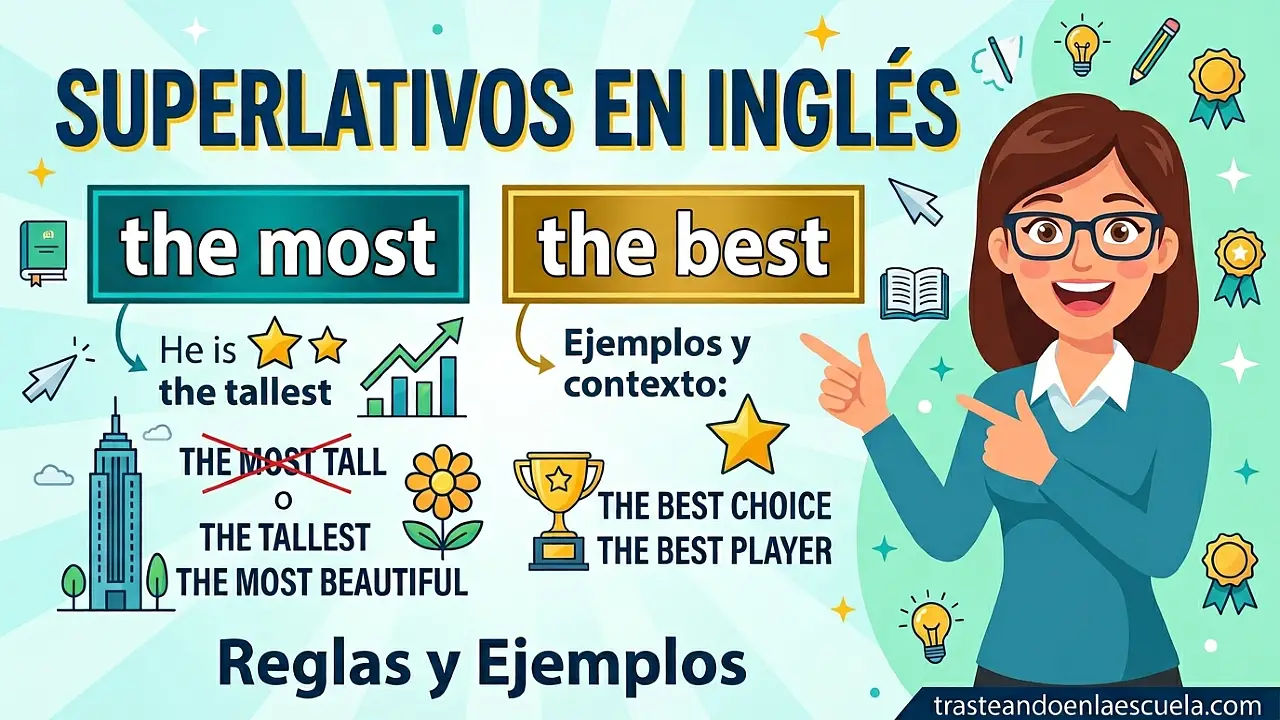
Superlatives in English: El mejor, el más alto, el más interesante
¿Alguna vez has querido decir que algo es «el mejor», «el más grande» o «el más importante» en inglés? Para eso necesitas los superlativos. Mientras que los comparativos comparan DOS elementos, los superlativos comparan TRES o MÁS para determinar cuál está en el grado máximo de una cualidad.
La buena noticia es que las reglas de los superlativos son muy similares a las de los comparativos: añadimos -est a los adjetivos cortos y usamos most con los adjetivos largos. Pero hay diferencias importantes: usamos «the» delante del superlativo y «in/of» para delimitar el grupo.
🎯 En este post aprenderás: La estructura del superlativo (the + adjetivo + est / most adjetivo), las reglas ortográficas para añadir -est, la diferencia entre «in» y «of» después del superlativo, los irregulares más comunes (best, worst, farthest/furthest), y 5 ejercicios prácticos para dominar esta estructura.
🔍 ¿Qué es un superlativo y cómo se forma?
👑 El grado máximo de comparación
Juan is the tallest in his class. (Juan es el más alto de su clase.)
This is the most beautiful beach in the world. (Esta es la playa más bonita del mundo.)
She is the best student in the school. (Ella es la mejor estudiante de la escuela.)
Analogía del podio: Imagina una competición con tres participantes. El comparativo eliges al ganador frente a otro (más alto QUE). El superlativo corona al ganador ABSOLUTO (EL MÁS alto). El superlativo siempre va acompañado de «the» porque solo hay UNO en el grado máximo.
📋 Regla 1: Adjetivos cortos (1 sílaba) → -est
🎯 La regla de oro
Los adjetivos de una sílaba forman el superlativo añadiendo -est al final. Siempre usamos the delante.
📝 Tabla de adjetivos cortos en superlativo
| Adjetivo | Superlativo | Ejemplo |
|---|---|---|
| tall (alto) | the tallest (el más alto) | He is the tallest player on the team. |
| small (pequeño) | the smallest (el más pequeño) | This is the smallest house in the neighborhood. |
| fast (rápido) | the fastest (el más rápido) | The cheetah is the fastest animal on land. |
| slow (lento) | the slowest (el más lento) | This is the slowest internet connection ever. |
| cheap (barato) | the cheapest (el más barato) | We found the cheapest flights online. |
| rich (rico) | the richest (el más rico) | He is one of the richest men in the world. |
💡 Importante: El superlativo siempre lleva «the» porque estamos hablando de algo único. No se puede decir «He is tallest player». ¡El «the» es obligatorio!
✍️ Reglas ortográficas para añadir -est
Las reglas son idénticas a las de los comparativos con -er:
1. Adjetivos terminados en -e: solo añadir -st
| Adjetivo | Superlativo | Ejemplo |
|---|---|---|
| nice (agradable) | the nicest (el más agradable) | She is the nicest person I know. |
| large (grande) | the largest (el más grande) | This is the largest room in the hotel. |
| wide (ancho) | the widest (el más ancho) | This is the widest river in the country. |
2. Adjetivos terminados en consonante + vocal + consonante (CVC): doblar la última consonante
| Adjetivo | Superlativo | Ejemplo |
|---|---|---|
| big (grande) | the biggest (el más grande) | This is the biggest apple I’ve ever seen. |
| hot (caliente) | the hottest (el más caliente) | August is the hottest month of the year. |
| thin (delgado) | the thinnest (el más delgado) | She is the thinnest girl in the class. |
| fat (gordo) | the fattest (el más gordo) | My cat is the fattest in the neighborhood. |
3. Adjetivos terminados en -y: cambiar la -y por -iest
| Adjetivo | Superlativo | Ejemplo |
|---|---|---|
| happy (feliz) | the happiest (el más feliz) | This is the happiest day of my life. |
| easy (fácil) | the easiest (el más fácil) | This is the easiest exercise in the book. |
| funny (gracioso) | the funniest (el más gracioso) | That was the funniest movie I’ve ever seen. |
| heavy (pesado) | the heaviest (el más pesado) | This is the heaviest suitcase. |
| busy (ocupado) | the busiest (el más ocupado) | Monday is the busiest day of the week. |
📋 Regla 2: Adjetivos largos (2+ sílabas) → the most + adjetivo
🎯 La regla de oro
Los adjetivos de dos o más sílabas (que no terminan en -y) forman el superlativo con the most + adjetivo.
📝 Tabla de adjetivos largos en superlativo
| Adjetivo | Superlativo | Ejemplo |
|---|---|---|
| beautiful (bonito) | the most beautiful (el más bonito) | This is the most beautiful place I’ve ever visited. |
| expensive (caro) | the most expensive (el más caro) | This is the most expensive restaurant in town. |
| interesting (interesante) | the most interesting (el más interesante) | That was the most interesting book I’ve read. |
| comfortable (cómodo) | the most comfortable (el más cómodo) | These are the most comfortable shoes. |
| difficult (difícil) | the most difficult (el más difícil) | This is the most difficult exam of the year. |
| dangerous (peligroso) | the most dangerous (el más peligroso) | That is the most dangerous road in the country. |
📋 Superlativo negativo: the least + adjetivo
Para decir «el menos…», usamos the least. Esta regla funciona para TODOS los adjetivos.
| Adjetivo | Superlativo negativo | Ejemplo |
|---|---|---|
| interesting | the least interesting (el menos interesante) | That was the least interesting lecture. |
| expensive | the least expensive (el menos caro) | This is the least expensive option. |
| difficult | the least difficult (el menos difícil) | This is the least difficult exercise. |
🗺️ ¿In o Of? La preposición después del superlativo
Después de un superlativo, a menudo especificamos el grupo al que pertenece el elemento. Usamos in o of dependiendo del contexto:
📍 IN + lugar / grupo grande
- He is the tallest in his class.
- This is the best restaurant in the city.
- She is the smartest in the school.
- Mount Everest is the highest mountain in the world.
Uso: «In» se usa con lugares (city, country, world) y grupos grandes (class, school, team).
🔢 OF + grupo específico / personas
- He is the tallest of all the students.
- This is the best of all the restaurants.
- She is the smartest of the three sisters.
- This is the most expensive of all the cars.
Uso: «Of» se usa con grupos específicos contables (of all, of the three, of my friends).
💡 Regla rápida: Si puedes sustituir el grupo por «them» o «all of them», usa «of». Si hablas de un lugar físico, usa «in».
Ejemplo: «She is the best in the class» (dentro del aula). «She is the best of the class» (de entre todos los estudiantes). La diferencia es sutil pero real.
📊 Comparativo vs Superlativo: ¿Cuál usar?
| Comparativo | Superlativo | Diferencia clave |
|---|---|---|
| taller than (más alto que) | the tallest (el más alto) | Compara 2 elementos → Comparativo. Compara 3+ → Superlativo. |
| more interesting than | the most interesting | Usa «than» → Comparativo. Usa «the» + «in/of» → Superlativo. |
| Juan is taller than María. | Juan is the tallest in the class. | Con «than» hay dos. Con «in/of» hay muchos. |
🧪 5 Ejercicios prácticos para dominar los superlativos
Ejercicio 1: Elige la forma correcta (-est o most)
Completa con el superlativo del adjetivo entre paréntesis.
- This is __________ (big) house in the street.
- She is __________ (intelligent) person I know.
- That was __________ (funny) movie of the year.
- This is __________ (expensive) hotel in the city.
- He is __________ (fast) runner on the team.
- Today is __________ (hot) day of the summer.
- This is __________ (beautiful) beach in Spain.
- She is __________ (happy) person in the world.
- This was __________ (difficult) exam of my life.
- He is __________ (rich) man in the country.
✅ Ver solución
- the biggest
- the most intelligent
- the funniest
- the most expensive
- the fastest
- the hottest
- the most beautiful
- the happiest
- the most difficult
- the richest
Ejercicio 2: Completa la tabla
Escribe el superlativo de cada adjetivo.
| Adjetivo | Superlativo |
|---|---|
| small | ___________ |
| popular | ___________ |
| sad | ___________ |
| noisy | ___________ |
| famous | ___________ |
| thin | ___________ |
| exciting | ___________ |
| lucky | ___________ |
| boring | ___________ |
| wet | ___________ |
✅ Ver solución
- small → the smallest
- popular → the most popular
- sad → the saddest
- noisy → the noisiest
- famous → the most famous
- thin → the thinnest
- exciting → the most exciting
- lucky → the luckiest
- boring → the most boring
- wet → the wettest
Ejercicio 3: Completa la frase con «in» o «of»
- This is the best restaurant __________ the city.
- She is the tallest __________ all the students.
- He is the smartest __________ his family.
- This is the most expensive __________ the three cars.
- Mount Everest is the highest mountain __________ the world.
- She is the most talented singer __________ the group.
- This is the worst day __________ my life.
- He is the fastest runner __________ the team.
✅ Ver solución
- in
- of
- in
- of
- in
- in
- of
- in
Ejercicio 4: Corrige los errores
- This is the beautifulest place I’ve ever seen.
- He is the more intelligent student in the class.
- She is the fastest of the team.
- This is most expensive restaurant in town.
- That was the baddest movie of the year.
- She is the happier person in the world.
- This is the most easiest exercise.
- He is the tall student in the school.
✅ Ver solución
- This is the most beautiful place I’ve ever seen.
- He is the most intelligent student in the class.
- She is the fastest in the team. (o «of all the players» pero no «of the team»)
- This is the most expensive restaurant in town.
- That was the worst movie of the year.
- She is the happiest person in the world.
- This is the easiest exercise. (most easiest → easiest)
- He is the tallest student in the school.
Ejercicio 5: Traduce al inglés
- Este es el día más feliz de mi vida.
- Ella es la estudiante más inteligente de la clase.
- Este es el coche más caro del mundo.
- El monte Everest es la montaña más alta del mundo.
- Esa fue la película menos interesante del año.
- Juan es el más alto de todos sus amigos.
- Este es el mejor restaurante de la ciudad.
- ¿Cuál es el animal más rápido del mundo?
✅ Ver solución
- This is the happiest day of my life.
- She is the most intelligent student in the class.
- This is the most expensive car in the world.
- Mount Everest is the highest mountain in the world.
- That was the least interesting movie of the year.
- Juan is the tallest of all his friends.
- This is the best restaurant in the city.
- What is the fastest animal in the world?
❌ Errores comunes con los superlativos
| Error | Ejemplo incorrecto | Corrección |
|---|---|---|
| Olvidar «the» | She is happiest person. | She is the happiest person. |
| Usar «more/most» con adjetivos cortos | This is most big. | This is the biggest. |
| Usar «-est» con adjetivos largos | This is beautifullest. | This is the most beautiful. |
| Confundir «in» y «of» | He is the tallest of the class. | He is the tallest in the class. |
| No doblar la consonante | This is the bigest. | This is the biggest. |
| No cambiar -y por -iest | She is the happyest. | She is the happiest. |
📚 Serie completa: Comparativos y superlativos
- Comparatives: reglas y ejemplos – Comparativos regulares.
- Superlatives: el más, el mejor – ¡Estás aquí!
- Irregular comparatives: good, bad, far – Las excepciones esenciales.
- As… as: comparaciones de igualdad – Tan… como.
- Ejercicios comparativos y superlativos – Práctica integrada.
🏆 Reto de la semana: Esta semana, cada vez que veas un «ranking» (top 10 canciones, mejores películas, ciudades más pobladas), describe en inglés al número 1 usando un superlativo. Ejemplo: «This is the most listened song on Spotify this week». «This is the highest mountain in the world». «She is the most nominated actress this year». ¡Entrena tu ojo para identificar el grado máximo!




Publicar comentario