One vs Ones: cómo sustituir sustantivos en inglés
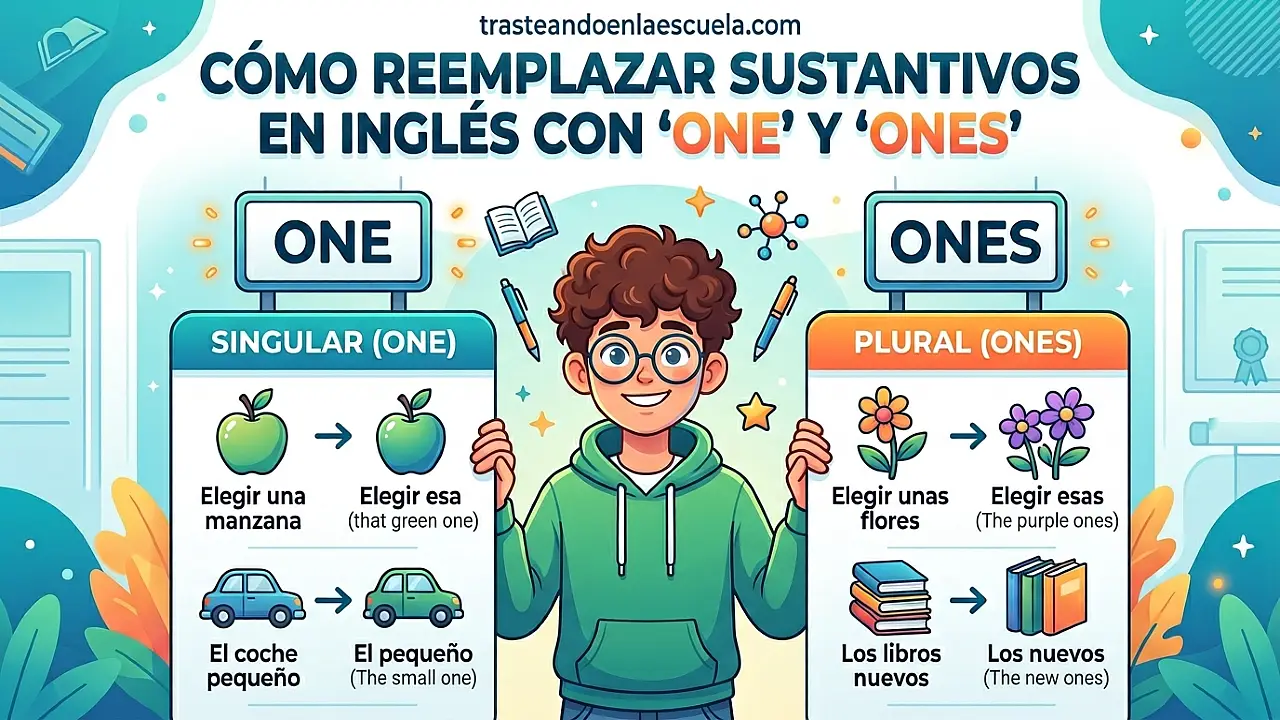
One vs Ones: El truco para no repetir sustantivos
¿Te has dado cuenta de que en español decimos «¿Cuál prefieres, el rojo o el azul?» sin necesidad de repetir «el coche» o «el vestido»? En inglés, esa misma función la cumplen one (singular) y ones (plural). Son palabras comodín que sustituyen a un sustantivo ya mencionado para evitar repeticiones y sonar más natural. Si quieres sonar como un nativo, dominar one y ones es imprescindible.
🎯 En este post aprenderás: Cuándo usar one y ones para sustituir sustantivos, la diferencia con los demostrativos, cómo combinarlos con adjetivos, ejemplos en conversaciones reales y ejercicios prácticos.
🔍 ¿Qué son ONE y ONES como sustitutos?
🃏 Las palabras comodín del inglés
One sustituye a un sustantivo contable singular ya mencionado.
Ones sustituye a un sustantivo contable plural ya mencionado.
No son números (one = uno), son pronombres que evitan repetir el nombre.
1️⃣ ONE (singular)
- «I like the red dress.» → «I like the red one.»
- «Do you have a pen?» → «Yes, I have one.»
- «Which book is yours?» → «The big one is mine.»
👥 ONES (plural)
- «I like the red dresses.» → «I like the red ones.»
- «Do you have any pens?» → «Yes, I have some ones.»
- «Which books are yours?» → «The big ones are mine.»
💡 Dato clave: One y ones SOLO sustituyen a sustantivos contables. No puedes usarlos con sustantivos incontables (water, rice, information, advice). Para esos, simplemente omites el sustantivo o usas «some».
- ❌ «I need water. Do you have cold one?»
- ✅ «I need water. Do you have some cold?» o «Do you have cold water?»
📋 One vs Ones: Todas las reglas
1. One para sustantivos contables singulares
One sustituye a un sustantivo singular ya mencionado, normalmente acompañado de un artículo, demostrativo o adjetivo:
- A: «Which car do you prefer?» B: «I prefer the blue one.» (El azul.)
- «I don’t have a jacket. I need to buy one.» (Necesito comprar una.)
- «That cake looks delicious. I’ll have a small one.» (Tomaré uno pequeño.)
- «My phone is broken. Can I use your one?» (¿Puedo usar el tuyo?)
2. Ones para sustantivos contables plurales
Ones sustituye a un sustantivo plural ya mencionado:
- A: «Which shoes do you like?» B: «I like the black ones.» (Los negros.)
- «These cookies are stale. Get some fresh ones.» (Compra unas frescas.)
- «I don’t like those chairs. I prefer these ones.» (Prefiero estas.)
3. One/Ones después de adjetivos
Es muy común usar one/ones después de un adjetivo para no repetir el sustantivo:
- «I have a big dog and a small one.» (Uno pequeño.)
- «She has expensive bags and cheap ones.» (Unos baratos.)
- «The Spanish students are louder than the Italian ones.» (Los italianos.)
4. One/Ones después de demostrativos
Los demostrativos (this, that, these, those) se combinan frecuentemente con one/ones para señalar objetos específicos sin repetir el sustantivo:
- «I don’t like this shirt. I prefer that one.» (Prefiero esa.)
- «These apples are green. Those ones are red.» (Esas son rojas.)
- «Which book? This one or that one?» (¿Este o ese?)
📊 Tabla de combinaciones con ONE y ONES
| Combinación | Singular | Plural | Ejemplo |
|---|---|---|---|
| the + adj + one/ones | the red one | the red ones | I like the red one(s). |
| a/an + adj + one | a big one | ❌ | I need a big one. |
| this/that + one | this one / that one | ❌ | This one is mine. |
| these/those + ones | ❌ | these ones / those ones | These ones are mine. |
| which + one/ones | which one? | which ones? | Which one(s) do you prefer? |
| the + one/ones | the one | the ones | He’s the one I told you about. |
🗣️ One y Ones en conversaciones cotidianas
En una tienda
- A: «Can I help you?» B: «Yes, I’m looking for a dress.»
- A: «What about this one?» B: «It’s nice, but I prefer a longer one.»
- A: «These ones are longer.» B: «Perfect! I’ll try the blue one.»
En un restaurante
- A: «Which pizza did you order?» B: «The vegetarian one.»
- A: «Are these chips good?» B: «Yes, but the sweet potato ones are better.»
- «I’d like a coffee, please.» «Which one? We have latte, cappuccino, or Americano.»
Con personas (cuidado con el contexto)
One/ones se puede usar para referirse a personas, pero con precaución para no sonar despectivo:
- ✅ «He’s the one I was telling you about.» (Él es de quien te hablaba. → Normal, neutro.)
- ✅ «She’s the one who got the promotion.» (Ella es la que consiguió el ascenso. → Normal.)
- ⚠️ «The short ones always complain.» (Los bajitos siempre se quejan. → Puede sonar despectivo.)
- 🟢 Mejor: «The ones who arrived late missed the speech.» (Los que llegaron tarde se perdieron el discurso. → Descripción neutra.)
🧠 Truco para decidir: Si necesitas preguntar «¿cuál?» en español, en inglés usarás «which one?» (singular) o «which ones?» (plural). Cuando en español respondes «el rojo» o «los baratos», en inglés respondes «the red one» o «the cheap ones».
❌ Cuándo NO usar ONE u ONES
⛔ Reglas de exclusión
- Con sustantivos incontables: No uses one/ones con water, milk, information, advice, money, rice, etc.
- ❌ «This milk is sour. Give me fresh one.»
- ✅ «This milk is sour. Give me some fresh.»
- Con números directamente: No uses one después de un número, porque el número ya sustituye al sustantivo.
- ❌ «I have two ones.»
- ✅ «I have two.»
- Con posesivos sin adjetivo: En inglés británico, no se usa one tras un posesivo si no hay adjetivo. En inglés americano es más aceptado.
- UK: «My car is faster than yours.» (No «your one»)
- USA: «My car is faster than your one.» (Coloquial, pero menos formal.)
🧪 Ejercicios prácticos
Ejercicio 1: Sustituye el sustantivo con ONE o ONES
Reescribe las frases sustituyendo la palabra repetida por one o ones:
- I don’t like this jacket. Show me another jacket.
- These apples are too sour. Do you have sweeter apples?
- The big house is nice, but I prefer the small house.
- Which cookies did you buy? The chocolate cookies or the vanilla cookies?
- I need a pen. Can you lend me a pen?
✅ Ver solución
- I don’t like this jacket. Show me another one.
- These apples are too sour. Do you have sweeter ones?
- The big house is nice, but I prefer the small one.
- Which cookies did you buy? The chocolate ones or the vanilla ones?
- I need a pen. Can you lend me one?
Ejercicio 2: ¿ONE u ONES? Elige correctamente
Completa con one u ones según corresponda:
- Which dress do you prefer? The red _________ or the blue _________?
- I have many books, but the science fiction _________ are my favorite.
- This problem is a difficult _________.
- Look at those birds! The white _________ are swans.
- I need a new phone. My old _________ is too slow.
✅ Ver solución
- The red one or the blue one? (Singular: dress.)
- The science fiction ones are my favorite. (Plural: books.)
- This problem is a difficult one. (Singular: problem.)
- The white ones are swans. (Plural: birds.)
- My old one is too slow. (Singular: phone.)
Ejercicio 3: Corrige los errores
Estas frases tienen errores en el uso de one/ones. Encuéntralos y corrígelos:
- This water is warm. I want a cold one.
- I have three apples and two one oranges.
- Which shoes are yours? The black one or the brown one?
- These information is wrong. Give me correct one.
- I like the Italian restaurant more than the Chinese one.
✅ Ver solución
- This water is warm. I want some cold. (Water es incontable, no se usa «one».)
- I have three apples and two oranges. (Con números, no se usa «one».)
- Which shoes are yours? The black ones or the brown ones? (Shoes es plural, se usa «ones».)
- This information is wrong. Give me the correct information. (Information es incontable, no se usa «one».)
- I like the Italian restaurant more than the Chinese one. ✅ (Esta es correcta. «Restaurant» es contable singular.)
Ejercicio 4: Completa el diálogo
Completa con one, ones, o deja en blanco si no se necesita:
A: I love these earrings! Especially the silver (1)_________.
B: The gold (2)_________ are also beautiful.
A: True, but I think I’ll buy the silver (3)_________.
B: Which (4)_________ exactly? The long (5)_________ or the short (6)_________?
A: The long (7)_________. They’re more elegant.
B: Good choice! I bought the short (8)_________ last week.
✅ Ver solución
- ones (Plural: earrings.)
- ones (Plural: earrings.)
- ones (Plural: earrings.)
- ones (Plural: «Which ones exactly?»)
- ones (Plural: earrings.)
- ones (Plural: earrings.)
- ones (Plural: earrings.)
- ones (Plural: earrings.)
Ejercicio 5: Traducción al inglés
Traduce estas frases usando one u ones correctamente:
- ¿Cuál prefieres, el grande o el pequeño?
- Estas galletas están duras. Tráeme unas frescas.
- No me gusta ese coche. Me gusta más el rojo.
- Los estudiantes de primer año son más ruidosos que los de último año.
- ¿Tienes un bolígrafo? Necesito uno para firmar esto.
✅ Ver solución
- Which one do you prefer, the big one or the small one?
- These cookies are hard. Bring me some fresh ones.
- I don’t like that car. I prefer the red one.
- The first-year students are louder than the final-year ones.
- Do you have a pen? I need one to sign this.
📊 One/Ones con demostrativos: tabla resumen
| Demostrativo | + one/ones | Ejemplo | Significado |
|---|---|---|---|
| This | This one | I like this one. | Este (singular, cerca) |
| That | That one | I prefer that one. | Ese/Aquel (singular, lejos) |
| These | These ones | These ones are better. | Estos (plural, cerca) |
| Those | Those ones | I’ll take those ones. | Esos/Aquellos (plural, lejos) |
🌍 Diferencia UK vs USA: En inglés británico, «these ones» y «those ones» son perfectamente normales. En inglés americano, algunos hablantes prefieren omitir «ones» y decir simplemente «these» o «those» cuando el contexto es claro. Ambas opciones son correctas.
📚 Serie completa: Demostrativos en Inglés
Continúa aprendiendo sobre los demostrativos con nuestra serie completa:
- This vs That: singular – Diferencia entre cercanía y lejanía en singular.
- These vs Those: plural – La versión plural de los demostrativos.
- Demostrativos con sustantivos – Cómo usar this/that/these/those con nombres.
- One vs Ones – ¡Estás aquí! Cómo evitar repeticiones con one y ones.
- Ejercicios de demostrativos – Práctica completa con todos los demostrativos.







Publicar comentario