Weather: el clima en inglés – vocabulario y expresiones
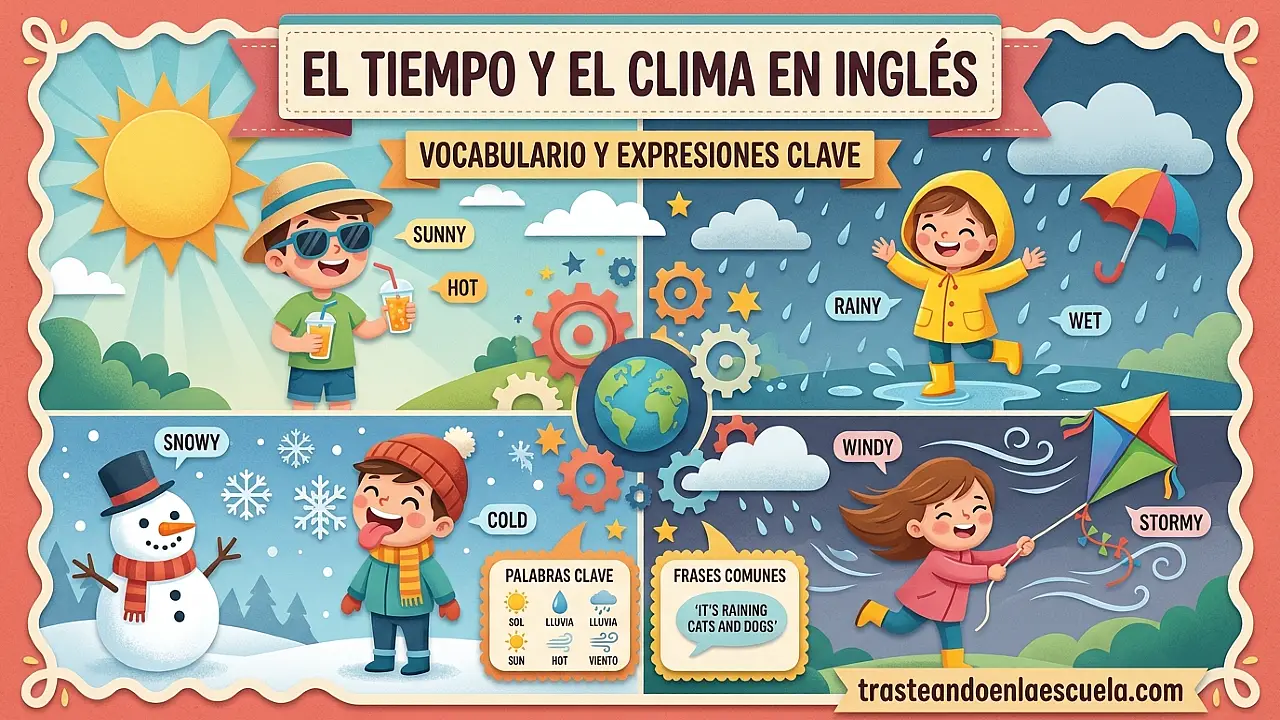
Weather: El clima en inglés
Hablar del clima es uno de los temas más comunes en cualquier conversación en inglés. Desde «It’s raining cats and dogs» hasta «It’s a scorcher», el vocabulario del clima es esencial para tu fluidez. Este tema es especialmente útil si estás planeando un viaje o simplemente quieres mejorar tu speaking en inglés. En este post, no solo aprenderás palabras sueltas, sino frases completas, expresiones idiomáticas y la diferencia entre «weather» y «climate», un error muy común incluso entre estudiantes avanzados. Además, incluimos ejercicios prácticos para que puedas aplicar lo aprendido de inmediato. Si alguna vez has querido entender un pronóstico del tiempo en la BBC o mantener una pequeña charla (small talk) sobre el clima como un nativo, este es tu recurso definitivo.
🎯 En este post aprenderás: Vocabulario básico y avanzado del clima (soleado, nublado, tormentoso), cómo preguntar y describir el tiempo usando estructuras gramaticales correctas, expresiones idiomáticas como «under the weather», diferencias entre palabras confusas (weather vs climate vs whether), y 5 ejercicios prácticos con soluciones detalladas para autoevaluarte.
☀️ Vocabulario básico del clima (Basic Weather Vocabulary)
Para empezar, necesitas las palabras básicas para describir el día a día. Estas son las primeras que se aprenden en niveles A1/A2, pero es crucial dominar su pronunciación y uso en contexto. El clima es un tema recurrente en los exámenes de Cambridge Speaking, especialmente en la parte de interacción con el examinador.
¿Qué tiempo hace hoy? (What’s the weather like today?)
☀️ Soleado
- Sunny /ˈsʌni/
- It’s sunny today. (Hoy hace sol)
- It’s a bright sunny day.
☁️ Nublado
- Cloudy /ˈklaʊdi/
- It’s partly cloudy. (Parcialmente nublado)
- It’s overcast. (Totalmente cubierto)
🌧️ Lluvioso
- Rainy /ˈreɪni/
- It’s a rainy day.
- It’s drizzling. (Está lloviznando)
🌫️ Ventoso
- Windy /ˈwɪndi/
- It’s very windy.
- There’s a strong wind.
🌡️ Temperaturas y sensaciones térmicas (Temperatures & Feelings)
Para hablar de cómo nos sentimos con el clima, usamos adjetivos específicos que van más allá de «hot» o «cold». Si quieres repasar los comparativos para hablar de temperaturas relativas (ej. «colder than», «as hot as»), revisa nuestra guía de adjetivos comparativos en inglés. Describir la sensación térmica es clave para dar una opinión personal sobre el clima.
| Sensación (Feeling) | Adjetivo (Adjective) | Ejemplo en contexto |
|---|---|---|
| Mucho calor (Extreme heat) | Hot / Boiling / Scorching | It’s boiling outside! Let’s stay in the shade. |
| Calor agradable (Pleasant heat) | Warm | It’s warm and pleasant. Perfect for a picnic. |
| Templado (Mild) | Mild | Spring weather is usually mild, not too hot or cold. |
| Frío (Cold) | Cold / Freezing / Icy | My hands are freezing. I need gloves. |
| Húmedo (Humidity) | Humid / Muggy | It’s very humid today. My hair is a mess. |
| Fresco / Fresquito (Cool) | Cool / Chilly / Crisp | It’s a bit chilly in here. Close the window. |
💡 Diferencia clave (Key difference): Weather (clima/tiempo atmosférico) se refiere a las condiciones en un momento y lugar específicos (ej. «The weather is bad today»). Climate (clima) se refiere a los patrones de weather a largo plazo en una región (ej. «The climate of Spain is Mediterranean»). No confundir Weather con Whether (si/ya que), ¡son homófonos pero significan cosas totalmente diferentes!
🌪️ Fenómenos meteorológicos intensos (Severe weather)
Aquí tienes vocabulario para describir tormentas y fenómenos más extremos, que conecta directamente con el post de desastres naturales en inglés. Este nivel de vocabulario es necesario para lecturas de nivel B2/C1.
- Thunderstorm (Tormenta eléctrica): «A thunderstorm is approaching. I see lightning.»
- Lightning (Rayo/Relámpago): «Lightning struck the tree and split it in half.»
- Thunder (Trueno): «We heard loud thunder about 10 seconds after the flash.»
- Hail (Granizo): «Hail damaged the cars. The hailstones were huge!»
- Flood (Inundación): «The heavy rain caused a flood in the basement.»
- Drought (Sequía): «The drought lasted for months, killing all the crops.»
- Hurricane / Typhoon / Cyclone (Huracán/Tifón/Ciclón): «The hurricane hit the coast with winds of 200 km/h.» (Depende de la región geográfica).
- Blizzard (Tormenta de nieve): «The blizzard closed the schools and airports.»
- Heatwave (Ola de calor): «Europe is experiencing a record-breaking heatwave.»
- Fog / Mist (Niebla/Neblina): «The fog is so thick that I can’t see the road.»
❓ Cómo preguntar sobre el clima (Asking about the weather)
Estas son las frases más comunes y naturales para preguntar por el tiempo en inglés. No solo sirven para iniciar una conversación, sino que son excelentes ejemplos de «small talk» británico o americano.
How’s the weather? (¿Cómo está el tiempo?)
What’s the temperature? (¿Cuál es la temperatura?)
Is it going to rain / snow? (¿Va a llover / nevar?)
What’s the forecast for tomorrow / this weekend? (¿Qué pronóstico hay para mañana / este fin de semana?)
Did you hear the weather report? (¿Escuchaste el informe del tiempo?)
Ejemplos de respuestas (Sample answers):
– «It’s sunny and warm, about 25 degrees Celsius.»
– «It’s pouring down.» (Está lloviendo a cántaros – Informal)
– «They say it’s going to be cloudy with a chance of rain in the afternoon.» (Muy británico).
– «It’s below freezing. Make sure you wear a coat.»
🌟 Expresiones idiomáticas (Idioms) relacionadas con el clima
Los nativos usan muchas expresiones figuradas con el clima. Aprender idioms te llevará a un nivel C1 de inglés. Aquí tienes las más útiles para sonar más natural.
| Idiom | Significado literal | Significado real (Real meaning) |
|---|---|---|
| Under the weather | Bajo el clima | Sentirse mal / enfermo. «I’m feeling a bit under the weather, I think I’ll stay home.» |
| Rain cats and dogs | Llover gatos y perros | Llover muy fuerte. «Don’t go out now, it’s raining cats and dogs!» |
| Storm in a teacup | Tormenta en una taza de té | Mucho ruido y pocas nueces (exagerar un problema). «Don’t worry about the argument, it’s a storm in a teacup.» |
| Chase rainbows | Perseguir arcoíris | Perseguir sueños imposibles o ilusiones. «He’s just chasing rainbows, he’ll never be a millionaire.» |
| Snowed under | Nevado por debajo | Estar saturado de trabajo o tareas. «I’m snowed under with homework this weekend.» |
| Take a rain check | Tomar un cheque de lluvia | Aplazar una invitación para otro día. «Can I take a rain check on that coffee? I’m busy today.» |
| Come rain or shine | Venga lluvia o sol | Pase lo que pase / sin importar las circunstancias. «I’ll be there for you, come rain or shine.» |
🧠 5 Ejercicios prácticos (5 Practical Exercises)
Ejercicio 1: Traduce las frases al inglés (Translate into English)
Traduce las siguientes frases del español al inglés usando el vocabulario aprendido.
- Hace mucho calor y está soleado. Creo que hay una ola de calor.
- El pronóstico dice que nevará mañana por la mañana.
- Estoy un poco enfermo (under the weather). Me quedaré en casa.
- ¿Cómo está el clima en Londres en invierno? Normalmente está nublado y lluvioso.
- ¡No salgas! Está lloviendo a cántaros (cats and dogs) y hay granizo.
✅ Ver solución
- It’s very hot and sunny. I think there is a heatwave.
- The forecast says it will snow tomorrow morning.
- I’m feeling a bit under the weather. I’ll stay at home.
- What’s the weather like in London in winter? It’s usually cloudy and rainy.
- Don’t go out! It’s raining cats and dogs and there is hail.
Ejercicio 2: Elige la palabra correcta (Multiple choice)
Selecciona la opción correcta para completar la oración.
- It’s so _____ today! The temperature is 38°C and I’m sweating. (a) boiling (b) freezing (c) chilly
- Look at that _____. Let’s go inside before it strikes the building. (a) thunder (b) lightning (c) flood
- The _____ in this region is cold and rainy for 6 months of the year. (a) weather (b) climate (c) temperature
- I can’t go out tonight, I’m completely _____ with work. (a) snowed under (b) under the weather (c) raining cats
- It’s a bit _____ outside. You should wear a jacket and a scarf. (a) warm (b) chilly (c) boiling
✅ Ver solución
- (a) boiling
- (b) lightning
- (b) climate
- (a) snowed under
- (b) chilly
Ejercicio 3: Completa el diálogo (Fill in the dialogue)
Completa el siguiente diálogo con las palabras del recuadro: like, forecast, umbrella, sunny, degrees, pouring.
Ana: What’s the weather _____ (1) in Madrid?
John: It’s _____ (2) and warm. About 25 _____ (3).
Ana: Great! What’s the _____ (4) for tomorrow?
John: It might rain. In fact, it’s _____ (5) down right now. Take an _____ (6) just in case.
✅ Ver solución
- like
- sunny
- degrees
- forecast
- pouring
- umbrella
Ejercicio 4: Identifica y corrige el error (Error correction)
Encuentra el error gramatical o de vocabulario en cada oración y corrígelo.
- It’s raining cats and dog outside.
- The whether is very hot today. I need water.
- I feel under the weathers, I think I have a cold.
- She is snowed under of homework this weekend.
- Can I take a raincheck for the cinema? I’m busy.
✅ Ver solución
- It’s raining cats and dogs outside.
- The weather is very hot today. (No confundir «weather» con «whether»).
- I feel under the weather, I think I have a cold.
- She is snowed under with homework this weekend.
- Can I take a rain check for the cinema? (Correcto, a veces se escribe separado «rain check»).
Ejercicio 5: Crea tu pronóstico del tiempo (Create your weather forecast)
Escribe un pequeño pronóstico del tiempo (4-5 frases) para tu ciudad o una ciudad famosa. Usa al menos 6 palabras de vocabulario aprendido (ej: sunny, cloudy, degrees, forecast, windy, thunderstorm, heatwave, etc.).
✅ Ver ejemplo de respuesta
Example (London): «Tomorrow’s forecast for London is cloudy and windy. The temperature will be around 12 degrees Celsius. In the afternoon, there is a chance of a light thunderstorm. It will be chilly, so don’t forget your jacket. Come rain or shine, the weekend looks better!»
📖 Glosario visual y avanzado (Advanced glossary)
- Breeze (brisa): Viento suave y agradable. «A gentle breeze is blowing.»
- Downpour (diluvio): Lluvia muy fuerte y repentina. «We got caught in a downpour.»
- Drizzle (llovizna): Lluvia muy fina. «Light drizzle is falling.»
- Fog (niebla): Nubes bajas que reducen la visibilidad a menos de 1km.
- Mist (neblina): Niebla ligera (visibilidad mayor a 1km).
- Humidity (humedad): Cantidad de vapor de agua en el aire.
- Atmospheric pressure (presión atmosférica): Factor clave en los mapas del tiempo.
- Weather front (frente meteorológico): Límite entre dos masas de aire.
📚 Serie completa: Naturaleza y medio ambiente en inglés
- Weather: el clima en inglés – ¡Estás aquí!
- Landscapes: paisajes en inglés – Montañas, playas y valles.
- Plants: plantas y árboles – Vocabulario botánico.
- Environment: medio ambiente – Problemas y soluciones globales.
- Natural disasters: desastres naturales – Fenómenos extremos.







Publicar comentario