Environment: medio ambiente en inglés – vocabulario clave
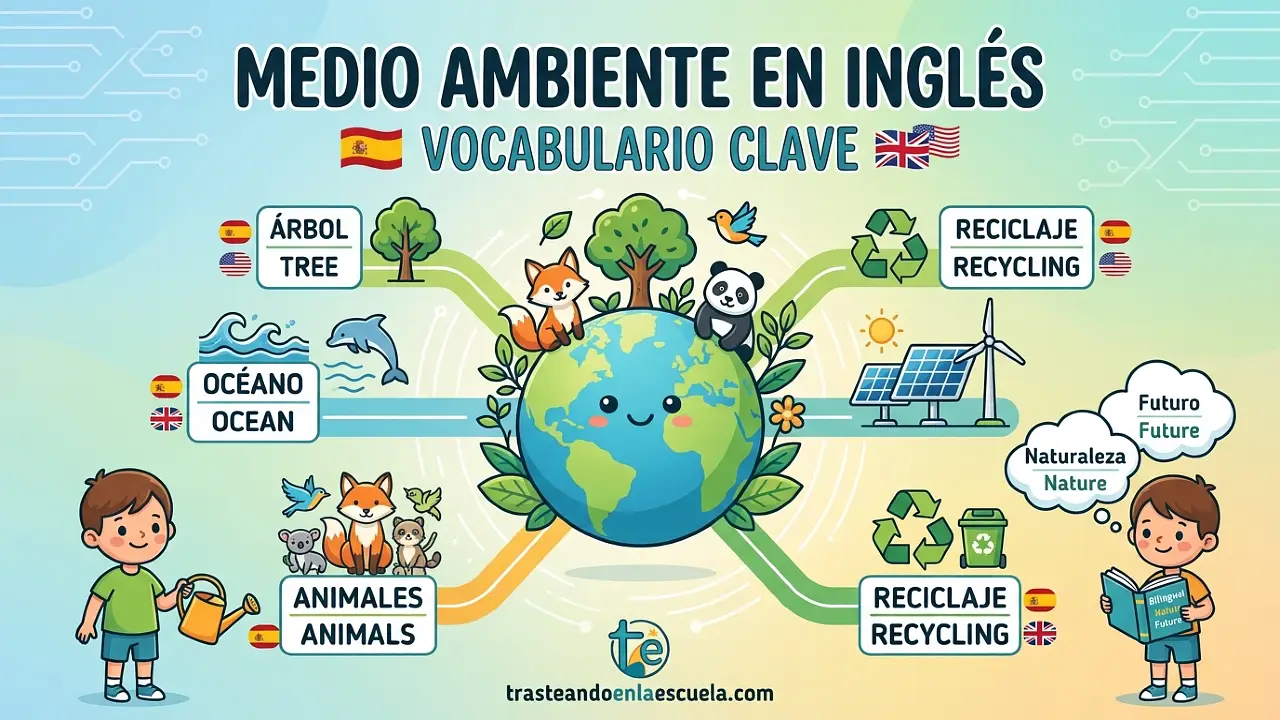
Environment: El medio ambiente en inglés
El cambio climático, la contaminación por plásticos, las energías renovables y la pérdida de biodiversidad son temas recurrentes en las noticias internacionales y, por supuesto, en los exámenes de inglés de nivel avanzado como el IELTS, TOEFL y Cambridge C1 Advanced (CAE). Este vocabulario te permitirá expresar tu opinión con precisión, entender debates complejos y escribir ensayos argumentativos de alta calidad. En este post, no solo aprenderás palabras aisladas, sino collocations (combinaciones de palabras) y frases hechas que utilizan los expertos. Conectamos este tema crucial con el clima global y los desastres naturales, mostrando la relación entre todos estos conceptos.
🎯 En este post aprenderás: Problemas medioambientales clave (climate change, pollution, deforestation), soluciones prácticas (recycling, renewable energy, conservation), verbos de acción para debates (to ban, to preserve, to pollute), expresiones útiles para writing y speaking, y 5 ejercicios prácticos de nivel intermedio-alto.
⚠️ Problemas medioambientales (Environmental issues)
El primer paso para hablar del medio ambiente es conocer los problemas que enfrentamos. Este vocabulario es esencial para la sección de listening de noticias en inglés.
| Problema (Issue) | Inglés (English) | Explicación / Causa (Explanation) |
|---|---|---|
| Cambio climático | Climate change | Long-term shift in global temperatures and weather patterns, mainly due to human activity. |
| Calentamiento global | Global warming | The increase in Earth’s average surface temperature due to greenhouse gases. |
| Contaminación | Pollution | Air pollution, water pollution, soil pollution. Introduction of harmful substances. |
| Deforestación | Deforestation | The action of clearing a wide area of trees (cutting down forests). |
| Pérdida de biodiversidad | Biodiversity loss | The extinction of species (plants and animals) worldwide. |
| Efecto invernadero | Greenhouse effect | Gases (CO2, methane) trap heat in the Earth’s atmosphere. |
| Huella de carbono | Carbon footprint | The amount of carbon dioxide (CO2) released into the atmosphere by an activity. |
| Residuos plásticos | Plastic waste / Pollution | Accumulation of plastic products in the environment, especially oceans. |
| Agotamiento de la capa de ozono | Ozone layer depletion | Thinning of the ozone layer due to CFCs (now banned). |
| Lluvia ácida | Acid rain | Rainfall made acidic by atmospheric pollution (sulfur dioxide). |
♻️ Soluciones y acciones positivas (Solutions & Positive actions)
Vocabulario para hablar de cómo podemos ayudar al planeta y revertir los problemas. Imprescindible para la parte de «suggestions» en los exámenes orales.
- Renewable energy (Energía renovable): Solar power, wind power, hydroelectric power, geothermal energy.
- Recycling (Reciclaje): The process of converting waste into reusable material. «To separate paper, glass, and plastic.»
- Reuse (Reutilizar): Use a product or material again. «Reuse your shopping bags.»
- Reduce (Reducir): Consume less. «Reduce your consumption of meat.»
- Sustainable (Sostenible): Able to be maintained at a certain rate or level without harming the planet. «Sustainable development.»
- Eco-friendly (Ecológico / Amigable con el ambiente): Not harmful to the environment. «Eco-friendly packaging.»
- Composting (Compostaje): Turning organic waste (food scraps) into fertilizer for plants.
- Conservation (Conservación): Protection of natural resources (water, forests, animals).
- Reforestation (Reforestación): Planting trees in an area that was previously forested.
- Carbon offsetting (Compensación de carbono): Compensating for CO2 emissions by funding an equivalent carbon dioxide saving elsewhere.
🗣️ Verbos clave para debates ambientales (Key verbs for debates)
Para los exámenes de Speaking (como el Speaking de Cambridge), necesitas verbos potentes y precisos que demuestren tu nivel.
| Verbo (Verb) | Significado (Meaning) | Ejemplo en contexto (Example) |
|---|---|---|
| To pollute | Contaminar | Factories and cars pollute the air we breathe. |
| To protect | Proteger | We must protect endangered species like the panda. |
| To damage | Dañar | Oil spills damage marine life and coastlines irreversibly. |
| To preserve | Preservar / Conservar | We need to preserve natural habitats for future generations. |
| To waste | Desperdiciar | Don’t waste water. Turn off the tap while brushing your teeth. |
| To ban | Prohibir | Many countries will ban single-use plastic bags. |
| To raise awareness | Concienciar | Documentaries raise awareness about climate change. |
| To tackle / address | Abordar (un problema) | Governments must tackle global warming immediately. |
📢 Expresiones útiles para debates y essays (Useful phrases):
– «We are running out of time.» (Se nos acaba el tiempo).
– «It is our responsibility to…» (Es nuestra responsabilidad…).
– «Governments should take immediate action.» (Los gobiernos deberían actuar de inmediato).
– «The solution lies in…» (La solución reside en…).
– «There is a direct correlation between…» (Hay una correlación directa entre…).
– «If we fail to act, the consequences will be catastrophic.» (Si no actuamos, las consecuencias serán catastróficas).
🧠 5 Ejercicios prácticos (Nivel Intermedio-Alto)
Ejercicio 1: Define el concepto (Define the concept)
Escribe una breve definición en inglés para los siguientes términos.
- CO2
- Greenhouse effect
- Deforestation
- Biodiversity
- Carbon footprint
✅ Ver solución
- Carbon Dioxide. A greenhouse gas released by burning fossil fuels.
- The trapping of the sun’s warmth in the Earth’s lower atmosphere due to greenhouse gases.
- The action of clearing a wide area of trees, usually to use the land for agriculture or urban development.
- The variety of plant and animal life in the world or in a particular habitat.
- The amount of carbon dioxide released into the atmosphere as a result of the activities of a particular person, organization, or community.
Ejercicio 2: Elige la opción correcta (Multiple choice)
- We need to _____ single-use plastics to reduce ocean pollution. (a) waste (b) ban (c) pollute)
- Solar and wind power are types of _____ energy. (a) renewable (b) waste (c) polluted)
- The _____ is getting warmer due to global warming, causing ice caps to melt. (a) planet (b) recycling (c) compost)
- Don’t _____ paper; you can use the other side for notes. (a) preserve (b) waste (c) protect)
- _____ means using less stuff. It’s the first of the three R’s. (a) Reuse (b) Recycle (c) Reduce
✅ Ver solución
- (b) ban
- (a) renewable
- (a) planet
- (b) waste
- (c) Reduce
Ejercicio 3: Completa el texto (Fill in the text)
Completa el siguiente párrafo con las palabras del recuadro: climate change, rising, pollution, renewable, carbon footprint, deforestation.
«_____ is one of the biggest threats facing humanity today. Sea levels are _____ due to melting glaciers. Air _____ affects the health of millions. Furthermore, _____ destroys vital habitats for animals. To reduce our individual _____, we must invest in _____ energy like wind and solar power.»
✅ Ver solución
«Climate change is one of the biggest threats facing humanity today. Sea levels are rising due to melting glaciers. Air pollution affects the health of millions. Furthermore, deforestation destroys vital habitats for animals. To reduce our individual carbon footprint, we must invest in renewable energy like wind and solar power.»
Ejercicio 4: Traduce las frases (Formal translation)
- El gobierno debería prohibir los coches diésel en el centro de la ciudad para reducir la contaminación del aire.
- Reciclar vidrio y papel es una forma efectiva de reducir los residuos en los vertederos (landfills).
- La deforestación en el Amazonas está destruyendo el hábitat de miles de especies.
- Necesitamos preservar los recursos naturales para las futuras generaciones, no explotarlos sin control.
- Mi huella de carbono es alta porque viajo mucho en avión por trabajo. Debería compensarla (offset it).
✅ Ver solución
- The government should ban diesel cars in the city center to reduce air pollution.
- Recycling glass and paper is an effective way to reduce waste in landfills.
- Deforestation in the Amazon is destroying the habitat of thousands of species.
- We need to preserve natural resources for future generations, not exploit them uncontrollably.
- My carbon footprint is high because I travel a lot by plane for work. I should offset it.
Ejercicio 5: Escribe un párrafo de opinión (Opinion paragraph)
Escribe 80-100 palabras respondiendo a esta pregunta: «Is climate change the most serious problem facing the world today, or are there other issues that are equally urgent?» Usa al menos 5 palabras del vocabulario de esta lección (ej: carbon footprint, renewable energy, pollution, government, etc.).
✅ Ver ejemplo de respuesta
«In my opinion, climate change is indeed the most serious problem because it exacerbates all other issues. It causes rising sea levels, extreme weather events, and biodiversity loss. If we don’t reduce our carbon footprint soon, the damage will be irreversible. However, other issues like poverty and inequality are also urgent. The key is that investing in renewable energy and sustainable development can tackle climate change while creating jobs and improving health by reducing pollution. Governments must take action immediately.»
📚 Serie completa: Naturaleza y medio ambiente en inglés
- Weather: el clima en inglés – Conceptos básicos del tiempo atmosférico.
- Landscapes: paisajes en inglés – Los ecosistemas que debemos proteger.
- Plants: plantas y árboles – La flora afectada por el cambio climático.
- Environment: medio ambiente – ¡Estás aquí!
- Natural disasters: desastres naturales – Las consecuencias extremas del cambio climático.






Publicar comentario