Verbs of Movement: verbos de movimiento en inglés para describir acciones
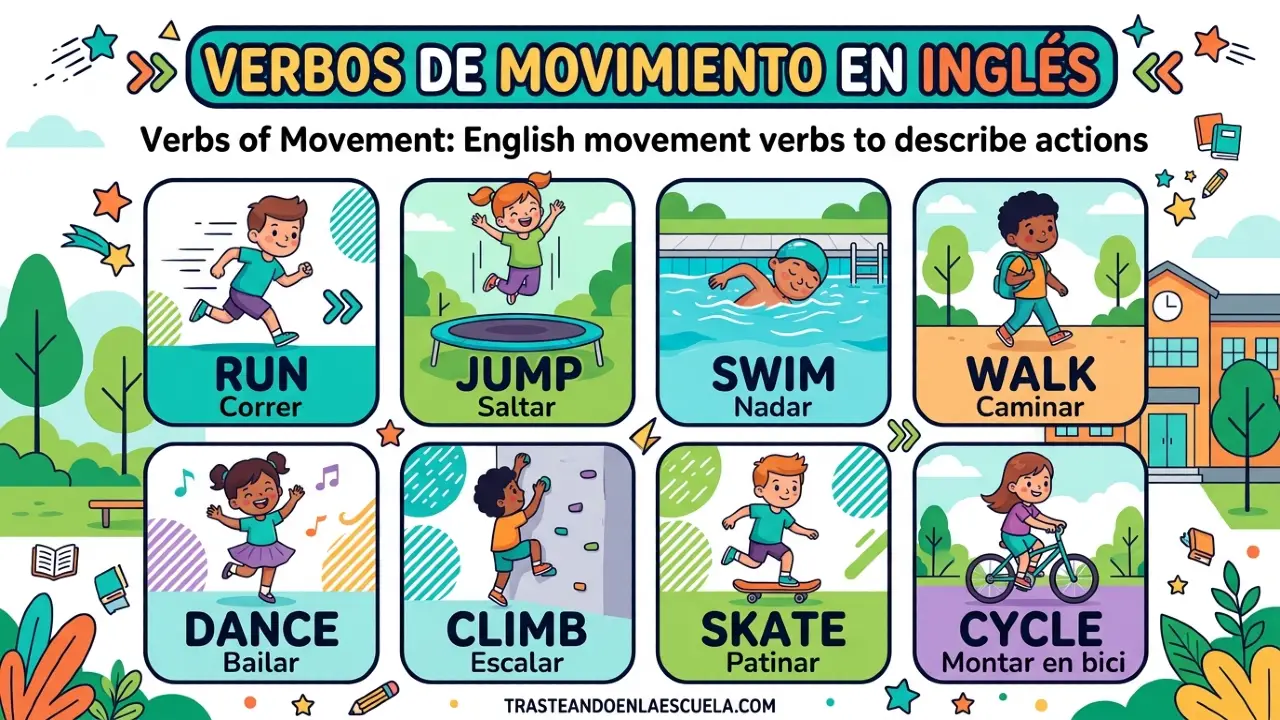
Verbs of Movement: Domina los verbos de movimiento en inglés
¿Alguna vez has querido describir cómo se mueve alguien y solo has podido decir «go»? Caminar, correr, saltar, arrastrarse, deslizarse, cojear… el inglés tiene una riqueza increíble de verbos de movimiento (verbs of movement) que te permitirán expresar con precisión cualquier acción, desde la más cotidiana hasta la más especializada. Ya sea para escribir una historia, dar direcciones, describir una escena de acción o simplemente hablar de tu día a día, dominar estos verbos elevará tu nivel de inglés a otro nivel.
🎯 En este post aprenderás: Más de 50 verbos de movimiento en inglés organizados por categorías (andar y correr, saltos, movimientos con las manos, desplazamientos en agua y aire, movimientos de animales), diferencias entre verbos similares (walk vs. stroll vs. march, run vs. sprint vs. jog), ejemplos en contexto, expresiones idiomáticas relacionadas y 5 ejercicios prácticos para consolidar tu aprendizaje.
🔍 ¿Por qué son importantes los verbos de movimiento?
📝 Dale vida a tus descripciones
Los verbos de movimiento son esenciales para añadir dinamismo y precisión a tu inglés. No es lo mismo decir «He went to the store» que «He rushed to the store» o «He stumbled to the store». Cada verbo pinta una imagen diferente en la mente del oyente:
- En narrativa y escritura creativa: «The soldier crawled through the mud while bullets whizzed past his head.» (El soldado se arrastraba por el barro mientras las balas silbaban junto a su cabeza.)
- En instrucciones y deportes: «Lunge forward with your right leg, then twist your torso.» (Lánzate hacia adelante con la pierna derecha, luego gira el torso.)
- En conversaciones cotidianas: «I was strolling through the park when I saw a dog dart across the path.» (Estaba paseando por el parque cuando vi a un perro cruzar el camino de un tirón.)
- Para dar direcciones: «Head straight for two blocks, then turn left and walk until you see the bank.» (Dirígete recto dos manzanas, luego gira a la izquierda y camina hasta que veas el banco.)
💡 Dato curioso: El inglés tiene más de 200 verbos relacionados con el movimiento. En este post cubriremos los más útiles y comunes para que puedas usarlos desde ya.
🎬 La analogía del director de cine
Imagina que eres el director de una película de acción. Necesitas dar instrucciones precisas a tus actores y al equipo de efectos especiales:
- No dices «move», dices «sprint» (correr a máxima velocidad) o «tiptoe» (caminar de puntillas).
- No dices «go down», dices «plummet» (caer en picado) o «descend» (descender).
- No dices «go up», dices «climb» (trepar) o «leap» (saltar).
Cada verbo de movimiento es como una instrucción de cámara o una nota para el actor. ¡Cuanto más preciso seas, mejor será la escena que describas!
📋 Verbos de movimiento organizados por categorías
🚶 1. Walking and Running (Caminar y correr)
He walks to work every day.
They strolled along the beach at sunset.
He sauntered into the room as if he owned the place.
The soldiers marched in perfect formation.
She paced back and forth while waiting for news.
He staggered out of the bar after drinking too much.
I stumbled over a rock on the path.
He limped home after twisting his ankle.
She tiptoed into the room to avoid waking the baby.
The cat crept toward the bird.
I rushed to catch the train.
He dashed across the street to avoid the rain.
The athlete sprinted toward the finish line.
I jog for 30 minutes every morning.
She runs three miles every day.
The children raced to the playground.
📝 Diferencia clave: Walk es neutro. Stroll implica tranquilidad y placer. March implica disciplina y firmeza. Stagger implica inestabilidad. Run es neutro. Sprint es máxima velocidad. Jog es ritmo suave.
🦘 2. Jumping and Falling (Saltar y caer)
The cat jumped onto the table.
The dancer leaped across the stage.
The rabbit hopped through the grass.
The children skipped down the street holding hands.
The ball bounced high into the air.
He dove into the pool.
The temperature plunged below zero.
Be careful not to fall off the ladder.
She tripped over the cable and fell.
He collapsed from exhaustion after the marathon.
The boy tumbled down the hill.
📝 Diferencia clave: Jump es genérico. Leap implica distancia o altura. Hop es un salto pequeño o a una pierna. Skip implica alegría y un patrón rítmico. Fall es genérico. Collapse implica debilidad o agotamiento.
🖐️ 3. Movements with Hands and Upper Body (Movimientos con manos y parte superior)
She waved goodbye from the window.
He pointed at the map.
She grabbed my arm to stop me.
He reached for the book on the top shelf.
Push the door, don’t pull it.
She pulled the drawer open.
Can you lift this box? It’s heavy.
He carried the suitcase upstairs.
She threw the ball to the dog.
He caught the ball with one hand.
I dropped my keys on the floor.
They shook hands before the meeting.
The audience clapped enthusiastically.
He stretched his arms above his head.
🏊 4. Movements in Water and Air (Movimientos en agua y aire)
She swims in the ocean every summer.
The leaves floated on the water.
The rock sank to the bottom of the lake.
He dove to explore the coral reef.
We paddled the canoe across the lake.
Birds fly south for the winter.
The eagle soared above the mountains.
The paper airplane glided across the room.
Butterflies fluttered among the flowers.
The helicopter hovered above the building.
🐍 5. Animal Movements (Movimientos de animales)
The baby crawls across the floor.
The cat crept toward the mouse.
The snake slithered through the grass.
The penguins waddled across the ice.
The horse galloped across the field.
The horse trotted along the trail.
The frog hopped onto a lily pad.
The mouse scurried under the fridge.
The cat pounced on the toy mouse.
🏂 6. Movements on Surfaces (Movimientos sobre superficies)
The children slid down the slide.
He slipped on the wet floor.
The ball rolled down the hill.
The ice skater spun gracefully.
She twisted her body to reach the remote.
Turn left at the next street.
He bent down to pick up the coin.
She knelt to tie her shoelaces.
The soldier crouched behind the wall.
He squatted to lift the heavy box properly.
📊 Tabla comparativa: Verbos similares con diferencias clave
| Verbo 1 | Verbo 2 | Diferencia | Ejemplo |
|---|---|---|---|
| Walk | Stroll | Stroll es más lento y placentero. | I walk to work (neutral) / I strolled through the park (agradable). |
| Run | Sprint | Sprint es la máxima velocidad en corta distancia. | He runs 5km / He sprinted the last 100 meters. |
| Jump | Leap | Leap implica un salto más grande o heroico. | The frog jumped / The hero leaped over the wall. |
| Fall | Collapse | Collapse implica agotamiento o debilidad. | He fell off the bike / He collapsed from exhaustion. |
| Push | Shove | Shove es más brusco y violento. | Push the door gently / He shoved me out of the way. |
| Throw | Toss | Toss es un lanzamiento suave y corto. | Throw the ball hard / Toss the salad gently. |
🎭 Expresiones idiomáticas con verbos de movimiento (Movement idioms)
🏃 Con caminar y correr
- To walk on eggshells: Andar con pies de plomo (tener cuidado de no ofender). «I have to walk on eggshells around my boss.»
- To run out of steam: Quedarse sin energía. «I ran out of steam halfway through the marathon.»
- To jump the gun: Adelantarse, precipitarse. «He jumped the gun and announced the news too early.»
🤲 Con las manos
- To lend a hand: Echar una mano, ayudar. «Can you lend me a hand with this box?»
- To catch someone’s eye: Llamar la atención de alguien. «A bright red car caught my eye.»
- To throw in the towel: Rendirse, tirar la toalla. «After three failures, he threw in the towel.»
🌊 Con agua y caídas
- To sink or swim: Arreglárselas solo o fracasar (supervivencia). «In this job, it’s sink or swim.»
- To fall flat on your face: Fracasar estrepitosamente. «His presentation fell flat on its face.»
- To dive into something: Meterse de lleno en algo. «She dove into her new project with enthusiasm.»
🧪 5 Ejercicios prácticos para dominar los verbos de movimiento
Ejercicio 1: Elige el verbo correcto según el contexto
- The baby tried to walk / crawl before he could stand. (Un bebé se arrastra antes de andar)
- The athlete jogged / sprinted the last 100 meters to break the record. (Máxima velocidad)
- She tiptoed / marched into the room so as not to wake anyone. (Silencio y cuidado)
- The snake waddled / slithered through the tall grass. (Movimiento serpentino)
- He was so tired that he collapsed / jumped onto the sofa. (Agotamiento)
✅ Ver solución
- Crawl (gatear / arrastrarse)
- Sprinted (corrió a máxima velocidad)
- Tiptoed (caminó de puntillas)
- Slithered (se deslizó como serpiente)
- Collapsed (se desplomó)
Ejercicio 2: Completa las oraciones con el verbo de movimiento adecuado
Verbos disponibles: staggered, hopped, glided, scurried, plunged
- The rabbit _________ across the garden.
- The skater _________ gracefully across the ice rink.
- He _________ out of the bar after drinking ten beers.
- The mouse _________ under the cabinet when it saw the cat.
- The temperature _________ below zero overnight.
✅ Ver solución
- Hopped (saltó como conejo)
- Glided (se deslizó)
- Staggered (salió tambaleándose)
- Scurried (corrió rápidamente con pasos pequeños)
- Plunged (se sumergió / cayó bruscamente)
Ejercicio 3: ¿Verdadero o falso? (True or False)
- «To saunter» means to walk very quickly and nervously. (True / False)
- «To limp» is used when someone has an injured leg or foot. (True / False)
- «To hover» means to fly very high and fast. (True / False)
- «To waddle» is the typical walk of a penguin or duck. (True / False)
- «To toss» is a more violent and aggressive way to throw something. (True / False)
✅ Ver solución
- False (Saunter es caminar despacio y con despreocupación).
- True (Cojear, por lesión).
- False (Hover es cernerse, quedarse suspendido).
- True (Caminar como pato, de lado a lado).
- False (Toss es un lanzamiento suave, no violento).
Ejercicio 4: Traduce las siguientes frases al inglés
- El ladrón entró sigilosamente en la casa mientras todos dormían.
- Los niños saltaban la comba y reían en el parque.
- El caballo galopaba a través del campo abierto.
- Me agaché para atarme los cordones y luego seguí caminando.
- El avión volaba alto mientras las nubes flotaban debajo.
✅ Ver solución
- The thief crept into the house while everyone was sleeping.
- The children were skipping rope and laughing in the park.
- The horse galloped across the open field.
- I bent down to tie my shoelaces and then kept walking.
- The plane was flying high while the clouds floated below.
Ejercicio 5: Crea una mini-historia usando verbos de movimiento
Escribe un pequeño párrafo (6-8 frases) describiendo una escena de acción o un viaje. Debes usar al menos 8 verbos de movimiento diferentes de este post. Puede ser una persecución, un viaje, una escena deportiva o lo que prefieras.
✅ Ver ejemplo de respuesta
Ejemplo (A chase scene): «The spy crept through the dark alley, trying not to make a sound. Suddenly, a guard appeared, so he ducked behind a dumpster. When the guard strolled past, the spy darted across the street. He sprinted toward the waiting car, but his pursuers were close. He leaped over a fence and crawled under a truck. Finally, he dove into the passenger seat as the car raced away into the night.»
🌍 Aplicaciones en la vida real
📝 Escritura creativa y narrativa
- Novelas y cuentos: «She stumbled through the forest, branches whipping at her face as she raced away from the danger.»
- Guión de cine: «The hero leaps from the rooftop, grabs the ledge, and swings through the window.»
- Poesía: «The leaves flutter and fall, dancing on the autumn breeze.»
🗣️ Conversaciones y direcciones
- Dar indicaciones precisas: «Head straight for two blocks, then turn right. You’ll see the bank. Don’t rush, it’s only a 5-minute walk.»
- Describir cómo te sientes: «I’m so tired I can barely crawl into bed.» «I was so happy I could skip down the street.»
🎮 Videojuegos y deportes
- Instrucciones de juego: «Press X to jump, O to crouch, and square to roll.»
- Entrenamiento deportivo: «Lunge forward, squat low, then push off and spring into the air.»
- Narraciones deportivas: «The player dribbles past two defenders, sprints toward the goal, and leaps to head the ball into the net!»
📖 Glosario visual rápido (Español ↔ Inglés)
📚 Serie completa: El cuerpo humano en inglés
¡Has completado el CLUSTER 26! Aquí tienes todos los posts de la serie:
- Body parts: partes del cuerpo – El vocabulario general del cuerpo humano.
- Face: partes de la cara – Vocabulario detallado de la cara.
- Internal organs: órganos internos – Vocabulario médico avanzado.
- Senses: los 5 sentidos – Cómo percibimos el mundo.
- Verbs of movement: moverse – ¡Estás aquí! Verbos para describir acciones y movimiento corporal.
🏆 Reto final: La coreografía de verbos
Con un amigo o familiar, diseñen una secuencia de movimientos simple (como una coreografía o una rutina de ejercicio). Cada persona debe describir lo que hace usando un verbo de movimiento diferente. Por ejemplo: «First, I crouch low. Then, I leap forward. Next, I spin around and clap my hands. Finally, I kneel down and stretch my arms.» ¡Graben la secuencia y compártanla con otros estudiantes para que adivinen los verbos!
🎉 ¡Felicidades por completar el CLUSTER 26 sobre el cuerpo humano! Ahora tienes un vocabulario completo para describir el cuerpo, la cara, los órganos internos, los sentidos y el movimiento. ¡Sigue practicando y verás cómo tu inglés mejora día a día!








Publicar comentario