Ejercicios de plurales en inglés: práctica completa con soluciones
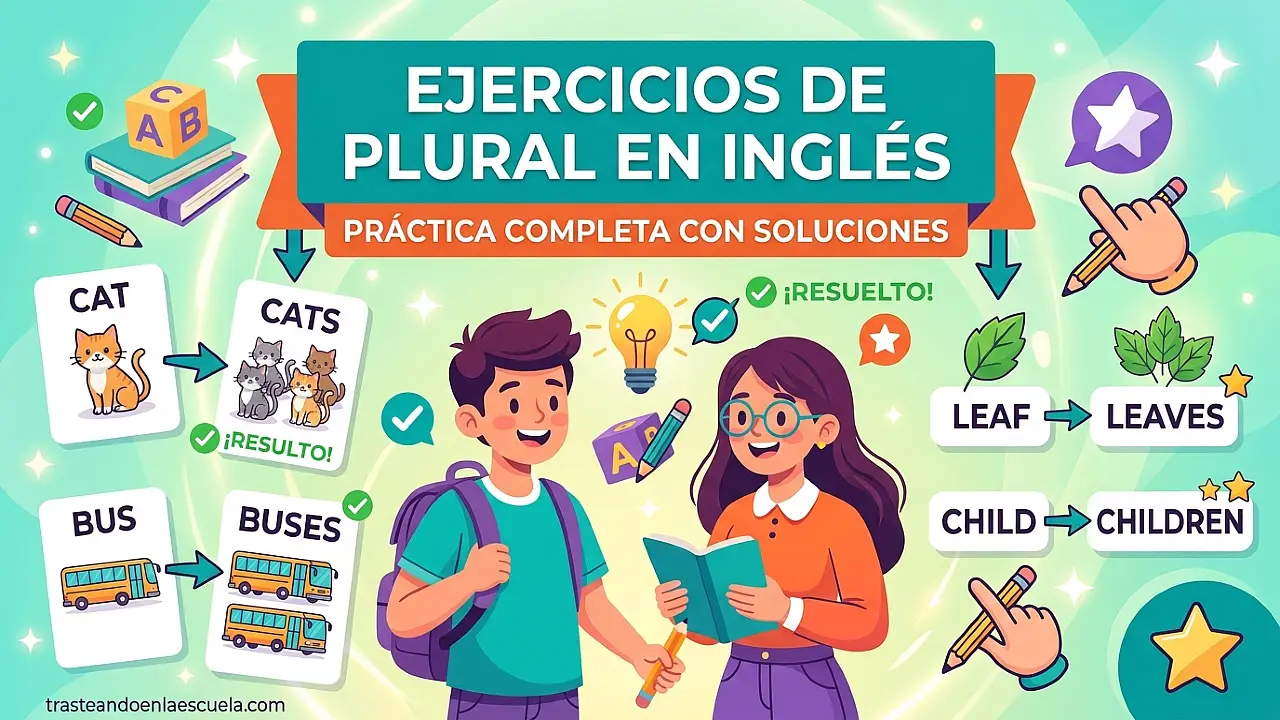
Ejercicios de plurales en inglés: La práctica definitiva
Después de aprender las reglas del plural regular, los plurales irregulares, las palabras invariables y los plurales extranjeros, ha llegado el momento de ponerlo todo en práctica. Este post reúne más de 50 ejercicios de todos los tipos de plurales, organizados por nivel y con soluciones detalladas. La práctica es la clave para dominar los plurales en inglés.
🎯 En este post encontrarás: Ejercicios de completar huecos, elegir la opción correcta, corregir errores, traducción, producción escrita y práctica oral. Todo organizado en 3 niveles: básico, intermedio y avanzado, con soluciones completas.
📊 Autoevaluación inicial: ¿Cuál es tu nivel?
🧪 Test rápido de 10 preguntas
Antes de empezar con los ejercicios, descubre tu nivel actual. Escribe el plural de estas 10 palabras:
- book
- child
- sheep
- crisis
- wife
- box
- phenomenon
- baby
- aircraft
- mouse
✅ Ver respuestas y diagnóstico
- book → books
- child → children
- sheep → sheep
- crisis → crises
- wife → wives
- box → boxes
- phenomenon → phenomena
- baby → babies
- aircraft → aircraft
- mouse → mice
📊 Diagnóstico:
- 8-10 correctas: ¡Excelente! Tienes un nivel avanzado. Te recomendamos enfocarte en los ejercicios de nivel avanzado para pulir detalles.
- 5-7 correctas: Buen nivel intermedio. Repasa los posts de la serie que más te hayan costado y practica con los ejercicios de nivel intermedio.
- 0-4 correctas: Estás empezando. Comienza por los ejercicios de nivel básico y repasa las reglas del plural regular antes de avanzar.
🟢 NIVEL BÁSICO: Plurales regulares
Ejercicio 1: Plural regular – añade -s BÁSICO
Forma el plural de estas palabras añadiendo -s:
- dog → __________
- table → __________
- car → __________
- house → __________
- computer → __________
- apple → __________
- street → __________
- cup → __________
- chair → __________
- door → __________
- pen → __________
- school → __________
✅ Ver solución
- dog → dogs
- table → tables
- car → cars
- house → houses
- computer → computers
- apple → apples
- street → streets
- cup → cups
- chair → chairs
- door → doors
- pen → pens
- school → schools
Ejercicio 2: Plural con -es BÁSICO
Forma el plural de estas palabras añadiendo -es. Todas terminan en -s, -ss, -sh, -ch, -x o -z:
- bus → __________
- class → __________
- dish → __________
- watch → __________
- box → __________
- church → __________
- brush → __________
- fox → __________
- glass → __________
- sandwich → __________
- beach → __________
- quiz → __________
✅ Ver solución
- bus → buses
- class → classes
- dish → dishes
- watch → watches
- box → boxes
- church → churches
- brush → brushes
- fox → foxes
- glass → glasses
- sandwich → sandwiches
- beach → beaches
- quiz → quizzes (se duplica la z)
Ejercicio 3: Consonante + y → -ies BÁSICO
Forma el plural cambiando -y por -ies. Cuidado: algunas solo añaden -s (vocal + y):
- baby → __________
- city → __________
- boy → __________
- party → __________
- day → __________
- family → __________
- key → __________
- country → __________
- toy → __________
- story → __________
- monkey → __________
- lady → __________
✅ Ver solución
- baby → babies
- city → cities
- boy → boys (vocal + y → solo +s)
- party → parties
- day → days (vocal + y → solo +s)
- family → families
- key → keys (vocal + y → solo +s)
- country → countries
- toy → toys (vocal + y → solo +s)
- story → stories
- monkey → monkeys (vocal + y → solo +s)
- lady → ladies
Ejercicio 4: Mezcla de reglas regulares BÁSICO
Forma el plural de estas palabras aplicando la regla correcta (-s, -es, o -ies):
- book
- box
- baby
- church
- day
- bus
- family
- beach
- key
- watch
- city
- class
- boy
- dish
- party
✅ Ver solución
- book → books (+s)
- box → boxes (+es: termina en -x)
- baby → babies (-ies: consonante + y)
- church → churches (+es: termina en -ch)
- day → days (+s: vocal + y)
- bus → buses (+es: termina en -s)
- family → families (-ies: consonante + y)
- beach → beaches (+es: termina en -ch)
- key → keys (+s: vocal + y)
- watch → watches (+es: termina en -ch)
- city → cities (-ies: consonante + y)
- class → classes (+es: termina en -ss)
- boy → boys (+s: vocal + y)
- dish → dishes (+es: termina en -sh)
- party → parties (-ies: consonante + y)
🟡 NIVEL INTERMEDIO: Irregulares, invariables y mixtos
Ejercicio 5: Plurales irregulares comunes INTERMEDIO
Escribe el plural irregular de estas palabras. Ninguna sigue la regla regular de añadir -s, -es o -ies:
- man → __________
- woman → __________
- child → __________
- foot → __________
- tooth → __________
- mouse → __________
- goose → __________
- ox → __________
- person → __________
- die → __________
- knife → __________
- leaf → __________
- wolf → __________
- thief → __________
- life → __________
✅ Ver solución
- man → men
- woman → women
- child → children
- foot → feet
- tooth → teeth
- mouse → mice
- goose → geese
- ox → oxen
- person → people
- die → dice
- knife → knives
- leaf → leaves
- wolf → wolves
- thief → thieves
- life → lives
Ejercicio 6: Plurales invariables (singular = plural) INTERMEDIO
Escribe el plural de estas palabras. Recuerda: todas son invariables (misma forma en singular y plural):
- sheep → __________
- deer → __________
- fish → __________ (plural normal)
- species → __________
- series → __________
- aircraft → __________
- salmon → __________
- means → __________
- offspring → __________
- spacecraft → __________
- trout → __________
- headquarters → __________
✅ Ver solución
- sheep → sheep
- deer → deer
- fish → fish
- species → species
- series → series
- aircraft → aircraft
- salmon → salmon
- means → means
- offspring → offspring
- spacecraft → spacecraft
- trout → trout
- headquarters → headquarters
Explicación: Todas estas palabras son invariables. El contexto (artículo, número, verbo) indica si es singular o plural.
Ejercicio 7: Plurales de origen latino y griego INTERMEDIO
Escribe el plural original (latino o griego) de estas palabras:
- crisis → __________
- datum → __________
- phenomenon → __________
- cactus → __________
- bacterium → __________
- analysis → __________
- criterion → __________
- fungus → __________
- thesis → __________
- stimulus → __________
- curriculum → __________
- hypothesis → __________
- vertebra → __________
- nucleus → __________
- medium → __________
✅ Ver solución
- crisis → crises (griego: -is → -es)
- datum → data (latín: -um → -a)
- phenomenon → phenomena (griego: -on → -a)
- cactus → cacti (latín: -us → -i)
- bacterium → bacteria (latín: -um → -a)
- analysis → analyses (griego: -is → -es)
- criterion → criteria (griego: -on → -a)
- fungus → fungi (latín: -us → -i)
- thesis → theses (griego: -is → -es)
- stimulus → stimuli (latín: -us → -i)
- curriculum → curricula (latín: -um → -a)
- hypothesis → hypotheses (griego: -is → -es)
- vertebra → vertebrae (latín: -a → -ae)
- nucleus → nuclei (latín: -us → -i)
- medium → media (latín: -um → -a)
Ejercicio 8: Elige la opción correcta INTERMEDIO
Selecciona la opción correcta para completar cada oración:
- I have two __________. (child / childs / children)
- The __________ are playing in the garden. (baby / babys / babies)
- We saw several __________ in the forest. (deer / deers / deeres)
- She needs to buy new __________ for the kitchen. (dish / dishs / dishes)
- How many __________ are in the tank? (fish / fishes / fishs)
- The __________ of this disease are alarming. (diagnosis / diagnoses / diagnosises)
- He lost both __________ in the accident. (tooth / tooths / teeth)
- Several __________ were parked at the airport. (aircraft / aircrafts / aircraftes)
- My feet are size 10, but his __________ are size 12. (foot / foots / feet)
- The __________ are kept in a separate cage. (mouse / mouses / mice)
- All the __________ in the company have laptops. (woman / womans / women)
- The security __________ were called immediately. (guard / guards / guardes)
✅ Ver solución
- I have two children.
- The babies are playing in the garden.
- We saw several deer in the forest.
- She needs to buy new dishes for the kitchen.
- How many fish are in the tank?
- The diagnoses of this disease are alarming.
- He lost both teeth in the accident.
- Several aircraft were parked at the airport.
- My feet are size 10, but his feet are size 12.
- The mice are kept in a separate cage.
- All the women in the company have laptops.
- The security guards were called immediately.
🔴 NIVEL AVANZADO: Errores, traducción y producción
Ejercicio 9: Corrige los errores AVANZADO
Cada oración contiene un error relacionado con los plurales. Encuéntralo y corrígelo:
- There are three sheeps in the field and two deers near the forest.
- The childs are playing with their new toys in the garden.
- She studied many phenomenons during her research project.
- I need to buy some potatos and tomatos for dinner.
- The crisis in the Middle East are getting worse every day.
- He caught five salmons and two trouts in the river.
- The womans in the office organized a party for their boss.
- These analysis show that the bacterias are spreading rapidly.
- The thiefs broke into three houses last night.
- She has two masters degrees: one in Mathematics and another in Physics.
- How many aircrafts does the airline own?
- The datas from the experiment were inconclusive.
- My foots hurt after running the marathon.
- The paparazzis were waiting outside the restaurant for hours.
- Several important crisis were discussed at the summit.
✅ Ver solución
- three sheep and two deer (invariables)
- The children are playing (child → children)
- many phenomena (phenomenon → phenomena)
- some potatoes and tomatoes (-o precedida de consonante → +es)
- The crises in the Middle East are getting worse (crisis → crises; «are» está bien porque es plural)
- five salmon and two trout (invariables)
- The women in the office (woman → women)
- These analyses show that the bacteria are spreading (analysis → analyses; bacterium → bacteria)
- The thieves broke in (thief → thieves)
- two master’s degrees (posesivo; «master’s» es correcto así)
- How many aircraft (invariable)
- The data from the experiment (datum → data; «data» como plural formal usa «were», que está bien)
- My feet hurt (foot → feet)
- The paparazzi were waiting (paparazzo → paparazzi, ya es plural)
- Several important crises were discussed (crisis → crises)
Ejercicio 10: Completa las oraciones con el plural correcto AVANZADO
Completa con el plural adecuado de la palabra entre paréntesis. Atención al contexto (académico, cotidiano, formal):
- The research team presented their __________ (analysis) at the conference.
- I bought two __________ (loaf) of bread at the bakery.
- The __________ (alumnus) of Harvard often donate to the university.
- Several endangered __________ (species) are protected in this reserve.
- The museum has a collection of ancient Greek __________ (codex).
- She has three __________ (sister-in-law) who live in different __________ (city).
- The __________ (criterion) for admission are very strict.
- We observed several interesting __________ (phenomenon) during the eclipse.
- The __________ (thief) were caught on camera by the security __________ (guard).
- These mathematical __________ (formula) are difficult to memorize.
✅ Ver solución
- their analyses (análisis, contexto académico)
- two loaves of bread (loaf → loaves)
- The alumni of Harvard (alumnus → alumni, masculino plural)
- Several endangered species (species es invariable)
- ancient Greek codices (codex → codices)
- three sisters-in-law in different cities
- The criteria for admission (criterion → criteria, plural)
- several interesting phenomena (phenomenon → phenomena)
- The thieves by the security guards
- These mathematical formulae or formulas (ambas correctas; «formulae» más formal)
Ejercicio 11: Traducción de oraciones AVANZADO
Traduce al inglés prestando especial atención a los plurales:
- Hay tres ovejas y cinco ciervos en el parque nacional.
- Los niños están jugando con los ratones del laboratorio.
- Los análisis de datos muestran varios fenómenos interesantes.
- Compré dos docenas de huevos, tres tomates y cuatro hogazas de pan.
- Las crisis económicas afectan a millones de personas en todo el mundo.
- Los paparazzi siguieron a la actriz por todo el aeropuerto.
- Las mujeres del comité presentaron sus tesis doctorales.
- Hay varias especies de peces en este lago, incluyendo truchas y salmones.
- Los estímulos visuales activan diferentes núcleos cerebrales.
- Mis pies me duelen y me faltan dos dientes desde el accidente.
✅ Ver solución
- There are three sheep and five deer in the national park.
- The children are playing with the lab mice.
- The data analyses show several interesting phenomena.
- I bought two dozen eggs, three tomatoes, and four loaves of bread.
- Economic crises affect millions of people worldwide.
- The paparazzi followed the actress throughout the airport.
- The women on the committee presented their doctoral theses.
- There are several species of fish in this lake, including trout and salmon.
- Visual stimuli activate different brain nuclei.
- My feet hurt and I’m missing two teeth since the accident.
Ejercicio 12: Dictado de plurales AVANZADO
Pide a alguien que te lea estas palabras en singular. Tú debes escribir el plural correcto. Si no tienes a nadie, tapa la columna del plural e intenta escribirlo:
| Singular (lee esto) | Plural (escribe esto) | Singular (lee esto) | Plural (escribe esto) |
|---|---|---|---|
| baby | babies | wife | wives |
| box | boxes | child | children |
| day | days | mouse | mice |
| bus | buses | foot | feet |
| party | parties | sheep | sheep |
| church | churches | crisis | crises |
| watch | watches | datum | data |
| dish | dishes | phenomenon | phenomena |
| key | keys | criterion | criteria |
| city | cities | analysis | analyses |
| knife | knives | aircraft | aircraft |
| leaf | leaves | species | species |
| man | men | alumnus | alumni |
| woman | women | bacterium | bacteria |
| tooth | teeth | thesis | theses |
🗣️ Ejercicios de producción oral y escrita
🎤 Ejercicio 13: Speaking practice AVANZADO
Grábate respondiendo a estas preguntas. Usa al menos 3 plurales diferentes en cada respuesta. Luego escúchate y verifica que los has usado correctamente:
- Describe what you can see from your window right now. (Describe lo que ves desde tu ventana ahora mismo.)
- Talk about your family. How many brothers, sisters, or children do you have? (Habla de tu familia.)
- What did you buy the last time you went to the supermarket? (¿Qué compraste la última vez que fuiste al supermercado?)
- Describe a typical day at your workplace or school. (Describe un día típico en tu trabajo o escuela.)
- What animals have you seen in the wild or at a zoo? (¿Qué animales has visto en la naturaleza o en un zoo?)
✅ Ver ejemplos de respuestas
- «From my window, I can see three tall trees, several houses with red roofs, and some children playing in the street. There are also two dogs and a few birds.»
- «I have two sisters and three brothers, so we are six children in total. Both my sisters are married and have babies. The women in my family are all very strong.»
- «I bought five apples, two loaves of bread, three tomatoes, a dozen eggs, and some fish for dinner. The dishes I plan to make require many fresh ingredients.»
- «At my office, there are twenty desks and several computers. The women and men work together on different projects. We have three meetings every day.»
- «At the zoo, I saw two deer, several sheep, and hundreds of different species of fish. The most impressive were the wolves and the geese.»
✍️ Ejercicio 14: Writing practice AVANZADO
Escribe un texto de 100-150 palabras sobre UNO de estos temas. Debes incluir al menos:
- 3 plurales regulares con -s
- 2 plurales regulares con -es
- 2 plurales regulares con -ies
- 2 plurales irregulares
- 1 plural invariable
- 1 plural de origen latino o griego
Temas (elige uno):
- Un día en el zoo
- Mi última visita al supermercado
- Mis planes para las próximas vacaciones
✅ Ver ejemplo de texto
Tema: Un día en el zoo
«Last weekend, I visited the zoo with my two children. We saw so many amazing animals! The first exhibit had three large deer and several sheep in a big field. My children loved watching the wolves, which were very active. We then went to the aquarium, where there were hundreds of different species of fish. I counted at least ten different varieties. The most interesting part was when we watched the zookeepers feed the geese. We took many photos with our phones. For lunch, we ate sandwiches and chips. The new conservation exhibit displayed fascinating data about endangered species. It was a day full of discoveries!»
Análisis:
-s: animals, varieties, photos, phones
-es: sandwiches, dishes (no usado), churches (no usado) → usemos «lunches» en lugar de «lunch»
-ies: discoveries, varieties (también -ies)
Irregulares: children, wolves, geese
Invariable: deer, sheep, fish, species
Latino/griego: data, species
🏆 Ejercicio final: Test completo de 25 preguntas
Ejercicio 15: Test final de plurales AVANZADO
Escribe el plural de las siguientes 25 palabras. Cubre todos los tipos de plurales estudiados en la serie:
- car
- watch
- baby
- man
- sheep
- crisis
- knife
- box
- child
- datum
- day
- foot
- species
- phenomenon
- wife
- bus
- mouse
- aircraft
- analysis
- city
- tooth
- deer
- church
- criterion
- person
✅ Ver solución del test final
- car → cars (regular: +s)
- watch → watches (regular: +es, termina en -ch)
- baby → babies (regular: consonante + y → -ies)
- man → men (irregular: cambio vocálico)
- sheep → sheep (invariable: singular = plural)
- crisis → crises (griego: -is → -es)
- knife → knives (irregular: -fe → -ves)
- box → boxes (regular: +es, termina en -x)
- child → children (irregular: terminación -ren)
- datum → data (latín: -um → -a)
- day → days (regular: vocal + y → +s)
- foot → feet (irregular: cambio vocálico)
- species → species (invariable: singular = plural)
- phenomenon → phenomena (griego: -on → -a)
- wife → wives (irregular: -fe → -ves)
- bus → buses (regular: +es, termina en -s)
- mouse → mice (irregular: -ouse → -ice)
- aircraft → aircraft (invariable: singular = plural)
- analysis → analyses (griego: -is → -es)
- city → cities (regular: consonante + y → -ies)
- tooth → teeth (irregular: cambio vocálico)
- deer → deer (invariable: singular = plural)
- church → churches (regular: +es, termina en -ch)
- criterion → criteria (griego: -on → -a)
- person → people (irregular: caso único)
📊 Resultado del test final
22-25 correctas: ¡Excelente! Dominas los plurales en inglés a nivel experto.
16-21 correctas: Muy buen nivel. Repasa los tipos que hayas fallado.
10-15 correctas: Buen progreso. Te recomendamos revisar los posts de la serie.
0-9 correctas: Sigue practicando. Vuelve a los ejercicios de nivel básico.
📖 Resumen de recursos y enlaces
📚 Serie completa: Plurales en inglés
Repasa cualquiera de los posts de la serie para reforzar los conceptos:
- Plural regular: reglas -s, -es, -ies – Las reglas básicas con pronunciación.
- Plural irregular: lista completa – Más de 100 plurales irregulares en 7 patrones.
- Plurales invariables: sheep, fish – Palabras que no cambian en plural.
- Plurales de palabras extranjeras – Latinismos, helenismos y préstamos.
- Ejercicios de plurales – ¡Estás aquí! Práctica completa de todos los tipos.
También te pueden interesar otros recursos de gramática:
- Sustantivos contables e incontables en inglés – Aprende qué sustantivos pueden llevar plural.
- Artículos a, an, the en inglés – Cómo usar los artículos con singulares y plurales.
- Concordancia sujeto-verbo en inglés – Cómo conjugar el verbo con sujetos en plural.
- Pronunciación de la -s final en inglés – /s/, /z/, /ɪz/ explicados en detalle.
🏆 Plan de práctica continua: Mantén tus conocimientos frescos
Para no olvidar lo aprendido, incorpora estos hábitos a tu rutina de estudio de inglés:
- Diariamente: Cuando leas en inglés, señala mentalmente todos los plurales que encuentres. ¿Son regulares o irregulares? ¿Siguen algún patrón?
- Semanalmente: Elige un patrón de plurales (ej. -is→-es, -um→-a, invariables) y escribe 5 oraciones originales usándolo.
- Mensualmente: Vuelve a hacer el test de 25 preguntas de este post y comprueba tu progreso. ¿Has mejorado desde la última vez?
- En conversación: Cuando hables en inglés, presta especial atención a los plurales. Si cometes un error, corrígete inmediatamente. La autocorrección es una de las mejores herramientas de aprendizaje.
🔑 Claves para recordar
- Plural regular: -s (la mayoría), -es (sibilantes), -ies (consonante + y).
- Plural irregular: Cambio vocálico (man→men), -en (child→children), -ves (wife→wives), casos únicos (person→people).
- Plural invariable: Misma forma (sheep, deer, fish, species, aircraft).
- Plural extranjero: Latín (-us→-i, -um→-a, -a→-ae), griego (-is→-es, -on→-a).
- Contexto: Artículos, números, demostrativos y verbos indican si es singular o plural.











Publicar comentario