Pasiva de doble objeto: give, send, show
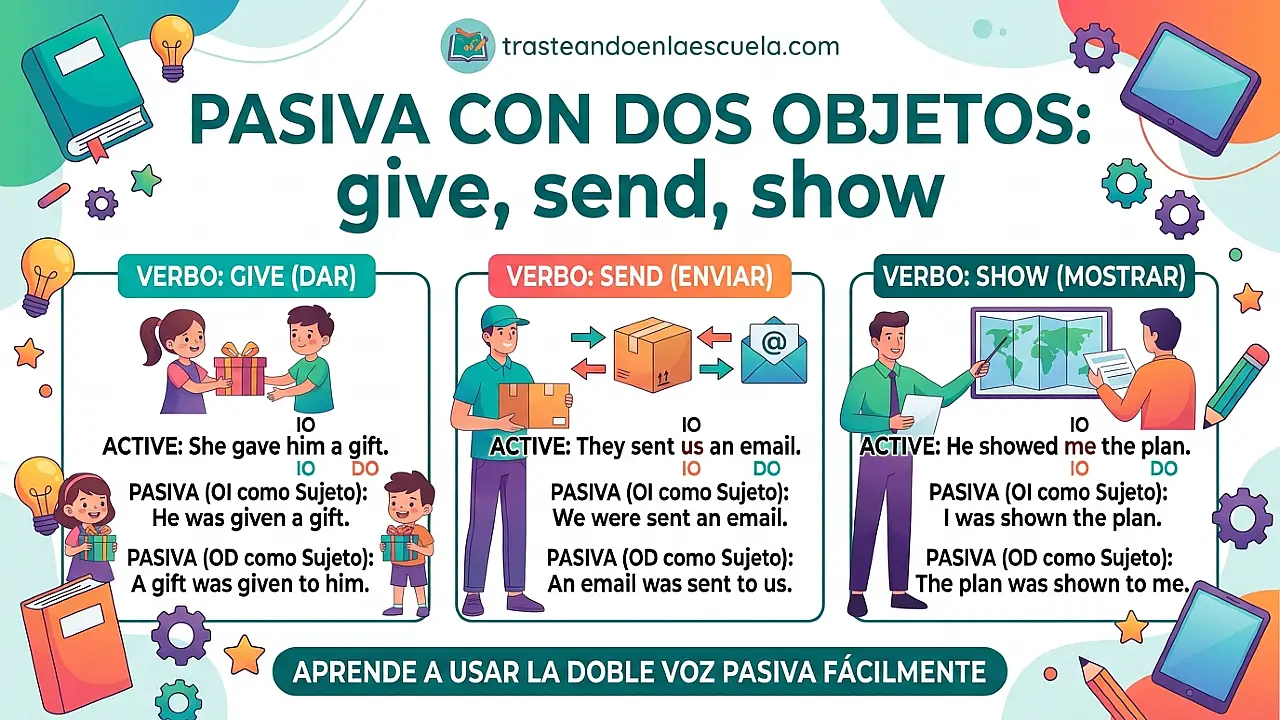
Verbos de doble objeto en pasiva: dos formas de decirlo
Algunos verbos en inglés pueden llevar dos objetos: uno directo (la cosa o tema) y otro indirecto (la persona que recibe la cosa). Por ejemplo: «I gave my friend (objeto indirecto) a gift (objeto directo)». En la voz pasiva, podemos elegir qué objeto queremos convertir en sujeto, dando lugar a dos estructuras diferentes y ambas correctas.
🎯 En este post aprenderás: Cuáles son los verbos de doble objeto más comunes (give, send, show, tell, offer, teach, etc.), las dos formas de construir la pasiva (persona como sujeto o cosa como sujeto), cuándo se prefiere una u otra, y ejercicios para practicar.
🔍 Verbos que admiten doble objeto
No todos los verbos pueden llevar dos objetos. Los más comunes en esta categoría son los verbos de transferencia o comunicación:
- give (dar)
- send (enviar)
- show (mostrar)
- tell (contar)
- offer (ofrecer)
- teach (enseñar)
- lend (prestar)
- sell (vender)
- buy (comprar – aunque en pasiva se usa más con persona)
- promise (prometer)
- read (leer)
- write (escribir)
💡 Regla de oro: En la voz activa, la estructura típica es Sujeto + Verbo + Persona (OI) + Cosa (OD). Por ejemplo: She sent her friend (persona) a postcard (cosa). También se puede poner la cosa primero con «to»: She sent a postcard to her friend.
📊 Las dos formas de la pasiva con doble objeto
🎯 Opción 1: La persona como sujeto (la más común)
En esta estructura, el objeto indirecto (la persona) pasa a ser el sujeto de la oración pasiva. El objeto directo (la cosa) se mantiene después del verbo. Esta es la forma más frecuente y natural en inglés.
🎯 Opción 2: La cosa como sujeto (menos común, más formal)
El objeto directo (la cosa) se convierte en el sujeto. La persona va introducida por «to» (para verbos como give, send, show) o «for» (para verbos como buy, make). Es más frecuente en contextos formales o cuando la cosa es el foco principal.
📌 Ejemplo con «give» en diferentes tiempos
Activa: My grandmother gave me a necklace.
- Pasiva (persona como sujeto): I was given a necklace (by my grandmother). → Más natural.
- Pasiva (cosa como sujeto): A necklace was given to me (by my grandmother). → Más formal, menos común.
📋 Tabla comparativa de estructuras
| Verbo | Activa | Pasiva (persona como sujeto) | Pasiva (cosa como sujeto) |
|---|---|---|---|
| send | They sent her a letter. | She was sent a letter. | A letter was sent to her. |
| show | The guide showed us the museum. | We were shown the museum. | The museum was shown to us. |
| tell | Someone told me a secret. | I was told a secret. | A secret was told to me. |
| offer | They offered him a job. | He was offered a job. | A job was offered to him. |
| teach | Mr. Jones taught us history. | We were taught history (by Mr. Jones). | History was taught to us (by Mr. Jones). |
| lend | My brother lent me £20. | I was lent £20. | £20 was lent to me. |
| buy | She bought her son a car. | Her son was bought a car. | A car was bought for her son. (usamos «for», no «to») |
| make | He made his daughter a dress. | His daughter was made a dress. | A dress was made for his daughter. |
⚠️ Atención con «buy» y «make»: Con estos verbos, la preposición en la pasiva con cosa como sujeto es «for» (no «to»), porque indican un beneficio, no una transferencia directa. Compara: A letter was sent to her (transferencia) vs A car was bought for her son (beneficio).
📝 Ejemplos detallados en diferentes tiempos verbales
🔹 Present Simple
- Activa: The company offers its employees a good salary.
- Pasiva (persona): The employees are offered a good salary.
- Pasiva (cosa): A good salary is offered to the employees.
🔹 Past Simple
- Activa: Someone told us a funny story.
- Pasiva (persona): We were told a funny story.
- Pasiva (cosa): A funny story was told to us.
🔹 Present Perfect
- Activa: They have shown me the new office.
- Pasiva (persona): I have been shown the new office.
- Pasiva (cosa): The new office has been shown to me.
🔹 Future (will)
- Activa: The manager will give you the keys.
- Pasiva (persona): You will be given the keys.
- Pasiva (cosa): The keys will be given to you.
🧪 5 Ejercicios prácticos: pasiva de doble objeto
Ejercicio 1: Transforma a pasiva (persona como sujeto)
- They gave me a beautiful present. → ________________________________
- The teacher told the students a legend. → ________________________________
- Someone has sent her an anonymous letter. → ________________________________
- The company will offer him a better position. → ________________________________
- My grandmother taught me this recipe. → ________________________________
✅ Ver solución
- I was given a beautiful present.
- The students were told a legend.
- She has been sent an anonymous letter.
- He will be offered a better position.
- I was taught this recipe (by my grandmother).
Ejercicio 2: Transforma a pasiva (cosa como sujeto)
- They gave me a beautiful present. → ________________________________
- Someone has sent her an anonymous letter. → ________________________________
- The company will offer him a better position. → ________________________________
- She bought her daughter a new laptop. → ________________________________
- The chef made us a delicious cake. → ________________________________
✅ Ver solución
- A beautiful present was given to me.
- An anonymous letter has been sent to her.
- A better position will be offered to him.
- A new laptop was bought for her daughter. (for, no to)
- A delicious cake was made for us. (for)
Ejercicio 3: Completa con la forma pasiva correcta (elige persona o cosa como sujeto)
- Last week, I __________ (give) a very special gift.
- The instructions __________ (show) to all the participants before the exam.
- All employees __________ (tell) the news yesterday morning.
- More opportunities __________ (offer) to young people in the future.
- This song __________ (teach) to me by my grandfather when I was a child.
✅ Ver solución
- was given (persona como sujeto, natural)
- were shown (cosa como sujeto, aquí «the instructions»)
- were told (persona como sujeto)
- will be offered (persona como sujeto implícita: «to young people»? cuidado. mejor: will be offered to young people o young people will be offered more opportunities – la opción a elegir: will be offered sin especificar sujeto? Mejor: young people will be offered more opportunities. Para la respuesta, voy a poner la estructura más natural: will be offered con sujeto «young people» – la frase está incompleta. Asumo que el sujeto es «opportunities»? La frase dice «More opportunities… to young people», luego el sujeto es «more opportunities», así que pasiva cosa: will be offered y luego «to young people». Respuesta: will be offered.)
- was taught (cosa como sujeto: «this song was taught to me»)
Nota: En (d), la respuesta esperada es will be offered (más opportunities will be offered to young people). En (e), was taught.
Ejercicio 4: Elige la opción correcta
- I __________ a new bike for my birthday.
a) was given / b) was gave / c) given - The documents __________ to the lawyer yesterday.
a) were sent / b) sent / c) was sent - She __________ a secret by her best friend.
a) was told / b) told / c) was tell - A scholarship __________ to the most outstanding student.
a) will be offered / b) will offer / c) will be offer - The children __________ a story every night by their father.
a) are read / b) are reading / c) read
✅ Ver solución
- a) was given
- a) were sent (the documents, plural)
- a) was told
- a) will be offered
- a) are read (pasiva presente: the children are read a story)
Ejercicio 5: Reescribe la oración usando la pasiva de doble objeto de las dos maneras posibles
The committee awarded the scientist a prestigious prize.
- Pasiva (persona como sujeto): ________________________________
- Pasiva (cosa como sujeto): ________________________________
She will lend her friend some money.
- Pasiva (persona como sujeto): ________________________________
- Pasiva (cosa como sujeto): ________________________________
✅ Ver solución
- The scientist was awarded a prestigious prize (by the committee).
- A prestigious prize was awarded to the scientist (by the committee).
- Her friend will be lent some money (by her).
- Some money will be lent to her friend (by her).
📚 Sigue avanzando con la voz pasiva
- La voz pasiva en inglés: qué es y cuándo usarla – Fundamentos.
- Cómo formar la pasiva en todos los tiempos verbales – Tablas completas.
- La pasiva con verbos modales en inglés – Estructura con modales.
- Pasiva de doble objeto: give, send, show – ¡Estás aquí!
- Ejercicios de voz pasiva en inglés resueltos – Práctica intensiva.



Publicar comentario