Job Interview: preguntas y respuestas clave en inglés
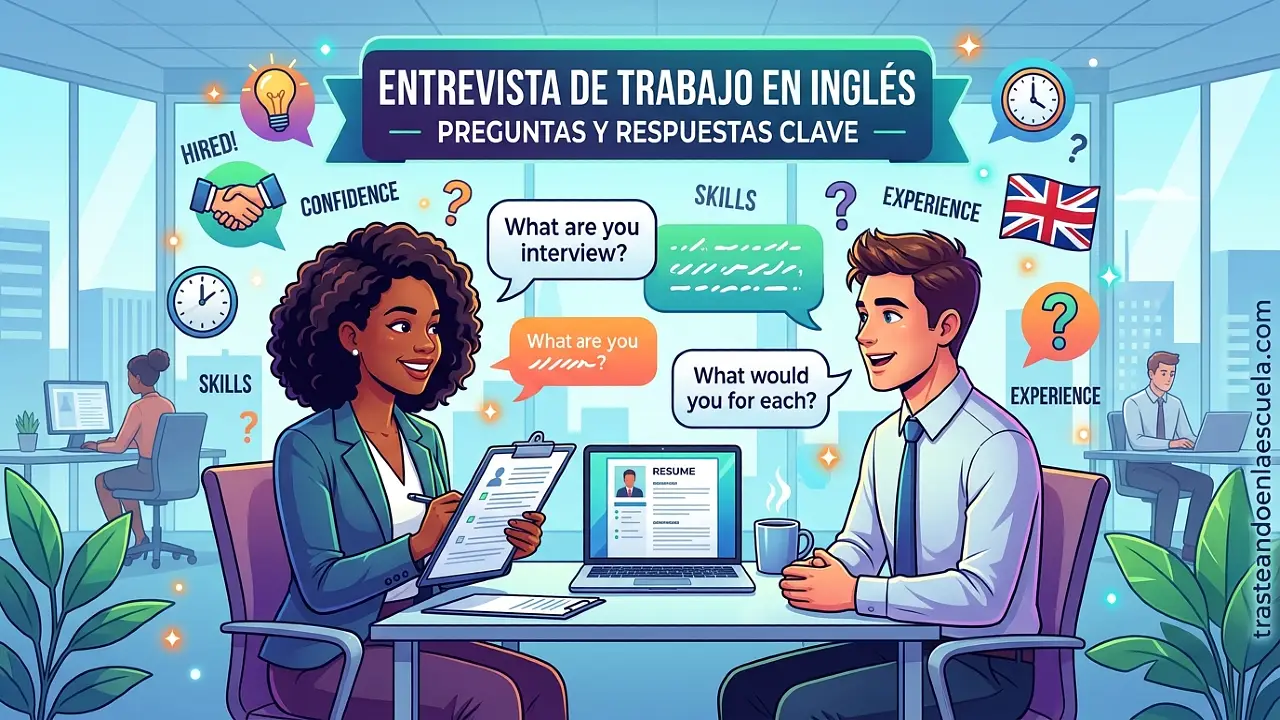
Job Interview: Domina tu entrevista de trabajo en inglés
La job interview (entrevista de trabajo) es el momento decisivo para conseguir ese puesto que tanto deseas. Cuando la entrevista es en inglés, los nervios pueden multiplicarse. Pero no te preocupes: con la preparación adecuada, puedes convertir el miedo en confianza. Esta guía te enseña las 15 preguntas más comunes, cómo estructurar tus respuestas con los métodos STAR y CARL, ejemplos prácticos palabra por palabra, y los errores que debes evitar.
🎯 En esta guía encontrarás: Lista completa de preguntas frecuentes, métodos para estructurar respuestas (STAR y CARL), ejemplos de respuestas para cada pregunta, vocabulario clave para destacar, frases para cuando no entiendas algo, y 5 ejercicios prácticos con soluciones.
🔍 Antes de la entrevista: Prepara estos 3 elementos clave
📋 Los 3 pilares de la preparación
1. INVESTIGA LA EMPRESA
- What does the company do? (¿A qué se dedica?)
- What are its values and mission? (Valores y misión)
- Recent news or achievements (Noticias recientes)
- Who are their competitors? (Competidores)
2. ANALIZA EL PUESTO (JOB DESCRIPTION)
- Required skills and qualifications (Habilidades necesarias)
- Key responsibilities (Responsabilidades clave)
- Match your experience with each requirement (Conecta tu experiencia)
3. PREPARA TUS PREGUNTAS
- You will ask questions at the end (Tú también preguntas)
- Show interest and engagement (Muestra interés)
- Example: «What does a typical day look like in this role?»
📊 Método STAR: La estructura definitiva para tus respuestas
⭐ ¿Qué es el método STAR?
El método STAR es una técnica utilizada por los reclutadores para evaluar tus competencias a través de ejemplos concretos. Úsalo para responder preguntas como «Tell me about a time when…»
T = Task (Tarea) → Tu objetivo o responsabilidad
A = Action (Acción) → Lo que TÚ hiciste (especifica)
R = Result (Resultado) → Qué lograste (con datos si es posible)
Ejemplo STAR: «Tell me about a time you solved a difficult problem.»
- Situation: «In my previous job as a customer service representative, we had a sudden 40% increase in complaints about shipping delays.»
- Task: «I was responsible for reducing the complaint volume and improving customer satisfaction.»
- Action: «I analyzed the data, identified that 70% of delays came from one courier, negotiated with a new provider, and created an automated tracking system for customers.»
- Result: «Within two months, complaints dropped by 85% and customer satisfaction scores increased from 3.2 to 4.7 out of 5.»
💡 Alternativa: Método CARL (similar, pero añade Learning – aprendizaje)
C = Challenge (Desafío) | A = Action (Acción) | R = Result (Resultado) | L = Learning (Qué aprendiste)
❓ Las 15 preguntas más comunes en job interviews
Qué busca el entrevistador: Una visión general de tu perfil profesional. NO quieren tu biografía completa ni datos personales.
Estructura recomendada: Presente (qué haces ahora) → Pasado (experiencia relevante) → Futuro (por qué quieres este puesto).
Ejemplo de respuesta: «I’m a marketing specialist with over 5 years of experience in the tech industry. Currently, I lead social media campaigns for a SaaS company, where I’ve increased engagement by 60% in the last year. Before that, I worked as a content creator for an e-commerce brand. I’m looking to bring my skills in data-driven marketing to a larger team, which is why I’m so excited about this opportunity at [Company Name].»
Qué busca: Que hayas investigado la empresa y que muestres entusiasmo genuino.
Ejemplo de respuesta: «I’ve been following [Company Name] for the past two years, and I’ve always admired your commitment to sustainability and innovation. Your recent launch of the eco-friendly product line really impressed me. I believe my experience in product development and my passion for sustainable solutions align perfectly with your mission. I want to contribute to a company that is making a real difference.»
Qué busca: Que identifiques tus fortalezas RELEVANTES para el puesto y las respaldes con ejemplos.
Ejemplo de respuesta: «My greatest strength is my problem-solving ability. In my current role, I’m often the person my team comes to when they’re stuck. For example, last quarter, our main software vendor had a critical outage. I quickly researched alternatives, set up a temporary solution in 24 hours, and trained the team. We didn’t miss a single deadline. I’m also very organized and detail-oriented, which helps me manage multiple projects simultaneously.»
Qué busca: Autoconocimiento y capacidad de mejora. NO digas «I’m a perfectionist» (es un cliché).
Ejemplo de respuesta: «I sometimes struggle with public speaking, especially in front of large audiences. However, I’ve been actively working on this. I joined a Toastmasters club six months ago and have been volunteering to present in team meetings. I’ve already seen a significant improvement in my confidence, and I’ve received positive feedback. I know it’s an area I need to continue developing.»
Qué busca: Un resumen convincente de por qué eres el mejor candidato.
Ejemplo de respuesta: «You should hire me because I have the perfect combination of skills and experience for this role. First, I have three years of hands-on experience with the exact CRM system you use. Second, I’ve consistently exceeded my sales targets by an average of 25%. Third, I’m a collaborative team player who thrives in fast-paced environments. I’m ready to start contributing from day one and help [Company Name] achieve its Q4 goals.»
Qué busca: Honestidad, responsabilidad y capacidad de aprender de los errores.
Ejemplo de respuesta (usando STAR): «In my first year as a project manager, I underestimated the time needed for a client’s website launch (Situation). My task was to deliver the project on time and on budget (Task). I didn’t communicate the potential delay early enough (Action – el error). The project was delivered two weeks late, and the client was unhappy (Result). I learned a valuable lesson about transparent communication. Now, I always add a 20% buffer to my timelines and communicate any potential risks as soon as I identify them. Since then, I’ve delivered all my projects on time (Learning).»
Qué busca: Ambición realista y que tus planes sean compatibles con el crecimiento de la empresa.
Ejemplo de respuesta: «In five years, I see myself as a senior member of a marketing team, possibly leading a small group. I want to have mastered the skills needed for this role and have taken on additional responsibilities, such as mentoring junior team members. I’m interested in growing with [Company Name] and taking on more strategic projects. Ultimately, I want to be known as an expert in data-driven marketing within the industry.»
Qué busca: Que no hables mal de tu antiguo empleador y que tengas una razón profesional.
Ejemplo de respuesta: «I learned a lot at my previous company, and I’m grateful for the opportunities I had. However, I felt that I had reached a point where there were no more growth opportunities for me. I’m looking for a new challenge where I can use my skills to their full potential and continue developing professionally. This role at [Company Name] seems like the perfect next step.»
Qué busca: Flexibilidad y capacidad de adaptación.
Ejemplo de respuesta: «I’m comfortable with both. I really enjoy the energy and creativity that comes from team brainstorming sessions. At the same time, I’m highly self-motivated and can work independently to meet deadlines. For example, in my current role, I collaborate with the design team in the mornings to align on projects, and then I work independently in the afternoons to execute my tasks. I think the key is knowing when each approach is more effective.»
Qué busca: Habilidades de resolución de conflictos y comunicación.
Ejemplo de respuesta: «A coworker and I once disagreed on the strategic direction for a client presentation. He wanted a very conservative approach, and I wanted something more innovative (Situation). My task was to create a presentation that would impress the client (Task). Instead of arguing, I suggested we each prepare a small section and present our ideas to a neutral third party in the office. After hearing both, my coworker actually agreed that the innovative approach was better, but he made some excellent tweaks to make it more feasible (Action). The final presentation was a blend of both ideas, and the client loved it (Result). We both learned that our different perspectives made the end product stronger.»
Qué busca: Que hayas investigado el rango salarial del puesto.
Ejemplo de respuesta: «Based on my research of similar roles in this industry and my 5 years of experience, I’m looking for a salary in the range of $65,000 to $75,000. However, I’m flexible and the total compensation package, including benefits and growth opportunities, is also very important to me.»
Qué busca: Resiliencia y mecanismos de afrontamiento saludables.
Ejemplo de respuesta: «I actually work well under pressure. I find that it helps me focus. When I have a tight deadline, I create a detailed to-do list, prioritize the most critical tasks, and break large projects into smaller, manageable steps. I also make sure to take short breaks to clear my head. Outside of work, I exercise regularly, which helps me manage stress effectively.»
Qué busca: Tus valores y qué te impulsa a dar lo mejor de ti.
Ejemplo de respuesta: «I’m highly motivated by seeing the impact of my work. When I launch a campaign and see the metrics improve, or when a client tells me that my solution saved them time and money, that’s what drives me. I also love learning new things. The moment I stop learning is the moment I start looking for a new challenge.»
Qué busca: Interés genuino. NUNCA digas «No, I think I’m good.»
Ejemplos de buenas preguntas:
- «What does a typical day look like in this role?»
- «What are the biggest challenges the person in this position will face?»
- «How would you describe the company culture?»
- «What opportunities for professional development are available?»
- «What are the next steps in the interview process?»
Qué busca: Iniciativa y capacidad para guiar a otros (no necesitas ser jefe para tener liderazgo).
Ejemplo de respuesta: «In my last role, we were implementing a new software system, and the team was struggling to learn it. No one was assigned to lead the training (Situation). I saw that we were falling behind, so I took the initiative (Task). I spent my evenings learning the system, created a simple guide with screenshots, and organized three lunch-and-learn sessions for the team (Action). As a result, everyone became proficient within two weeks, and our productivity actually increased by 15% compared to the old system (Result).»
📝 Frases útiles para la entrevista
🎧 Cuando no entiendes una pregunta
- «Could you please repeat the question?» (¿Podría repetir la pregunta?)
- «I’m sorry, I didn’t quite catch that. Could you say it again?» (Lo siento, no lo he entendido bien. ¿Podría repetirlo?)
- «Let me make sure I understand. Are you asking about…?» (Déjame asegurarme de que entiendo. ¿Me estás preguntando sobre…?)
⏱️ Cuando necesitas tiempo para pensar
- «That’s an excellent question. Let me think about it for a moment.» (Esa es una excelente pregunta. Déjame pensar un momento.)
- «I’d like to give you a thoughtful answer. Could I have a few seconds?» (Me gustaría darte una respuesta reflexiva. ¿Puedo tener unos segundos?)
✨ Para conectar tu experiencia con el puesto
- «This relates directly to my experience with…» (Esto se relaciona directamente con mi experiencia en…)
- «A specific example of this from my previous role is…» (Un ejemplo específico de esto de mi puesto anterior es…)
- «I believe my skills in [skill] would be valuable for this position because…» (Creo que mis habilidades en [skill] serían valiosas para este puesto porque…)
🔚 Para cerrar la entrevista con fuerza
- «Thank you for your time. I’m very excited about this opportunity and I hope to hear from you soon.»
- «Is there anything else I can provide to help you make your decision?»
- «I look forward to the next steps in the process.»
❌ Errores comunes en una job interview en inglés
| Error | Ejemplo incorrecto | Alternativa correcta |
|---|---|---|
| Memorizar respuestas | Respuesta robótica y poco natural | Prepara puntos clave, no textos completos. Practica en voz alta. |
| Llegar tarde | Llegar 5 minutos tarde | Llega 10-15 minutos antes (presencial) o conéctate 5 minutos antes (online). |
| Hablar mal del jefe anterior | «My old boss was terrible and didn’t know anything.» | «I learned a lot, but I was looking for new challenges and growth opportunities.» |
| Responder «I don’t know» sin más | «I don’t know.» (fin de la respuesta) | «That’s not an area I have direct experience in, but here’s how I would approach learning it…» |
| No hacer preguntas al final | «No, I don’t have any questions.» | «Actually, I do have a couple of questions. First…» |
| Usar lenguaje demasiado informal | «Yeah, like, I’m pretty good at that stuff.» | «Yes, I have strong experience in that area.» |
🧪 5 Ejercicios prácticos
Ejercicio 1: Identifica qué pregunta están respondiendo
Lee la respuesta y escribe cuál de las 15 preguntas crees que es.
- «I’ve always admired this company’s innovative approach to renewable energy. I want to contribute to projects that have a positive environmental impact, and I believe my engineering background aligns perfectly with your goals.»
- «I used to struggle with delegating tasks. I felt I had to do everything myself. But I realized that was burning me out. Now, I actively delegate to my team members, which has improved both my productivity and theirs.»
- «In five years, I hope to have grown into a senior account manager role, leading key client relationships and mentoring new team members.»
✅ Ver solución
- «Why do you want to work here?» (Pregunta #2)
- «What are your greatest weaknesses?» (Pregunta #4)
- «Where do you see yourself in 5 years?» (Pregunta #7)
Ejercicio 2: Completa las frases con la palabra correcta
Elige entre: deadline, strengths, research, questions, experience
- Before the interview, do thorough _______ about the company.
- Always have _______ ready to ask at the end of the interview.
- When discussing your _______, always provide specific examples.
- I have five years of _______ in project management.
- I’m very good at meeting tight _______.
✅ Ver solución
- research
- questions
- strengths
- experience
- deadlines
Ejercicio 3: Corrige los errores en estas respuestas
- «My old boss was terrible, so I left.»
- «No, I don’t have any questions.» (al final de la entrevista)
- «My weakness is that I work too hard.»
✅ Ver solución
- Corrección: «I learned a lot in my previous role, but I felt I had reached a point where I needed new challenges to continue growing professionally.»
- Corrección: «Actually, I do have a few questions. Could you tell me more about the team I’d be working with? And what are the next steps in the process?»
- Corrección: «I sometimes struggle with public speaking, but I’ve been taking steps to improve by presenting in team meetings and joining a public speaking group.»
Ejercicio 4: Aplica el método STAR
Usa el método STAR para estructurar una respuesta a: «Tell me about a time you achieved a difficult goal.» Escribe una frase para cada letra (S, T, A, R).
✅ Ver solución de ejemplo
- S (Situation): «In my previous role as a sales associate, our team was given a target of increasing sales by 30% in one quarter, which had never been done before.»
- T (Task): «My personal task was to bring in $50,000 in new business within that period.»
- A (Action): «I created a targeted outreach plan, identified 50 high-potential leads, personalized my approach for each, and followed up consistently.»
- R (Result): «I exceeded my goal by 20%, bringing in $60,000, and our team as a whole achieved a 32% increase.»
Ejercicio 5: Graba tu respuesta a estas 3 preguntas
Graba un audio (puede ser con tu móvil) respondiendo a estas tres preguntas. Luego escúchate y evalúa: fluidez, vocabulario, y si respondiste completamente.
- Tell me about yourself.
- Why do you want to work here? (elige una empresa real)
- What are your greatest strengths?
✅ Consejos para la autoevaluación
- Duración ideal: 1-2 minutos por respuesta.
- ¿Usaste ejemplos específicos? No solo digas «I’m hardworking», di «I once worked over the weekend to…»
- ¿Hablaste demasiado rápido o lento? Busca un ritmo natural.
- ¿Usaste muletillas? «Like», «you know», «um» – intenta reducirlas.
- ¿Sonaste entusiasta? El tono de voz es importante.
🌍 Antes, durante y después de la entrevista: Checklist
✅ ANTES
- Investiga la empresa y el puesto a fondo.
- Prepara tus respuestas (no memorices, practica).
- Prepara 3-5 preguntas para hacer al final.
- Prepara tu «elevator pitch» de 60 segundos para «Tell me about yourself».
- Revisa tu currículum en inglés para hablar de él con confianza.
- Prueba tu cámara, micrófono e internet (si es online).
- Elige ropa profesional y apropiada.
✅ DURANTE
- Llega 10 minutos antes (presencial) o conéctate 5 minutos antes (online).
- Sonríe y mantén contacto visual.
- Escucha activamente y no interrumpas.
- Usa ejemplos concretos (método STAR).
- No hables mal de empleadores anteriores.
- Haz tus preguntas al final.
- Pregunta sobre los siguientes pasos (next steps).
✅ DESPUÉS
- Envía un correo de agradecimiento (thank-you email) en las 24 horas siguientes.
- Anota los puntos clave que discutiste para futuras rondas.
- Conecta con el entrevistador en LinkedIn (si es apropiado).
📧 Plantilla para tu thank-you email:
Subject: Thank you – [Your Name] – [Position Name] Interview
Dear [Interviewer Name],
Thank you so much for your time today. I really enjoyed learning more about the [Position Name] role and about [Company Name]’s exciting plans for [specific project or goal you discussed].
Our conversation confirmed my interest in this position. I’m confident that my experience in [your key skill] would allow me to contribute immediately to your team’s success.
Please let me know if there’s any additional information I can provide. I look forward to hearing about the next steps.
Best regards,
[Your Name]
[Your Phone Number]
📚 Serie completa: Vocabulario laboral en inglés
- Jobs: profesiones en inglés – Lista completa de trabajos.
- Workplace: lugar de trabajo – Vocabulario de oficina y departamentos.
- Job interview: entrevista de trabajo – ¡Estás aquí! Preguntas y respuestas clave.
- CV: cómo escribir un currículum – Plantillas y ejemplos para tu CV.
- Office vocabulary: oficina – Objetos y acciones de oficina.
🎯 Tu misión esta semana: Graba un video de 2-3 minutos respondiendo a «Tell me about yourself» y «Why do you want to work here?» para una empresa real que te interese. Escúchate, corrige errores, y grábate de nuevo hasta que te sientas seguro. ¡La práctica es la clave del éxito en cualquier job interview!






Publicar comentario