Ejercicios de Reported Speech resueltos (25+ preguntas para practicar todo)
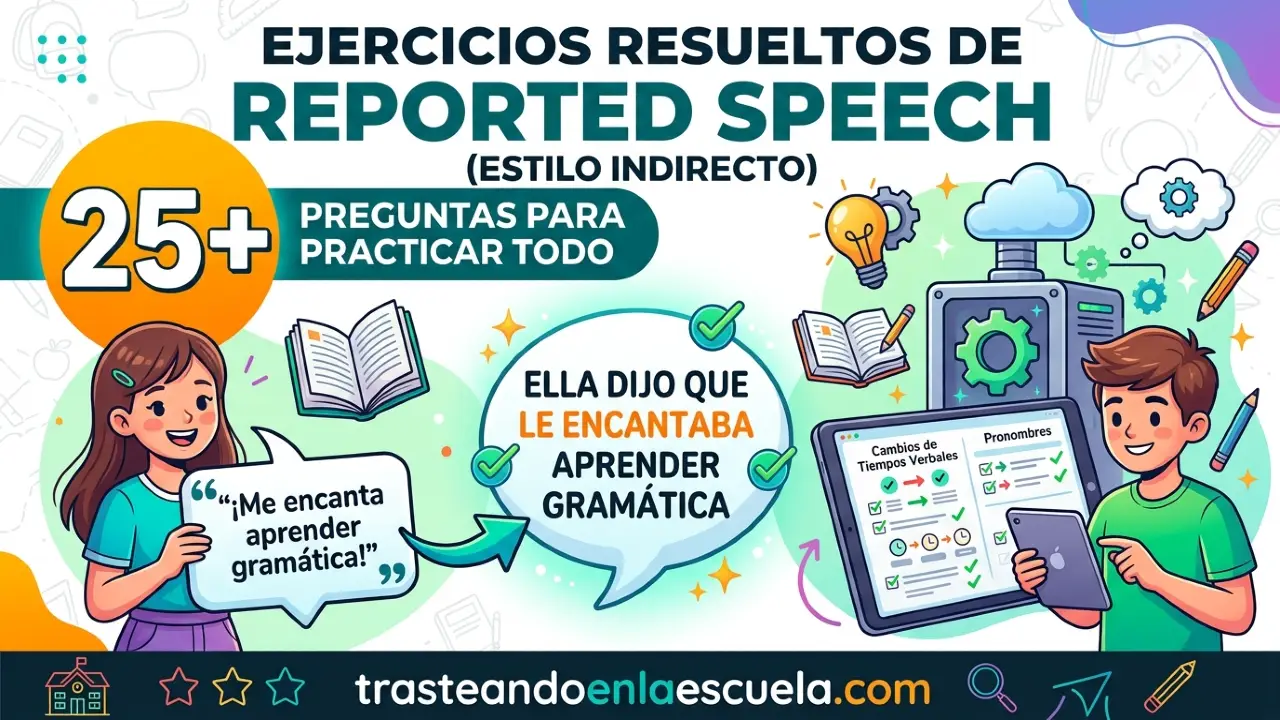
25 Ejercicios de Reported Speech con soluciones detalladas
Has aprendido las reglas básicas, los cambios de tiempo verbal, cómo reportar preguntas y órdenes, y los verbos de reporte más importantes. Ahora es el momento de ponerlo todo en práctica. Esta batería de 25 ejercicios cubre todos los aspectos del estilo indirecto: afirmaciones, preguntas (yes/no y wh-), órdenes, verbos de reporte variados, excepciones y mezcla de tipos. Cada ejercicio incluye su solución desplegable para que puedas autocorregirte.
🎯 Objetivo: Al completar estos ejercicios, serás capaz de usar el reported speech con fluidez en contextos reales. Dedica al menos 30 minutos y no mires las soluciones hasta haber intentado cada frase.
📊 Tabla resumen rápida (antes de practicar)
| Tipo de oración | Estructura en reported speech | Ejemplo |
|---|---|---|
| Afirmativa | say/tell + (that) + sujeto + verbo (con backshift) | «I am tired» → He said he was tired. |
| Pregunta sí/no | ask + if/whether + sujeto + verbo | «Do you work?» → He asked if I worked. |
| Pregunta wh- | ask + wh- + sujeto + verbo | «Where do you live?» → He asked where I lived. |
| Orden afirmativa | tell + persona + to + infinitivo | «Sit down» → He told me to sit down. |
| Orden negativa | tell + persona + not + to + infinitivo | «Don’t run» → He told me not to run. |
🔹 Bloque 1: Afirmaciones básicas (cambios de tiempo y pronombres)
Ejercicios 1 al 5
- «I am a teacher,» said John.
- «We are watching a movie,» they said.
- «I will visit you tomorrow,» she told me.
- «She has bought a new car,» her father said.
- «They went to the beach yesterday,» said Paul.
✅ Ver soluciones 1-5
- John said (that) he was a teacher.
- They said (that) they were watching a movie.
- She told me (that) she would visit me the next day / the following day.
- Her father said (that) she had bought a new car.
- Paul said (that) they had gone to the beach the day before / the previous day.
🔹 Bloque 2: Preguntas (yes/no y wh-)
Ejercicios 6 al 10
- «Do you like coffee?» she asked me.
- «Where is the nearest station?» the tourist asked.
- «Have you finished your homework?» the mother asked her son.
- «Why did you arrive late?» the boss asked.
- «Can you help me move this table?» he asked his friend.
✅ Ver soluciones 6-10
- She asked me if I liked coffee.
- The tourist asked where the nearest station was.
- The mother asked her son if he had finished his homework.
- The boss asked why I/he/she had arrived late.
- He asked his friend if he could help him move that table.
🔹 Bloque 3: Órdenes, peticiones y consejos
Ejercicios 11 al 15
- «Close the door,» he said to me.
- «Don’t be rude,» the mother told her child.
- «Please lend me some money,» she asked her brother.
- «You should rest for a few days,» the doctor advised the patient.
- «Don’t touch the wire,» the electrician warned us.
✅ Ver soluciones 11-15
- He told me to close the door.
- The mother told her child not to be rude.
- She asked her brother to lend her some money.
- The doctor advised the patient to rest for a few days.
- The electrician warned us not to touch the wire.
🔹 Bloque 4: Verbos de reporte variados (promise, suggest, admit, explain, complain)
Ejercicios 16 al 20
- «I will always love you,» he said. (promise)
- «Let’s go to the cinema,» she said. (suggest + gerundio)
- «I stole the wallet,» the thief said. (admit)
- «The reason I was absent is that I was sick,» the student said. (explain)
- «This room is too cold,» the guest said. (complain)
✅ Ver soluciones 16-20
- He promised (that) he would always love me / to always love me.
- She suggested going to the cinema.
- The thief admitted stealing the wallet / that he had stolen the wallet.
- The student explained that the reason he had been absent was that he had been sick.
- The guest complained that the room was too cold.
🔹 Bloque 5: Excepciones y casos especiales (sin backshift, condicionales, modales sin cambio)
Ejercicios 21 al 25
- «The Earth revolves around the Sun,» the scientist said.
- He says, «I am hungry.» (reporting verb en presente)
- «I would buy a boat if I were rich,» he said.
- «They had already eaten,» she said.
- «I might come to the party,» she said.
✅ Ver soluciones 21-25
- The scientist said that the Earth revolves around the Sun. (verdad universal, no cambio)
- He says that he is hungry. (presente, no backshift)
- He said that he would buy a boat if he were rich. (condicional sin cambio)
- She said that they had already eaten. (past perfect no cambia)
- She said that she might come to the party. (might no cambia)
🔹 BLOQUE EXTRA: 5 ejercicios mixtos para consolidar
Ejercicios 26 al 30 (nivel avanzado)
- «Don’t forget to lock the door,» my father said to me. (remind)
- «What time does the train leave?» the passenger asked.
- «I’m sorry I broke your vase,» my sister said to me. (apologize)
- «You should apply for that job,» my friend said. (encourage)
- «If I had studied harder, I would have passed the exam,» he said. (tercer condicional)
✅ Ver soluciones 26-30
- My father reminded me to lock the door.
- The passenger asked what time the train left.
- My sister apologized to me for breaking my vase.
- My friend encouraged me to apply for that job.
- He said that if he had studied harder, he would have passed the exam. (sin cambios, porque el tercer condicional ya está en pasado perfecto y would have)
Nota: Los ejercicios 26-30 son de nivel avanzado. Si los has resuelto correctamente, ¡dominas el reported speech!
📈 Autoevaluación: ¿Cómo te ha ido?
| Aciertos | Nivel | Recomendación |
|---|---|---|
| 25-30 | Avanzado | Ya puedes usar reported speech con confianza. Revisa solo los errores puntuales. |
| 18-24 | Intermedio alto | Repasa los cambios de tiempo y las preguntas. Vuelve a los posts anteriores. |
| 10-17 | Intermedio | Practica más con los bloques 1, 2 y 3. Haz de nuevo los ejercicios. |
| Menos de 10 | Básico | Estudia de nuevo la serie completa desde el primer post. |
💡 Consejos finales:
- No memorices las soluciones, entiende por qué cambia cada elemento (pronombre, tiempo, adverbio).
- Practica en voz alta: imagina que le cuentas a un amigo lo que otra persona dijo.
- Escucha noticias en inglés y trata de reportar las declaraciones de los políticos o testigos.
📚 Serie completa de Reported Speech (para repasar antes o después)
- El estilo indirecto en inglés: qué es y reglas básicas
- Cambios de tiempo verbal en el Reported Speech (backshift)
- Reported Speech con preguntas y órdenes
- Verbos de reporte más usados: say, tell, ask, warn
- Ejercicios de Reported Speech resueltos (esta página, con 30 ejercicios)
🏆 ¡Enhorabuena! Has completado la práctica completa
Has trabajado 30 ejercicios que cubren todos los aspectos del estilo indirecto. Ahora ya puedes:
- Reportar afirmaciones con los cambios de tiempo correctos.
- Transformar preguntas directas en indirectas (sin inversión).
- Convertir órdenes en infinitivo con tell / ask / warn.
- Usar verbos como suggest, promise, admit, explain con precisión.
- Identificar cuándo NO se aplica el backshift.
¡Sigue practicando y el reported speech se volverá natural para ti!






Publicar comentario