Cambios de tiempo verbal en el Reported Speech (backshift)
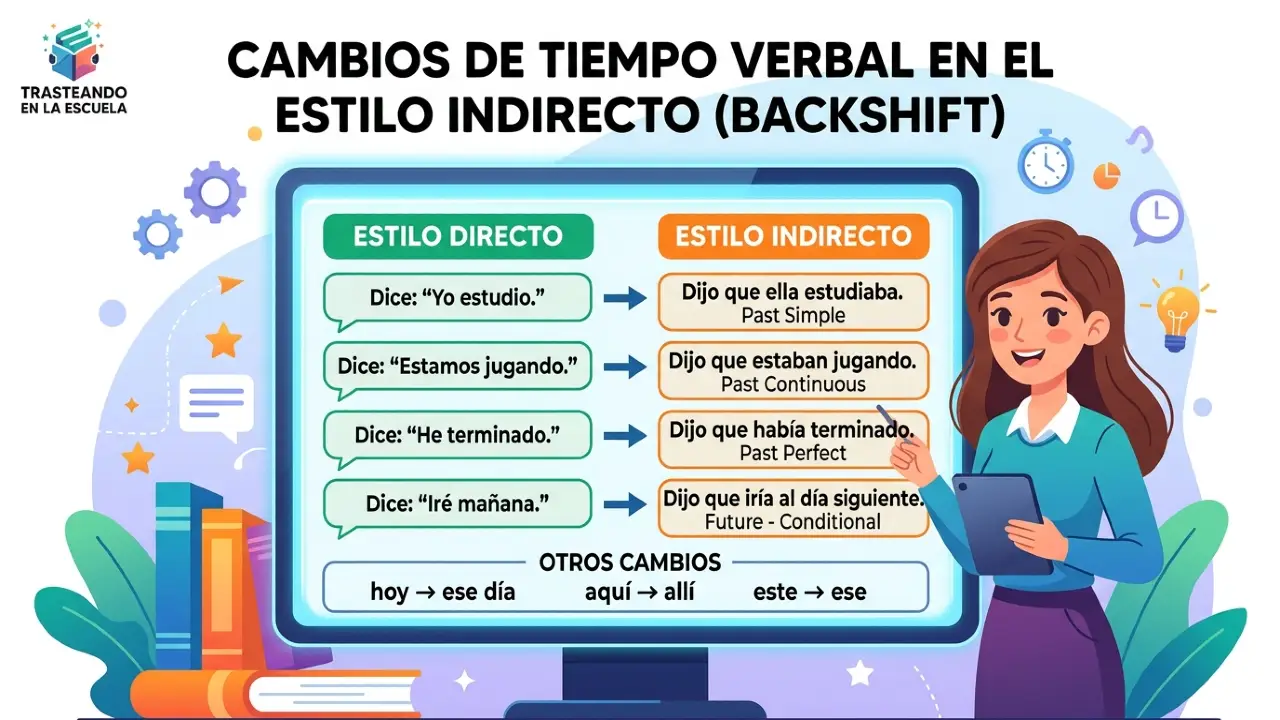
Backshift: El corazón del Reported Speech
Cuando pasamos una oración de estilo directo a indirecto, lo más habitual es que los tiempos verbales «se muevan hacia atrás» en el tiempo. Ese fenómeno se llama backshift (desplazamiento hacia atrás). Por ejemplo: «I am tired» se convierte en He said he was tired. El presente simple pasa a pasado simple. En este post aprenderás todas las transformaciones, incluyendo verbos modales y casos especiales.
🎯 En este post aprenderás: La tabla completa de backshift (presente→pasado, pasado→past perfect, futuro→condicional), cómo funcionan los modales (can, will, may, must…), excepciones (cuando NO se cambia), y 5 ejercicios para automatizar los cambios.
📊 Tabla general de backshift
⏰ De atrás hacia más atrás
Cuando el verbo introductorio está en pasado (said, told, asked, etc.), los tiempos verbales de la oración original retroceden un paso en el pasado.
| Tiempo en directo | Tiempo en indirecto | Ejemplo directo | Ejemplo indirecto |
|---|---|---|---|
| Present simple → | Past simple | «I walk to school» | He said he walked to school |
| Present continuous → | Past continuous | «I am reading» | He said he was reading |
| Past simple → | Past perfect | «I saw a film» | He said he had seen a film |
| Past continuous → | Past perfect continuous | «I was sleeping» | He said he had been sleeping |
| Present perfect → | Past perfect | «I have eaten» | He said he had eaten |
| Present perfect continuous → | Past perfect continuous | «I have been waiting» | He said he had been waiting |
| Past perfect → | Past perfect (sin cambio) | «I had left» | He said he had left |
| Future (will) → | Would | «I will call» | He said he would call |
| Future continuous (will be) → | Would be | «I will be waiting» | He said he would be waiting |
| Future perfect (will have) → | Would have | «I will have finished» | He said he would have finished |
🔧 Verbos modales: cambios especiales
| Modal en directo | Modal en indirecto | Ejemplo directo | Ejemplo indirecto |
|---|---|---|---|
| can | could | «I can swim» | He said he could swim |
| may | might | «It may rain» | He said it might rain |
| must / have to | had to (o must para obligaciones generales) | «I must go» | He said he had to go / He said he must go (formal) |
| shall | should / would (según contexto) | «I shall call» | He said he would call |
| could, might, should, would, ought to | sin cambio | «I could help» | He said he could help |
⚙️ Ejemplos paso a paso
🎯 De presente a pasado
- Directo: «I work in an office.» → Indirecto: He said that he worked in an office. (present simple → past simple)
- Directo: «I am working now.» → Indirecto: She said that she was working then. (present continuous → past continuous)
🎯 De pasado a past perfect
- Directo: «I bought a new car.» → Indirecto: He told me that he had bought a new car. (past simple → past perfect)
- Directo: «I was reading when you called.» → Indirecto: She said that she had been reading when I had called. (past continuous → past perfect continuous)
🎯 De presente perfecto a past perfect
- Directo: «I have finished my homework.» → Indirecto: He said that he had finished his homework.
🎯 De futuro a condicional
- Directo: «I will travel to Japan.» → Indirecto: He said that he would travel to Japan.
💡 Regla nemotécnica: Si en directo tienes un tiempo «X», en indirecto (con reporting verb en pasado) usarás «past X» o «would X». Ejemplo: present → past, past → past perfect, will → would.
📌 Excepciones: ¿Cuándo NO se produce backshift?
- Verdades universales o hechos científicos: «Water boils at 100°C» → The teacher said that water boils at 100°C. (no cambia)
- Cuando el reporting verb está en presente, futuro o presente perfecto: He says, «I am tired» → He says he is tired.
- Cuando el contenido sigue siendo verdad en el momento de reportar (opcional): «I live in Madrid» (todavía vive allí) → She said she lives / lived in Madrid. Ambas son aceptables.
- Subjuntivo o ciertas expresiones con should, let’s: «I suggest that he go» → She suggested that he go.
- En lenguaje muy informal o hablado a veces se omite el backshift para sonar más directo.
🧪 5 Ejercicios de cambios de tiempo verbal
Ejercicio 1: De presente a pasado
Pasa a reported speech. El reporting verb está en pasado (said).
- «I like chocolate,» said Lucy.
- «We are watching a movie,» said my parents.
- «He doesn’t speak French,» said the guide.
- «The children are playing outside,» said the nanny.
- «I need a break,» said the worker.
✅ Ver solución
- Lucy said (that) she liked chocolate.
- My parents said (that) they were watching a movie.
- The guide said (that) he didn’t speak French.
- The nanny said (that) the children were playing outside.
- The worker said (that) he needed a break.
Ejercicio 2: De pasado a past perfect
- «I went to the gym yesterday,» said Mark.
- «We were sleeping when the alarm rang,» said they.
- «She didn’t see the accident,» said the witness.
- «I bought this dress last week,» said Anna.
- «They arrived late,» said the host.
✅ Ver solución
- Mark said (that) he had gone to the gym the day before.
- They said (that) they had been sleeping when the alarm had rung / rang (el past perfect opcional en segunda parte).
- The witness said (that) she hadn’t seen the accident.
- Anna said (that) she had bought that dress the previous week.
- The host said (that) they had arrived late.
Ejercicio 3: De presente perfecto y futuro a indirecto
- «I have visited Paris three times,» said Paul.
- «We will call you tomorrow,» they told me.
- «She has been studying all day,» said her mother.
- «I will be waiting at the station,» he said.
- «They will have finished by noon,» said the boss.
✅ Ver solución
- Paul said (that) he had visited Paris three times.
- They told me (that) they would call me the next day.
- Her mother said (that) she had been studying all day.
- He said (that) he would be waiting at the station.
- The boss said (that) they would have finished by noon.
Ejercicio 4: Modales y verbos mixtos
- «I can solve this problem,» said the engineer.
- «You may leave early,» the manager told me.
- «We must finish the project,» said the team leader.
- «I could help you,» she said to me.
- «You should see a doctor,» my friend said.
✅ Ver solución
- The engineer said (that) he could solve that problem.
- The manager told me (that) I might leave early.
- The team leader said (that) they had to / must finish the project.
- She told me (that) she could help me. (could no cambia)
- My friend said (that) I should see a doctor. (should no cambia)
Ejercicio 5: Excepciones (sin backshift o cambio opcional)
Decide si mantienes el tiempo o aplicas backshift. Justifica.
- «The Earth orbits the Sun,» said the teacher.
- «I live in Barcelona,» (todavía vive allí) said Marta.
- «Water freezes at 0°C,» explained the scientist.
- He says, «I am hungry.» → Reported speech con «He says that…»
- «I had already eaten,» said Tom.
✅ Ver solución
- The teacher said that the Earth orbits the Sun. (verdad universal, no cambia)
- Marta said that she lives / lived in Barcelona. (opcional, porque sigue siendo cierto)
- The scientist explained that water freezes at 0°C. (hecho científico)
- He says that he is hungry. (no hay backshift porque el reporting verb está en presente)
- Tom said that he had already eaten. (past perfect no cambia)
❌ Errores frecuentes con el backshift
| Error | Corrección |
|---|---|
| Mantener presente simple cuando debería ser pasado | «He said he is tired» → «He said he was tired» |
| Olvidar cambiar el pasado simple a past perfect | «She said she went» → «She said she had gone» (aunque en inglés coloquial a veces se omite) |
| No cambiar will a would | «He said he will come» → «He said he would come» |
| Cambiar modales que no deben cambiar (could, might, should) | «He said he could» es correcto, no «had been able to» (excepto en contextos muy formales) |
📚 Profundiza en el Reported Speech
- El estilo indirecto en inglés: qué es y reglas básicas – Los fundamentos.
- Reported Speech con preguntas y órdenes – Cómo aplicar el backshift en preguntas y mandatos.
- Verbos de reporte más usados – Elige el verbo adecuado.
- Ejercicios de Reported Speech resueltos – Práctica global.
🎓 Reto: Elige un párrafo de un libro en inglés y conviértelo a reported speech cambiando todos los tiempos verbales según las reglas de backshift. Luego compáralo con el original.







Publicar comentario