Artículos con nombres propios en inglés: cuándo usar THE
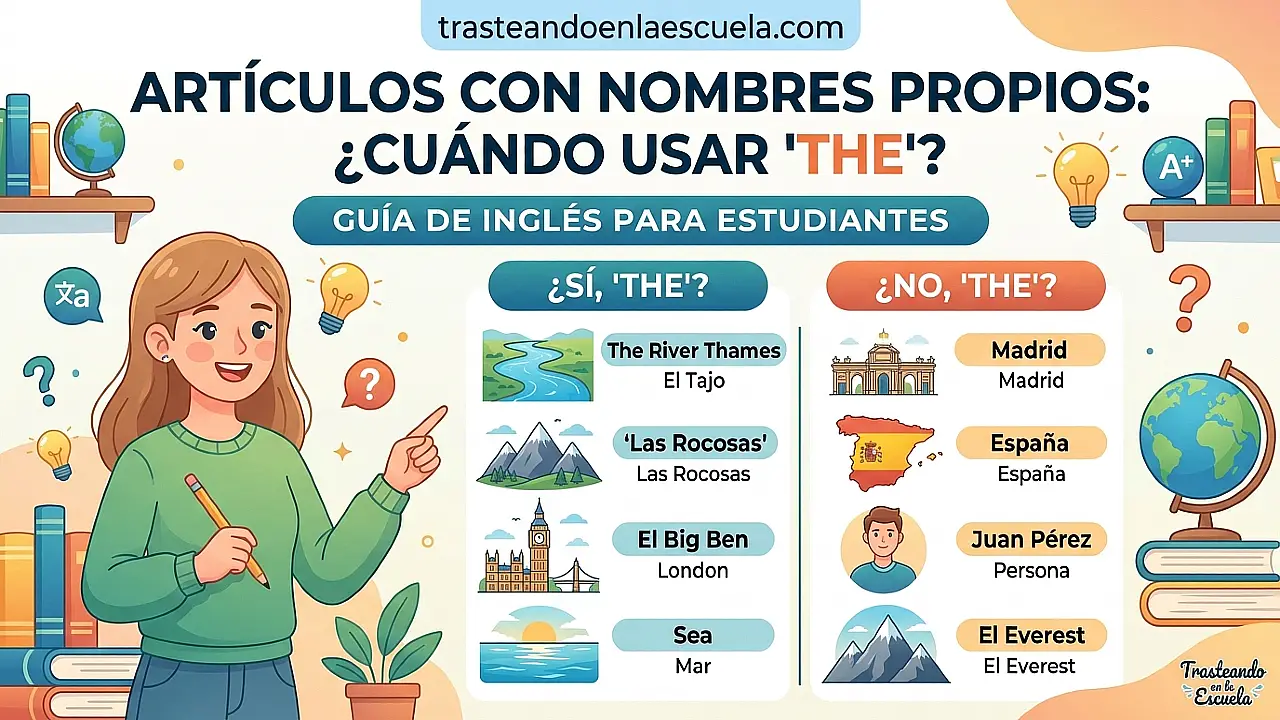
Artículos con nombres propios: El gran desafío del inglés
¿Por qué decimos «the United States» pero no «the Spain»? ¿Por qué es «the Amazon» pero «Lake Victoria»? ¿Cuándo lleva THE un edificio famoso y cuándo no? El uso de artículos con nombres propios es una de las áreas más complejas del inglés porque está llena de reglas, subreglas y excepciones que no siempre siguen una lógica aparente. Sin embargo, conocer estos patrones es esencial para sonar natural y evitar errores que delaten que no eres nativo.
🎯 En este post aprenderás: Las reglas para usar THE (o no) con países, ciudades, accidentes geográficos, edificios, personas, organizaciones y marcas. Incluye tablas visuales con todas las categorías, excepciones importantes y ejercicios prácticos.
🔍 ¿Por qué los nombres propios llevan o no artículo?
🧩 La lógica (o falta de ella) detrás de los artículos con nombres propios
En teoría, los nombres propios designan entidades únicas y por tanto no deberían necesitar artículo. Sin embargo, el inglés usa THE con ciertos nombres propios por razones históricas, etimológicas o simplemente porque el nombre incluye un sustantivo común.
NOMBRE PROPIO PURO (único por definición) → Ø (Zero Article)
NOMBRE PROPIO COMPUESTO (incluye sustantivo común descriptivo) → THE
Ejemplos:
Ø Spain (nombre propio puro) vs The United States (States = sustantivo común)
Ø Mount Everest (nombre propio puro) vs The Rocky Mountains (Mountains = sustantivo común)
🎭 La analogía del nombre y apellido
Piensa en los nombres propios como personas. «Mary» no necesita artículo porque es un nombre único. Pero «the Queen of England» sí lleva THE porque «Queen» es un título, un rol, un sustantivo común que describe una posición. Con los lugares funciona igual: «Paris» es un nombre único (Ø), pero «the City of Light» es una descripción que incluye un sustantivo común (City), así que lleva THE.
🌍 Países y territorios
Países que NO llevan THE
✅ REGLA: La mayoría de países NO llevan THE
Los nombres de países individuales, formados por una sola palabra o un nombre propio sin sustantivo común, van sin artículo.
- Ø Spain is in Europe.
- Ø France is famous for its cuisine.
- Ø China has the largest population.
- Ø Brazil won the World Cup.
- Ø Japan is an island nation.
- Ø Germany has a strong economy.
- Ø India is incredibly diverse.
- Ø Canada is bilingual.
- Ø Australia is a continent.
- Ø Argentina is in South America.
Países que SÍ llevan THE
⚠️ EXCEPCIONES: Países y territorios que llevan THE
Llevan THE los países y territorios cuyos nombres incluyen un sustantivo común como «States», «Kingdom», «Republic», «Union», «Emirates», o que son nombres compuestos o plurales.
| País / Territorio | Motivo (sustantivo común incluido) |
|---|---|
| The United States (of America) | «States» es un sustantivo común |
| The United Kingdom | «Kingdom» es un sustantivo común |
| The Czech Republic | «Republic» es un sustantivo común |
| The Dominican Republic | «Republic» es un sustantivo común |
| The United Arab Emirates | «Emirates» es un sustantivo común |
| The Netherlands | Nombre plural («tierras bajas») |
| The Philippines | Nombre plural (grupo de islas) |
| The Gambia | Excepción histórica (río Gambia) |
| The Bahamas | Nombre plural (archipiélago) |
| The Maldives | Nombre plural (archipiélago) |
💡 Truco para países: Si el nombre del país no contiene un sustantivo común como «Republic», «Kingdom», «States», «Union» o «Emirates», lo más probable es que NO lleve THE. Si el país está en plural (Netherlands, Philippines, Bahamas), SÍ lleva THE.
🏙️ Ciudades, pueblos y estados
✅ REGLA: Las ciudades, pueblos y estados/provincias NO llevan THE
Salvo contadísimas excepciones, los nombres de asentamientos humanos van sin artículo.
✅ ZERO ARTICLE
- Ø London
- Ø New York
- Ø Tokyo
- Ø Paris
- Ø Madrid
- Ø Sydney
- Ø Buenos Aires
- Ø California
- Ø Texas
- Ø Ontario
⚠️ EXCEPCIONES (THE)
- The Hague (La Haya)
- The Bronx (barrio de NYC)
- The Vatican (se usa a veces)
¡Muy pocas excepciones! La Haya es la más importante.
🏔️ Accidentes geográficos
Montañas y cordilleras
MONTAÑAS INDIVIDUALES → Ø
- Ø Mount Everest
- Ø Mount Fuji
- Ø Mount Kilimanjaro
- Ø Mont Blanc
- Ø K2
- Ø Denali
CORDILLERAS → THE
- The Alps
- The Andes
- The Himalayas
- The Rocky Mountains
- The Pyrenees
- The Atlas Mountains
Lógica: Una montaña individual es única (Ø), pero una cordillera es un conjunto con nombre plural o compuesto (THE).
Ríos, mares y océanos
✅ REGLA: Ríos, mares, océanos y canales SIEMPRE llevan THE
- The Amazon, the Nile, the Thames, the Mississippi
- The Mediterranean (Sea), the Red Sea, the Caribbean (Sea)
- The Pacific (Ocean), the Atlantic, the Indian Ocean
- The Panama Canal, the Suez Canal
Lagos
✅ REGLA: Los lagos NO llevan THE (con excepciones)
✅ ZERO ARTICLE
- Ø Lake Superior
- Ø Lake Victoria
- Ø Lake Michigan
- Ø Lake Titicaca
- Ø Lake Geneva
- Ø Loch Ness
⚠️ EXCEPCIONES (THE)
- The Great Salt Lake
- The Lake of Geneva
- The Lake District (región)
Si «Lake» va primero, sin THE. Si «Lake» va después, con THE.
Islas y archipiélagos
ISLAS INDIVIDUALES → Ø
- Ø Cuba
- Ø Sicily
- Ø Madagascar
- Ø Iceland
- Ø Greenland
- Ø Bali
- Ø Crete
ARCHIPIÉLAGOS → THE
- The Canary Islands
- The Balearic Islands
- The Bahamas
- The Philippines
- The Maldives
- The Seychelles
Desiertos, penínsulas y otras formaciones
- Desiertos → THE: the Sahara, the Gobi, the Kalahari, the Atacama
- Penínsulas → Ø (generalmente): Ø Iberian Peninsula, Ø Arabian Peninsula, Ø Florida
- Golfos y bahías → THE: the Gulf of Mexico, the Bay of Bengal
- Estrechos → THE: the Strait of Gibraltar, the Bosphorus
🏛️ Edificios, monumentos y lugares famosos
La regla del nombre compuesto
En general, los edificios y monumentos cuyo nombre incluye un sustantivo común descriptivo llevan THE. Los que son nombres propios puros no lo llevan.
✅ ZERO ARTICLE
- Ø Buckingham Palace
- Ø Westminster Abbey
- Ø Windsor Castle
- Ø Canterbury Cathedral
- Ø Carnegie Hall
- Ø Grand Central Station
- Ø Heathrow Airport
- Ø JFK Airport
⚠️ CON THE
- The White House
- The Empire State Building
- The Eiffel Tower
- The Taj Mahal
- The Colosseum
- The British Museum
- The Tate Gallery
- The Ritz (Hotel)
💡 Lógica subyacente: Si el nombre del edificio empieza con el nombre de una persona (Buckingham, Windsor, Carnegie) o un lugar (Westminster, Canterbury, Heathrow), suele ir sin THE. Si empieza con un adjetivo o sustantivo descriptivo (White, Empire State, Eiffel, British), suele llevar THE.
👤 Personas y títulos
Nombres de personas
✅ REGLA: Los nombres de personas NO llevan artículo
Nunca decimos «the Mary» o «the John» para referirnos a alguien por su nombre.
Títulos con nombre
TÍTULO + NOMBRE → Ø
- Ø Queen Elizabeth
- Ø President Biden
- Ø Doctor Smith
- Ø Professor Johnson
- Ø Captain America
- Ø Saint Patrick
TÍTULO SIN NOMBRE → THE
- The Queen
- The President
- The Doctor
- The Professor
- The Captain
- The Pope
🏢 Organizaciones, empresas y marcas
Organizaciones e instituciones
✅ ZERO ARTICLE
- Ø Google
- Ø Microsoft
- Ø Apple
- Ø Samsung
- Ø Toyota
- Ø Nike
- Ø Coca-Cola
⚠️ CON THE
- The United Nations
- The European Union
- The BBC
- The World Bank
- The Red Cross
- The New York Times
Hoteles, restaurantes y pubs
Muchos establecimientos hosteleros llevan THE, especialmente los de cierto prestigio o tradición.
- The Ritz, the Savoy, the Hilton (cuando se usa el nombre completo: The Hilton Hotel)
- The Ivy, the Fat Duck (restaurantes)
- The Red Lion, the Crown (pubs tradicionales británicos)
Museos, galerías y teatros
- Con THE: The British Museum, The Prado, The Louvre, The Tate, The Globe Theatre
- Sin THE: Ø MOMA (Museum of Modern Art), Ø Tate Modern
📊 Tabla resumen general
| Categoría | ¿THE o Ø? | Ejemplos |
|---|---|---|
| Países individuales | Ø | Spain, France, Japan, Brazil |
| Países con «States», «Kingdom», «Republic» | THE | The USA, The UK, The Czech Republic |
| Países plurales | THE | The Netherlands, The Philippines |
| Ciudades | Ø | London, Paris, Tokyo, Madrid |
| La Haya | THE | The Hague (excepción) |
| Montañas individuales | Ø | Mount Everest, Mount Fuji |
| Cordilleras | THE | The Alps, The Andes, The Himalayas |
| Ríos | THE | The Amazon, The Nile, The Thames |
| Mares y océanos | THE | The Pacific, The Mediterranean |
| Lagos (Lake + nombre) | Ø | Lake Victoria, Lake Superior |
| Islas individuales | Ø | Cuba, Sicily, Madagascar |
| Archipiélagos | THE | The Canary Islands, The Bahamas |
| Desiertos | THE | The Sahara, The Gobi |
| Pueblos y estados | Ø | California, Texas, Ontario |
| Castillos, palacios, abadías | Ø | Buckingham Palace, Windsor Castle |
| Edificios con adjetivo/sustantivo común | THE | The White House, The Eiffel Tower |
| Empresas y marcas | Ø | Google, Apple, Microsoft |
| Organizaciones con sustantivo común | THE | The United Nations, The EU |
🧪 5 Ejercicios para dominar los artículos con nombres propios
Ejercicio 1: Países y ciudades
Completa con THE o Ø (Zero Article):
- _____ Spain is a beautiful country.
- _____ United Kingdom voted to leave _____ European Union.
- She lives in _____ Netherlands.
- _____ Paris is the capital of _____ France.
- We visited _____ Czech Republic and _____ Germany.
- _____ Hague is a city in _____ Netherlands.
- _____ United States shares a border with _____ Canada.
- I’ve been to _____ Philippines and _____ Thailand.
✅ Ver solución
- Ø Spain is a beautiful country.
- The United Kingdom voted to leave the European Union.
- She lives in the Netherlands.
- Ø Paris is the capital of Ø France.
- We visited the Czech Republic and Ø Germany.
- The Hague is a city in the Netherlands.
- The United States shares a border with Ø Canada.
- I’ve been to the Philippines and Ø Thailand.
Ejercicio 2: Geografía física
Completa con THE o Ø:
- _____ Mount Everest is in _____ Himalayas.
- _____ Amazon River flows through _____ Brazil.
- _____ Lake Victoria is in _____ Africa.
- _____ Sahara Desert covers much of North Africa.
- She sailed across _____ Mediterranean Sea.
- _____ Canary Islands are off the coast of _____ Spain.
- _____ Mont Blanc is in _____ Alps.
- _____ Cuba is an island in _____ Caribbean Sea.
✅ Ver solución
- Ø Mount Everest is in the Himalayas.
- The Amazon River flows through Ø Brazil.
- Ø Lake Victoria is in Ø Africa.
- The Sahara Desert covers much of North Africa.
- She sailed across the Mediterranean Sea.
- The Canary Islands are off the coast of Ø Spain.
- Ø Mont Blanc is in the Alps.
- Ø Cuba is an island in the Caribbean Sea.
Ejercicio 3: Edificios y monumentos
Completa con THE o Ø:
- We visited _____ Eiffel Tower and _____ Louvre Museum.
- _____ Buckingham Palace is the residence of _____ Queen.
- _____ Empire State Building is in _____ New York.
- Tourists love _____ Westminster Abbey.
- _____ White House was built in the 18th century.
- Flights arrive at _____ Heathrow Airport.
- _____ Ritz is a famous hotel in London.
- _____ Tate Modern is a popular art gallery.
✅ Ver solución
- We visited the Eiffel Tower and the Louvre Museum.
- Ø Buckingham Palace is the residence of the Queen.
- The Empire State Building is in Ø New York.
- Tourists love Ø Westminster Abbey.
- The White House was built in the 18th century.
- Flights arrive at Ø Heathrow Airport.
- The Ritz is a famous hotel in London.
- Ø Tate Modern is a popular art gallery.
Ejercicio 4: Personas, títulos y organizaciones
Completa con THE o Ø:
- _____ Queen Elizabeth was crowned in 1953.
- _____ Pope lives in _____ Vatican.
- _____ United Nations was founded in 1945.
- I work for _____ Google.
- _____ Red Cross provides humanitarian aid.
- _____ New York Times published the story.
- _____ Microsoft and _____ Apple are tech giants.
- _____ Professor Williams teaches history.
✅ Ver solución
- Ø Queen Elizabeth was crowned in 1953. (Título + nombre)
- The Pope lives in Ø Vatican. (Título sin nombre + nombre propio puro)
- The United Nations was founded in 1945. (Organización con sustantivo común)
- I work for Ø Google. (Marca/empresa)
- The Red Cross provides humanitarian aid. (Organización con sustantivo común)
- The New York Times published the story. (Periódico con sustantivo común)
- Ø Microsoft and Ø Apple are tech giants. (Marcas/empresas)
- Ø Professor Williams teaches history. (Título + nombre)
Ejercicio 5: Corrección de errores
Encuentra y corrige los errores en estas oraciones:
- I’m from the Spain but I live in UK.
- We visited the Mount Fuji and the Lake Geneva.
- The Canaries are a popular destination in the Spain.
- She met the Queen Elizabeth at the Buckingham Palace.
- The Amazon flows through the Brazil.
- He works for the Microsoft in the California.
- We stayed at the Ritz Hotel in the Paris.
- The Cuba is an island in Caribbean.
✅ Ver solución
- I’m from Ø Spain but I live in the UK.
- We visited Ø Mount Fuji and Ø Lake Geneva.
- Ø The Canaries are a popular destination in Ø Spain.
- She met Ø Queen Elizabeth at Ø Buckingham Palace.
- The Amazon flows through Ø Brazil.
- He works for Ø Microsoft in Ø California.
- We stayed at the Ritz Hotel in Ø Paris.
- Ø Cuba is an island in the Caribbean.
📖 Glosario de términos
| Término | Definición | Ejemplo |
|---|---|---|
| Proper noun | Nombre propio (entidad única) | Mary, Spain, Google |
| Common noun | Sustantivo común (categoría general) | state, republic, mountain, river |
| Compound name | Nombre compuesto con sustantivo común | The United States, The White House |
| Plural name | Nombre en plural (grupo o conjunto) | The Netherlands, The Philippines |
| Title + Name | Título seguido de nombre propio (sin THE) | Queen Elizabeth, Doctor Smith |
| Title without Name | Título sin nombre propio (con THE) | The Queen, The President |
| Mountain range | Cordillera (conjunto de montañas, con THE) | The Alps, The Andes |
| Archipelago | Archipiélago (grupo de islas, con THE) | The Canary Islands, The Bahamas |
📚 Serie completa: Artículos en inglés
Completa tu dominio de los artículos con toda la serie:
- A vs An: cuándo usar cada uno – La regla del sonido para el artículo indefinido.
- The: artículo definido – Cuándo usar THE y cuándo omitirlo.
- No article: cuándo no usar – Los casos del Zero Article en profundidad.
- Artículos con nombres propios – ¡Estás aquí! Reglas para países, lugares y personas.
- Ejercicios artículos – Práctica combinada de todos los artículos.
🏆 Reto de geografía inglesa: Domina los nombres propios
Durante una semana, practica con los nombres propios de forma activa:
- Día 1: Coge un mapa del mundo y nombra 10 países. ¿Cuáles llevan THE?
- Día 2: Nombra 5 ríos famosos (todos con THE) y 5 montañas famosas (todas con Ø).
- Día 3: Haz una lista de 10 edificios famosos. Sepáralos en dos columnas: THE y Ø.
- Día 4: Escribe 5 frases con títulos (Queen…, President…).
- Día 5: Nombra 5 mares u océanos (con THE) y 5 lagos (con Ø, Lake…).
- Día 6: Escribe un párrafo sobre un viaje imaginario usando al menos 8 nombres propios.
- Día 7: Revisa noticias en inglés y anota 10 nombres propios con su artículo correspondiente.
¡Los nombres propios ya no tendrán secretos para ti!





Publicar comentario