Reported Speech con preguntas y órdenes
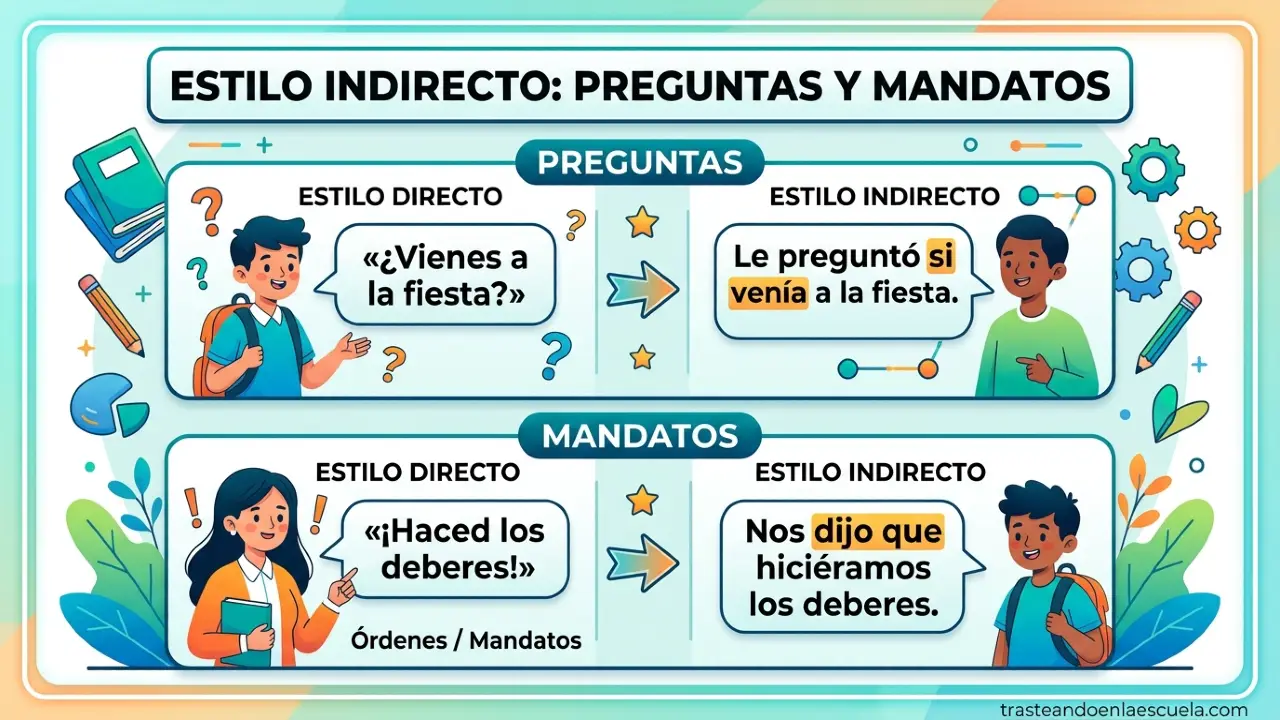
Reportando preguntas y órdenes: más allá de las afirmaciones
Cuando necesitas contar lo que alguien preguntó u ordenó, las reglas cambian. No es lo mismo reportar «I am tired» que «Are you tired?» o «Sit down!». En este post aprenderás a transformar preguntas (yes/no y wh-questions) y órdenes en reported speech, manteniendo el significado y la gramática correcta.
🎯 En este post aprenderás: La estructura para preguntas (ask + if/whether), el orden de las palabras en wh-questions, cómo cambiar imperativos a infinitivo (tell/order + to), y 5 ejercicios completos con preguntas y órdenes.
🔍 Preguntas en Reported Speech
❓ Dos tipos: Yes/No questions y Wh-questions
En estilo indirecto, las preguntas dejan de ser interrogativas y se convierten en afirmativas. No usamos signos de interrogación ni el verbo auxiliar delante del sujeto. El verbo introductorio más común es ask (también wonder, want to know).
1️⃣ Yes/No questions (preguntas de sí/no)
Estructura: ask + (objeto) + if / whether + sujeto + verbo (con backshift si el reporting verb está en pasado).
| Directo | Indirecto |
|---|---|
| «Do you like coffee?» he asked. | He asked if I liked coffee. |
| «Are you coming?» she said. | She asked whether I was coming. |
| «Has he finished?» they asked. | They asked if he had finished. |
Diferencia entre if y whether: Whether es más formal y se usa a menudo cuando hay alternativas o después de preposiciones. Ejemplo: He asked whether (or not) I liked coffee.
2️⃣ Wh-questions (preguntas con partícula)
Estructura: ask + (objeto) + wh-word + sujeto + verbo (sin inversión del sujeto y verbo auxiliar). La wh-word (what, where, when, why, how, etc.) se mantiene.
| Directo | Indirecto |
|---|---|
| «Where do you live?» he asked. | He asked where I lived. |
| «What time is it?» she said. | She asked what time it was. |
| «Why did you leave?» they asked. | They asked why I had left. |
⚠️ Atención al orden: En las preguntas indirectas, el sujeto va antes del verbo, como en una afirmación. No decimos He asked where did I live sino He asked where I lived.
📢 Órdenes, peticiones y consejos en Reported Speech
Para reportar imperativos (órdenes, mandatos, instrucciones, consejos), usamos tell / order / ask / advise / warn + (objeto) + to + infinitivo. Si la orden es negativa, añadimos not antes del infinitivo.
| Tipo de imperativo | Estructura | Ejemplo directo | Ejemplo indirecto |
|---|---|---|---|
| Orden afirmativa | tell + persona + to + infinitivo | «Sit down,» he said. | He told me to sit down. |
| Orden negativa | tell + persona + not + to + infinitivo | «Don’t touch that,» she said. | She told me not to touch that. |
| Petición | ask + persona + to + infinitivo | «Please help me,» he said. | He asked me to help him. |
| Consejo | advise + persona + to + infinitivo | «You should see a doctor,» she said. | She advised me to see a doctor. |
| Advertencia | warn + persona + not + to + infinitivo | «Don’t go alone,» he said. | He warned me not to go alone. |
🧪 Ejemplo combinado: El jefe dijo: «Finish the report and don’t be late.»
Indirecto: The boss told us to finish the report and not to be late.
⚙️ Aplicación del backshift en preguntas
Las reglas de cambio de tiempo verbal también se aplican en preguntas indirectas exactamente igual que en afirmaciones. Observa:
- «Do you work?» → He asked if I worked.
- «Did you go?» → He asked if I had gone.
- «Will she come?» → He asked if she would come.
🧪 5 Ejercicios: preguntas y órdenes
Ejercicio 1: Yes/No questions
Convierte a reported speech usando «ask».
- «Do you speak English?» the tourist asked me.
- «Are they coming to the party?» she asked.
- «Have you seen my keys?» he asked his wife.
- «Will it rain tomorrow?» we asked the farmer.
- «Can you help me?» the boy asked the stranger.
✅ Ver solución
- The tourist asked me if I spoke English.
- She asked whether they were coming to the party.
- He asked his wife if she had seen his keys.
- We asked the farmer if it would rain the next day.
- The boy asked the stranger if he could help him.
Ejercicio 2: Wh-questions
- «Where is the nearest station?» the man asked.
- «What time does the movie start?» they asked.
- «Why did you quit your job?» his friend asked.
- «How much does this cost?» the customer asked.
- «Who broke the window?» the teacher asked.
✅ Ver solución
- The man asked where the nearest station was.
- They asked what time the movie started.
- His friend asked why he had quit his job.
- The customer asked how much that cost.
- The teacher asked who had broken the window.
Ejercicio 3: Órdenes y peticiones
- «Close the door,» he said to me.
- «Don’t be late,» my mother told me.
- «Please wait here,» the secretary said to us.
- «Take two pills a day,» the doctor said to the patient.
- «Don’t smoke in this area,» the guard warned us.
✅ Ver solución
- He told me to close the door.
- My mother told me not to be late.
- The secretary asked us to wait there.
- The doctor told the patient to take two pills a day.
- The guard warned us not to smoke in that area.
Ejercicio 4: Mezcla de preguntas y órdenes
- «Can you lend me some money?» he asked me. (pregunta)
- «Turn off your phones,» the teacher ordered the students.
- «Where did you buy that jacket?» she asked her friend.
- «Don’t touch the wet paint,» the artist said to the visitors.
- «Would you like to dance?» he asked her. (pregunta de sí/no)
✅ Ver solución
- He asked me if I could lend him some money.
- The teacher ordered the students to turn off their phones.
- She asked her friend where she had bought that jacket.
- The artist told the visitors not to touch the wet paint.
- He asked her if she would like to dance.
Ejercicio 5: Errores comunes – corrige
- She asked me where did I live.
- He told that sit down.
- They asked if was I ready.
- I asked him what time is it.
- The doctor advised me don’t smoke.
✅ Ver solución
- She asked me where I lived. (sin inversión)
- He told me to sit down. (falta objeto y «to»)
- They asked if I was ready. (sujeto antes del verbo)
- I asked him what time it was. (backshift)
- The doctor advised me not to smoke. (necesita «not to»)
❌ Errores frecuentes
| Error | Corrección |
|---|---|
| Mantener la inversión en wh-questions | «He asked where was the station» → «He asked where the station was» |
| Usar «if» o «whether» con wh-questions | «He asked if where I lived» → «He asked where I lived» |
| Olvidar el objeto con «tell» en órdenes | «He told to come» → «He told me to come» |
| Usar «said» para órdenes | «He said to sit down» (informal pero menos correcto) → «He told me to sit down» |








Publicar comentario