Ejercicios de voz pasiva en inglés resueltos (20 ejercicios)
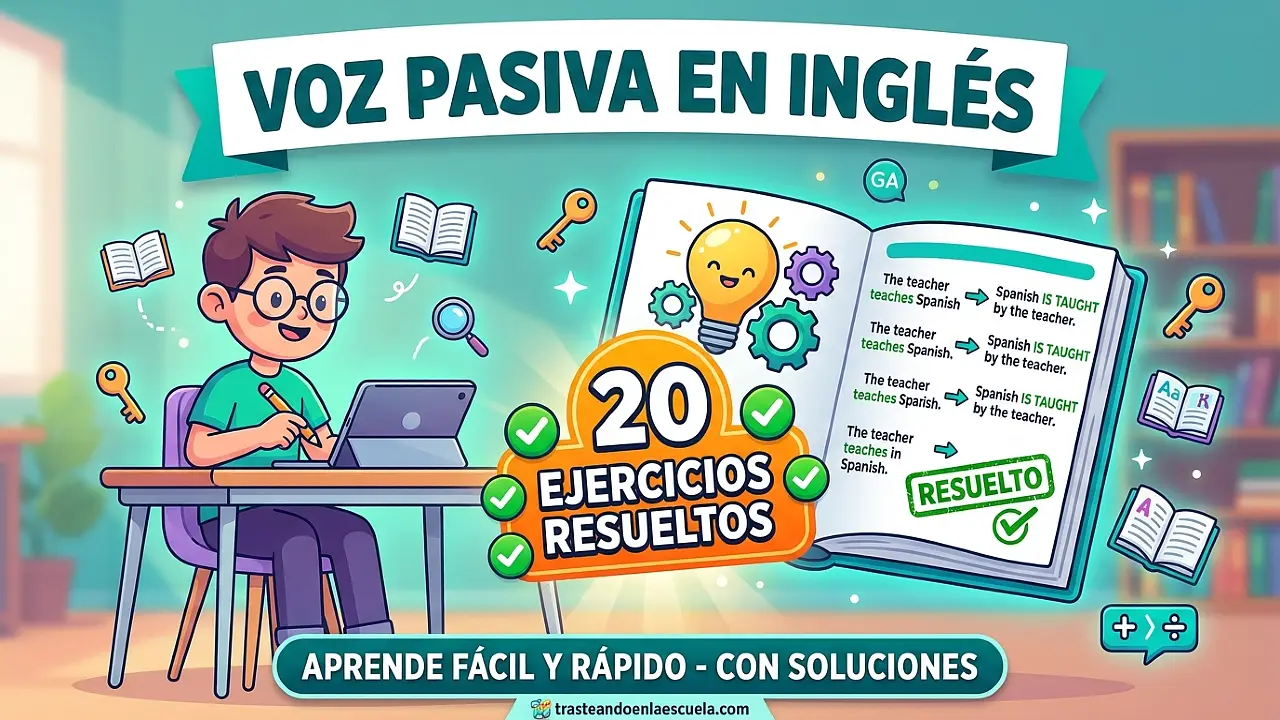
20 ejercicios de voz pasiva en inglés: ¡conviértete en un experto!
Has recorrido un largo camino: desde entender qué es la voz pasiva, pasando por todos los tiempos verbales, los verbos modales y la pasiva con doble objeto. Ahora es el momento de poner en práctica todo ese conocimiento con una batería de 20 ejercicios completos. Este post es tu campo de entrenamiento final para dominar la pasiva.
🎯 En este post encontrarás: 20 ejercicios que cubren todos los aspectos de la pasiva (transformaciones, elección de tiempo, modales, doble objeto, traducciones y un test final), soluciones detalladas con explicaciones, y consejos para seguir practicando.
🧪 Ejercicio 1: Transforma de activa a pasiva (presente simple y pasado simple)
Convierte las siguientes oraciones a voz pasiva.
- Someone cleans this office every day.
- They built a new school in our neighborhood.
- The waiter serves breakfast from 7 to 10 AM.
- Leonardo da Vinci painted the Mona Lisa.
- People speak Portuguese in Brazil.
✅ Ver solución
- This office is cleaned every day.
- A new school was built in our neighborhood.
- Breakfast is served from 7 to 10 AM (by the waiter).
- The Mona Lisa was painted by Leonardo da Vinci.
- Portuguese is spoken in Brazil.
🧪 Ejercicio 2: Transforma de activa a pasiva (presente continuo y pasado continuo)
- Someone is repairing the roof right now.
- They were building a new bridge when the earthquake hit.
- The chef is preparing a special dish for the guests.
- Someone was following me on my way home.
- The company is launching a new product this month.
✅ Ver solución
- The roof is being repaired right now.
- A new bridge was being built when the earthquake hit.
- A special dish is being prepared for the guests (by the chef).
- I was being followed on my way home.
- A new product is being launched this month (by the company).
🧪 Ejercicio 3: Transforma de activa a pasiva (presente perfecto y pasado perfecto)
- Someone has already eaten all the cookies.
- They had finished the project before the deadline.
- She has never visited that museum.
- Someone had cleaned the room before we arrived.
- The company has offered him a promotion.
✅ Ver solución
- All the cookies have already been eaten.
- The project had been finished before the deadline.
- That museum has never been visited (by her).
- The room had been cleaned before we arrived.
- He has been offered a promotion (by the company).
🧪 Ejercicio 4: Transforma de activa a pasiva (futuro con will y going to)
- They will announce the winners tomorrow.
- The company is going to launch a new app.
- Someone will fix your computer soon.
- They are going to build a hospital in this area.
- The president will give a speech tonight.
✅ Ver solución
- The winners will be announced tomorrow.
- A new app is going to be launched (by the company).
- Your computer will be fixed soon.
- A hospital is going to be built in this area.
- A speech will be given by the president tonight.
🧪 Ejercicio 5: Transforma de pasiva a activa
- The car was washed by my father.
- Spanish is spoken in many countries.
- The package will be delivered by the postman.
- The cake has been eaten by someone.
- The letter was being written by her when I called.
✅ Ver solución
- My father washed the car.
- People speak Spanish in many countries.
- The postman will deliver the package.
- Someone has eaten the cake.
- She was writing the letter when I called.
🧪 Ejercicio 6: Completa con la forma pasiva correcta (verbos entre paréntesis)
- English __________ (speak) all over the world.
- The museum __________ (visit) by thousands of tourists last year.
- A new hospital __________ (build) in our city right now.
- The letters __________ (already/send).
- The problem __________ (solve) by the time you arrive.
✅ Ver solución
- is spoken
- was visited
- is being built
- have already been sent
- will have been solved
🧪 Ejercicio 7: Elige la opción correcta (tiempos verbales)
- The bridge __________ in 1920.
a) is built b) was built c) has been built - The documents __________ by the assistant right now.
a) are typed b) are being typed c) have been typed - All the tickets __________ by the time we arrived.
a) were sold b) had been sold c) have been sold - The results __________ next Monday.
a) will be announced b) will announce c) are being announced - Your suitcase __________ yet. Please wait.
a) hasn’t been checked b) wasn’t checked c) isn’t checked
✅ Ver solución
- b) was built (fecha concreta en el pasado)
- b) are being typed (right now = presente continuo)
- b) had been sold (by the time we arrived = past perfect)
- a) will be announced (future will)
- a) hasn’t been checked (yet = presente perfecto negativo)
🧪 Ejercicio 8: Pasiva con verbos modales (presente/futuro)
- You must finish this report today. → ________________________________
- Someone can fix the computer. → ________________________________
- You should take this medicine twice a day. → ________________________________
- They may cancel the event. → ________________________________
- You need to water the plants. → ________________________________
✅ Ver solución
- This report must be finished today.
- The computer can be fixed.
- This medicine should be taken twice a day.
- The event may be cancelled.
- The plants need to be watered.
🧪 Ejercicio 9: Pasiva con verbos modales (pasado: modal + have been + past participle)
- Someone must have stolen the painting. → ________________________________
- You should have told her the truth. → ________________________________
- They could have rescued the hikers. → ________________________________
- Someone might have left the door open. → ________________________________
- The company would have launched the product. → ________________________________
✅ Ver solución
- The painting must have been stolen.
- The truth should have been told to her.
- The hikers could have been rescued.
- The door might have been left open.
- The product would have been launched.
🧪 Ejercicio 10: Pasiva de doble objeto (persona como sujeto)
- They gave me a beautiful present. → ________________________________
- The teacher told the students a legend. → ________________________________
- Someone has sent her an anonymous letter. → ________________________________
- The company will offer him a better position. → ________________________________
- My grandmother taught me this recipe. → ________________________________
✅ Ver solución
- I was given a beautiful present.
- The students were told a legend.
- She has been sent an anonymous letter.
- He will be offered a better position.
- I was taught this recipe (by my grandmother).
🧪 Ejercicio 11: Pasiva de doble objeto (cosa como sujeto)
- They gave me a beautiful present. → ________________________________
- Someone has sent her an anonymous letter. → ________________________________
- The company will offer him a better position. → ________________________________
- She bought her daughter a new laptop. → ________________________________
- The chef made us a delicious cake. → ________________________________
✅ Ver solución
- A beautiful present was given to me.
- An anonymous letter has been sent to her.
- A better position will be offered to him.
- A new laptop was bought for her daughter. (for)
- A delicious cake was made for us. (for)
🧪 Ejercicio 12: Completa con la pasiva (verbos preposicionales)
Recuerda que la preposición se queda junto al verbo.
- The child __________ (look after) by his grandmother.
- This idea __________ (laugh at) by everyone.
- The patients __________ (operate on) by Dr. Smith.
- That issue __________ (not/deal with) yet.
- The missing keys __________ (search for) everywhere.
✅ Ver solución
- is looked after
- was laughed at (o is laughed at, según contexto)
- were operated on (o are operated on)
- hasn’t been dealt with
- have been searched for
🧪 Ejercicio 13: Traducción del español al inglés (pasiva)
- Se habla inglés en todo el mundo.
- Mi teléfono fue robado la semana pasada.
- La cena está siendo preparada ahora mismo.
- Este problema debería ser resuelto lo antes posible.
- Me ofrecieron un trabajo interesante, pero lo rechacé.
✅ Ver solución
- English is spoken all over the world.
- My phone was stolen last week.
- Dinner is being prepared right now.
- This problem should be solved as soon as possible.
- I was offered an interesting job, but I turned it down.
🧪 Ejercicio 14: Más traducciones
- Las cartas ya han sido enviadas.
- Se me dijo que esperara en la sala.
- El museo será cerrado por reformas el próximo mes.
- ¿Te han mostrado las nuevas instalaciones?
- Se debe haber perdido el paquete durante el transporte.
✅ Ver solución
- The letters have already been sent.
- I was told to wait in the room.
- The museum will be closed for renovations next month.
- Have you been shown the new facilities?
- The package must have been lost during transport.
🧪 Ejercicio 15: Identifica el error y corrige
Cada oración tiene un error. Escríbela correctamente.
- The book was wrote by J.K. Rowling.
- The house is build by workers.
- The letter has been send yesterday.
- The car was being repair when I saw it.
- The children are took to school by their mother.
✅ Ver solución
- The book was written by J.K. Rowling. (participio pasado de write es written)
- The house is built by workers. (participio pasado de build es built)
- The letter was sent yesterday. (yesterday requiere pasado simple, no presente perfecto)
- The car was being repaired when I saw it. (participio pasado repair → repaired)
- The children are taken to school by their mother. (participio pasado de take es taken)
🧪 Ejercicio 16: Preguntas en voz pasiva
Transforma las preguntas activas a pasivas.
- Did someone steal your car? → ________________________________
- Will they announce the results tomorrow? → ________________________________
- Has anyone seen my wallet? → ________________________________
- Why did they cancel the event? → ________________________________
- When will they deliver the package? → ________________________________
✅ Ver solución
- Was your car stolen?
- Will the results be announced tomorrow?
- Has my wallet been seen?
- Why was the event cancelled?
- When will the package be delivered?
🧪 Ejercicio 17: Oraciones negativas en pasiva
- Someone didn’t lock the door. → ________________________________
- They haven’t finished the job yet. → ________________________________
- You must not touch the paintings. → ________________________________
- People don’t use this road very often. → ________________________________
- The company won’t launch the product until next year. → ________________________________
✅ Ver solución
- The door wasn’t locked.
- The job hasn’t been finished yet.
- The paintings must not be touched.
- This road isn’t used very often.
- The product won’t be launched until next year.
🧪 Ejercicio 18: Texto completo para transformar a pasiva
Transforma todo el texto a voz pasiva. (Mantén el mismo tiempo)
Someone built this house in 1985. They designed it with a modern style. The owners have renovated it twice. They will paint the exterior next summer. Someone planted a beautiful garden in front of it.
✅ Ver solución
This house was built in 1985. It was designed with a modern style. It has been renovated twice (by the owners). The exterior will be painted next summer. A beautiful garden was planted in front of it.
🧪 Ejercicio 19: Completa con la pasiva (todos los tiempos mezclados)
- This photo __________ (take) by my grandfather many years ago.
- The invitations __________ (send) next week.
- The car __________ (repair) at the moment, so we can’t use it.
- The missing dog __________ (find) yet.
- All the food __________ (eat) by the time we arrived.
- The instructions __________ (should/follow) carefully.
- I __________ (offer) the job, but I haven’t decided yet.
- The match __________ (play) when it started to rain.
- The documents __________ (sign) by the manager yesterday.
- Your application __________ (review) right now.
✅ Ver solución
- was taken
- will be sent
- is being repaired
- hasn’t been found
- had been eaten
- should be followed
- have been offered
- was being played
- were signed
- is being reviewed
🧪 Ejercicio 20: Test final (10 preguntas para evaluarte)
Elige la opción correcta en cada caso.
- The new library __________ last week.
a) opened b) was opened c) is opened - A Picasso painting __________ from the museum yesterday.
a) stole b) was stolen c) has been stolen - The documents __________ by the assistant right now.
a) are typing b) are being typed c) have been typed - This problem __________ very easily.
a) can solve b) can be solved c) can be solve - I __________ a strange noise last night.
a) was heard b) heard c) was hear - The results __________ by the time you come back.
a) will be announced b) will have been announced c) are announced - She __________ a beautiful dress for her birthday.
a) was given b) gave c) was giving - This letter __________ immediately.
a) must send b) must be sent c) must have sent - The children __________ to the park every Sunday.
a) take b) are taken c) have taken - Why __________ the meeting __________?
a) was / cancelled b) did / cancel c) was / cancelling
✅ Ver solución
- b) was opened
- b) was stolen
- b) are being typed
- b) can be solved
- b) heard (activa, porque «I» realiza la acción)
- b) will have been announced
- a) was given
- b) must be sent
- b) are taken
- a) was / cancelled
Puntuación: Cada respuesta correcta suma 1 punto. Si has obtenido 8-10: ¡experto! 5-7: necesitas repasar. Menos de 5: vuelve a leer los posts de la serie.
📈 Autoevaluación final: Suma tus aciertos de los 20 ejercicios. Si has acertado más del 80% (es decir, más de 16 de 20 en total, considerando que cada ejercicio tiene varios ítems), ¡felicidades! Dominas la voz pasiva en inglés. Si estás entre el 60% y el 80%, repasa los posts anteriores. Si es menos del 60%, te recomiendo volver a leer los posts y practicar con los ejercicios una segunda vez.
📚 Toda la serie sobre la voz pasiva
Repasa cualquier tema que necesites reforzar:
- La voz pasiva en inglés: qué es y cuándo usarla – Introducción y cuándo usarla.
- Cómo formar la pasiva en todos los tiempos verbales – Tablas completas.
- La pasiva con verbos modales en inglés – Modales en pasiva.
- Pasiva de doble objeto: give, send, show – Dos formas de construirla.
- Ejercicios de voz pasiva en inglés resueltos (20 ejercicios) – ¡Estás aquí!






Publicar comentario