Cómo formar la pasiva en todos los tiempos verbales
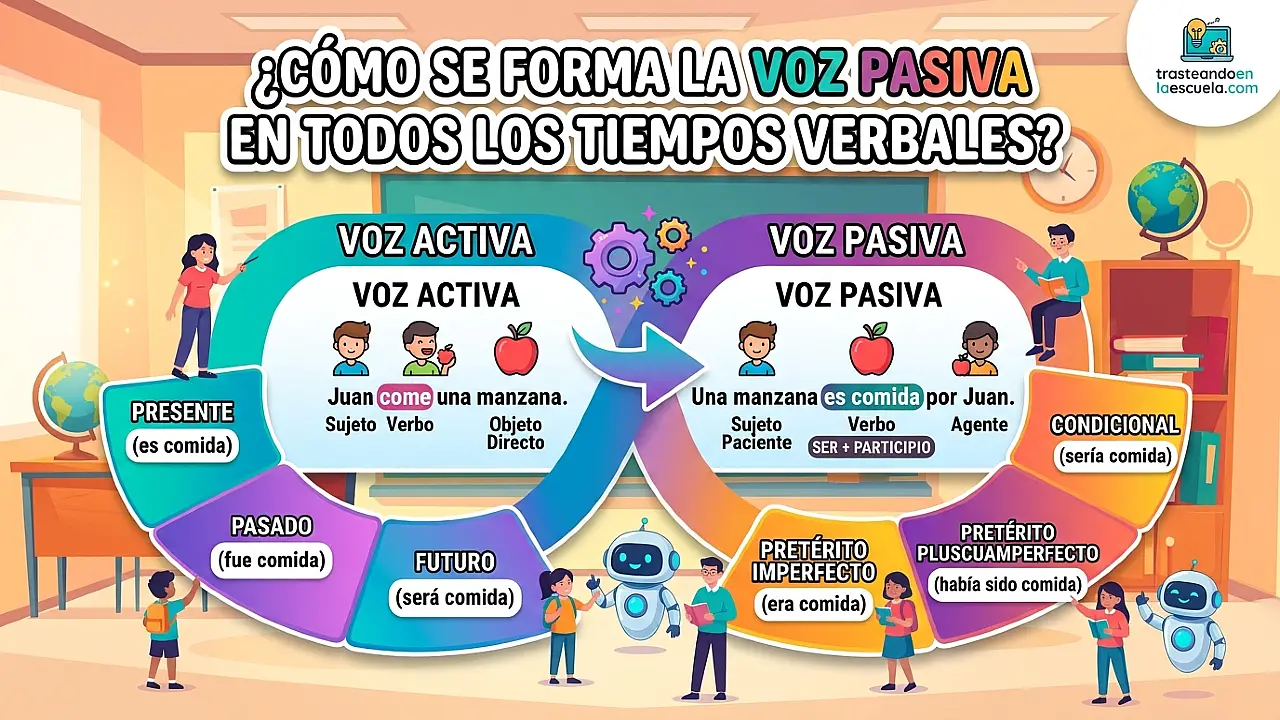
Voz pasiva en inglés: todos los tiempos verbales explicados
Una vez que entiendes la estructura básica de la voz pasiva (to be + past participle), el siguiente paso es aplicarla a todos los tiempos verbales. ¿Cómo se dice «The house is being built» (presente continuo) o «The letter had been sent» (past perfect)? La clave está en conjugar el verbo «to be» en el mismo tiempo que el verbo de la oración activa.
🎯 En este post aprenderás: Tablas completas con la forma pasiva de cada tiempo verbal (presente, pasado, futuro, perfectos y continuos), ejemplos claros con su versión activa, diferencias sutiles entre tiempos similares y ejercicios para practicar cada estructura.
📊 Tabla general: tiempos verbales en voz pasiva
Antes de ver cada tiempo por separado, aquí tienes una visión general de cómo se transforma el verbo «to be» y se añade el participio pasado.
| Tiempo verbal | Estructura pasiva | Ejemplo (activa → pasiva) |
|---|---|---|
| Present Simple | am/is/are + past participle | Someone cleans the room. → The room is cleaned. |
| Past Simple | was/were + past participle | Someone cleaned the room. → The room was cleaned. |
| Present Continuous | am/is/are being + past participle | Someone is cleaning the room. → The room is being cleaned. |
| Past Continuous | was/were being + past participle | Someone was cleaning the room. → The room was being cleaned. |
| Present Perfect | has/have been + past participle | Someone has cleaned the room. → The room has been cleaned. |
| Past Perfect | had been + past participle | Someone had cleaned the room. → The room had been cleaned. |
| Future Simple (will) | will be + past participle | Someone will clean the room. → The room will be cleaned. |
| Future (going to) | am/is/are going to be + past participle | Someone is going to clean the room. → The room is going to be cleaned. |
| Future Perfect | will have been + past participle | Someone will have cleaned the room. → The room will have been cleaned. |
| Conditional (would) | would be + past participle | Someone would clean the room. → The room would be cleaned. |
| Conditional Perfect | would have been + past participle | Someone would have cleaned the room. → The room would have been cleaned. |
💡 Patrón inamovible: En todos los casos, el participio pasado (past participle) permanece igual. Lo único que cambia es la forma del verbo «to be». Si dominas la conjugación del verbo «to be» en cualquier tiempo, tienes el 90% del trabajo hecho.
🔹 1. Present Simple Pasivo
Se usa para hechos generales, rutinas o verdades universales en las que el foco está en la acción o en el objeto.
| Activa | Pasiva |
|---|---|
| The chef prepares the food. | The food is prepared by the chef. |
| They sell fresh bread here. | Fresh bread is sold here. |
| Does someone clean this office every day? | Is this office cleaned every day? |
🔹 2. Past Simple Pasivo
Para acciones completas en el pasado donde el resultado o el objeto receptor es más importante que quién realizó la acción.
| Activa | Pasiva |
|---|---|
| Columbus discovered America in 1492. | America was discovered by Columbus in 1492. |
| Someone stole my bike. | My bike was stolen. |
🔹 3. Present Continuous Pasivo
Para acciones que están ocurriendo en este mismo momento. La forma «being» es esencial: sin ella, sería presente simple.
| Activa | Pasiva |
|---|---|
| The workers are building a new school. | A new school is being built. |
| They are fixing my car right now. | My car is being fixed right now. |
⚠️ Atención: «is being» ≠ «is». The house is built (se construye, generalmente) vs The house is being built (se está construyendo ahora mismo).
🔹 4. Past Continuous Pasivo
Para acciones que estaban en desarrollo en un momento específico del pasado.
| Activa | Pasiva |
|---|---|
| They were painting the house when I arrived. | The house was being painted when I arrived. |
| Someone was following me. | I was being followed. |
🔹 5. Present Perfect Pasivo
Para acciones pasadas con relevancia en el presente, o experiencias sin especificar cuándo ocurrieron.
| Activa | Pasiva |
|---|---|
| Someone has eaten all the cookies. | All the cookies have been eaten. |
| The company has fired 20 employees. | 20 employees have been fired. |
🔹 6. Past Perfect Pasivo
Para acciones que ocurrieron antes de otra acción en el pasado. Es el «pasado del pasado».
| Activa | Pasiva |
|---|---|
| They had already sold the tickets. | The tickets had already been sold. |
| She had finished the report before the meeting. | The report had been finished before the meeting. |
🔹 7. Futuro Simple (will) Pasivo
Para predicciones, promesas o decisiones espontáneas en el futuro.
| Activa | Pasiva |
|---|---|
| The president will announce the new law. | The new law will be announced by the president. |
| They will deliver the package tomorrow. | The package will be delivered tomorrow. |
🔹 8. Futuro (going to) Pasivo
Para planes o intenciones ya decididas en el futuro.
| Activa | Pasiva |
|---|---|
| They are going to launch a new product. | A new product is going to be launched. |
🔹 9. Future Perfect Pasivo
Para acciones que ya se habrán completado en un momento futuro.
| Activa | Pasiva |
|---|---|
| By next month, they will have finished the project. | The project will have been finished by next month. |
🧪 5 Ejercicios prácticos para dominar la pasiva en todos los tiempos
Ejercicio 1: Identifica el tiempo de la pasiva
Indica qué tiempo verbal se ha usado en cada pasiva.
- The film is being shown at the cinema.
- The package had been opened before it arrived.
- More houses will be built next year.
- The letter has just been sent.
- My phone was stolen yesterday.
✅ Ver solución
- Present Continuous (is being shown)
- Past Perfect (had been opened)
- Future Simple (will) (will be built)
- Present Perfect (has been sent)
- Past Simple (was stolen)
Ejercicio 2: Completa con la forma pasiva correcta (verbos entre paréntesis)
- The emails __________ (send) every morning at 9 AM.
- A new shopping center __________ (build) in our town right now.
- The movie __________ (already/see) by most people.
- The results __________ (announce) next Monday.
- The old bridge __________ (repair) when the storm hit.
✅ Ver solución
- are sent (Present Simple)
- is being built (Present Continuous)
- has already been seen (Present Perfect)
- will be announced (Future will)
- was being repaired (Past Continuous)
Ejercicio 3: Transforma a pasiva manteniendo el mismo tiempo
- Someone is recording our conversation. → ________________________________
- They had already finished the work when I arrived. → ________________________________
- People use smartphones every day. → ________________________________
- The company will launch the new model in July. → ________________________________
- Someone has stolen all the money. → ________________________________
✅ Ver solución
- Our conversation is being recorded.
- The work had already been finished when I arrived.
- Smartphones are used every day.
- The new model will be launched in July.
- All the money has been stolen.
Ejercicio 4: Elige la opción correcta
- The documents __________ by the assistant right now.
a) are typed / b) are being typed / c) have been typed - By 2026, the new stadium __________.
a) will be completed / b) will have been completed / c) is completed - The cake __________ when we arrived at the party.
a) was eaten / b) had been eaten / c) was being eaten - This problem __________ to the committee yet.
a) hasn’t been reported / b) wasn’t reported / c) isn’t being reported - All the tickets __________ by the time we got there.
a) were sold / b) had been sold / c) have been sold
✅ Ver solución
- b) are being typed (right now = presente continuo)
- b) will have been completed (By 2026 + future perfect)
- c) was being eaten (cuando llegamos, la acción estaba en progreso)
- a) hasn’t been reported (yet = presente perfecto negativo)
- b) had been sold (by the time we got there = past perfect)
Ejercicio 5: Traduce al inglés usando la pasiva en el tiempo correcto
- Se habla inglés en todo el mundo. → ________________________________
- Están reparando mi coche en este momento. → ________________________________
- El informe ya ha sido entregado. → ________________________________
- La casa se estaba pintando cuando llegué. → ________________________________
- Las invitaciones se enviarán la próxima semana. → ________________________________
✅ Ver solución
- English is spoken all over the world.
- My car is being repaired at the moment.
- The report has already been delivered.
- The house was being painted when I arrived.
- The invitations will be sent next week.
📚 Sigue aprendiendo la voz pasiva
- La voz pasiva en inglés: qué es y cuándo usarla – Los fundamentos.
- Cómo formar la pasiva en todos los tiempos verbales – ¡Estás aquí!
- La pasiva con verbos modales en inglés – Estructura con can, must, etc.
- Pasiva de doble objeto: give, send, show – Dos formas de construir la pasiva.
- Ejercicios de voz pasiva en inglés resueltos – Práctica intensiva.






Publicar comentario