Singular y plural iguales en inglés: sheep, fish, deer y más
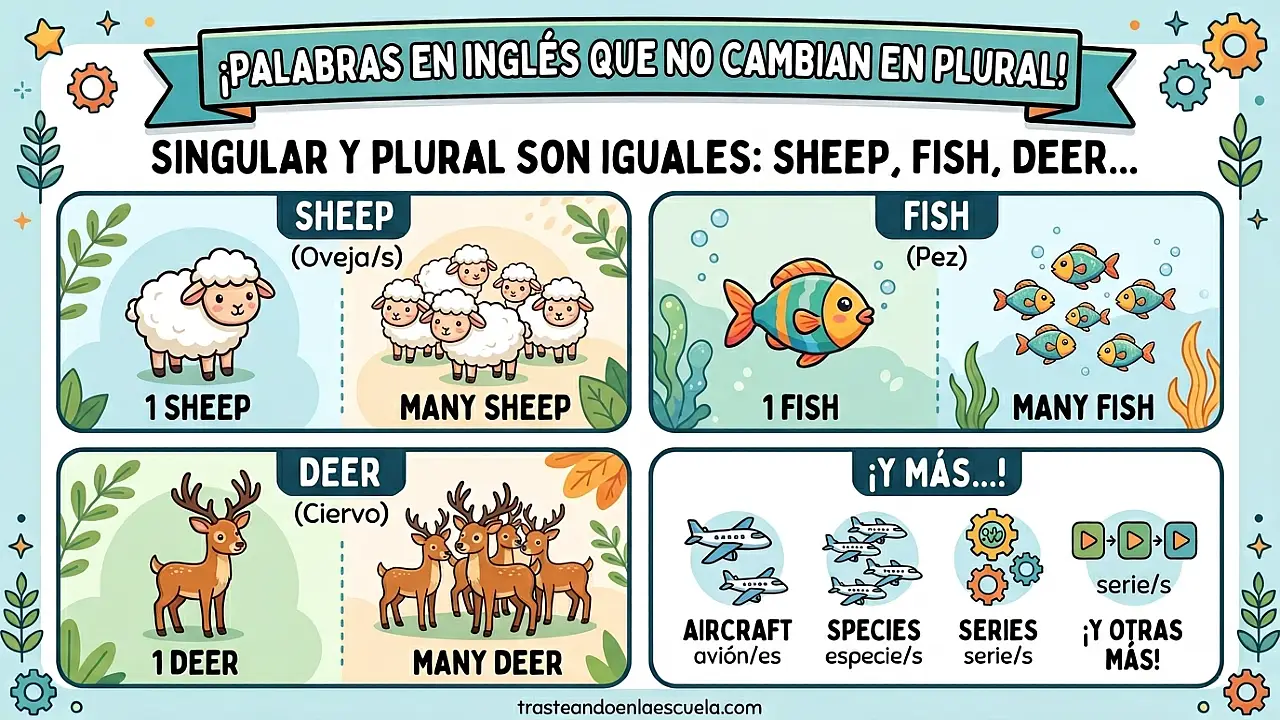
Singular y plural iguales: sheep, fish, deer… Las palabras que nunca cambian
¿Sabías que en inglés puedes decir «I have one sheep» y «I have ten sheep» usando exactamente la misma palabra? Existe un grupo de sustantivos que se niegan a cambiar en plural. Son palabras invariables: idénticas en singular y en plural. No añaden -s, -es, ni cambian sus vocales. Simplemente, permanecen igual. Este fenómeno desconcierta a muchos estudiantes, pero tiene su lógica. En este post te explicamos todo sobre estas palabras rebeldes.
🎯 En este post aprenderás: Qué son los plurales invariables, las 5 categorías principales (animales, palabras terminadas en -s, medidas, números y palabras extranjeras), excepciones y usos especiales, casos polémicos como «fish» vs «fishes», y 5 ejercicios para dominarlos.
🔍 ¿Qué son las palabras invariables (singular = plural)?
🟰 Misma forma, diferente número
Las palabras invariables son sustantivos que tienen la misma forma en singular y en plural. La diferencia entre «uno» y «varios» se entiende únicamente por el contexto: el artículo, el número, el verbo o los adjetivos que las acompañan.
one sheep (una oveja) → ten sheep (diez ovejas)
a deer (un ciervo) → many deer (muchos ciervos)
this species (esta especie) → these species (estas especies)
🔑 Clave: El contexto (artículos, números, demostrativos) indica si es singular o plural.
👥 La analogía del uniforme
Imagina un equipo donde todos los jugadores visten exactamente el mismo uniforme. No puedes distinguir si es un jugador o todo el equipo mirando solo la ropa. Necesitas fijarte en otros detalles: ¿hay un balón o varios? ¿El entrenador habla en singular o en plural? Así funcionan las palabras invariables: la palabra es el uniforme, no cambia. El contexto (números, verbos, determinantes) es lo que te dice si hablas de uno o de varios.
📋 Las 5 categorías de palabras invariables
🐾 CATEGORÍA 1: Animales (la más numerosa)
Muchos nombres de animales, especialmente aquellos que históricamente se cazaban o pescaban en grupo, tienen la misma forma en singular y plural. Es como si en inglés antiguo estos animales se vieran como «colectivos» por naturaleza.
| Animal (singular = plural) | Significado | Ejemplo en singular | Ejemplo en plural |
|---|---|---|---|
| sheep | oveja(s) | There is a sheep in the field. | There are fifty sheep in the flock. |
| deer | ciervo(s) | I saw a deer in the forest. | We saw ten deer yesterday. |
| fish | pez/peces | I caught a fish. | I caught five fish. |
| salmon | salmón/salmones | He ordered a salmon. | They caught twelve salmon. |
| trout | trucha(s) | I saw a trout in the river. | The river is full of trout. |
| cod | bacalao(s) | She bought a cod at the market. | Fishermen caught many cod. |
| squid | calamar(es) | I ate a squid. | We ate grilled squid. |
| shrimp | gamba(s)/camarón(es) | There’s a shrimp on the plate. | I ordered a pound of shrimp. |
| moose | alce(s) | A moose crossed the road. | Several moose live in these woods. |
| bison | bisonte(s) | We saw a bison. | A herd of bison roamed the plain. |
| swine | cerdo(s) (formal) | He called him a swine. | Those swine cheated us! |
| grouse | urogallo(s) | He shot a grouse. | They hunted grouse all day. |
⚠️ El caso polémico de «fish»: «Fish» es el plural normal e invariable cuando hablas de varios peces de la misma especie o en general. Pero existe el plural «fishes», que se usa en dos contextos muy específicos: (1) cuando hablas de diferentes especies de peces: «The aquarium has over 100 different fishes» (El acuario tiene más de 100 especies diferentes de peces). (2) En contextos científicos o de biología marina. En la conversación cotidiana, usa siempre «fish» para el plural: «I caught three fish» (no «three fishes»).
📏 CATEGORÍA 2: Palabras terminadas en -s (que parecen plurales pero no lo son)
Algunas palabras en inglés terminan en -s tanto en singular como en plural. Pueden ser confusas porque visualmente «parecen» plurales pero pueden funcionar como singular.
| Palabra (singular = plural) | Significado | Ejemplo singular | Ejemplo plural |
|---|---|---|---|
| species | especie(s) | This species is endangered. | Many species are at risk. |
| series | serie(s) | I love this TV series. | Netflix has many good series. |
| means | medio(s) | This means of transport is fast. | All means of communication failed. |
| headquarters | sede(s) central(es) | The headquarters is in London. | They have three headquarters. |
| crossroads | cruce(s) | Turn left at the crossroads. | London has many busy crossroads. |
| barracks | cuartel(es) | He lives in the barracks. | The army built new barracks. |
📝 Oraciones de ejemplo:
«This species of bird is rare.» (singular) / «Several species of birds migrate here.» (plural)
«The new TV series starts tonight.» (singular) / «I’ve watched ten series this year.» (plural)
«The most common means of travel is the car.» (singular) / «All means of travel have advantages.» (plural)
✈️ CATEGORÍA 3: Vehículos y medios de transporte con -craft
Todas las palabras compuestas que terminan en -craft (aeronave, nave) son invariables. No importa si es una o cien: la palabra no cambia.
| Palabra (singular = plural) | Significado | Ejemplo |
|---|---|---|
| aircraft | aeronave(s) | One aircraft landed. / Ten aircraft landed. |
| spacecraft | nave(s) espacial(es) | A spacecraft was launched. / Several spacecraft explored Mars. |
| watercraft | embarcación/embarcaciones | One watercraft / All watercraft must be registered. |
| hovercraft | aerodeslizador(es) | A hovercraft / Two hovercraft |
| aircraft carrier | portaaviones | The navy has one aircraft carrier. / The navy has five aircraft carriers. (¡Ojo! «carrier» sí tiene plural) |
💡 Importante: Las palabras terminadas en -craft son invariables cuando van solas o como parte de una palabra compuesta. Pero ojo: en «aircraft carrier», la palabra «aircraft» es invariable, pero «carrier» SÍ tiene plural: «aircraft carriers». En «aircraft», el plural es siempre «aircraft», nunca «aircrafts».
🧬 CATEGORÍA 4: Palabras de origen extranjero y términos científicos
Algunas palabras de origen latino, griego o francés conservan su forma invariable en inglés. Muchas son términos académicos. Para un estudio más profundo de estos casos, consulta nuestro post sobre plurales de palabras extranjeras.
| Palabra (singular = plural) | Significado | Ejemplo |
|---|---|---|
| offspring | descendiente(s), cría(s) | Her offspring is healthy. / All her offspring are doctors. |
| rendezvous | encuentro(s), cita(s) | The rendezvous is at noon. / We had several rendezvous. |
| corps | cuerpo(s) (militar/diplomático) | The Marine Corps / Three corps were deployed. |
| chassis | chasis | The car chassis is damaged. / The factory produces chassis. |
| bourgeois | burgués/burgueses | He is a bourgeois. / They are bourgeois. |
| patois | dialecto(s) | He speaks a patois. / Many patois exist in the region. |
🔢 CATEGORÍA 5: Números y medidas (casos especiales)
Ciertas palabras de cantidad o medida pueden funcionar como invariables en contextos específicos, especialmente después de números.
| Palabra | Uso invariable | Ejemplo | Uso variable |
|---|---|---|---|
| dozen | Después de número: «two dozen eggs» | I bought two dozen eggs. | «Dozens of people» (decenas de personas) |
| hundred | Después de número: «five hundred» | It costs five hundred dollars. | «Hundreds of people» (cientos de personas) |
| thousand | Después de número: «ten thousand» | Ten thousand people attended. | «Thousands of fans» (miles de fans) |
| million | Después de número: «three million» | Three million dollars. | «Millions of stars» (millones de estrellas) |
| pair | Después de número: «two pair of shoes» (informal) | I bought two pair of pants. | «Two pairs of shoes» (más formal) |
| foot | En medidas de altura: «six foot tall» | He is six foot tall. | «The table is six feet long» (también correcto) |
| stone | En peso británico: «ten stone» | He weighs twelve stone. | «He weighs twelve stones» (menos común) |
💡 Regla nemotécnica para números: Cuando un número concreto precede a hundred, thousand, million, dozen, estas palabras NO llevan -s. «Five hundred» (no «five hundreds»). Pero cuando se usan de forma indefinida, SÍ llevan -s: «hundreds of», «thousands of», «millions of», «dozens of». La presencia del número concreto marca la diferencia.
📊 Tabla completa: Todos los plurales invariables
| Categoría | Palabras | Característica |
|---|---|---|
| Animales | sheep, deer, fish, salmon, trout, cod, squid, shrimp, moose, bison, swine, grouse, plaice, pike | Animales de caza, pesca o ganadería |
| Terminados en -s | species, series, means, headquarters, crossroads, barracks, gallows | Parecen plurales por su -s final |
| -craft | aircraft, spacecraft, watercraft, hovercraft | Vehículos y medios de transporte |
| Extranjerismos | offspring, rendezvous, corps, chassis, bourgeois, patois | Origen latino, griego o francés |
| Números/medidas | dozen, hundred, thousand, million, pair, foot, stone | Invariables tras número concreto |
⚠️ Errores comunes con los plurales invariables
| Error | Forma incorrecta | Forma correcta | Explicación |
|---|---|---|---|
| Añadir -s a invariables | sheeps, deers, mooses, aircrafts | sheep, deer, moose, aircraft | Estas palabras nunca llevan -s en plural normal. |
| «Fishes» en contexto cotidiano | «I caught three fishes» | «I caught three fish» | Usa «fish» para el plural normal. «Fishes» solo para especies diferentes. |
| Pluralizar «species» | «That is a specie» | «That is a species» | «Specie» no existe (es dinero metálico). El singular es «species». |
| «Aircrafts» | «The airport has 50 aircrafts» | «The airport has 50 aircraft» | «Aircraft» es siempre invariable. «-Craft» no añade -s. |
| «A means» en plural | «There are several meanses of transport» | «There are several means of transport» | «Means» es invariable, igual en singular y plural. |
| Confundir «people» con «sheep» | Pensar que «sheep» funciona como «people» | «People» es plural de «person». «Sheep» es invariable. | Son conceptos diferentes: «people» es irregular (person→people), «sheep» es invariable (sheep→sheep). |
| Usar «a series» como plural | «These series is good» | «This series is good» (singular) o «These series are good» (plural) | El verbo y el demostrativo indican el número; «series» no cambia. |
🧠 Ejercicios prácticos
Ejercicio 1: Identifica si es singular o plural (nivel básico)
Indica si la palabra en negrita funciona como singular (S) o plural (P) en cada oración:
- There is a sheep in the garden. (S / P)
- The farmer has 200 sheep. (S / P)
- This species is very rare. (S / P)
- Several aircraft were grounded. (S / P)
- I saw a deer near the road. (S / P)
- The series was cancelled after one season. (S / P)
- He caught ten salmon in Alaska. (S / P)
- Headquarters is in New York. (S / P)
- Many fish swim in this river. (S / P)
- Their offspring are all very successful. (S / P)
✅ Ver solución
- There is a sheep → Singular (artículo «a» indica uno)
- 200 sheep → Plural (número 200 indica varios)
- This species is → Singular («this» + verbo en singular «is»)
- Several aircraft were → Plural («several» + verbo plural «were»)
- A deer → Singular (artículo «a»)
- The series was → Singular (verbo en singular «was» + «one season»)
- Ten salmon → Plural (número «ten»)
- Headquarters is → Singular (verbo en singular «is»)
- Many fish swim → Plural («many» + verbo plural «swim»)
- Their offspring are → Plural («their» + verbo plural «are» + «all»)
Ejercicio 2: Elige la opción correcta (nivel intermedio)
Selecciona la palabra correcta para completar la oración:
- I saw three __________ in the forest yesterday. (deer / deers)
- The zoo has over fifty different __________ of birds. (species / specie)
- How many __________ did you catch? (fish / fishes)
- There are several __________ at the airport right now. (aircraft / aircrafts)
- She bought two __________ eggs from the farm. (dozen / dozens)
- Several __________ were deployed to the disaster zone. (aircraft / aircrafts)
- This lake is full of __________. (trout / trouts)
- I’ve watched all the __________ on Netflix. (series / serieses)
- The __________ of transportation in this city are limited. (means / meanses)
- They have five __________ of shoes. (pair / pairs)
✅ Ver solución
- three deer (deer es invariable)
- fifty different species (species es invariable, «specie» no existe en este contexto)
- How many fish (plural normal cotidiano)
- several aircraft (aircraft es invariable)
- two dozen eggs (con número concreto, no lleva -s)
- Several aircraft (invariable)
- full of trout (trout es invariable)
- all the series (series es invariable)
- The means (means es invariable)
- five pairs of shoes (ambos son correctos, pero «pairs» es más formal)
Ejercicio 3: Completa con el verbo correcto (nivel intermedio)
Completa con la forma correcta del verbo «to be» (is/are) o «to have» (has/have) según corresponda:
- The sheep __________ in the field. (muchas ovejas)
- This species __________ endangered. (esta especie)
- The headquarters __________ located in three different cities. (las sedes)
- Aircraft __________ to be inspected every month. (todas las aeronaves)
- Her offspring __________ three children. (su descendencia)
- The series just __________ been renewed. (la serie, singular)
- Several fish __________ swimming in the tank. (varios peces)
- That deer __________ very large. (ese ciervo, singular)
- All means of communication __________ failed. (todos los medios)
- The crossroads __________ very dangerous. (ese cruce, singular)
✅ Ver solución
- The sheep are in the field. (plural: muchas ovejas)
- This species is endangered. (singular: «this» + una especie)
- The headquarters are located in three different cities. (plural: tres ciudades)
- Aircraft have to be inspected every month. (plural: todas)
- Her offspring has three children. (singular: «her» = su descendencia, una persona)
- The series has just been renewed. (singular: una serie)
- Several fish are swimming. (plural: «several»)
- That deer is very large. (singular: «that» + un ciervo)
- All means of communication have failed. (plural: «all»)
- The crossroads is very dangerous. (singular: un cruce en concreto)
Ejercicio 4: Corrige los errores (nivel avanzado)
Estas oraciones contienen errores. Identifíca y corrígelos:
- We saw three sheeps and two deers during our hike.
- The airport was full of different aircrafts from around the world.
- I’d like a dozen of eggs and two loafs of bread, please.
- These phenomenons are being studied by several different species of scientists.
- The salmons were jumping upstream, and the trouts were in the deeper pools.
- Two spacecrafts were launched, but only one arrived at Mars.
- How many different fishes did you see at the aquarium?
- This serie is my favorite because the means of production is amazing.
- The headquarter is in London, but they have many other offices.
- The mooses crossed the river while the bisons grazed nearby.
✅ Ver solución
- We saw three sheep and two deer during our hike.
- The airport was full of different aircraft from around the world.
- I’d like a dozen eggs and two loaves of bread, please. (loaf es irregular: loaf→loaves)
- These phenomena are being studied by several different species of scientists. (species es invariable, phenomenon→phenomena)
- The salmon were jumping upstream, and the trout were in the deeper pools.
- Two spacecraft were launched, but only one arrived at Mars.
- How many different fishes did you see at the aquarium? (¡Esta es correcta! Habla de especies diferentes de peces en un acuario)
- This series is my favorite because the means of production are amazing. (medios → plural)
- The headquarters is in London, but they have many other offices. (headquarters es invariable; si hubiera varias sedes: «The headquarters are…»)
- The moose crossed the river while the bison grazed nearby.
Ejercicio 5: Traducción y producción (nivel avanzado)
Traduce estas oraciones al inglés prestando especial atención a los plurales invariables:
- Hay tres ovejas en el prado y cinco ciervos en el bosque.
- Esta especie de pez está en peligro de extinción.
- Vi diez peces en el río esta mañana.
- Las naves espaciales fueron lanzadas desde la misma base.
- Compré dos docenas de huevos en el mercado.
- La sede central está en Tokio, pero tienen oficinas en todo el mundo.
- Los medios de comunicación modernos han cambiado nuestras vidas.
- Varios aviones aterrizaron durante la tormenta.
- Este cruce es muy peligroso; hay tres cruces similares en la ciudad.
- En el acuario tienen más de 200 especies diferentes de peces.
✅ Ver solución
- There are three sheep in the meadow and five deer in the forest.
- This species of fish is endangered.
- I saw ten fish in the river this morning.
- The spacecraft were launched from the same base.
- I bought two dozen eggs at the market.
- The headquarters is in Tokyo, but they have offices all over the world.
- Modern means of communication have changed our lives.
- Several aircraft landed during the storm.
- This crossroads is very dangerous; there are three similar crossroads in the city.
- The aquarium has over 200 different species of fishes. (Usamos «fishes» porque habla de especies diferentes)
📖 Glosario de términos
| Término | Definición | Ejemplo |
|---|---|---|
| Plural invariable | Sustantivo que tiene la misma forma en singular y en plural | sheep → sheep, deer → deer |
| Contexto | Información alrededor de la palabra que indica número | «This sheep» (singular) vs «These sheep» (plural) |
| Determinante | Palabra que precede al sustantivo indicando cantidad o posesión | a, an, the, this, that, these, those, my, your, many, several |
| Concordancia verbal | El verbo debe coincidir en número con el sujeto | «The sheep is…» (sg.) / «The sheep are…» (pl.) |
| -craft | Sufijo en palabras de vehículos que las hace invariables | aircraft, spacecraft, hovercraft |
| Colectivo | Sustantivo que designa un grupo de individuos | flock (rebaño), herd (manada), shoal (cardumen) |
🌍 Aplicaciones en la vida real
🐑 En el campo y la naturaleza
- «The shepherd has a flock of 500 sheep.» (El pastor tiene un rebaño de 500 ovejas.)
- «We spotted several deer at dawn.» (Avistamos varios ciervos al amanecer.)
- «This river is full of salmon during spawning season.» (Este río está lleno de salmones durante la temporada de desove.)
🛩️ En aeropuertos y transporte
- «All aircraft must undergo regular maintenance.» (Todas las aeronaves deben someterse a mantenimiento regular.)
- «Several spacecraft have successfully landed on Mars.» (Varias naves espaciales han aterrizado con éxito en Marte.)
- «Crossing the Channel by hovercraft takes about 30 minutes.» (Cruzar el Canal en aerodeslizador tarda unos 30 minutos.)
📺 En el entretenimiento
- «I’ve been watching three different series this month.» (He estado viendo tres series diferentes este mes.)
- «Netflix produces many original series every year.» (Netflix produce muchas series originales cada año.)
- «This series is my absolute favorite.» (Esta serie es mi favorita absoluta.)
📚 Serie completa: Plurales en inglés
Continúa aprendiendo sobre los plurales en inglés con nuestra serie:
- Plural regular: reglas -s, -es, -ies – Las reglas del plural regular con pronunciación.
- Plural irregular: lista completa – Más de 100 plurales irregulares clasificados en 7 patrones.
- Singular y plural iguales – ¡Estás aquí! Palabras invariables como sheep y fish.
- Plurales de palabras extranjeras – Latinismos y helenismos en profundidad.
- Ejercicios de plurales – Práctica general con todos los tipos.
También te pueden interesar:
- Sustantivos contables e incontables – Por qué «fish» es contable pero «rice» no.
- Concordancia sujeto-verbo en inglés – Cómo usar el verbo correcto con sustantivos invariables.
🐟 Plan de práctica de 3 días: Domina los plurales invariables
- Día 1 (Observación): Mira documentales de naturaleza en inglés (BBC Earth, National Geographic). Anota cada vez que escuches «sheep», «deer», «fish», «species» y fíjate en el contexto que indica si es singular o plural.
- Día 2 (Escritura): Escribe un párrafo describiendo una visita a un zoo o un acuario. Usa al menos 10 palabras invariables diferentes. Revisa que los verbos y determinantes concuerden correctamente.
- Día 3 (Habla): Grábate describiendo un día en el campo o un viaje en avión. Usa al menos 8 plurales invariables. Escucha la grabación y verifica que has usado las formas correctas.





Publicar comentario