Ejercicios de artículos en inglés: A, An, The y Zero Article
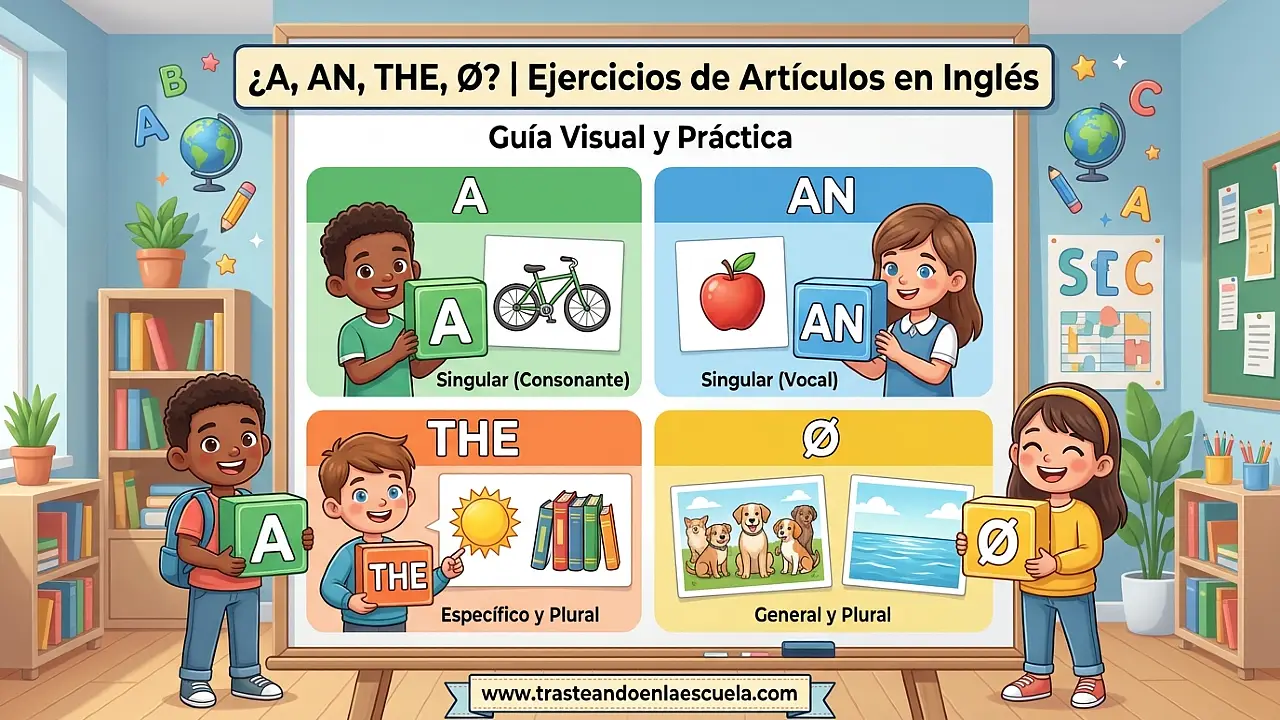
Ejercicios de artículos: Pon a prueba todo lo que sabes
Has llegado al post más práctico de la serie. Después de aprender las reglas de A vs An, los usos de The, cuándo aplicar el Zero Article y cómo funcionan los artículos con nombres propios, es el momento de ponerlo todo en práctica. Este post recopila 5 bloques de ejercicios de dificultad progresiva que integran todos los tipos de artículos, con soluciones detalladas y explicaciones para que entiendas cada respuesta.
🎯 En este post encontrarás: Ejercicios de nivel básico, intermedio y avanzado. Práctica combinada de A, An, The y Zero Article. Textos para completar, corrección de errores y ejercicios de traducción inversa. Todo con soluciones explicadas paso a paso.
📋 Repaso rápido: Las 4 opciones de artículos
Sonido consonante
a dog, a house
Sonido vocal
an apple, an hour
Específico / único
the sun, the book
General / nombres propios
Ø dogs, Ø Spain
💡 Antes de empezar: Recuerda las reglas clave de cada artículo. Si necesitas repasar algún concepto, visita los posts específicos de la serie:
- A vs An – La regla del sonido, no de la letra.
- The – Para algo específico, único o ya mencionado.
- Zero Article – Para generalizaciones, conceptos abstractos y muchos nombres propios.
- Artículos con nombres propios – Reglas para países, lugares y personas.
🧪 Bloque 1: Ejercicios de nivel básico
NIVEL BÁSICO Ejercicio 1: Completa con A, An, The o Ø
Completa las siguientes oraciones con el artículo correcto. Enfócate en la regla básica de A/An y en los usos fundamentales de The.
- I saw _____ cat in the garden. _____ cat was black.
- She is _____ teacher at the local school.
- Can you pass me _____ salt, please?
- He ate _____ apple and _____ banana for breakfast.
- _____ sun rises in _____ east.
- My brother is _____ engineer.
- We went to _____ cinema last night.
- That was _____ best movie I’ve ever seen.
- She has _____ dog and _____ cat.
- I need _____ hour to finish this work.
✅ Ver solución
- I saw a cat in the garden. The cat was black.
Primera mención → A. Segunda mención (ya conocido) → The. - She is a teacher at the local school.
Profesión, primera mención, sonido consonante /t/. - Can you pass me the salt, please?
La sal que está en la mesa, específica y conocida por ambos. - He ate an apple and a banana for breakfast.
Apple = sonido /æ/ (vocal) → AN. Banana = sonido /b/ (consonante) → A. - The sun rises in the east.
Sol y este son únicos → The. - My brother is an engineer.
Engineer = sonido /e/ (vocal) → AN. - We went to the cinema last night.
Cinema es un lugar específico en este contexto → The. - That was the best movie I’ve ever seen.
Superlativo (best) siempre lleva The. - She has a dog and a cat.
Dog = sonido /d/, cat = sonido /k/. Ambos consonantes → A. - I need an hour to finish this work.
Hour tiene H muda, suena /aʊər/ (vocal) → AN.
NIVEL BÁSICO Ejercicio 2: ¿A o An?
Elige entre A y An según el sonido inicial de cada palabra:
- _____ university
- _____ umbrella
- _____ honest person
- _____ horse
- _____ hour
- _____ European country
- _____ one-way street
- _____ X-ray
- _____ useful tool
- _____ uncle
✅ Ver solución
- A university (U = /ju:/, sonido consonante «yu»)
- An umbrella (U = /ʌ/, sonido vocal)
- An honest person (H muda, sonido /ɒ/)
- A horse (H sonora, sonido /h/)
- An hour (H muda, sonido /aʊ/)
- A European country (Eu = /jʊə/, sonido consonante)
- A one-way street (One = /wʌn/, sonido consonante)
- An X-ray (X = /eks/, sonido vocal)
- A useful tool (U = /ju:/, sonido consonante)
- An uncle (U = /ʌ/, sonido vocal)
🧪 Bloque 2: Ejercicios de nivel intermedio
NIVEL INTERMEDIO Ejercicio 3: The vs Zero Article
Completa con The o Ø (Zero Article). Presta atención a si hablas de algo general o específico:
- _____ dogs are more loyal than _____ cats.
- _____ dogs that live next door bark all night.
- _____ love is a beautiful thing.
- _____ love I feel for you is eternal.
- _____ water is essential for life.
- _____ water in this glass is warm.
- She speaks _____ French and _____ Italian.
- _____ English language is spoken worldwide.
- I go to _____ work by _____ bus.
- _____ breakfast is the most important meal of the day.
✅ Ver solución
- Ø Dogs are more loyal than Ø cats. (Generalización con plurales)
- The dogs that live next door bark all night. (Perros concretos, especificados)
- Ø Love is a beautiful thing. (Concepto abstracto general)
- The love I feel for you is eternal. (Amor concreto, especificado con «I feel for you»)
- Ø Water is essential for life. (Agua en general, incontable)
- The water in this glass is warm. (Agua concreta, especificada)
- She speaks Ø French and Ø Italian. (Idiomas sin artículo)
- The English language is spoken worldwide. («Language» es un sustantivo concreto especificado)
- I go to Ø work by Ø bus. (Trabajo en general + by + transporte)
- Ø Breakfast is the most important meal of the day. (Comida en general)
NIVEL INTERMEDIO Ejercicio 4: Texto para completar
Completa el siguiente texto con A, An, The o Ø según corresponda:
Yesterday was (a) _____ interesting day. I woke up early and had (b) _____ breakfast with my family. Then I took (c) _____ bus to (d) _____ city center. I visited (e) _____ British Museum, which is one of (f) _____ best museums in (g) _____ world. After that, I had (h) _____ lunch at (i) _____ Italian restaurant near (j) _____ museum. In (k) _____ afternoon, I met (l) _____ friend who is (m) _____ engineer. We went to (n) _____ cinema and watched (o) _____ movie about (p) _____ space exploration. It was (q) _____ most interesting film I’ve seen this year. On my way home, I saw (r) _____ owl in (s) _____ tree. (t) _____ owl was beautiful.
✅ Ver solución
Yesterday was an interesting day. I woke up early and had Ø breakfast with my family. Then I took the bus to the city center. I visited the British Museum, which is one of the best museums in the world. After that, I had Ø lunch at an Italian restaurant near the museum. In the afternoon, I met a friend who is an engineer. We went to the cinema and watched a movie about Ø space exploration. It was the most interesting film I’ve seen this year. On my way home, I saw an owl in a tree. The owl was beautiful.
📝 Explicación detallada:
- (a) an – Interesting empieza con sonido /ɪ/ (vocal) → AN
- (b) Ø – Breakfast en general, comida del día
- (c) the – «Tomé el bus», un bus concreto en mi rutina
- (d) the – El centro de la ciudad, específico
- (e) the – British Museum, edificio con adjetivo
- (f) the – Superlativo «best»
- (g) the – World es único
- (h) Ø – Lunch en general, comida del día
- (i) an – Italian empieza con sonido /ɪ/ (vocal)
- (j) the – El museo ya mencionado
- (k) the – «Por la tarde», expresión fija
- (l) a – Friend, primera mención, sonido /f/ (consonante)
- (m) an – Engineer, sonido /e/ (vocal)
- (n) the – Cinema, lugar específico
- (o) a – Movie, primera mención, sonido /m/ (consonante)
- (p) Ø – Space exploration en general, concepto abstracto
- (q) the – Superlativo «most interesting»
- (r) an – Owl, sonido /aʊ/ (vocal)
- (s) a – Tree, primera mención, sonido /t/ (consonante)
- (t) The – Owl ya mencionado anteriormente
🧪 Bloque 3: Ejercicios de nivel avanzado
NIVEL AVANZADO Ejercicio 5: Nombres propios y geografía
Completa con The o Ø. Pon a prueba tu conocimiento de nombres geográficos y propios:
- _____ United Kingdom is made up of four countries.
- _____ Mount Everest is in _____ Himalayas.
- _____ Thames flows through _____ London.
- I’ve always wanted to visit _____ Canary Islands.
- _____ Netherlands is famous for its tulips.
- She crossed _____ Atlantic Ocean by boat.
- _____ Lake Victoria is in _____ Africa.
- _____ Spain is a member of _____ European Union.
- _____ Sahara Desert is expanding.
- We visited _____ Buckingham Palace and _____ Tower of London.
- _____ Queen Elizabeth reigned for 70 years.
- _____ Pope lives in _____ Vatican City.
- _____ Amazon is the longest river in the world.
- They went skiing in _____ Alps.
- _____ Cuba is an island in _____ Caribbean.
✅ Ver solución
- The United Kingdom (nombre compuesto con «Kingdom»)
- Ø Mount Everest (montaña individual) is in the Himalayas (cordillera)
- The Thames (río) flows through Ø London (ciudad)
- I’ve always wanted to visit the Canary Islands (archipiélago)
- The Netherlands (país con nombre plural)
- She crossed the Atlantic Ocean (océano)
- Ø Lake Victoria (lago, Lake + nombre) is in Ø Africa (continente)
- Ø Spain (país individual) is a member of the European Union (organización con sustantivo común)
- The Sahara Desert (desierto)
- We visited Ø Buckingham Palace (nombre propio + Palace) and the Tower of London (nombre con «of»)
- Ø Queen Elizabeth (título + nombre propio)
- The Pope (título sin nombre) lives in Ø Vatican City (nombre propio)
- The Amazon (río)
- They went skiing in the Alps (cordillera)
- Ø Cuba (isla individual) is an island in the Caribbean (mar)
NIVEL AVANZADO Ejercicio 6: Corrección de errores
Las siguientes 15 oraciones contienen errores con los artículos. Encuéntralos y corrígelos:
- I’m studying the medicine at the university.
- The Mount Kilimanjaro is in the Tanzania.
- She speaks the Japanese and the Korean fluently.
- The love is more important than the money.
- He goes to the work by the car every day.
- We visited a Eiffel Tower and a Louvre last summer.
- The breakfast is served at 7 am in the hotel.
- I saw an unicorn in my dream last night.
- The Paris is a capital of the France.
- She plays the tennis and the basketball.
- He’s a honest businessman from United Kingdom.
- The nature is beautiful in spring.
- I need a advice about my career.
- The Queen Elizabeth II was born in London.
- We went to the Spain for holidays last year.
✅ Ver solución
- I’m studying Ø medicine at Ø university. (Asignatura sin artículo + universidad como actividad)
- Ø Mount Kilimanjaro is in Ø Tanzania. (Montaña y país individual sin artículo)
- She speaks Ø Japanese and Ø Korean fluently. (Idiomas sin artículo)
- Ø Love is more important than Ø money. (Conceptos abstractos generales)
- He goes to Ø work by Ø car every day. (Trabajo en general + by + transporte)
- We visited the Eiffel Tower and the Louvre last summer. (Edificios con nombre compuesto)
- Ø Breakfast is served at 7 am in the hotel. (Comida en general, aunque «the hotel» sí es correcto por ser específico)
- I saw a unicorn in my dream. (Unicorn = /ju:/, sonido consonante)
- Ø Paris is the capital of Ø France. (Ciudad y país sin artículo, «the capital» sí porque es única)
- She plays Ø tennis and Ø basketball. (Deportes sin artículo)
- He’s an honest businessman from the United Kingdom. (Honest con H muda + UK con THE)
- Ø Nature is beautiful in Ø spring. (Concepto abstracto + estación del año)
- I need Ø advice about my career. (Advice es incontable, no lleva A/An)
- Ø Queen Elizabeth II was born in Ø London. (Título + nombre y ciudad sin artículo)
- We went to Ø Spain for holidays. (País individual sin artículo)
🧪 Bloque 4: Ejercicios de traducción inversa
NIVEL AVANZADO Ejercicio 7: Traducción inversa
Traduce al inglés prestando especial atención a los artículos:
- El agua es esencial para la vida.
- Los perros son animales leales.
- La música que escuchamos ayer era preciosa.
- Estudio medicina en la universidad.
- El Monte Everest está en el Himalaya.
- Habla francés e italiano.
- Fui al cine con un amigo que es ingeniero.
- El amor es más fuerte que el odio.
- Visité el Museo Británico en Londres.
- El desayuno es la comida más importante del día.
✅ Ver solución
- Ø Water is essential for Ø life. (Ambos conceptos generales, incontables)
- Ø Dogs are loyal animals. (Generalización con plural)
- The music we listened to yesterday was beautiful. (Música concreta, especificada)
- I study Ø medicine at Ø university. (Asignatura + actividad universitaria)
- Ø Mount Everest is in the Himalayas. (Montaña individual + cordillera)
- He/She speaks Ø French and Ø Italian. (Idiomas sin artículo)
- I went to the cinema with a friend who is an engineer. (Lugar concreto + primeras menciones con A/An)
- Ø Love is stronger than Ø hate. (Conceptos abstractos generales)
- I visited the British Museum in Ø London. (Museo con THE + ciudad sin artículo)
- Ø Breakfast is the most important meal of the day. (Comida en general + superlativo + «the day» expresión fija)
🧪 Bloque 5: Ejercicio final integrador
NIVEL AVANZADO Ejercicio 8: Texto completo con todos los artículos
Completa el siguiente texto con el artículo correcto (A, An, The o Ø). Este ejercicio integra TODOS los tipos de artículos que has aprendido en la serie:
My name is Carlos and I’m (a) _____ student from (b) _____ Spain. I’m studying (c) _____ engineering at (d) _____ University of Madrid. (e) _____ engineering is (f) _____ fascinating subject, but it requires (g) _____ lot of dedication. Every morning, I have (h) _____ breakfast at 7 am and then I take (i) _____ bus to (j) _____ university. (k) _____ bus is usually crowded, so I listen to (l) _____ music during (m) _____ journey. Last summer, I visited (n) _____ United Kingdom with my family. We spent (o) _____ week in (p) _____ London and then traveled to (q) _____ Scotland. We visited (r) _____ Edinburgh Castle and saw (s) _____ Loch Ness, but we didn’t see (t) _____ monster! It was (u) _____ unforgettable experience. (v) _____ British people were very friendly, and I had (w) _____ opportunity to practice (x) _____ English. Next year, I want to visit (y) _____ United States or maybe (z) _____ Canada.
✅ Ver solución
My name is Carlos and I’m a student from Ø Spain. I’m studying Ø engineering at the University of Madrid. Ø Engineering is a fascinating subject, but it requires a lot of dedication. Every morning, I have Ø breakfast at 7 am and then I take the bus to Ø university. The bus is usually crowded, so I listen to Ø music during the journey. Last summer, I visited the United Kingdom with my family. We spent a week in Ø London and then traveled to Ø Scotland. We visited Ø Edinburgh Castle and saw Ø Loch Ness, but we didn’t see the monster! It was an unforgettable experience. The British people were very friendly, and I had the opportunity to practice Ø English. Next year, I want to visit the United States or maybe Ø Canada.
📝 Explicación detallada por letras:
- (a) a – Student, sonido /s/ (consonante)
- (b) Ø – Spain, país individual
- (c) Ø – Engineering como asignatura general
- (d) the – University of Madrid, nombre que incluye «of»
- (e) Ø – Engineering como concepto general
- (f) a – Fascinating, sonido /f/ (consonante)
- (g) a – «a lot of» es una expresión fija con A
- (h) Ø – Breakfast, comida en general
- (i) the – El bus de mi rutina, conocido
- (j) Ø – University como actividad (soy estudiante)
- (k) The – El bus ya mencionado
- (l) Ø – Music en general
- (m) the – «The journey», el trayecto concreto
- (n) the – United Kingdom, nombre con «Kingdom»
- (o) a – Week, sonido /w/ (consonante)
- (p) Ø – London, ciudad
- (q) Ø – Scotland, país individual
- (r) Ø – Edinburgh Castle, nombre propio + Castle
- (s) Ø – Loch Ness, lago (similar a Lake)
- (t) the – The monster (el monstruo del lago Ness, conocido)
- (u) an – Unforgettable, sonido /ʌ/ (vocal)
- (v) The – The British people, grupo específico
- (w) the – «The opportunity», oportunidad concreta de practicar
- (x) Ø – English, idioma sin artículo
- (y) the – United States, nombre con «States»
- (z) Ø – Canada, país individual
📊 Tabla resumen de errores más comunes
Después de hacer los ejercicios, revisa esta tabla con los errores más frecuentes y asegúrate de no cometerlos:
| Error | Ejemplo incorrecto | Corrección | Regla |
|---|---|---|---|
| Usar THE con generalizaciones plurales | The cats are independent | Ø Cats are independent | Plural genérico = Zero Article |
| Usar THE con países individuales | The Spain, The France | Ø Spain, Ø France | Países individuales sin THE |
| Usar A con sonido vocálico | A apple, A hour | An apple, An hour | AN antes de sonido vocal |
| Usar AN con sonido consonante de U | An university | A university | U = /ju/ es sonido consonante |
| Usar THE con idiomas | The English, The Spanish | Ø English, Ø Spanish | Idiomas sin artículo |
| Usar THE con deportes | Play the football | Play Ø football | Deportes sin artículo |
| Usar THE con conceptos abstractos | The love is beautiful | Ø Love is beautiful | Abstractos generales = Zero Article |
| Usar artículo con by + transporte | By the car, by the bus | By Ø car, by Ø bus | By + transporte = Zero Article |
| Usar THE con montañas individuales | The Mount Everest | Ø Mount Everest | Montañas individuales sin THE |
| Olvidar THE con ríos | Amazon is long | The Amazon is long | Ríos siempre con THE |
✅ Checklist final: ¿Has dominado los artículos?
Marca mentalmente cada punto que ya domines:
- Sé cuándo usar A y cuándo AN basándome en el sonido, no en la letra.
- Entiendo la diferencia entre algo general (Ø) y algo específico (THE).
- No pongo THE delante de países individuales como Spain o France.
- Sé que los ríos, mares y océanos llevan THE.
- No pongo artículo delante de idiomas, deportes ni asignaturas.
- Uso AN con H muda (hour, honest) y A con H sonora (house, horse).
- Sé que U puede ser /ju/ (A university) o /ʌ/ (AN umbrella).
- Conozco los países que llevan THE (UK, USA, Netherlands, Philippines).
- No pongo THE con montañas individuales (Mount Everest) pero sí con cordilleras (The Alps).
- Puedo completar un texto con todos los tipos de artículos sin errores.
🎉 ¡Felicidades por completar la serie de artículos!
Has aprendido las reglas de A/An, The, Zero Article y los artículos con nombres propios. Si puedes completar todos los ejercicios de este post con un 80% o más de aciertos, tienes un dominio sólido de los artículos en inglés. Si no, repasa los posts específicos donde tengas más dudas.
📖 Glosario rápido de la serie
| Término | Definición | Post relacionado |
|---|---|---|
| A/An | Artículo indefinido (uno cualquiera) | A vs An |
| The | Artículo definido (algo concreto) | The: artículo definido |
| Zero Article (Ø) | Ausencia de artículo (generalizaciones) | Zero Article |
| Proper noun | Nombre propio (personas, países, lugares) | Artículos con nombres propios |
| Vowel sound | Sonido vocálico (requiere AN) | A vs An |
| Consonant sound | Sonido consonante (requiere A) | A vs An |
| Generic reference | Referencia genérica (Zero Article) | Zero Article |
| Specific reference | Referencia concreta (The) | The: artículo definido |
📚 Serie completa: Artículos en inglés
Aquí tienes todos los posts de la serie para repasar lo que necesites:
- A vs An: cuándo usar cada uno – La regla del sonido para el artículo indefinido.
- The: artículo definido – Cuándo usar THE y cuándo omitirlo.
- No article: cuándo no usar – Los casos del Zero Article en profundidad.
- Artículos con nombres propios – Reglas para países, lugares y personas.
- Ejercicios artículos – ¡Estás aquí! Práctica combinada de todos los artículos.
🏆 Reto final: Conviértete en un maestro de los artículos
Para consolidar todo lo aprendido en la serie, te propongo un plan de 5 días de repaso intensivo:
- Día 1: Relee el post de A vs An y haz de nuevo el Ejercicio 2 de este post. ¿Has mejorado tu puntuación?
- Día 2: Relee el post de The y haz de nuevo el Ejercicio 3 de este post. Comprueba tu progreso.
- Día 3: Relee el post de Zero Article y completa de nuevo el Ejercicio 4.
- Día 4: Relee el post de nombres propios y vuelve a hacer el Ejercicio 5.
- Día 5: Haz el Ejercicio 8 (texto integrador) sin mirar las soluciones. Corrígete y celebra tus aciertos.
¡En menos de una semana habrás pasado de estudiante a experto en artículos!




Publicar comentario