The: artículo definido en inglés – Cuándo usarlo y cuándo no
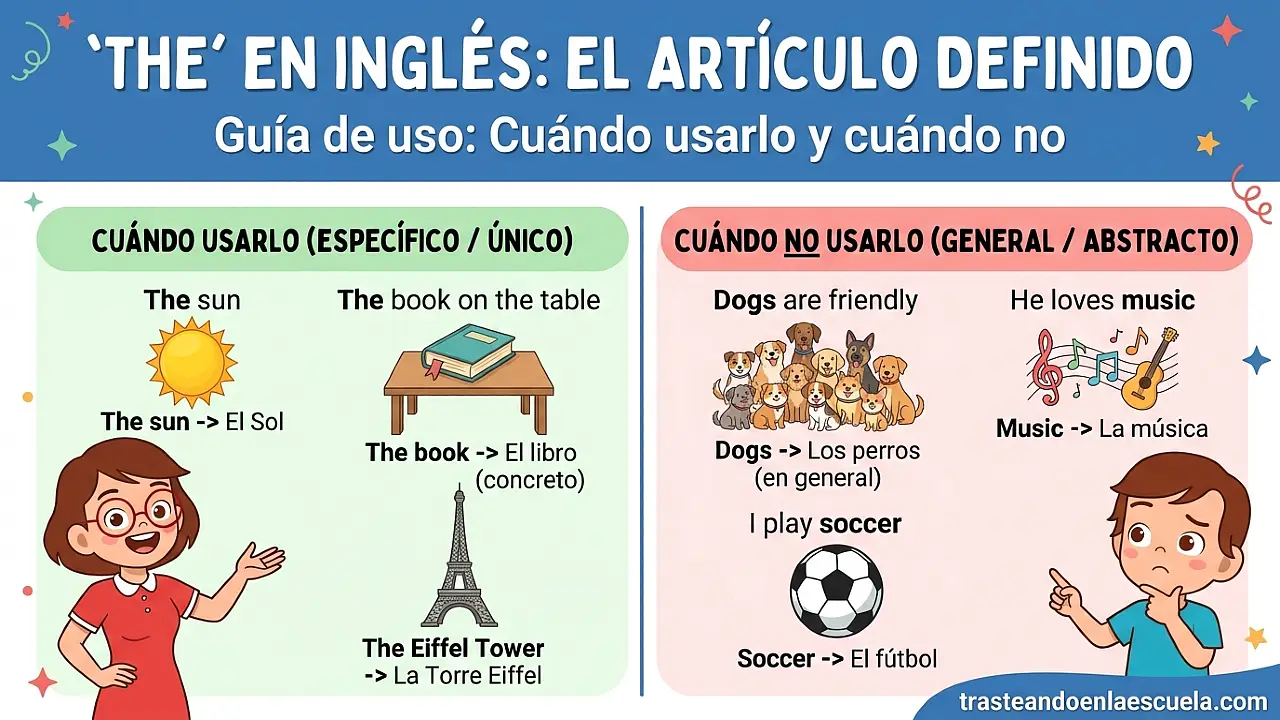
The: El artículo definido que todo lo especifica
¿Por qué decimos «I love the chocolate» (me encanta el chocolate) pero «I love chocolate» (me encanta el chocolate en general)? ¿Cuál es la diferencia entre «the dog» (ese perro concreto) y «a dog» (un perro cualquiera)? El artículo THE es la palabra más común del inglés y, sin embargo, es una de las que más confusión genera entre los hispanohablantes porque en español usamos «el/la/los/las» en situaciones donde en inglés no se usa ningún artículo.
🎯 En este post aprenderás: Cuándo usar THE (con sustantivos únicos, específicos, conocidos por ambos), cuándo NO usarlo (generalizaciones, nombres propios, comidas), las diferencias clave con el español, y ejercicios prácticos para dominarlo.
🔍 ¿Qué es THE y para qué sirve?
🎯 THE = «ese/a en concreto, no uno cualquiera»
THE es el artículo definido del inglés. A diferencia de A/AN (que presentan algo nuevo o no específico), THE señala algo que ya conocemos o que es único en su contexto. Es como si con THE estuviéramos señalando con el dedo.
Usamos THE cuando tanto el hablante como el oyente saben exactamente a qué nos referimos.
Ejemplo: «Pass me the salt» (Pásame la sal = esa sal que está en la mesa, la conocemos ambos)
vs «Pass me salt» (Pásame sal = un poco de sal, sin especificar)
🎭 La analogía del GPS compartido
Imagina que THE funciona como un localizador GPS. Cuando usas THE, tanto tú como la otra persona tenéis las mismas coordenadas mentales. Los dos sabéis exactamente de qué estáis hablando. «The car» = ese coche concreto que ambos conocéis. «The meeting» = esa reunión específica de la que ya habéis hablado. Sin THE, estás hablando de algo en general, sin ubicación concreta en el mapa mental compartido.
✅ Cuándo SÍ usar THE
1. Cuando el sustantivo ya ha sido mencionado antes
La primera vez que mencionamos algo, usamos A/AN. La segunda vez (y siguientes), como ya sabemos de qué hablamos, usamos THE.
Ejemplo: I saw a dog in the park. The dog was very friendly. (Vi un perro en el parque. El perro era muy amable.)
Explicación: Primera mención: «a dog» (un perro cualquiera). Segunda mención: «the dog» (ese perro concreto que acabo de mencionar).
2. Cuando es único en su contexto
Usamos THE con cosas que son únicas, ya sea en el mundo o en un contexto específico.
- Únicos en el mundo: the sun, the moon, the Earth, the sky, the universe
- Únicos en un contexto: the president, the government, the kitchen (en una casa), the door (de una habitación)
- Superlativos: the best, the tallest, the most expensive, the first, the last, the only
3. Con sustantivos definidos por una frase o cláusula
Cuando el sustantivo va seguido de información que lo especifica, usamos THE.
Ejemplos:
- The book that I bought yesterday is fascinating. (El libro que compré ayer…)
- The woman in the red dress is my sister. (La mujer del vestido rojo…)
- The capital of Spain is Madrid. (La capital de España…)
4. Con nombres geográficos específicos
Esta es una de las áreas más complejas porque hay reglas específicas. Aquí tienes las categorías que SÍ llevan THE:
| Categoría | Ejemplos con THE | Nota |
|---|---|---|
| Ríos | the Amazon, the Nile, the Thames | Siempre con THE |
| Mares y océanos | the Pacific, the Mediterranean, the Atlantic | Siempre con THE |
| Cordilleras | the Andes, the Alps, the Himalayas | Grupos de montañas |
| Desiertos | the Sahara, the Gobi, the Atacama | Siempre con THE |
| Grupos de islas | the Canary Islands, the Bahamas, the Philippines | Archipiélagos, no islas individuales |
| Países con «Republic», «Kingdom», «States» | the United States, the UK, the Czech Republic | Países con nombres compuestos |
| Regiones | the Middle East, the Far East, the Arctic | Zonas geográficas |
5. Con ciertos sustantivos de lugares cotidianos
En inglés, usamos THE con muchos lugares de la vida diaria, incluso cuando en español no usaríamos artículo.
Ejemplos:
- I’m going to the supermarket. (Voy al supermercado.)
- She’s at the hospital. (Ella está en el hospital.)
- Let’s go to the cinema. (Vamos al cine.)
- He’s at the gym. (Está en el gimnasio.)
- I need to go to the bank. (Necesito ir al banco.)
6. Con instrumentos musicales y medios de comunicación
- Instrumentos: play the piano, play the guitar, play the violin
- Medios: the radio, the internet, the news, the newspaper
- Excepción: Television no suele llevar THE: «I watch TV» (pero «turn off the TV» sí)
❌ Cuándo NO usar THE
1. Generalizaciones con plurales e incontables
Cuando hablamos de algo en general, sin especificar, NO usamos THE.
❌ INCORRECTO
- The dogs are loyal.
- The money is important.
- The education is vital.
✅ CORRECTO
- Dogs are loyal.
- Money is important.
- Education is vital.
2. Nombres propios de personas y lugares
La mayoría de nombres propios NO llevan THE:
- Personas: Mary, John, Dr. Smith (no «the Mary»)
- Países individuales: Spain, France, Japan, Brazil (no «the Spain»)
- Ciudades: London, New York, Tokyo, Madrid
- Continentes: Europe, Asia, Africa, South America
- Montañas individuales: Mount Everest, Kilimanjaro (no «the Mount Everest»)
- Lagos: Lake Superior, Lake Victoria, Lake Titicaca
- Islas individuales: Sicily, Madagascar, Cuba
3. Comidas, asignaturas y deportes
- Comidas: Breakfast is ready. Lunch was delicious. (No «the breakfast» en general)
- Asignaturas: I study Mathematics. She teaches History.
- Deportes: I play football. She loves tennis.
- Idiomas: He speaks English. (Pero: «the English language» sí)
4. Transportes con «by»
Cuando hablamos del medio de transporte de forma general con «by», NO usamos THE.
- by car, by bus, by train, by plane, by bike, on foot
- Pero: «I took the bus» (un bus concreto) vs «I go by bus» (en general)
5. Sustantivos abstractos en sentido general
- Life is beautiful. (La vida es bella – en general)
- Love is all you need. (El amor es todo lo que necesitas)
- Freedom is priceless. (La libertad no tiene precio)
- Time flies. (El tiempo vuela)
6. Nombres de calles, parques y edificios (generalmente)
- Calles: Oxford Street, Fifth Avenue, Wall Street
- Parques: Hyde Park, Central Park, Golden Gate Park
- Estaciones: Grand Central Station, Victoria Station
- Aeropuertos: Heathrow Airport, JFK Airport
- Excepciones: The White House, The Empire State Building, The Eiffel Tower
📊 Tabla comparativa: Con THE vs Sin THE
| Situación | Con THE | Sin THE |
|---|---|---|
| Perros | The dogs in my neighborhood are noisy. (Esos perros concretos) | Dogs are loyal animals. (Los perros en general) |
| Escuela | I’m going to the school for a meeting. (El edificio) | She goes to school every day. (La actividad de estudiar) |
| Hospital | He’s at the hospital visiting his aunt. (El edificio) | She’s in hospital recovering. (Como paciente – UK) |
| Iglesia | They visited the church as tourists. (El edificio) | They go to church every Sunday. (La actividad religiosa) |
| Cárcel | He went to the prison to visit his brother. (El edificio) | He went to prison for robbery. (Como preso) |
| Universidad | My mother came to the university. (El edificio) | I go to university. (Soy estudiante universitario) |
| Naturaleza | The nature of this problem is complex. (La naturaleza de algo concreto) | Nature is beautiful. (La naturaleza en general) |
| Televisión | Turn off the TV. (El aparato) | I watch TV every night. (El medio) |
💡 El truco de la institución vs el edificio: En inglés británico, cuando vas a un lugar por su función principal (estudiar, rezar, estar ingresado), no usas THE. Cuando vas al edificio por otro motivo, sí usas THE. «Go to school» = ser estudiante. «Go to the school» = visitar el edificio.
🌍 Casos especiales con nombres geográficos
✅ SÍ LLEVAN THE
- Ríos: the Thames, the Amazon
- Océanos: the Pacific, the Atlantic
- Mares: the Mediterranean, the Red Sea
- Desiertos: the Sahara, the Kalahari
- Cordilleras: the Rockies, the Alps
- Canales: the Panama Canal, the Suez Canal
- Estados compuestos: the USA, the UAE
- Repúblicas/Reinos: the UK, the Dominican Republic
- Regiones: the Middle East, the Arctic
- Grupos de islas: the Maldives, the Philippines
❌ NO LLEVAN THE
- Países individuales: Spain, France, China
- Ciudades: London, Tokyo, Buenos Aires
- Continentes: Europe, Asia, Africa
- Montañas: Mount Everest, Mount Fuji
- Lagos: Lake Michigan, Lake Geneva
- Islas: Cuba, Iceland, Madagascar
- Calles: Oxford Street, Broadway
- Plazas: Times Square, Trafalgar Square
- Parques: Hyde Park, Central Park
- Aeropuertos: Heathrow, JFK
🧪 5 Ejercicios para dominar THE
Ejercicio 1: ¿THE o nada? (nivel básico)
Completa las oraciones con THE o dejando el espacio en blanco (Ø) cuando no sea necesario:
- _____ sun rises in _____ east.
- _____ dogs are my favorite animals.
- Can you pass me _____ salt, please?
- I saw _____ movie you recommended. _____ movie was great.
- _____ Mount Everest is _____ highest mountain in _____ world.
✅ Ver solución
- The sun rises in the east. (Sol y este son únicos)
- Ø Dogs are my favorite animals. (Generalización con plural)
- Can you pass me the salt, please? (La sal que está en la mesa, específica)
- I saw the movie you recommended. The movie was great. (Especificado por «you recommended», luego ya mencionado)
- Ø Mount Everest is the highest mountain in the world. (Everest sin THE, superlativo y world sí llevan)
Ejercicio 2: Geografía y lugares
Completa con THE o Ø según corresponda:
- _____ Spain is in _____ Europe.
- _____ Amazon River flows through _____ Brazil.
- _____ Canary Islands are popular with tourists.
- She climbed _____ Mount Kilimanjaro last year.
- _____ United Kingdom consists of four countries.
- They sailed across _____ Pacific Ocean.
- _____ Lake Geneva is beautiful in summer.
- He lives in _____ United States.
✅ Ver solución
- Ø Spain is in Ø Europe. (Países individuales y continentes sin THE)
- The Amazon River flows through Ø Brazil. (Río con THE, país sin)
- The Canary Islands are popular with tourists. (Grupo de islas con THE)
- She climbed Ø Mount Kilimanjaro last year. (Montaña individual sin THE)
- The United Kingdom consists of four countries. (Nombre compuesto con «Kingdom»)
- They sailed across the Pacific Ocean. (Océano con THE)
- Ø Lake Geneva is beautiful in summer. (Lago sin THE)
- He lives in the United States. (Nombre compuesto con «States»)
Ejercicio 3: Institución vs edificio
Elige THE o Ø según el significado de la oración:
- She goes to _____ school by bus. (Es estudiante)
- My father went to _____ school to talk to my teacher. (Fue al edificio)
- He’s in _____ hospital with a broken leg. (Está ingresado)
- The doctor arrived at _____ hospital for the surgery. (Llegó al edificio)
- They go to _____ church every Sunday. (Actividad religiosa)
- Tourists visited _____ church in the old town. (El edificio histórico)
✅ Ver solución
- She goes to Ø school by bus. (Actividad: estudiar)
- My father went to the school to talk to my teacher. (Edificio)
- He’s in Ø hospital with a broken leg. (Paciente ingresado – inglés británico)
- The doctor arrived at the hospital for the surgery. (Edificio)
- They go to Ø church every Sunday. (Actividad religiosa)
- Tourists visited the church in the old town. (Edificio concreto)
Ejercicio 4: Elige la opción correcta
Selecciona la opción que completa correctamente cada oración:
- _____ is the most important thing in life.
a) The health / b) Health / c) A health - I play _____ guitar in a band.
a) the / b) a / c) Ø - She’s _____ best student in the class.
a) the / b) a / c) Ø - We traveled by _____ plane to Paris.
a) the / b) a / c) Ø - _____ love is a beautiful feeling.
a) The / b) A / c) Ø
✅ Ver solución
- b) Health is the most important thing in life. (Sustantivo abstracto general)
- I play a) the guitar in a band. (Instrumento musical con THE)
- She’s a) the best student in the class. (Superlativo con THE)
- We traveled by c) Ø plane to Paris. (Transporte con «by» sin THE)
- c) Ø Love is a beautiful feeling. (Sustantivo abstracto general)
Ejercicio 5: Corrección de errores
Las siguientes oraciones contienen errores con THE. Encuéntralos y corrige cada una:
- The money can’t buy the happiness.
- I’m going to the Spain next summer.
- The cats are independent animals.
- She speaks the French and the German.
- We visited the Lake Como and the Mount Vesuvius.
- He listens to radio every morning.
- The education is fundamental for the society.
- They went to cinema last night.
✅ Ver solución
- Ø Money can’t buy Ø happiness. (Sustantivos incontables generales)
- I’m going to Ø Spain next summer. (País individual sin THE)
- Ø Cats are independent animals. (Generalización con plural)
- She speaks Ø French and Ø German. (Idiomas sin THE)
- We visited Ø Lake Como and Ø Mount Vesuvius. (Lago y montaña individual sin THE)
- He listens to the radio every morning. (Radio con THE)
- Ø Education is fundamental for Ø society. (Sustantivos abstractos generales)
- They went to the cinema last night. (Cinema siempre con THE en este contexto)
📖 Glosario de términos
| Término | Definición | Ejemplo |
|---|---|---|
| Definite article | Artículo definido (THE) | the book, the sun |
| Specific reference | Referencia a algo concreto y conocido | the car we bought |
| Generic reference | Referencia a algo en general (sin THE) | Cars are expensive |
| Superlative | Grado superlativo (siempre con THE) | the best, the tallest |
| Unique nouns | Sustantivos únicos en su contexto | the sun, the president |
| Abstract nouns | Sustantivos abstractos (sin THE en general) | love, freedom, time |
| Geographical names | Nombres geográficos con reglas específicas | the Alps, Ø Spain |
📚 Serie completa: Artículos en inglés
Domina todos los artículos del inglés con esta serie de posts:
- A vs An: cuándo usar cada uno – La regla del sonido para el artículo indefinido.
- The: artículo definido – ¡Estás aquí! Cuándo usar y cuándo omitir THE.
- No article: cuándo no usar – Los casos del «artículo cero» en profundidad.
- Artículos con nombres propios – Reglas con personas, lugares y marcas.
- Ejercicios artículos – Práctica combinada de todos los artículos.
🏆 Reto de 7 días: Domina THE en contexto real
Te propongo un plan semanal para interiorizar el uso de THE:
- Día 1: Identifica 5 usos de THE en una canción que te guste. ¿Por qué aparece THE?
- Día 2: Escribe 5 frases sobre objetos únicos de tu casa (the fridge, the sofa, the TV).
- Día 3: Escribe 5 generalizaciones sin THE (Dogs are…, Money is…, Life is…).
- Día 4: Busca en Google Maps 5 ríos y 5 montañas. ¿Cuáles llevan THE?
- Día 5: Escribe un párrafo sobre tu rutina diaria (go to school, go to the gym…).
- Día 6: Ve un capítulo de una serie en inglés y anota 5 usos de THE. Analiza por qué.
- Día 7: Escribe 10 reglas con tus propias palabras explicando cuándo usar y no usar THE.
¡En una semana tendrás un dominio mucho más sólido del artículo THE!





Publicar comentario