Excited vs Exciting: la emoción bien expresada en inglés
Excited vs Exciting: ¿estás emocionado o es emocionante?
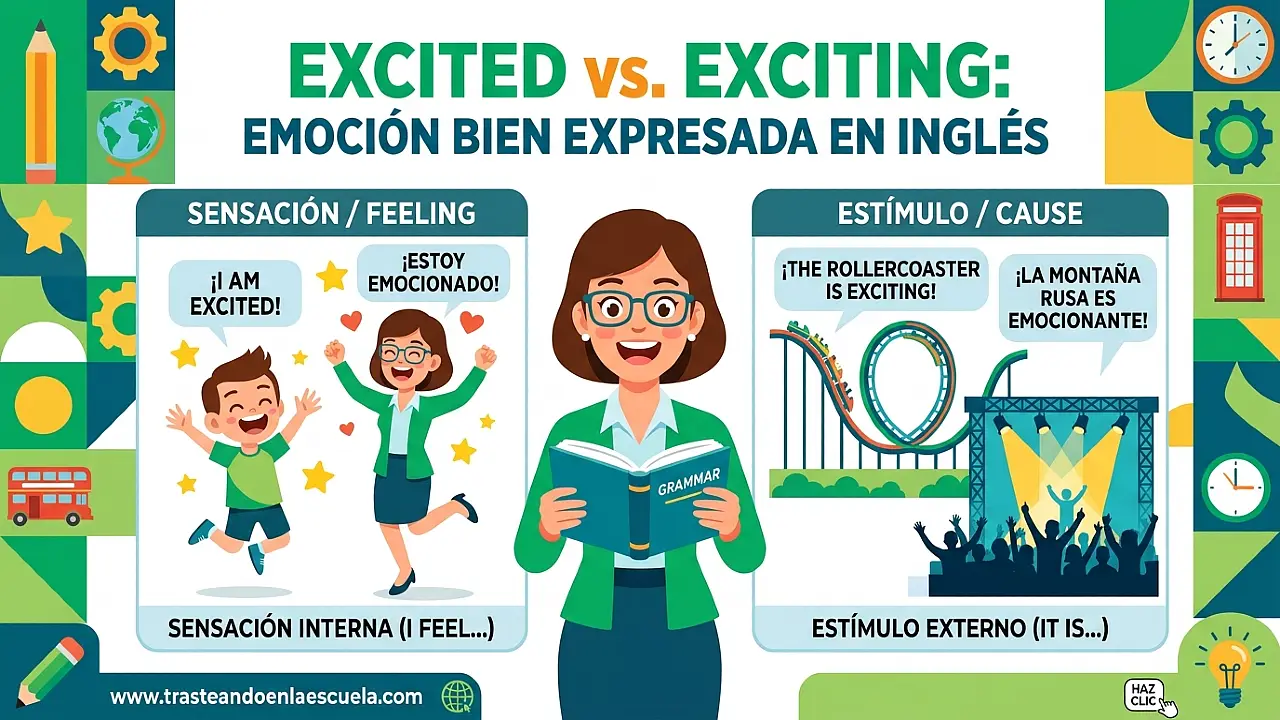
¡Por fin llegan las vacaciones! Quieres expresar tu alegría y dices: «I am very exciting about my trip». ¡Cuidado! Acabas de decir que tú eres una persona emocionante, no que estás emocionado. La diferencia entre excited y exciting es crucial para hablar de emociones positivas. Excited es cómo te sientes tú (emocionado), exciting es cómo es algo que te causa esa emoción (emocionante).
🎯 En este post aprenderás: La diferencia clave entre excited y exciting, cuándo usar cada uno, las preposiciones correctas (excited about, excited to), sinónimos para enriquecer tu vocabulario, expresiones útiles y ejercicios para que hables de tus emociones con precisión.
🔍 Excited vs Exciting: la regla de oro
📖 ¿Cómo te sientes? ¿O cómo es?
EXCITED (-ed): Describe el sentimiento de una persona que espera algo con alegría, anticipación o entusiasmo. Significa «emocionado», «ilusionado».
EXCITING (-ing): Describe una cualidad de algo o alguien que causa emoción, entusiasmo o expectación. Significa «emocionante», «apasionante».
💡 La regla más fácil del mundo:
- EXCITED = «Me siento emocionado» → emoción interna.
- EXCITING = «Esto es emocionante» → cualidad externa.
Pregúntate: ¿Estoy hablando de mi estado emocional o de la cualidad de algo?
😊 EXCITED (-ed)
Significado: Emocionado/a, ilusionado/a (cómo se siente alguien)
- «I am excited about my birthday.»
- «The kids are excited for Christmas.»
- «She was excited to see her friend.»
Sujeto persona + to be/get/feel + excited + about/for/to
🎢 EXCITING (-ing)
Significado: Emocionante, apasionante (que causa emoción)
- «This movie is exciting.»
- «She has an exciting new job.»
- «What an exciting adventure!»
Sujeto (cosa/persona) + to be + exciting
📊 Tabla comparativa detallada
| EXCITED (-ed) | EXCITING (-ing) | |
|---|---|---|
| ¿Qué expresa? | Emoción, entusiasmo, anticipación | Cualidad que genera emoción |
| ¿Quién/qué? | Personas (o animales conscientes) | Cosas, actividades, eventos, personas (como causa) |
| Traducción al español | «Emocionado», «ilusionado» | «Emocionante», «apasionante» |
| Pregunta asociada | «¿Cómo te sientes?» | «¿Cómo es?» |
| Preposiciones comunes | Excited about / excited for / excited to | Exciting to (a veces) + verbo |
🎯 Usos detallados con ejemplos
📌 Excited: cómo expresar tu emoción personal
Estructuras comunes:
- To be excited about + sustantivo — estar emocionado por algo
- To be excited to + verbo — estar emocionado de hacer algo
- To be excited for + sustantivo/persona — estar emocionado por algo/alguien
- To get excited — emocionarse, ilusionarse
Ejemplos:
- I’m so excited about my new job! (Estoy tan emocionado por mi nuevo trabajo.)
- The children are excited about going to the amusement park. (Los niños están ilusionados con ir al parque de atracciones.)
- I’m excited to see you next week. (Estoy emocionado de verte la semana que viene.)
- She was excited for her friend’s wedding. (Estaba emocionada por la boda de su amiga.)
- Don’t get excited yet; we haven’t won. (No te emociones aún, no hemos ganado.)
- I’m excited about the possibilities. (Estoy emocionado por las posibilidades.)
- He’s excited to start his new project. (Está emocionado de empezar su nuevo proyecto.)
⚠️ Nota importante:
- Excited about + sustantivo/gerundio → lo más común
- Excited to + verbo → antes de una acción
- Excited for + sustantivo → a menudo para eventos futuros
📌 Exciting: cómo describir lo que causa emoción
Estructuras comunes:
- To be exciting — ser emocionante
- To find something exciting — encontrar algo emocionante
- Exciting + sustantivo — adjetivo antes del nombre
- It is exciting to + verbo — es emocionante hacer algo
Ejemplos:
- This roller coaster is so exciting! (¡Esta montaña rusa es tan emocionante!)
- She has an exciting new project at work. (Tiene un nuevo proyecto emocionante en el trabajo.)
- It’s exciting to think about the future. (Es emocionante pensar en el futuro.)
- I find skydiving very exciting. (Me parece muy emocionante hacer paracaidismo.)
- What an exciting opportunity! (¡Qué oportunidad tan emocionante!)
- The final match was incredibly exciting. (El partido final fue increíblemente emocionante.)
- Traveling to new places is always exciting. (Viajar a lugares nuevos siempre es emocionante.)
🔄 La misma persona: ¿excited o exciting?
📌 Una persona puede ser EXCITED y también EXCITING
Una misma persona puede sentirse emocionada (excited) y además ser alguien que causa emoción en los demás (exciting). No es contradictorio.
Ejemplo:
- «I am so excited about my trip to Japan next month. My friends say I’m an exciting person to travel with because I always find fun activities.»
- «She was excited about her presentation, and her energy made it an exciting experience for everyone.»
El matiz importante:
- Excited = su experiencia personal (emoción interna)
- Exciting = cómo lo perciben los demás (capacidad de generar emoción)
📝 Sinónimos para enriquecer tu vocabulario
📚 Palabras más avanzadas para evitar repeticiones
| En lugar de EXCITED | En lugar de EXCITING |
|---|---|
| Thrilled — encantado, muy emocionado «I’m thrilled about the news.» |
Thrilling — emocionante (más intenso) «a thrilling movie» |
| Enthusiastic — entusiasta «She’s enthusiastic about the project.» |
Exhilarating — estimulante, emocionante «an exhilarating experience» |
| Eager — deseoso, ansioso por «I’m eager to start.» |
Breathtaking — impresionante, que quita el aliento «a breathtaking view» |
| Pumped — emocionado (coloquial) «I’m pumped for the game!» |
Electrifying — electrizante «an electrifying performance» |
| Overjoyed — eufórico, muy feliz «We were overjoyed by the news.» |
Gripping — cautivador, apasionante «a gripping novel» |
💡 Diferencia de intensidad: «Thrilled» y «thrilling» son más intensos que «excited» y «exciting». «I’m thrilled» = estoy muchísimo más emocionado que «I’m excited».
🎭 Expresiones idiomáticas con «excited» y «exciting»
- «I can’t wait!» — ¡No puedo esperar! (muy común con excited)
«I’m so excited about the concert. I can’t wait!» - «Buzzing with excitement» — rebosante de emoción
«The children were buzzing with excitement before the party.» - «On the edge of my seat» — al borde del asiento (muy emocionado por algo que está pasando)
«The movie was so exciting I was on the edge of my seat.» - «A roller coaster of emotions» — una montaña rusa de emociones
«The final match was exciting; it was a real roller coaster of emotions.» - «To jump for joy» — saltar de alegría
«She was so excited that she jumped for joy.»
❌ Errores comunes
| Error | Explicación | Corrección |
|---|---|---|
| «I am exciting.» | Estás diciendo que eres una persona emocionante, no que estás emocionado. | «I am excited.» |
| «This game is excited.» | Un juego (cosa) no puede sentir emoción. | «This game is exciting.» |
| «I’m exciting about the trip.» | «Exciting» no se usa con «about». Es «excited about». | «I’m excited about the trip.» |
| «She is excited for do that.» | Después de preposición «for» no puede ir un verbo en infinitivo. Usa «to». | «She is excited to do that.» o «She is excited about doing that.» |
| «I get exciting when I see her.» | «Get exciting» significa volverse emocionante (cualidad), no sentirse emocionado. | «I get excited when I see her.» |
🧪 5 Ejercicios prácticos
Ejercicio 1: Completa con «excited» o «exciting»
- I’m so ______ about the concert tomorrow!
- This is the most ______ book I’ve ever read.
- The children were ______ to open their presents.
- We had an ______ adventure in the jungle.
- Are you ______ about starting your new job?
- The final match was incredibly ______.
- She’s ______ to meet her favorite actor.
- What an ______ opportunity this is!
- I get ______ when I think about our trip.
- The trailer for the new movie looks really ______.
✅ Ver solución
- I’m so excited about the concert tomorrow!
- This is the most exciting book I’ve ever read.
- The children were excited to open their presents.
- We had an exciting adventure in the jungle.
- Are you excited about starting your new job?
- The final match was incredibly exciting.
- She’s excited to meet her favorite actor.
- What an exciting opportunity this is!
- I get excited when I think about our trip.
- The trailer for the new movie looks really exciting.
Ejercicio 2: Traduce al inglés
- Estoy emocionado por mis vacaciones.
- Esta película de acción es muy emocionante.
- Los niños están ilusionados con ir al zoo.
- ¿Qué es lo más emocionante que te ha pasado?
- Estamos emocionados de anunciar el lanzamiento del producto.
✅ Ver solución
- I’m excited about my vacation.
- This action movie is very exciting.
- The children are excited about going to the zoo.
- What’s the most exciting thing that has happened to you?
- We are excited to announce the product launch.
Ejercicio 3: Corrige los errores
- I am very exciting about the party.
- The roller coaster was so excited.
- She’s exciting to see her family after so long.
- This is a very excited opportunity.
- We get exciting when the holidays approach.
✅ Ver solución
- ❌ I am very exciting about the party. → I am very excited about the party.
- ❌ The roller coaster was so excited. → The roller coaster was so exciting.
- ❌ She’s exciting to see her family… → She’s excited to see her family…
- ❌ This is a very excited opportunity. → This is a very exciting opportunity.
- ❌ We get exciting when the holidays approach. → We get excited when the holidays approach.
Ejercicio 4: Responde a las preguntas
- What are you excited about right now?
- What’s the most exciting movie you’ve seen recently?
- Are you excited to learn English? Why?
- What do you find exciting about your job or studies?
- What was an exciting moment in your life?
✅ Ver ejemplos de respuestas
- a. «I’m excited about my birthday next week.»
- b. «The most exciting movie I’ve seen recently was ‘Top Gun: Maverick’.»
- c. «Yes, I’m excited to learn English because it opens many doors for my career.»
- d. «I find learning new skills exciting because every day is different.»
- e. «An exciting moment in my life was when I graduated from university.»
Ejercicio 5: Escribe un pequeño párrafo
Describe una experiencia emocionante que hayas tenido o que quieras tener. Usa «excited» y «exciting» al menos dos veces cada uno.
✅ Ver ejemplo de respuesta
Ejemplo: «Next summer, I’m going to travel to Japan for the first time. I’m so excited about visiting Tokyo and trying authentic Japanese food. It’s an exciting opportunity because I’ve always wanted to experience a different culture. My friend, who has been there before, told me that the bullet train is incredibly exciting. I’m also excited to see the cherry blossoms in person. I think the whole trip will be the most exciting adventure of my life. I can’t wait!»
📚 Adjetivos terminados en -ed vs -ing
Continúa aprendiendo con el resto de la serie:
- Interested vs interesting – El primer par de la serie.
- Bored vs boring – Aburrido vs aburridor.
- Excited vs exciting – ¡Estás aquí!
- Tired vs tiring – Próximamente: cansado vs agotador.
- 50 adjetivos -ed/-ing lista – La guía completa.
Para seguir practicando inglés, visita también nuestras guías sobre adjetivos de personalidad y apariencia física.
🏆 Reto de la semana: Esta semana, cada vez que tengas un plan que te haga ilusión, escribe una frase en inglés usando «excited about» o «excited to». Cada vez que veas una película, leas un libro o vivas una experiencia, pregúntate: «Was it exciting?» y anótalo. Al final de la semana, tendrás un diario de emociones en inglés que reflejará tu dominio de este par de adjetivos.



Publicar comentario