Tired vs Tiring: ¿estás cansado o es agotador?
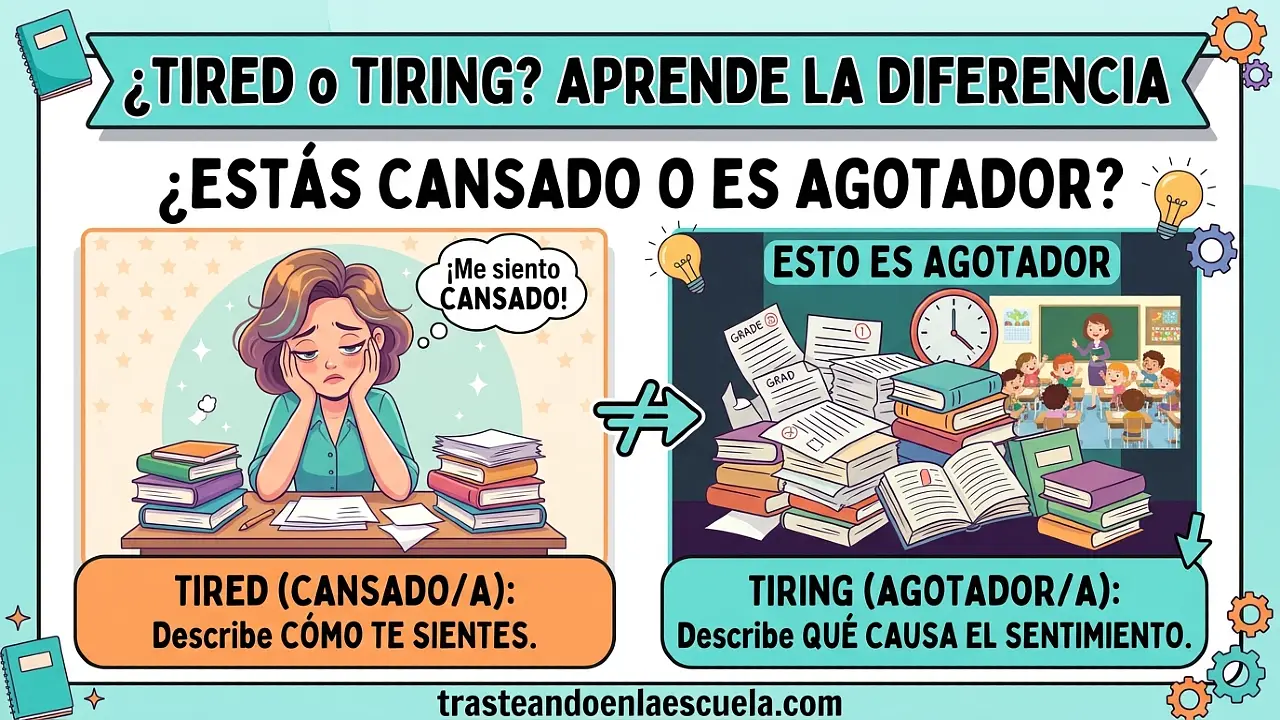
Tired vs Tiring: ¿estás cansado o es cansado?
Has tenido un día muy largo. Quieres decir «Estoy muy cansado» y dices «I am very tiring». ¡Cuidado! Acabas de decir que tú eres una persona agotadora, que cansas a los demás. La diferencia entre tired y tiring es fundamental para hablar de fatiga y esfuerzo. Tired es cómo te sientes tú (cansado), tiring es cómo es algo que te causa cansancio (agotador, cansado).
🎯 En este post aprenderás: La diferencia clave entre tired y tiring, cuándo usar cada uno, las preposiciones correctas (tired of, tired from), sinónimos para enriquecer tu vocabulario, expresiones útiles y ejercicios para que hables de tu cansancio con precisión.
🔍 Tired vs Tiring: la regla de oro
📖 ¿Cómo te sientes? ¿O cómo es?
TIRED (-ed): Describe el sentimiento de una persona que necesita descansar. Significa «cansado», «fatigado».
TIRING (-ing): Describe una cualidad de algo o alguien que causa cansancio, fatiga o agotamiento. Significa «agotador», «cansado» (en el sentido de que cansa).
💡 La regla más fácil del mundo:
- TIRED = «Me siento cansado» → estado interno (falta de energía).
- TIRING = «Esto es agotador» → cualidad externa (causa fatiga).
Pregúntate: ¿Estoy hablando de mi falta de energía o de la cualidad de algo que requiere esfuerzo?
😫 TIRED (-ed)
Significado: Cansado/a (cómo se siente alguien)
- «I am so tired.»
- «She looks tired today.»
- «We were tired after the hike.»
Sujeto persona + to be/get/feel + tired + from/of
🏋️ TIRING (-ing)
Significado: Agotador, cansado (que causa cansancio)
- «This workout is tiring.»
- «What a tiring day!»
- «Traveling can be very tiring.»
Sujeto (cosa/actividad) + to be + tiring
📊 Tabla comparativa detallada
| TIRED (-ed) | TIRING (-ing) | |
|---|---|---|
| ¿Qué expresa? | Cansancio, fatiga, falta de energía | Cualidad que causa cansancio |
| ¿Quién/qué? | Personas (o animales conscientes) | Actividades, trabajos, viajes, experiencias |
| Traducción al español | «Cansado», «fatigado» | «Agotador», «cansado», «fatigoso» |
| Pregunta asociada | «¿Cómo te sientes?» | «¿Cómo es?» |
| Preposiciones comunes | Tired of (harto de) / tired from (cansado por) | Tiring to (a veces) + verbo |
🎯 Usos detallados con ejemplos
📌 Tired: cómo expresar tu cansancio personal
Estructuras comunes:
- To be tired — estar cansado
- To get tired — cansarse
- To feel tired — sentirse cansado
- Tired of + sustantivo/gerundio — harto de algo (figuradamente cansado)
- Tired from + sustantivo/gerundio — cansado por haber hecho algo
Ejemplos:
- I’m tired. I think I’ll go to bed early. (Estoy cansado. Creo que me acostaré temprano.)
- She was tired after running the marathon. (Estaba cansada después de correr el maratón.)
- I get tired easily when I don’t sleep well. (Me canso fácilmente cuando no duermo bien.)
- I’m tired of eating the same food every day. (Estoy harto de comer la misma comida todos los días.)
- He’s tired of his job and wants a change. (Está harto de su trabajo y quiere un cambio.)
- We were tired from the long flight. (Estábamos cansados por el largo vuelo.)
- Are you tired? You look exhausted. (¿Estás cansado? Te ves agotado.)
⚠️ Nota importante:
- Tired of = harto, aburrido, frustrado (sentimiento figurado)
- Tired from = cansado físicamente por una actividad específica
📌 Tiring: cómo describir lo que causa cansancio
Estructuras comunes:
- To be tiring — ser agotador/cansado
- To find something tiring — encontrar algo agotador
- Tiring + sustantivo — adjetivo antes del nombre
- It is tiring to + verbo — es agotador hacer algo
Ejemplos:
- This workout is very tiring. (Este entrenamiento es muy agotador.)
- We had a tiring journey across the mountains. (Tuvimos un viaje agotador a través de las montañas.)
- It’s tiring to work 12 hours a day. (Es agotador trabajar 12 horas al día.)
- I find cleaning the house very tiring. (Me parece muy agotador limpiar la casa.)
- What a tiring day at work! (¡Qué día tan agotador en el trabajo!)
- Childcare can be rewarding but also tiring. (Cuidar niños puede ser gratificante pero también agotador.)
- The hike was long and tiring, but the view was worth it. (La caminata fue larga y agotadora, pero las vistas valieron la pena.)
🔄 La misma persona: ¿tired o tiring?
📌 Una persona puede ser TIRED y también TIRING
Una misma persona puede sentirse cansada (tired) y además ser alguien que cansa a los demás (tiring).
Ejemplo:
- «I’m so tired because I didn’t sleep well. But I hope I’m not being tiring to my friends with my complaints.»
- «My little brother is very energetic and sometimes he is tiring to be around. He never gets tired!»
El matiz importante:
- Tired = su experiencia personal (falta de energía)
- Tiring = cómo lo perciben los demás (capacidad de cansar a otros)
📝 Sinónimos para enriquecer tu vocabulario
📚 Palabras más avanzadas para evitar repeticiones
| En lugar de TIRED | En lugar de TIRING |
|---|---|
| Exhausted — agotado (muy cansado) «I’m exhausted after the gym.» |
Exhausting — agotador «an exhausting day» |
| Fatigued — fatigado (formal) «He felt fatigued after the illness.» |
Fatiguing — fatigoso (formal) «a fatiguing task» |
| Worn out — agotado, molido «I’m worn out from work.» |
Wearing — agotador, desgastante «a wearing experience» |
| Drained — drenado, sin energía «I feel completely drained.» |
Draining — que drena la energía «a draining conversation» |
| Sleepy — con sueño «I’m feeling sleepy.» |
Demanding — exigente «a demanding job» |
💡 Diferencia de intensidad: «Exhausted» y «exhausting» son más intensos que «tired» y «tiring». «I’m exhausted» = estoy muchísimo más cansado que «I’m tired».
🎭 Expresiones idiomáticas con «tired»
- «Tired to death» — cansado hasta la muerte (muy cansado).
«I’m tired to death of this argument.» - «Sick and tired» — harto y cansado (muy harto).
«I’m sick and tired of your excuses!» (¡Estoy harto y cansado de tus excusas!) - «Dead tired» — muerto de cansancio.
«After the marathon, I was dead tired.» - «Tired out» — agotado.
«The kids are completely tired out after playing all day.» - «Sleep like a log» — dormir como un tronco.
«I was so tired I slept like a log.» - «Running on empty» — funcionando con el depósito vacío (sin energía).
«I’ve been running on empty all week.»
❌ Errores comunes
| Error | Explicación | Corrección |
|---|---|---|
| «I am very tiring.» | Estás diciendo que eres una persona agotadora, no que estás cansado. | «I am very tired.» |
| «This job is tired.» | Un trabajo (cosa) no puede sentir cansancio. | «This job is tiring.» |
| «I’m tiring of this.» | «Tiring of» no es correcto. El verbo «to tire of» existe, pero como adjetivo es «tired of». | «I’m tired of this.» |
| «The walk was tired.» | Un paseo no puede estar cansado, puede ser agotador. | «The walk was tiring.» |
| «I get tiring easily.» | «Get tiring» significa volverse agotador (cualidad). | «I get tired easily.» (Me canso fácilmente) |
🧪 5 Ejercicios prácticos
Ejercicio 1: Completa con «tired» o «tiring»
- I’m so ______. I think I need a nap.
- This hike is very ______. My legs hurt.
- She’s ______ of listening to the same excuses.
- We had a ______ journey that lasted 12 hours.
- Are you ______? You look exhausted.
- Cleaning the whole house is a ______ task.
- He got ______ after playing soccer for two hours.
- What a ______ day! I can’t wait to go to bed.
- I’m ______ from working all day in the garden.
- Dealing with difficult customers can be very ______.
✅ Ver solución
- I’m so tired. I think I need a nap.
- This hike is very tiring.
- She’s tired of listening to the same excuses.
- We had a tiring journey that lasted 12 hours.
- Are you tired? You look exhausted.
- Cleaning the whole house is a tiring task.
- He got tired after playing soccer for two hours.
- What a tiring day! I can’t wait to go to bed.
- I’m tired from working all day in the garden.
- Dealing with difficult customers can be very tiring.
Ejercicio 2: Traduce al inglés
- Estoy muy cansado hoy.
- Este trabajo es muy agotador.
- Estoy harto de la misma rutina.
- La caminata fue larga y agotadora.
- Me canso fácilmente cuando hace calor.
✅ Ver solución
- I’m very tired today.
- This job is very tiring.
- I’m tired of the same routine.
- The hike was long and tiring.
- I get tired easily when it’s hot.
Ejercicio 3: Corrige los errores
- I am very tiring after work.
- The meeting was so tired.
- She’s tiring of waiting.
- This is a very tired job.
- We get tiring when we exercise.
✅ Ver solución
- ❌ I am very tiring after work. → I am very tired after work.
- ❌ The meeting was so tired. → The meeting was so tiring.
- ❌ She’s tiring of waiting. → She’s tired of waiting.
- ❌ This is a very tired job. → This is a very tiring job.
- ❌ We get tiring when we exercise. → We get tired when we exercise.
Ejercicio 4: Responde a las preguntas
- What time do you usually go to bed when you feel tired?
- What is the most tiring activity you do regularly?
- Are you tired of anything right now?
- What do you do to recover when you feel exhausted?
- Is studying English tiring for you? Why or why not?
✅ Ver ejemplos de respuestas
- a. «When I feel tired, I usually go to bed around 10 PM.»
- b. «The most tiring activity I do regularly is going to the gym after work.»
- c. «Yes, I’m tired of commuting for two hours every day.»
- d. «When I feel exhausted, I take a hot shower and drink some tea.»
- e. «No, studying English isn’t tiring for me because I enjoy it and find it stimulating.»
Ejercicio 5: Escribe un pequeño párrafo
Describe un día especialmente cansado o agotador que hayas tenido. Usa «tired», «tiring», y al menos un sinónimo de cada uno (exhausted/exhausting, drained/draining, etc.).
✅ Ver ejemplo de respuesta
Ejemplo: «Yesterday was one of the most tiring days of my life. I had to wake up at 5 AM to catch an early flight. The airport was crowded, and waiting in long lines was exhausting. After landing, I had a 4-hour meeting that was mentally draining. By the time I got home at 10 PM, I was completely exhausted. I was so tired that I couldn’t even eat dinner. I just went straight to bed and fell asleep immediately. The whole experience was wearing, and I hope I don’t have another day like that anytime soon. I’m still tired today, but at least I can rest now.»
📚 Adjetivos terminados en -ed vs -ing
Continúa aprendiendo con el resto de la serie:
- Interested vs interesting – Interesado vs interesante.
- Bored vs boring – Aburrido vs aburridor.
- Excited vs exciting – Emocionado vs emocionante.
- Tired vs tiring – ¡Estás aquí!
- 50 adjetivos -ed/-ing lista – La guía completa con todos los pares.
Para seguir practicando inglés, visita también nuestras guías sobre adjetivos de personalidad y adjetivos de tamaño.
🏆 Reto de la semana: Esta semana, cada vez que termines una actividad que requiera esfuerzo, pregúntate: «Was it tiring? How do I feel? Am I tired?» Lleva un diario de tus niveles de energía en inglés. Al final de la semana, revisa todas las actividades que describiste como «tiring» y reflexiona sobre cuáles realmente merecen esa etiqueta. Verás cómo tu vocabulario para describir fatiga y esfuerzo se enriquece notablemente.







Publicar comentario