Natural disasters: desastres naturales en inglés
Natural disasters: Desastres naturales en inglés
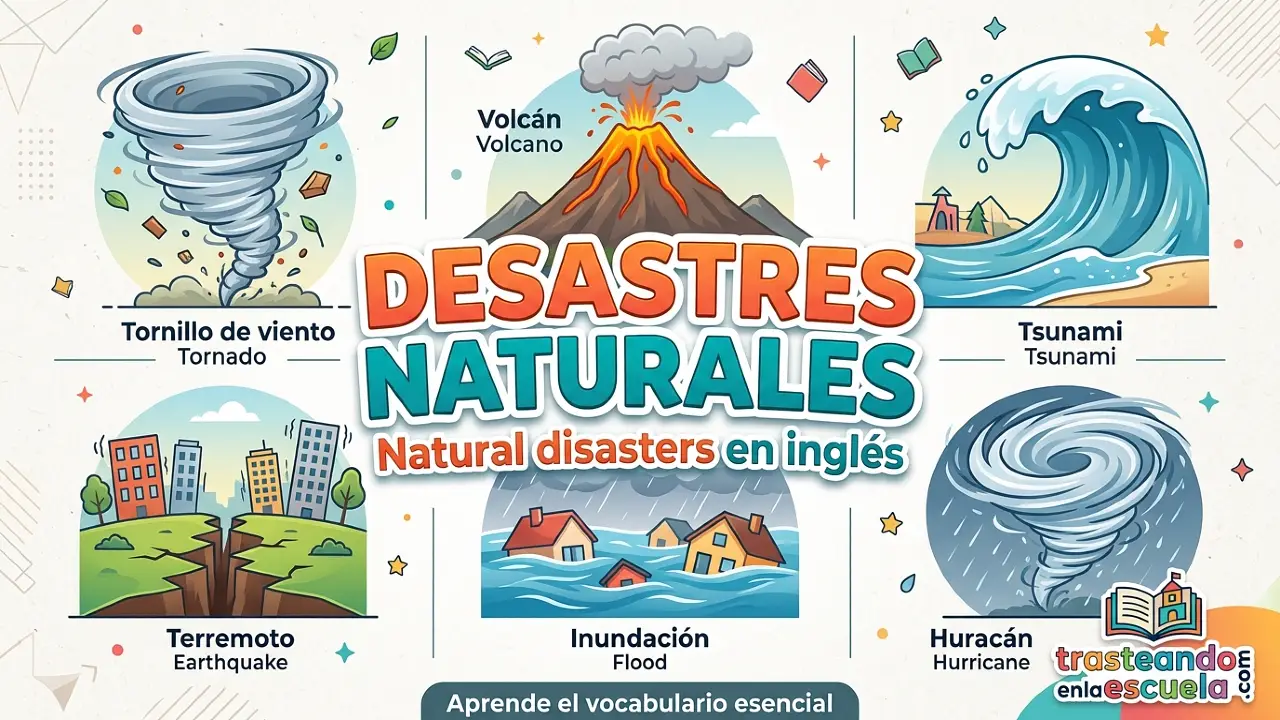
Terremotos, huracanes, tsunamis, incendios forestales… Cuando ocurre una catástrofe natural, los medios de comunicación de todo el mundo la cubren en inglés. Conocer este vocabulario es crucial para entender las noticias internacionales (listening comprehension), describir eventos extremos en tu speaking o writing, y estar preparado para temas de actualidad en los exámenes. Este vocabulario conecta directamente con el clima extremo (tormentas, sequías) y el medio ambiente (causas y consecuencias de estos desastres). En este post, aprenderás no solo los nombres, sino los verbos específicos que se usan en los titulares (headlines) y las frases típicas de los reportajes de emergencia.
🎯 En este post aprenderás: Nombres de desastres naturales clasificados por su origen (geológicos, meteorológicos, hidrológicos), verbos para describir su impacto devastador (to strike, to erupt, to sweep away), términos relacionados con emergencias (evacuation, death toll, survivors), frases útiles para entender noticias, y 5 ejercicios prácticos para consolidar el aprendizaje.
🌪️ Lista completa de desastres naturales (Complete list)
Clasificados por su origen: geológicos (tierra), meteorológicos (clima) e hidrológicos (agua).
| Desastre (Disaster) | Inglés (English) | Característica / Origen (Origin) |
|---|---|---|
| Terremoto | Earthquake | Shaking of the ground caused by a sudden release of energy in the Earth’s crust. |
| Tsunami | Tsunami | Giant wave or series of waves caused by an underwater earthquake or volcanic eruption. |
| Erupción volcánica | Volcanic eruption | Lava, ash, and gases escape from a volcano. |
| Huracán | Hurricane | Large tropical storm with strong winds (Atlantic and Northeast Pacific). |
| Tifón | Typhoon | Same as a hurricane, but in the Northwest Pacific. |
| Ciclón | Cyclone | Same as a hurricane, but in the South Pacific and Indian Ocean. |
| Tornado | Tornado | Violent rotating column of air that touches the ground (USA «Tornado Alley»). |
| Inundación | Flood | Overflow of water onto normally dry land. |
| Deslizamiento de tierra | Landslide / Mudslide | Movement of rock, earth, or debris down a slope. |
| Sequía | Drought | Prolonged period of abnormally low rainfall, leading to water shortage. |
| Incendio forestal | Wildfire / Bushfire | Uncontrolled fire in an area of combustible vegetation (forest, grassland). |
| Avalancha | Avalanche | Rapid flow of snow down a mountain slope. |
| Tormenta de nieve | Blizzard | Severe snowstorm with very strong winds and low visibility. |
⚡ Verbos para describir el impacto (Verbs to describe the impact)
Para contar lo que pasó o entender un reportaje, necesitas estos verbos en pasado. Son imprescindibles para la sección de verbos irregulares en inglés.
- To strike (struck, struck) (Golpear / Afectar): «The earthquake struck at midnight, catching everyone by surprise.»
- To hit (hit, hit) (Golpear): «The hurricane hit the coast with winds of 200 km/h.»
- To erupt (erupted, erupted) (Entrar en erupción): «The volcano erupted violently, sending ash high into the sky.»
- To shake (shook, shaken) (Sacudir): «The ground shook for almost 30 seconds during the quake.»
- To destroy (destroyed, destroyed) (Destruir): «The tornado destroyed the entire village, leaving nothing standing.»
- To sweep away (swept away, swept away) (Arrasar / Llevarse): «The flood swept away cars, houses, and bridges.»
- To injure / kill (Herir / Matar): «The tsunami killed thousands of people and injured many more.»
- To evacuate (evacuated, evacuated) (Evacuar): «Authorities evacuated the area before the hurricane made landfall.»
- To rescue (rescued, rescued) (Rescatar): «Firefighters rescued the survivors from the rubble.»
- To trap (trapped, trapped) (Atrapar): «Many people were trapped under the collapsed buildings.»
📰 Frases útiles para noticias y reportajes (Useful phrases for news)
Este lenguaje es perfecto para mejorar tu listening cuando veas la CNN, BBC o Sky News.
Expresiones típicas en reportajes de catástrofes:
– «A state of emergency has been declared.» (Se ha declarado el estado de emergencia).
– «The death toll is rising.» (El número de víctimas mortales está aumentando).
– «Hundreds are left homeless.» (Cientos de personas se quedan sin hogar).
– «Rescue teams are searching for survivors.» (Los equipos de rescate buscan supervivientes).
– «The area has been cordoned off.» (La zona ha sido acordonada).
– «The full extent of the damage is not yet known.» (Todavía no se conoce la magnitud total de los daños).
– «They are providing aid and shelter to the victims.» (Están proporcionando ayuda y refugio a las víctimas).
– «Landslides have blocked several roads, hampering rescue efforts.» (Los deslizamientos han bloqueado varias carreteras, dificultando las labores de rescate).
🧠 5 Ejercicios prácticos (5 Practical Exercises)
Ejercicio 1: Empareja el desastre con la descripción (Match the disaster)
- Violent wind spiral that touches the ground (common in USA).
- Giant wave caused by an underwater earthquake.
- Lava, ash, and gases coming from a mountain.
- Shaking buildings and ground.
- No rain for months or years, crops die.
✅ Ver solución
- Tornado
- Tsunami
- Volcanic eruption
- Earthquake
- Drought
Ejercicio 2: Elige el verbo correcto (Choose the correct verb)
- The volcano _____ after 100 years of silence. (a) shook (b) erupted (c) struck)
- The flood _____ the bridge away. (a) destroyed (b) swept (c) hit)
- They had to _____ the town before the hurricane arrived. (a) rescue (b) evacuate (c) shake)
- The earthquake _____ the city at 3 AM while people were sleeping. (a) struck (b) swept (c) erupted)
- The building _____ violently during the quake, and then collapsed. (a) erupted (b) shook (c) flooded
✅ Ver solución
- (b) erupted
- (b) swept
- (b) evacuate
- (a) struck
- (b) shook
Ejercicio 3: Completa la noticia (Fill in the news report)
Completa el siguiente texto con las palabras del recuadro: death toll, homeless, survivors, rescue, emergency, trapped.
«After the devastating earthquake, the _____ is rising rapidly. Hundreds of people are left _____ after their houses collapsed. _____ teams are working hard to find _____ under the rubble. Many people are still _____. The government has declared a state of _____.»
✅ Ver solución
«After the devastating earthquake, the death toll is rising rapidly. Hundreds of people are left homeless after their houses collapsed. Rescue teams are working hard to find survivors under the rubble. Many people are still trapped. The government has declared a state of emergency.»
Ejercicio 4: Traduce las frases al inglés (Translate into English)
- El tsunami arrasó la costa y destruyó cientos de casas y negocios.
- Los bomberos rescataron a las personas atrapadas en el incendio forestal usando helicópteros.
- Un tornado puede levantar un coche del suelo y arrancar árboles de raíz.
- La sequía afectó gravemente la producción de alimentos en la región.
- El terremoto tuvo una magnitud de 7.5 en la escala de Richter.
✅ Ver solución
- The tsunami swept away the coast and destroyed hundreds of houses and businesses.
- Firefighters rescued the people trapped in the wildfire using helicopters.
- A tornado can lift a car off the ground and uproot trees.
- The drought severely affected food production in the region.
- The earthquake had a magnitude of 7.5 on the Richter scale.
Ejercicio 5: Escribe un titular y un pie de foto (Write a headline and caption)
Imagina que eres periodista de la BBC. Escribe el titular (headline) y una frase de pie de foto para una imagen de: (a) Un huracán, (b) Una erupción volcánica. Usa vocabulario específico.
✅ Ver ejemplo de respuesta
Hurricane (Huracán):
Headline: «Hurricane John leaves trail of destruction in Florida; thousands evacuated.»
Caption: «A car is completely submerged in floodwater after the hurricane hit the coast with devastating force.»
Volcano (Volcán):
Headline: «State of emergency declared as volcano erupts in Indonesia, covering villages in ash.»
Caption: «Red hot lava flows down the mountainside, lighting up the night sky as residents flee to safety.»
📚 Serie completa: Naturaleza y medio ambiente en inglés
- Weather: el clima en inglés – Fenómenos meteorológicos básicos.
- Landscapes: paisajes en inglés – El terreno afectado por desastres.
- Plants: plantas y árboles – La flora destruida por incendios.
- Environment: medio ambiente – Causas y prevención de desastres.
- Natural disasters: desastres naturales – ¡Estás aquí!









Publicar comentario