University: Vocabulario Esencial para la Vida Universitaria en Inglés
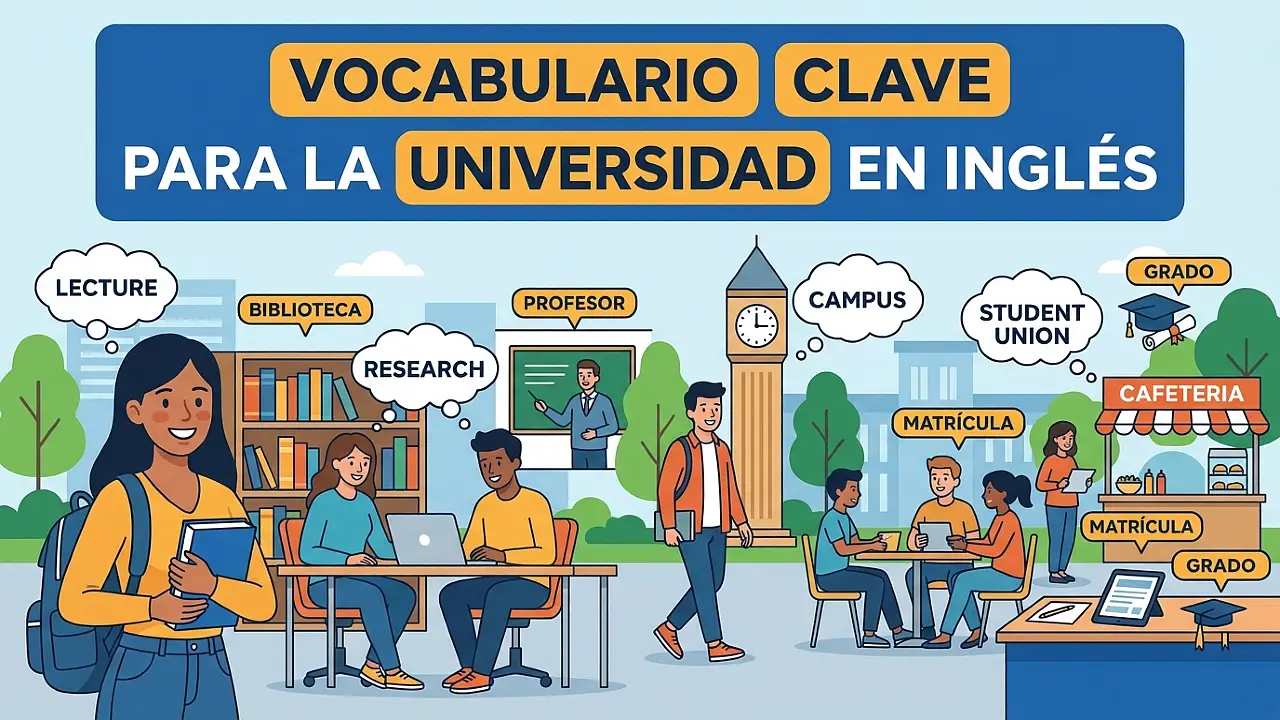
University: Vocabulario Esencial para la Vida Universitaria en Inglés
La universidad es un mundo nuevo lleno de experiencias, pero también de un vocabulario muy específico. Desde los diferentes tipos de grados (Bachelor’s, Master’s) hasta las personas que forman parte de la comunidad universitaria (lecturer, dean, graduate), dominar este léxico es crucial si planeas estudiar en el extranjero o seguir formándote en inglés.
🎯 En este post aprenderás: El nombre de los títulos universitarios, los miembros de la facultad, las instalaciones del campus (campus, library, lecture hall), verbos clave como «to enroll» o «to graduate», y expresiones útiles para tu día a día en la universidad. Esto complementa a la perfección el vocabulario de School: asignaturas y objetos para tu progresión académica.
📜 Títulos y Tipos de Estudios (Degrees & Courses)
🎓 Tu camino académico
El primer paso es saber cómo se llaman los diferentes niveles educativos y los documentos que recibirás.
| En Español | En Inglés | Notas |
|---|---|---|
| Grado / Carrera | Bachelor’s Degree / Undergraduate Degree | Ej: «She has a Bachelor’s Degree in Biology.» |
| Máster | Master’s Degree / Postgraduate Degree | Ej: «He’s doing a Master’s in Business Administration (MBA).» |
| Doctorado | Doctorate / PhD | Ej: «After her Master’s, she wants to earn a PhD.» |
| Curso / Asignatura | Course / Module | Ej: «I’m taking three courses this semester.» |
| Diploma | Diploma / Certificate | Ej: «A one-year diploma in graphic design.» |
| Estudiante de grado | Undergraduate (student) | Ej: «Most undergraduates live on campus.» |
| Estudiante de posgrado | Postgraduate (student) / Graduate student | Ej: «Graduate students often work as teaching assistants.» |
| Graduado | Graduate | Ej: «He is a graduate of Oxford University.» |
🏛️ La Gente de la Universidad (University People)
No todo son estudiantes. Conocer al personal te ayudará a desenvolverte con respeto y precisión.
👩🏫 Profesorado
- Professor (Profesor titular)
- Lecturer (Profesor / Conferenciante)
- Teacher / Instructor (Profesor, menos común en uni)
- Teaching Assistant (TA) (Ayudante de profesor)
- Tutor (Tutor personal)
- Dean (Decano)
- Head of Department (Jefe de departamento)
👨🎓 Estudiantes y Personal
- Fresher / First-year student (Estudiante de primer año)
- Second-year / Sophomore (Segundo año)
- Final-year student (Estudiante de último año)
- Classmate (Compañero de clase)
- Fellow student (Compañero estudiante)
- Principal / Chancellor (Rector)
- Librarian (Bibliotecario)
📣 Diálogo en la universidad:
Student A: «Hi! I’m a fresher. Is this the lecture hall for the Economics course?»
Student B: «Yes, it is. The professor should be here soon. Are you an undergraduate?»
Student A: «Yes, I’m in my first year. What about you?»
Student B: «I’m a postgraduate student. I’m doing my Master’s here.»
🏢 Instalaciones y Lugares en el Campus
Para orientarte, necesitas saber cómo se llaman los edificios y servicios. Esto te será muy útil si visitas una universidad angloparlante.
- Campus – El recinto universitario.
- Lecture Hall / Auditorium – Aula magna o sala de conferencias (para clases grandes).
- Classroom – Aula normal (para grupos más pequeños).
- Laboratory (Lab) – Laboratorio.
- Library – Biblioteca.
- Student Union – Edificio de la asociación de estudiantes (con cafetería, tiendas, etc.).
- Dormitory / Halls of Residence – Residencia universitaria.
- Cafeteria / Canteen – Cafetería / comedor.
- Sports Centre / Gym – Centro deportivo / gimnasio.
- Dean’s Office / Administrative Building – Edificio de administración.
- Parking Lot – Aparcamiento.
🗣️ Verbos y Expresiones Clave para la Universidad
Acciones fundamentales en la vida académica
- To enroll in a course (matricularse en un curso) – «I need to enroll in the French course before Friday.»
- To attend a lecture / class (asistir a una clase) – «You must attend at least 80% of the lectures.»
- To take notes (tomar apuntes) – «It’s a good habit to take notes during the lecture.»
- To hand in / submit an assignment (entregar un trabajo) – «Please submit your assignment via the online portal.»
- To research (investigar) – «For our thesis, we need to research extensively.»
- To graduate from university (graduarse de la universidad) – «She will graduate next summer.»
- To get a degree (obtener un título) – «After four years, you will get a Bachelor’s degree.»
- To do a PhD / Master’s (hacer un doctorado/máster) – «He’s planning to do a PhD in Physics.»
- To major in (especializarse en) – «I want to major in Computer Science.»
🧪 5 Ejercicios Prácticos
Ejercicio 1: Relaciona la persona con su definición
- Professor
- Undergraduate
- Dean
- Teaching Assistant (TA)
- Graduate
Definiciones: (i) A student who has already completed a degree. (ii) The head of a faculty or department. (iii) A senior university teacher. (iv) A student who helps a professor with teaching. (v) A university student who hasn’t got a degree yet.
✅ Ver solución
- Professor -> (iii) A senior university teacher.
- Undergraduate -> (v) A university student who hasn’t got a degree yet.
- Dean -> (ii) The head of a faculty or department.
- Teaching Assistant (TA) -> (iv) A student who helps a professor with teaching.
- Graduate -> (i) A student who has already completed a degree.
Ejercicio 2: Traduce las siguientes frases al inglés
- Me voy a matricular en un máster de Historia.
- Debes entregar el trabajo antes del viernes.
- ¿Dónde está la biblioteca? Necesito investigar para mi tesis.
- Nos graduaremos en el auditorio principal.
- Mi compañero de clase y yo asistimos a la conferencia sobre física cuántica.
✅ Ver solución
- I’m going to enroll in a Master’s in History.
- You must submit the assignment before Friday.
- Where is the library? I need to research for my thesis.
- We will graduate in the main auditorium.
- My classmate and I attended the lecture on quantum physics.
Ejercicio 3: Elige la palabra correcta para completar la frase
- After finishing my Bachelor’s, I want to pursue a (a) diploma (b) Master’s degree (c) course.
- The head of the university is called the (a) Dean (b) Professor (c) Chancellor.
- We have a (a) lecture hall (b) dormitory (c) parking lot for 300 students in the Physics class.
- To get a good grade, it’s important to (a) graduate (b) take notes (c) enroll.
- I live on campus in the (a) Student Union (b) Halls of Residence (c) Laboratory.
✅ Ver solución
- b) Master’s degree
- c) Chancellor (Dean es para una facultad específica)
- a) lecture hall
- b) take notes
- b) Halls of Residence
Ejercicio 4: Completa el mini-diálogo
Student: «Excuse me, where can I ____________ for the Art History ____________?»
Administrator: «You need to go to the ____________ Office. But first, are you an ____________ or a postgraduate?»
Student: «I’m a ____________. It’s my first year.»
Administrator: «Great! Then you can also apply for a room in the ____________ of Residence.»
✅ Ver solución
Student: «Excuse me, where can I enroll for the Art History course?»
Administrator: «You need to go to the Administrative Office. But first, are you an undergraduate or a postgraduate?»
Student: «I’m an undergraduate. It’s my first year.»
Administrator: «Great! Then you can also apply for a room in the Halls of Residence.»
Ejercicio 5: ¿Verdadero o falso? Corrige las falsas
- A «PhD» is a type of Master’s degree.
- A «lecturer» and a «professor» are exactly the same in every university.
- «To graduate» means to finish your studies and get a degree.
- The «Student Union» is a place where students can go to study in silence.
- A «final-year student» is about to finish their studies.
✅ Ver solución
- False. A PhD is a doctorate, a higher level than a Master’s.
- False. A professor is usually a higher, more senior rank than a lecturer.
- True.
- False. A Student Union is a social hub, not a silent study space (that’s the library).
- True.
🌍 Aplicaciones y Consejos para tu Año en el Extranjero
📝 Diferencias entre inglés británico y americano:
- Course: En UK se refiere a un programa completo (ej. «a Law course»). En US se refiere a una asignatura individual (ej. «I’m taking a Math course»).
- School: En US, puedes decir «I’m going to law school». En UK, se dice «I’m going to university to study law».
- Lecturer vs. Professor: En US, «professor» es el término común. En UK, «lecturer» es un puesto inicial, y «professor» es un puesto muy alto.
- First-year student: En UK se dice «fresher». En US se dice «freshman».
📚 Serie completa: Vocabulario de Educación en Inglés
Sigue aprendiendo sobre el mundo académico en inglés:
- School: asignaturas y objetos – La base de tu educación.
- University: universidad – ¡Estás aquí!
- Exams: exámenes y notas – El momento de la verdad.
- Classroom: en la clase – El entorno de aprendizaje.
- Stationery: material de oficina – Tus herramientas de estudio.







Publicar comentario