Ejercicios present simple y continuous con soluciones
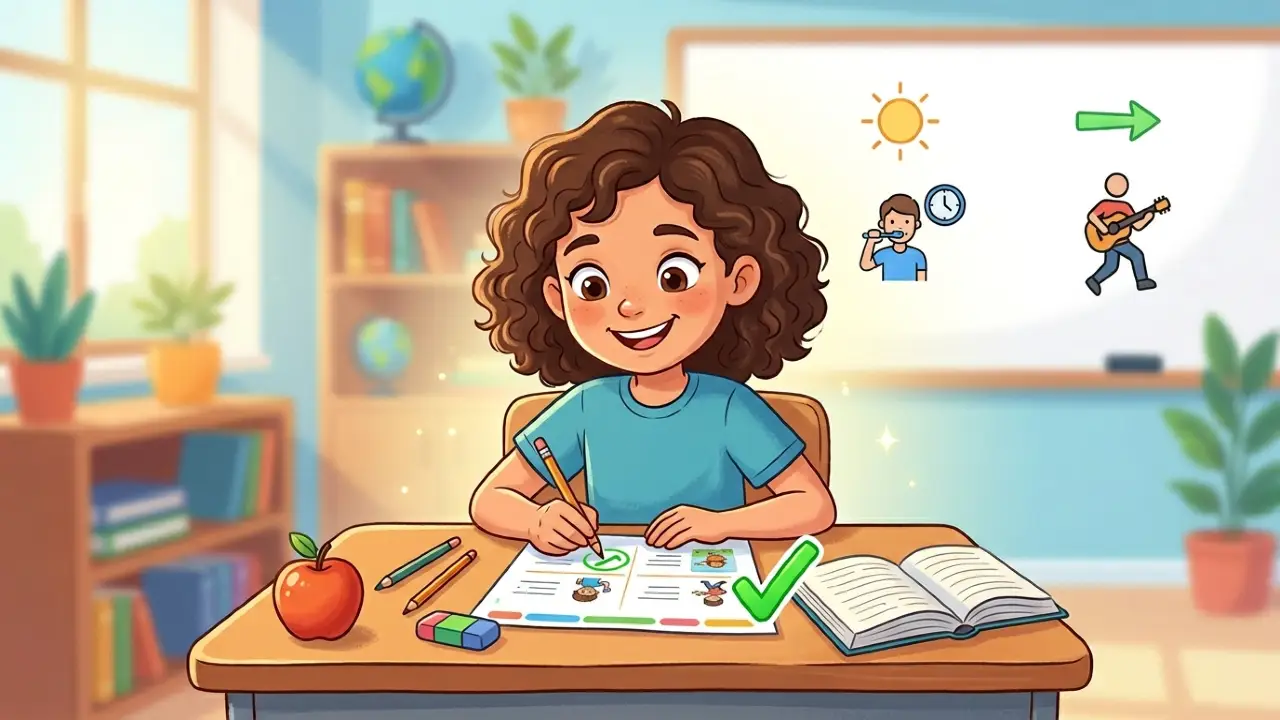
Pon a prueba lo aprendido: Ejercicios de Present Simple y Continuous
La teoría es importante, pero la práctica es la que realmente fija los conocimientos. Hemos preparado una batería de ejercicios para que demuestres si dominas la diferencia entre el present simple y el present continuous, y si recuerdas los verbos estáticos.
🎯 En este post encontrarás: 5 ejercicios de dificultad progresiva (desde rellenar huecos hasta traducir frases), con sus soluciones detalladas y explicaciones para que entiendas por qué una respuesta es correcta y otra no.
📝 Ejercicio 1: Elige la opción correcta
Selecciona la forma verbal adecuada para cada oración.
- She usually __________ (walk / is walking) to school.
- Look! The children __________ (play / are playing) in the garden.
- I __________ (don’t understand / am not understanding) this exercise.
- We __________ (go / are going) to the beach every summer.
- He __________ (has / is having) a shower at the moment.
✅ Ver soluciones y explicaciones
- walks – «Usually» es un marcador de rutina, por lo tanto usamos Present Simple.
- are playing – «Look!» llama la atención sobre una acción que está ocurriendo ahora, usamos Present Continuous.
- don’t understand – «Understand» es un stative verb (verbo de pensamiento) y no se usa en continuous.
- go – «Every summer» indica una acción que se repite (hábito), por lo tanto Present Simple.
- is having – «At the moment» es una marca de ahora. Además, «have a shower» es una expresión que usa «have» como acción (dinámico), no como posesión.
📝 Ejercicio 2: Completa los huecos
Completa las oraciones con la forma correcta del verbo entre paréntesis (present simple o present continuous).
- She __________ (work) as a nurse. She __________ (love) her job.
- I can’t hear you because the children __________ (make) a lot of noise.
- What time __________ (the train / leave)?
- He usually __________ (drink) coffee, but today he __________ (drink) tea.
- Please, be quiet. I __________ (try) to concentrate.
- My brother __________ (have) a new car. He __________ (buy) it last week.
- Why __________ (you / look) at me like that?
- This soup __________ (taste) delicious. __________ (you / want) some?
- They __________ (live) in London, but this month they __________ (stay) in a hotel.
- Listen! Someone __________ (sing) in the next room.
✅ Ver soluciones
- works, loves (Hechos generales/profesión y sentimiento)
- are making (Acción en curso ahora)
- does the train leave (Horario fijo, Present Simple con valor de futuro)
- drinks, is drinking (Hábito general vs. acción puntual de hoy)
- am trying (Acción en curso ahora)
- has, bought (Posesión, estado, no se usa continuous; ‘bought’ es pasado simple, no se incluye aquí)
- are you looking (Acción de mirar, dinámico)
- tastes, Do you want (‘Tastes’ es verbo de sentido estático; ‘want’ es estático de deseo)
- live, are staying (Permanente vs. temporal)
- is singing (Acción que oímos ahora)
📝 Ejercicio 3: Encuentra y corrige el error
En cada una de estas oraciones hay un error. Identifícalo y escribe la versión correcta.
- I am wanting to buy a new laptop.
- She is usually getting up at 7 am.
- We are go to the cinema tonight.
- He doesn’t likes getting up early.
- Look! It rains. Take an umbrella.
- What do you do right now? I am busy.
- This cake is tasting delicious.
- They are believing in God.
- I am knowing the answer to that question.
- She is having a beautiful house in the countryside.
✅ Ver soluciones y correcciones
- ❌ I am wanting → ✅ I want (‘want’ es stative verb).
- ❌ is usually getting → ✅ usually gets (‘Usually’ y rutina requieren Present Simple).
- ❌ are go → ✅ are going (Falta el -ing para el futuro con ‘going to’).
- ❌ doesn’t likes → ✅ doesn’t like (Con auxiliar ‘does’, el verbo va sin -s).
- ❌ It rains → ✅ is raining (‘Look!’ indica una acción ahora).
- ❌ What do you do → ✅ are you doing (‘Right now’ indica acción en curso).
- ❌ is tasting → ✅ tastes (Verbo de sentido ‘taste’ es estático aquí).
- ❌ are believing → ✅ believe (‘Believe’ es stative verb).
- ❌ am knowing → ✅ know (‘Know’ es stative verb).
- ❌ is having → ✅ has (Aquí ‘have’ significa poseer, es estático).
📝 Ejercicio 4: Traducción
Traduce las siguientes oraciones al inglés, prestando especial atención al tiempo verbal.
- Normalmente desayuno a las 8, pero hoy estoy desayunando más tarde.
- ¿Qué haces? (ahora mismo) – Estoy leyendo un libro.
- Mi hermana vive en Barcelona, pero esta semana está visitando a unos amigos en Madrid.
- El tren sale a las 5 de la tarde.
- No entiendo esta palabra. ¿Qué significa?
- ¡Siempre estás perdiendo las llaves! Es muy molesto.
- Esta sopa sabe un poco extraña. ¿La estás probando?
- ¿Vienes a la fiesta esta noche? – No, tengo que trabajar mañana.
- Él está siendo muy grosero hoy, no es normal en él.
- Pss, no hagas ruido. El bebé está durmiendo.
✅ Ver soluciones
- I usually have breakfast at 8, but today I am having breakfast later.
- What are you doing? – I am reading a book.
- My sister lives in Barcelona, but this week she is visiting friends in Madrid.
- The train leaves at 5 pm.
- I don’t understand this word. What does it mean?
- You are always losing your keys! It’s very annoying.
- This soup tastes a bit strange. Are you tasting it?
- Are you coming to the party tonight? – No, I have to work tomorrow.
- He is being very rude today, it’s not like him.
- Shh, don’t make noise. The baby is sleeping.
📝 Ejercicio 5: Texto para completar
Completa el siguiente texto con la forma correcta de los verbos.
My name (be) __________ Laura and I (work) __________ as a teacher. Every morning, I (get up) __________ at 7 am and I (have) __________ a quick breakfast. Then, I (catch) __________ the bus to school. Right now, I (sit) __________ in my classroom and I (wait) __________ for my students. They usually (arrive) __________ a few minutes before the class starts. Today, however, one of my students, Tom, (not/be) __________ here. He (visit) __________ his grandparents this week. I (hope) __________ he (have) __________ a great time. At the moment, the sun (shine) __________ through the window. It (be) __________ a beautiful day! I (love) __________ my job, especially on days like this.
✅ Ver soluciones
My name is Laura and I work as a teacher. Every morning, I get up at 7 am and I have a quick breakfast. Then, I catch the bus to school. Right now, I am sitting in my classroom and I am waiting for my students. They usually arrive a few minutes before the class starts. Today, however, one of my students, Tom, is not here. He is visiting his grandparents this week. I hope he is having a great time. At the moment, the sun is shining through the window. It is a beautiful day! I love my job, especially on days like this.
📊 Tabla resumen para repasar
| Concepto | Present Simple | Present Continuous |
|---|---|---|
| Uso | Hábitos, rutinas, hechos generales. | Acciones ahora, temporales, planes futuros. |
| Palabras clave | always, usually, every day, on Mondays… | now, at the moment, today, tonight, listen!… |
| Forma (+) | I/You/We/They play. He/She/It plays. | I am playing. He/She/It is playing. We/You/They are playing. |
| Forma (-) | I don’t play. He doesn’t play. | I’m not playing. He isn’t playing. They aren’t playing. |
| Forma (?) | Do you play? Does he play? | Are you playing? Is he playing? |
💡 Repaso final: Antes de hacer los ejercicios, asegúrate de tener claros los conceptos de los posts anteriores. Si tienes dudas, vuelve a ellos:
- Present Simple – Para rutinas y hechos.
- Present Continuous – Para acciones en progreso y planes.
- Diferencias clave – Comparativa visual.
- Stative Verbs – Verbos que no se usan en continuous.
📚 Serie completa: Present Simple & Continuous
- Present Simple: usos, reglas y 100 ejemplos – Post 1
- Present Continuous: cómo y cuándo usarlo – Post 2
- Present Simple vs Present Continuous: diferencias clave – Post 3
- Verbos estáticos (stative verbs) que no se usan en continuous – Post 4
- Ejercicios present simple y continuous con soluciones – ¡Estás aquí!
💡 Sigue practicando: La clave para dominar estos tiempos es la exposición y la práctica constante. Te recomiendo que, además de estos ejercicios, intentes escribir un pequeño diario en inglés describiendo tu día (usando Simple y Continuous) o que hables contigo mismo describiendo lo que ves a tu alrededor. ¡No te rindas!





Publicar comentario