Mixed Conditionals: explicación, estructura y ejemplos en inglés
Mixed Conditionals: El condicional que mezcla tiempos
Imagina que quieres decir «Si no hubiera comido tanto ayer, no tendría hambre ahora». O «Si hablara inglés perfecto, habría conseguido ese trabajo la semana pasada». En estas frases, la condición y el resultado ocurren en tiempos diferentes (una en el pasado, otra en el presente). Para estas situaciones, el inglés utiliza los Mixed Conditionals (condicionales mixtos), la combinación más avanzada de los condicionales.
🎯 En este post aprenderás: Los dos tipos principales de mixed conditionals (pasado→presente y presente→pasado), sus estructuras (If + Past Perfect, would + infinitivo y If + Past Simple, would have + participio), cuándo usarlos, la diferencia con los condicionales estándar, y más de 25 ejemplos con ejercicios prácticos para dominar este nivel avanzado.
🔍 ¿Qué son los Mixed Conditionals?
⏱️ La fórmula de la asimetría temporal
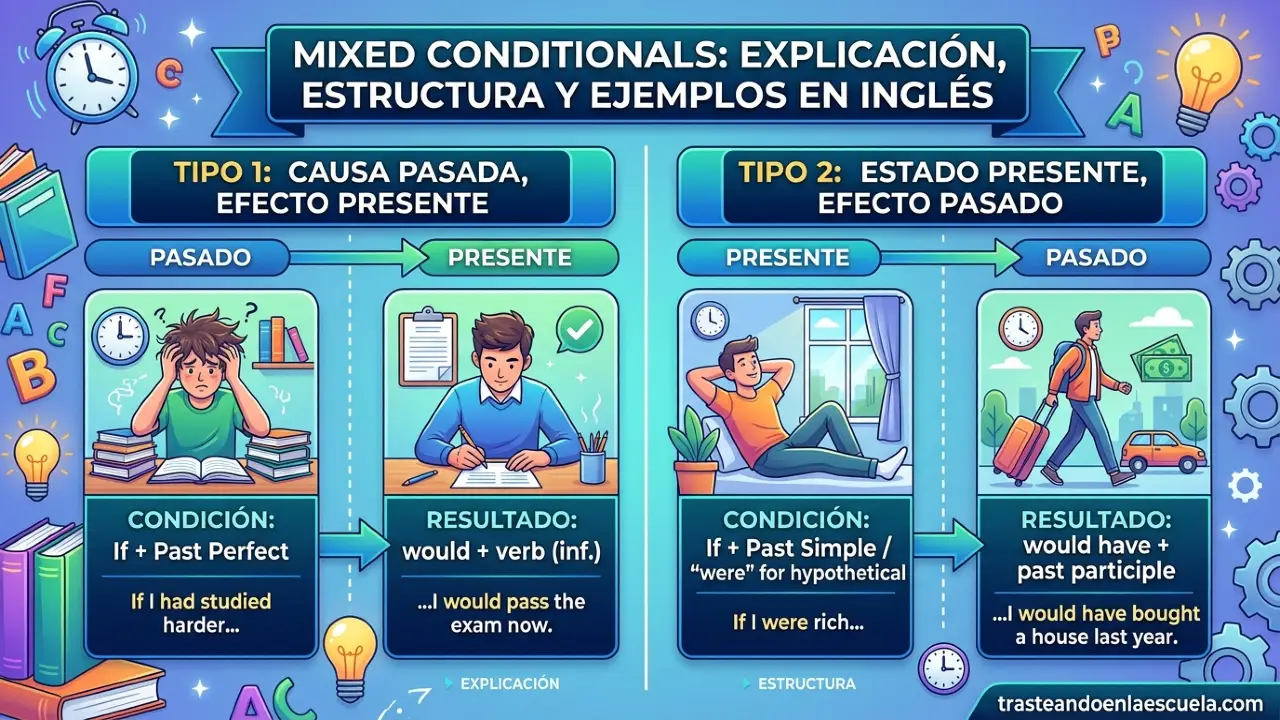
Los condicionales mixtos son combinaciones de diferentes tipos de condicionales. Se usan cuando la condición y el resultado ocurren en tiempos diferentes. Los dos tipos más comunes son:
TIPO 1: PASADO → PRESENTE
If I had studied medicine , I would be a doctor now.
(Si hubiera estudiado medicina, ahora sería médico.)
TIPO 2: PRESENTE → PASADO
If I were more confident , I would have applied for that job.
(Si fuera más confidente, habría solicitado ese trabajo.)
📅 Línea temporal de los Mixed Conditionals
Tipo 1 (Pasado → Presente):
CONDICIÓN (pasado) → RESULTADO (presente)
If I had studied… (pasado) | I would be a doctor now (presente)
Tipo 2 (Presente → Pasado):
CONDICIÓN (presente) → RESULTADO (pasado)
If I were confident… (presente) | I would have applied (pasado)
🎭 La analogía del teatro
Imagina una obra de teatro con dos actos que ocurren en diferentes épocas:
- Condicional estándar: Ambos actos ocurren en la misma época (todo en pasado, todo en presente, todo en futuro).
- Mixed conditional: Un acto ocurre en el pasado y el otro en el presente. Los personajes viajan entre épocas.
Por ejemplo: «If I had bought Google shares in 2005 (acto en el pasado), I would be rich now (acto en el presente)».
📋 Tipo 1: Condición en pasado, resultado en presente
🎯 Estructura: If + Past Perfect, would + infinitivo
🔨 ¿Cuándo se usa?
Usamos esta estructura cuando queremos hablar de cómo una situación pasada (que no ocurrió) afecta al presente actual. Es muy común para expresar:
- Cómo sería diferente nuestra vida ahora si hubiéramos tomado otras decisiones.
- Habilidades o situaciones presentes que son consecuencia de acciones pasadas no realizadas.
Ejemplos detallados
- If I had studied computer science, I would have a high-paying job now. (Si hubiera estudiado informática, tendría un trabajo bien pagado ahora.)
- She would be married now if she had accepted his proposal. (Ella estaría casada ahora si hubiera aceptado su propuesta.)
- If we had left earlier, we wouldn’t be stuck in traffic now. (Si hubiéramos salido antes, no estaríamos atascados en el tráfico ahora.)
- I would know the answer if I had paid attention in class. (Sabría la respuesta si hubiera prestado atención en clase.)
- If you had taken my advice, you wouldn’t have problems now. (Si hubieras seguido mi consejo, no tendrías problemas ahora.)
✍️ Comparación con el tercer condicional
Tercer condicional (todo en pasado):
If I had studied, I would have passed the exam. (Si hubiera estudiado, habría aprobado el examen.) → Todo ocurrió en el pasado.
Mixed type 1 (pasado → presente):
If I had studied, I would be a doctor now. (Si hubiera estudiado, ahora sería médico.) → Condición en pasado, resultado en presente.
📝 Más ejemplos del Tipo 1
| Situación | Ejemplo |
|---|---|
| Educación | If I had learned English as a child, I would speak fluently now. |
| Salud | I would feel better today if I hadn’t eaten that spicy food last night. |
| Finanzas | If we had bought that house years ago, we would be rich now. |
| Relaciones | She would still be my friend if I hadn’t lied to her. |
| Carrera | If I had taken that job, I would work in London now. |
📋 Tipo 2: Condición en presente, resultado en pasado
🎯 Estructura: If + Past Simple, would have + participio
🔨 ¿Cuándo se usa?
Usamos esta estructura cuando queremos hablar de cómo una situación presente (que no es real) habría afectado a una acción pasada. Es como imaginar que si tu personalidad o circunstancias actuales fueran diferentes, habrías actuado de otra manera en el pasado.
Ejemplos detallados
- If I were more organized, I wouldn’t have lost my passport. (Si fuera más organizado, no habría perdido mi pasaporte.)
- She would have accepted the job if she spoke French. (Ella habría aceptado el trabajo si hablara francés.)
- If we had a car, we would have driven to the beach yesterday. (Si tuviéramos coche, habríamos ido en coche a la playa ayer.)
- I would have called you if I had your number. (Te habría llamado si tuviera tu número.)
- If he weren’t so shy, he would have asked her out. (Si no fuera tan tímido, le habría pedido una cita.)
✍️ Comparación con el segundo condicional
Segundo condicional (todo en presente/futuro):
If I spoke French, I would work in Paris. (Si hablara francés, trabajaría en París.) → Futuro imaginario.
Mixed type 2 (presente → pasado):
If I spoke French, I would have got the job last week. (Si hablara francés, habría conseguido el trabajo la semana pasada.) → Condición en presente, resultado en pasado.
📝 Más ejemplos del Tipo 2
| Situación | Ejemplo |
|---|---|
| Personalidad | If I were more outgoing, I would have made more friends at the party. |
| Habilidades | She would have finished the project if she were more efficient. |
| Preferencias | If I liked coffee, I would have ordered a cappuccino. |
| Circunstancias | We would have visited you if we lived closer. |
| Conocimiento | If I knew how to cook, I wouldn’t have ordered pizza. |
📊 Tabla comparativa: Todos los condicionales
| Tipo | Estructura | Uso | Ejemplo |
|---|---|---|---|
| Zero | If + Present Simple, Present Simple | Siempre cierto | If you heat ice, it melts. |
| First | If + Present Simple, will + inf | Posible futuro | If it rains, we will stay home. |
| Second | If + Past Simple, would + inf | Imaginario presente/futuro | If I won the lottery, I would travel. |
| Third | If + Past Perfect, would have + part | Imaginario pasado | If I had studied, I would have passed. |
| Mixed 1 | If + Past Perfect, would + inf | Pasado → Presente | If I had studied, I would be a doctor now. |
| Mixed 2 | If + Past Simple, would have + part | Presente → Pasado | If I were confident, I would have applied. |
💡 Regla de oro: Para identificar qué mixed conditional usar, pregúntate: «¿En qué tiempo ocurre la condición?» y «¿En qué tiempo ocurre el resultado?». Luego aplica la estructura correspondiente:
- Condición en PASADO + Resultado en PRESENTE = If + Past Perfect, would + inf
- Condición en PRESENTE + Resultado en PASADO = If + Past Simple, would have + part
🧪 5 Ejercicios prácticos para dominar los Mixed Conditionals
Ejercicio 1: Identifica el tipo de mixed conditional
Identifica si cada oración es Tipo 1 (pasado→presente) o Tipo 2 (presente→pasado).
- If I had listened to my mother, I wouldn’t be in trouble now.
- She would have bought the dress if she had more money.
- If he weren’t so lazy, he would have finished the report yesterday.
- We would be millionaires now if we had invested in that company.
- If I knew how to swim, I would have gone to the beach with them.
✅ Ver solución
- Tipo 1 (pasado→presente): If I had listened (pasado) → I wouldn’t be (presente)
- Tipo 2 (presente→pasado): If she had (presente) → would have bought (pasado)
- Tipo 2 (presente→pasado): If he weren’t (presente) → would have finished (pasado)
- Tipo 1 (pasado→presente): If we had invested (pasado) → would be (presente)
- Tipo 2 (presente→pasado): If I knew (presente) → would have gone (pasado)
Ejercicio 2: Completa las oraciones (Tipo 1 – pasado→presente)
Completa con la forma correcta del verbo para formar mixed conditionals tipo 1.
- If I __________ (take) that job, I __________ (work) in New York now.
- We __________ (not/be) lost now if we __________ (follow) the GPS.
- She __________ (speak) perfect Italian now if she __________ (live) in Rome for years.
- If you __________ (save) money, you __________ (have) a car now.
- I __________ (feel) better today if I __________ (not/eat) so much last night.
✅ Ver solución
- If I had taken that job, I would work in New York now.
- We wouldn’t be lost now if we had followed the GPS.
- She would speak perfect Italian now if she had lived in Rome for years.
- If you had saved money, you would have a car now.
- I would feel better today if I hadn’t eaten so much last night.
Estructura: If + had + participio, would + infinitivo (presente).
Ejercicio 3: Completa las oraciones (Tipo 2 – presente→pasado)
Completa con la forma correcta del verbo para formar mixed conditionals tipo 2.
- If I __________ (be) more careful, I __________ (not/break) my phone yesterday.
- She __________ (accept) the invitation if she __________ (know) them better.
- If we __________ (have) a map, we __________ (not/get) lost last week.
- He __________ (buy) the house if he __________ (have) more money.
- If I __________ (can) drive, I __________ (rent) a car for our trip last summer.
✅ Ver solución
- If I were more careful, I wouldn’t have broken my phone yesterday.
- She would have accepted the invitation if she knew them better.
- If we had a map, we wouldn’t have gotten lost last week.
- He would have bought the house if he had more money.
- If I could drive, I would have rented a car for our trip last summer.
Estructura: If + past simple, would have + participio. Recuerda «were» para el verbo to be.
Ejercicio 4: Elige la opción correcta
Selecciona la opción que completa correctamente cada oración.
- If I __________ harder in school, I would have a better job now.
a) had worked / b) worked / c) would have worked - She would have come to the party if she __________ invited.
a) had been / b) were / c) would be - If we __________ a bigger apartment, we would have invited you to stay last month.
a) had had / b) had / c) would have - I __________ you if I had your number.
a) would call / b) would have called / c) called - If he weren’t so arrogant, he __________ more friends in college.
a) would make / b) would have made / c) made
✅ Ver solución
- a) had worked – If I had worked harder in school, I would have a better job now. (Tipo 1)
- b) were – She would have come to the party if she were invited. (Tipo 2: presente→pasado)
- b) had – If we had a bigger apartment, we would have invited you to stay last month. (Tipo 2)
- b) would have called – I would have called you if I had your number. (Tipo 2)
- b) would have made – If he weren’t so arrogant, he would have made more friends in college. (Tipo 2)
Ejercicio 5: Crea tus propios mixed conditionals
Completa las siguientes oraciones de manera lógica usando mixed conditionals.
- If I had learned to play the piano as a child, ____________________ now.
- I would have bought that car if ____________________.
- If I were more patient, ____________________ yesterday.
- We wouldn’t be so tired now if ____________________.
- What would you have done last week if ____________________?
✅ Ver soluciones de ejemplo
Posibles respuestas:
- If I had learned to play the piano as a child, I would be a musician now. (Tipo 1)
- I would have bought that car if I had more money. (Tipo 2)
- If I were more patient, I wouldn’t have argued with my boss yesterday. (Tipo 2)
- We wouldn’t be so tired now if we had gone to bed earlier last night. (Tipo 1)
- What would you have done last week if you had won the lottery? (Tipo 2 – pero aquí la condición es pasada, así que sería tipo 1? Cuidado: «if you had won» es pasado, el resultado «would have done» también es pasado, ¡eso es tercer condicional! La pregunta correcta para mixed sería: «What would you do now if you had won the lottery last week?» (Tipo 1))
Nota: En el último ejemplo, la pregunta original (what would you have done last week if…?) lleva a un tercer condicional si la condición también es pasada. Para mixed, necesitamos tiempos diferentes.
❌ Errores comunes con los Mixed Conditionals
| Error | Ejemplo incorrecto | Corrección | Explicación |
|---|---|---|---|
| Mezclar estructuras incorrectamente | If I had studied, I would have a job now? (bien) / If I studied, I would have a job now? (mal) | If I had studied, I would have a job now. | Tipo 1 necesita Past Perfect en la condición. |
| Usar «would have» en la condición | If I would have studied, I would be a doctor. | If I had studied, I would be a doctor. | NUNCA uses «would have» después de «if». |
| Confundir Tipo 1 con Tercer Condicional | If I had studied, I would have been a doctor now. | If I had studied, I would be a doctor now. | Si el resultado es presente, no puede ser «would have been». |
| Confundir Tipo 2 con Segundo Condicional | If I were confident, I would apply for that job. | If I were confident, I would have applied for that job. | Si la acción ya pasó, necesitas «would have applied». |
| Olvidar «were» en lugar de «was» | If I was confident, I would have applied. | If I were confident, I would have applied. | En situaciones hipotéticas, «were» es correcto para todos. |
| Usar el tiempo equivocado en la condición | If I have money, I would have bought it. | If I had money, I would have bought it. | Presente simple no va con «would have». |
🌍 Aplicaciones en la vida real
🗣️ En conversaciones cotidianas (nivel avanzado)
- Explicando situaciones presentes por acciones pasadas: «If I hadn’t missed the bus this morning, I wouldn’t be so stressed now.»
- Reflexionando sobre oportunidades pasadas relacionadas con el presente: «I would be fluent in Japanese now if I had continued my classes.»
- Imaginando cómo el presente afectó decisiones pasadas: «If I liked spicy food, I would have ordered the curry last night.»
🎓 En el ámbito profesional
- Entrevistas de trabajo: «If I had known about this opportunity earlier, I would have prepared a different portfolio.»
- Evaluaciones de desempeño: «I would have finished the project on time if I had a better team.»
- Negociaciones: «If we had secured the funding, we would be expanding now.»
📚 En contextos académicos
- Ensayos históricos: «If the Roman Empire hadn’t fallen, Europe would be very different today.»
- Análisis literario: «If Hamlet had acted sooner, he wouldn’t be tormented by doubt throughout the play.»
- Ciencias sociales: «If the policy had been implemented earlier, we wouldn’t see such high unemployment rates now.»
📖 Glosario de términos
| Término | Definición | Ejemplo |
|---|---|---|
| Mixed Conditional | Condicional que combina diferentes tiempos | If I had studied, I would be rich. |
| Past → Present | Tipo 1: condición pasada, resultado presente | If I had bought Bitcoin, I would be rich now. |
| Present → Past | Tipo 2: condición presente, resultado pasado | If I were taller, I would have played basketball. |
| Past Perfect | had + participio (para condición pasada) | had known, had seen, had gone |
| Past Simple (hypothetical) | Pasado simple para condición presente irreal | I had, I knew, I were |
| Would + infinitive | Resultado en presente imaginario | I would be, she would have |
| Would have + participle | Resultado en pasado imaginario | I would have been, they would have gone |
| Time asymmetry | Asimetría temporal (condición y resultado en tiempos diferentes) | Past condition + present result |
📚 Serie completa: Condicionales en Inglés
¡Has llegado al final de la serie! Aquí tienes todos los condicionales:
- Conditional Zero – Hechos y verdades universales.
- First Conditional – Situaciones reales y posibles.
- Second Conditional – Hipotéticos e imaginarios.
- Third Conditional – Arrepentimientos y situaciones pasadas.
- Mixed Conditionals – ¡Estás aquí! Combinaciones de tiempos.
🏆 Reto final: Domina todos los condicionales
Para consolidar todo lo aprendido en la serie, te propongo un reto: durante una semana, cada día escribe un ejemplo de cada tipo de condicional relacionado con tu vida:
- Día 1 (Zero): Algo que siempre ocurre (If I drink coffee late, I can’t sleep).
- Día 2 (First): Un plan futuro posible (If it’s sunny, I’ll go to the park).
- Día 3 (Second): Un sueño o deseo (If I had a million dollars, I’d travel).
- Día 4 (Third): Un arrepentimiento (If I had studied, I would have passed).
- Día 5 (Mixed 1): Algo del pasado que afecta tu presente (If I had learned guitar, I’d be in a band now).
- Día 6 (Mixed 2): Algo de tu presente que afectó el pasado (If I weren’t afraid, I would have gone skydiving).
- Día 7: Repaso y corrección de todos los ejemplos.
¡En una semana habrás interiorizado todos los condicionales!




Publicar comentario