Farm animals: vocabulario de animales de granja en inglés
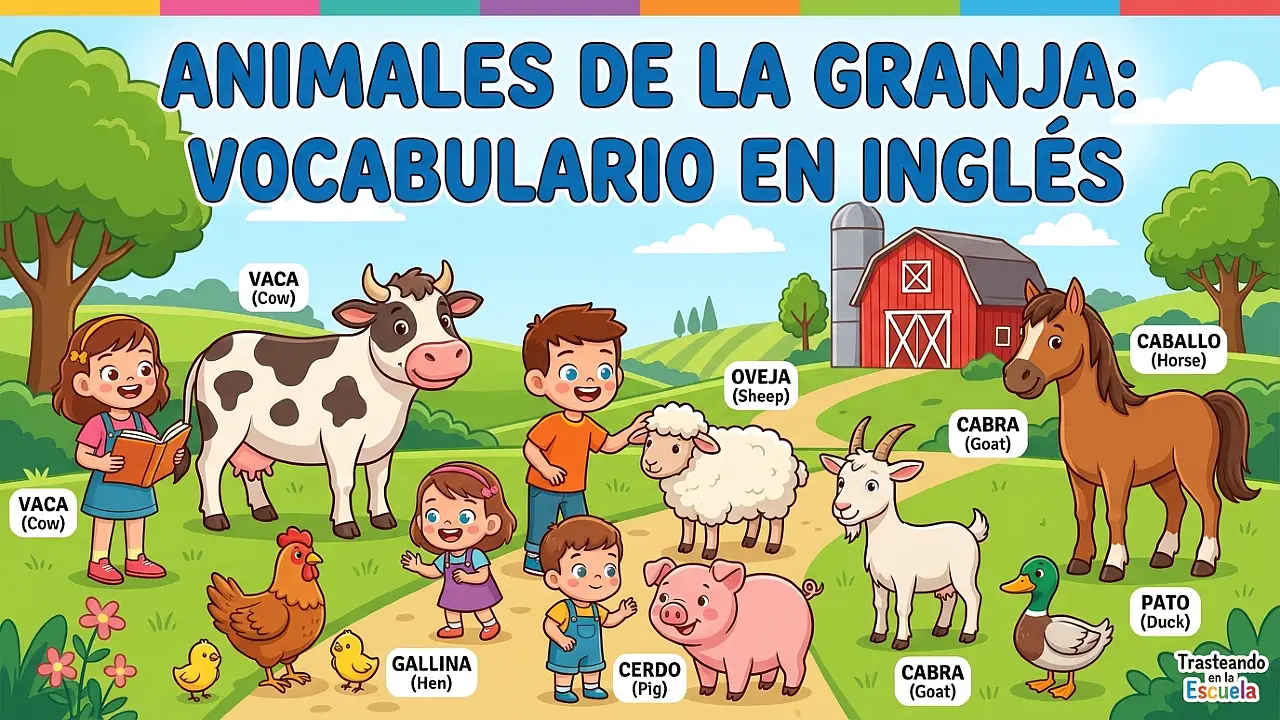
Farm animals: El vocabulario del campo en inglés
Los animales de granja son parte esencial del vocabulario básico en inglés. Desde la cow (vaca) que nos da leche hasta la sheep (oveja) que nos da lana, pasando por el pig (cerdo) y el horse (caballo), este post te enseñará todo lo que necesitas saber para hablar de la vida en el campo. Ya sea para una visita a una granja, leer cuentos infantiles o simplemente ampliar tu vocabulario, ¡aquí encontrarás todo!
🎯 En este post aprenderás: Los nombres de todos los animales de granja en inglés (mamíferos, aves y otros), el nombre de las crías (baby animals), los sonidos que hacen, los productos que obtenemos de ellos, verbos relacionados con la granja, y mucho más.
🔍 ¿Qué son los farm animals?
🚜 Animales domesticados en el campo
Farm animals (animales de granja) son animales domesticados que se crían en granjas para producir alimentos (leche, carne, huevos), materiales (lana, cuero) o para trabajar (como caballos y bueyes). A diferencia de las pets (mascotas), los animales de granja suelen vivir al aire libre o en establos.
💡 Dato curioso: En inglés, se usa el término livestock para referirse a los animales de granja criados para producir alimento o materiales. Las aves de corral se llaman poultry.
🐮 Mamíferos de granja (Farm mammals)
Vacas y bóvidos (Cows & cattle)
| Español | English | Nota |
|---|---|---|
| Vaca | Cow | Hembra adulta |
| Toro | Bull | Macho adulto no castrado |
| Buey | Ox (plural: oxen) | Macho castrado, usado para trabajar |
| Ternero / Becerro | Calf (plural: calves) | Cría |
| Ganado vacuno | Cattle | Término colectivo (plural sin «s») |
🐖 Cerdos (Pigs)
| Español | English | Nota |
|---|---|---|
| Cerdo | Pig | Término general |
| Cochino / Marrano | Hog | Cerdo adulto (especialmente para consumo) |
| Verraco | Boar | Cerdo macho reproductor |
| Cerda | Sow | Cerdo hembra adulta |
| Lechón / Cochino | Piglet | Cría |
🐑 Ovejas y cabras (Sheep & goats)
| Español | English | Nota |
|---|---|---|
| Oveja | Sheep (plural: sheep) | No cambia en plural |
| Carnero | Ram | Oveja macho |
| Cordero | Lamb | Cría de oveja |
| Cabra | Goat | – |
| Cabro / Macho cabrío | Billy goat | Cabra macho |
| Cabrita / Chivo | Kid | Cría de cabra |
🐎 Caballos y équidos (Horses & equines)
| Español | English | Nota |
|---|---|---|
| Caballo | Horse | Término general |
| Yegua | Mare | Caballo hembra |
| Potro / Potranca | Foal | Cría de caballo |
| Burro / Asno | Donkey / Ass | – |
| Mula | Mule | Híbrido de burro y yegua |
| Poni | Pony | Caballo de raza pequeña |
🐔 Aves de corral (Poultry)
| Español | English | Nota |
|---|---|---|
| Gallina | Hen | Hembra adulta |
| Gallo | Rooster (US) / Cockerel (UK) | Macho adulto |
| Pollito | Chick | Cría recién nacida |
| Pollo (joven) | Pullet | Gallina joven |
| Pato | Duck | – |
| Ánade / Pato macho | Drake | Pato macho |
| Patito | Duckling | Cría de pato |
| Ganso | Goose (plural: geese) | – |
| Ganso macho | Gander | – |
| Ansarino / Gansito | Gosling | Cría de ganso |
| Pavo | Turkey | – |
| Pavipollo | Poult | Cría de pavo |
| Codorniz | Quail | – |
| Faisán | Pheasant | – |
🐇 Otros animales de granja
| Español | English | Nota |
|---|---|---|
| Conejo | Rabbit | Se cría para carne y piel |
| Abeja | Bee | Produce miel |
| Perro pastor | Sheepdog / Herding dog | Ayuda a pastorear |
| Gato de granja | Farm cat | Controla ratones |
| Llama | Llama | Animal de carga y lana |
| Alpaca | Alpaca | Lana muy fina |
🐣 Las crías de los animales de granja (Baby farm animals)
| Español | English | Adulto |
|---|---|---|
| Ternero / Becerro | Calf | Cow / Bull |
| Lechón / Cochino | Piglet | Pig / Hog |
| Cordero | Lamb | Sheep |
| Cabrito / Chivo | Kid | Goat |
| Potro / Potranca | Foal | Horse |
| Pollito | Chick | Hen / Rooster |
| Patito | Duckling | Duck |
| Ansarino / Gansito | Gosling | Goose |
| Pavipollo | Poult | Turkey |
| Conejito | Bunny / Kit | Rabbit |
🗣️ Los sonidos de los animales de granja en inglés
🎵 ¿Qué dice la vaca? ¡Moo!
Los sonidos de los animales de granja son diferentes en inglés. ¡Aquí tienes los más importantes!
| Animal | Sonido (English) | Verbo | Ejemplo |
|---|---|---|---|
| Cow (Vaca) | Moo | to moo / to low | The cows are mooing in the field. |
| Pig (Cerdo) | Oink | to oink / to grunt | The pig oinks when it’s hungry. |
| Sheep (Oveja) | Baa | to baa / to bleat | The lambs were baaing for their mother. |
| Goat (Cabra) | Bleat / Maa | to bleat | Goats bleat loudly. |
| Horse (Caballo) | Neigh / Whinny | to neigh / to whinny | The horse neighed when it saw me. |
| Hen (Gallina) | Cluck | to cluck | Hens cluck after laying eggs. |
| Rooster (Gallo) | Cock-a-doodle-doo | to crow | The rooster crows at sunrise. |
| Duck (Pato) | Quack | to quack | Ducks quack by the pond. |
| Turkey (Pavo) | Gobble | to gobble | Turkeys gobble in the yard. |
🥛 Productos de los animales de granja
🥚 ¿Qué obtenemos de cada animal?
| Animal | Producto | English |
|---|---|---|
| Cow (Vaca) | Leche, carne, cuero | Milk, beef, leather |
| Sheep (Oveja) | Lana, carne (cordero), leche (queso de oveja) | Wool, lamb/mutton, milk (sheep cheese) |
| Goat (Cabra) | Leche, queso de cabra, carne, piel | Milk, goat cheese, meat, leather |
| Pig (Cerdo) | Carne (cerdo), tocino, jamón, cuero | Pork, bacon, ham, leather |
| Hen (Gallina) | Huevos, carne (pollo) | Eggs, chicken meat |
| Bee (Abeja) | Miel, cera | Honey, beeswax |
🔧 Verbos relacionados con la granja
📌 Acciones típicas en una granja
| Verbo | Significado | Ejemplo |
|---|---|---|
| To farm | Cultivar / Trabajar la tierra | He has been farming for 20 years. |
| To raise / To breed | Criar animales | They raise sheep on their farm. |
| To graze | Pastar | The cows are grazing in the meadow. |
| To milk | Ordeñar | She milks the cows every morning. |
| To feed | Alimentar | We feed the pigs twice a day. |
| To shear | Esquilar | Farmers shear the sheep in spring. |
| To hatch | Nacer (del huevo) / Empollar | The chicks hatched yesterday. |
| To lay eggs | Poner huevos | Hens lay eggs almost every day. |
| To plow / To plough | Ara la tierra | The farmer plows the field. |
| To harvest | Cosechar | They harvest the crops in autumn. |
🏠 Partes de la granja (Farm buildings & areas)
| Español | English |
|---|---|
| Granja | Farm |
| Establo / Cuadra | Stable |
| Granero | Barn |
| Cobertizo | Shed |
| Pocilga | Pigsty / Pigpen |
| Gallinero | Chicken coop / Henhouse |
| Prado / Pasto | Meadow / Pasture / Field |
| Cerca / Valla | Fence |
| Portera / Cancela | Gate |
| Estanque | Pond |
🗣️ Diálogos sobre animales de granja
💬 Diálogo 1: Visitando una granja
Teacher: Children, we are at the farm today. What animals can you see? (Niños, hoy estamos en la granja. ¿Qué animales pueden ver?)
Emma: I see cows and sheep! (¡Veo vacas y ovejas!)
James: Look! There’s a pig with her piglets. They’re so cute! (¡Mira! Hay un cerdo con sus lechones. ¡Son tan lindos!)
Teacher: Can you hear the rooster? What sound does it make? (¿Pueden oír el gallo? ¿Qué sonido hace?)
Children: Cock-a-doodle-doo! (¡Quiquiriquí!)
💬 Diálogo 2: Comprando productos de granja
Customer: Good morning! Do you sell fresh eggs? (¡Buenos días! ¿Venden huevos frescos?)
Farmer: Yes, we do. Our hens lay eggs every morning. How many do you need? (Sí. Nuestras gallinas ponen huevos cada mañana. ¿Cuántos necesita?)
Customer: A dozen, please. I also need some milk. (Una docena, por favor. También necesito leche.)
Farmer: We have fresh milk from our cows. We milk them at 6 AM every day. (Tenemos leche fresca de nuestras vacas. Las ordeñamos a las 6 AM cada día.)
📚 Expresiones idiomáticas con animales de granja
| Expresión | Significado | Ejemplo |
|---|---|---|
| To be like a bull in a china shop | Ser torpe / romper cosas sin querer | Don’t let him in the kitchen, he’s like a bull in a china shop. |
| To separate the sheep from the goats | Separar a los buenos de los malos | This exam will separate the sheep from the goats. |
| To kill two birds with one stone | Matar dos pájaros de un tiro | I can walk the dog and buy milk at the same time. Two birds with one stone! |
| To be a dark horse | Ser un desconocido que triunfa | No one expected him to win. He’s a dark horse. |
| Until the cows come home | Por mucho tiempo / para siempre | You can argue until the cows come home, but I’m right. |
| To eat like a horse | Comer mucho | He ate three pizzas. He eats like a horse! |
| To be a pig | Ser desordenado / glotón | Clean your room! Don’t be a pig. |
| To have a cow | Enojarse mucho | Don’t have a cow! It’s not a big deal. |
🧪 5 Ejercicios prácticos sobre animales de granja
Ejercicio 1: Elige la palabra correcta
- The baby cow is called a _______. (calf / lamb / piglet)
- The sound a sheep makes is _______. (moo / baa / oink)
- The _______ crows at sunrise. (hen / rooster / duck)
- We get wool from _______. (cows / sheep / pigs)
- Pigs live in a _______. (stable / barn / pigsty)
- A group of cattle is called _______. (cows / cattle / oxen)
✅ Ver solución
- calf – Ternero
- baa – Beee (oveja)
- rooster – Gallo
- sheep – Ovejas
- pigsty – Pocilga
- cattle – Ganado vacuno
Ejercicio 2: Traduce al inglés
- Las vacas pastan en el prado.
- Mi abuelo cría ovejas en su granja.
- Los pollitos están siguiendo a la gallina.
- El granjero ordeña las vacas cada mañana.
- Los patos nadan en el estanque.
- Necesitamos esquilar las ovejas en primavera.
✅ Ver solución
- The cows are grazing in the meadow.
- My grandfather raises sheep on his farm.
- The chicks are following the hen.
- The farmer milks the cows every morning.
- The ducks are swimming in the pond.
- We need to shear the sheep in spring.
Ejercicio 3: Relaciona el animal con su cría y su sonido
Une cada animal adulto con su cría y el sonido que hace.
| Adulto | Cría | Sonido |
|---|---|---|
| 1. Cow | A. Lamb | X. Oink |
| 2. Pig | B. Calf | Y. Moo |
| 3. Sheep | C. Foal | Z. Baa |
| 4. Horse | D. Piglet | W. Neigh |
| 5. Hen | E. Duckling | V. Cluck |
✅ Ver solución
- Cow → B (Calf) → Y (Moo)
- Pig → D (Piglet) → X (Oink)
- Sheep → A (Lamb) → Z (Baa)
- Horse → C (Foal) → W (Neigh)
- Hen → Chick (no está en la lista) → V (Cluck)
Ejercicio 4: Completa el texto
Completa el siguiente texto con las palabras del recuadro: farm, cows, milk, eggs, sheep, wool, pigs, hens
My grandparents have a _______ in the countryside. They have many animals. The _______ give us fresh _______ every morning. The _______ lay delicious _______ for breakfast. We also have _______ that produce soft _______. And the _______ are very funny. They love eating and rolling in the mud!
✅ Ver solución
My grandparents have a farm in the countryside. They have many animals. The cows give us fresh milk every morning. The hens lay delicious eggs for breakfast. We also have sheep that produce soft wool. And the pigs are very funny. They love eating and rolling in the mud!
Ejercicio 5: Escribe sobre tu animal de granja favorito
Responde a estas preguntas en inglés.
- What is your favorite farm animal? Why?
- What sound does it make?
- What product do we get from this animal?
- Have you ever seen this animal in real life? Where?
- Would you like to have a farm? Why or why not?
✅ Ver ejemplos de respuesta
- My favorite farm animal is the sheep because they are soft and gentle.
- Sheep make the sound «baa».
- We get wool and meat from sheep.
- Yes, I saw sheep on a farm when I was on a school trip.
- I would like to have a small farm with some sheep and chickens. I think it would be relaxing to live in the countryside.
❌ Errores comunes con animales de granja
| Error | Ejemplo incorrecto | Corrección |
|---|---|---|
| Usar «cows» para todo el ganado | There are 50 cows on the farm. (incluyendo toros) | There are 50 cattle on the farm. |
| Sheep plural incorrecto | There are many sheeps. | There are many sheep. (plural igual que singular) |
| Confundir «lamb» y «sheep» | Look at that big lamb! (un adulto) | Look at that big sheep! (lamb es cría) |
| Decir «hen» para cualquier gallina | That rooster is a hen. | That is a rooster. (hen es hembra) |
| Usar «pig» como verbo incorrectamente | Don’t pig the food. | Don’t be a pig with the food. |
📖 Glosario de términos de granja
| English | Español | Ejemplo |
|---|---|---|
| Livestock | Ganado (todos los animales de granja) | The farmer’s livestock includes cows, sheep, and pigs. |
| Poultry | Aves de corral | Poultry includes chickens, ducks, and turkeys. |
| Herd | Rebaño / Manada (vacas, caballos) | A herd of cows was grazing in the field. |
| Flock | Rebaño (ovejas, aves) | A flock of sheep crossed the road. |
| Litter | Camarada (grupo de crías de un parto) | The pig had a litter of eight piglets. |
| Pasture | Pastizal / Prado | The animals were eating grass in the pasture. |
📚 Serie completa: Animales en inglés
Este post es parte de una serie sobre vocabulario de animales. No te pierdas el resto:
- Pets: mascotas en inglés – Perros, gatos, hámsters y más.
- Farm animals: animales de granja en inglés – ¡Estás aquí! Vacas, caballos, ovejas y cerdos.
- Wild animals: animales salvajes en inglés – Leones, elefantes, tigres y osos.
- Sea animals: animales marinos en inglés – Delfines, ballenas, tiburones y peces.
- Insects: insectos en inglés – Hormigas, abejas, mariposas y arañas.
🌾 Reto final: Visita virtual a una granja en inglés
Para terminar, te propongo un reto: Busca un video en YouTube de una granja en inglés (puedes buscar «farm visit» o «farm animals for kids»). Mientras lo ves, intenta:
- Nombrar cada animal que aparece en inglés.
- Identificar los sonidos que hacen.
- Escribir 5 oraciones describiendo lo que ves.
- Si el granjero habla, intenta entender las palabras relacionadas con la granja.
Bonus: Aprende la canción infantil «Old MacDonald Had a Farm» en inglés. ¡Es perfecta para practicar los animales y sus sonidos!





Publicar comentario