Ejercicios de oraciones de relativo resueltos (25+ ejercicios prácticos)
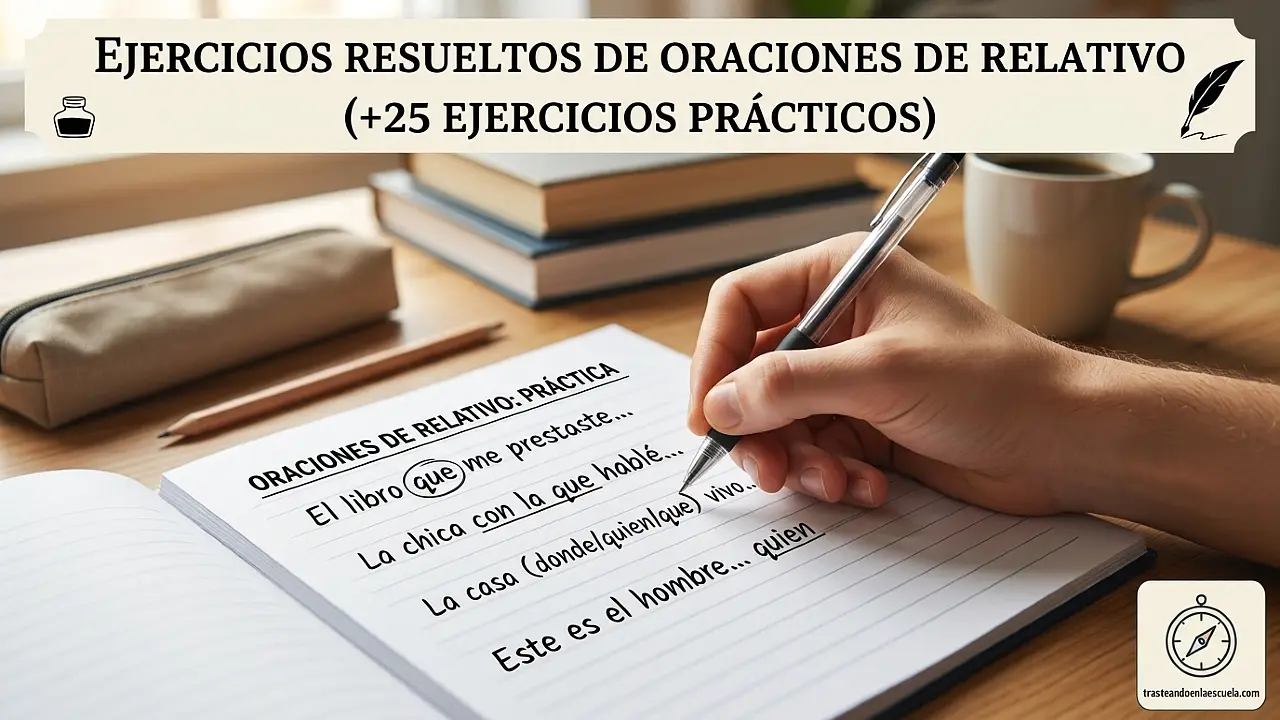
Ejercicios de oraciones de relativo: más de 25 ejercicios resueltos
Has aprendido los pronombres relativos (who, which, that, where, whose), la diferencia entre defining y non-defining, las reglas de omisión del pronombre y las estructuras formales de preposición + whom/which. Ahora es el momento de ponerlo todo en práctica. Este post contiene más de 25 ejercicios variados con sus soluciones detalladas.
🎯 En este post encontrarás: Ejercicios de completar, elegir opción, unir oraciones, corregir errores, traducir y transformar entre estilos formal e informal. Todas las soluciones están explicadas paso a paso.
🔍 Resumen rápido de las reglas (antes de practicar)
📖 Guía de referencia rápida
- who → personas (sujeto u objeto informal)
- whom → personas (objeto, estilo formal)
- which → cosas, animales, ideas
- that → personas o cosas (solo en defining clauses)
- whose → posesión (personas o cosas)
- where → lugares
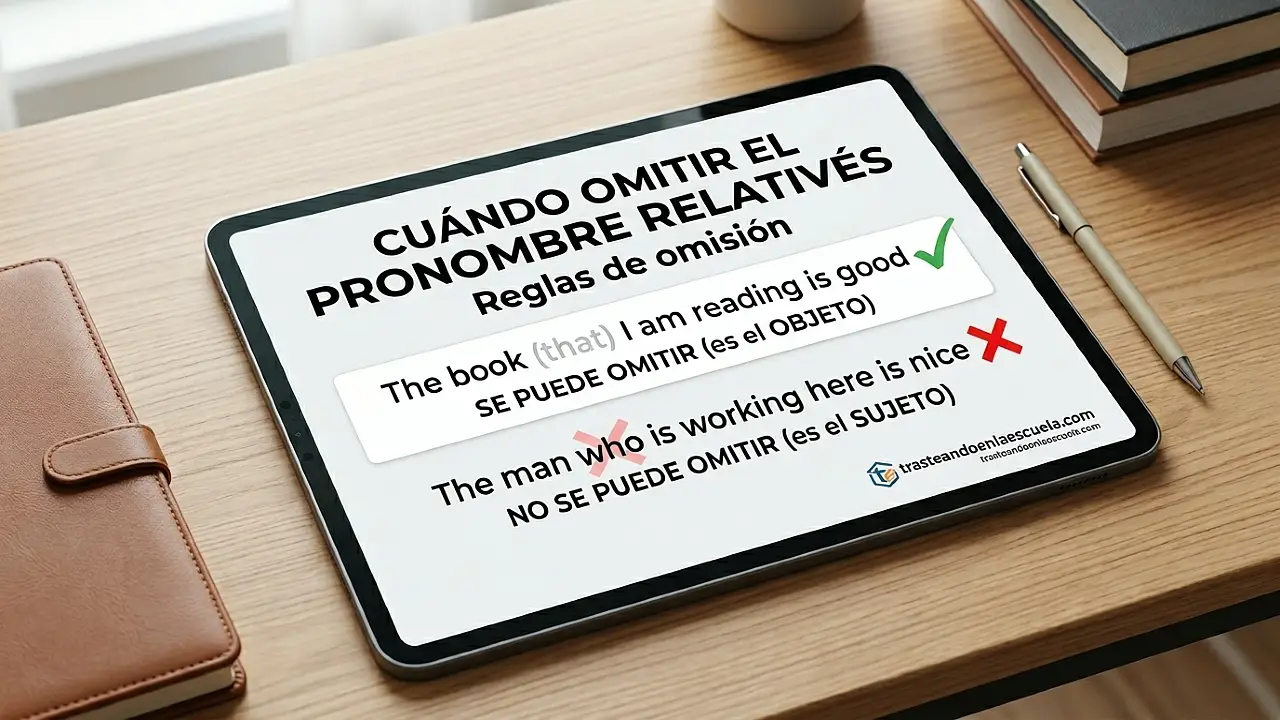
- Omisión → solo en defining clauses cuando el pronombre es objeto
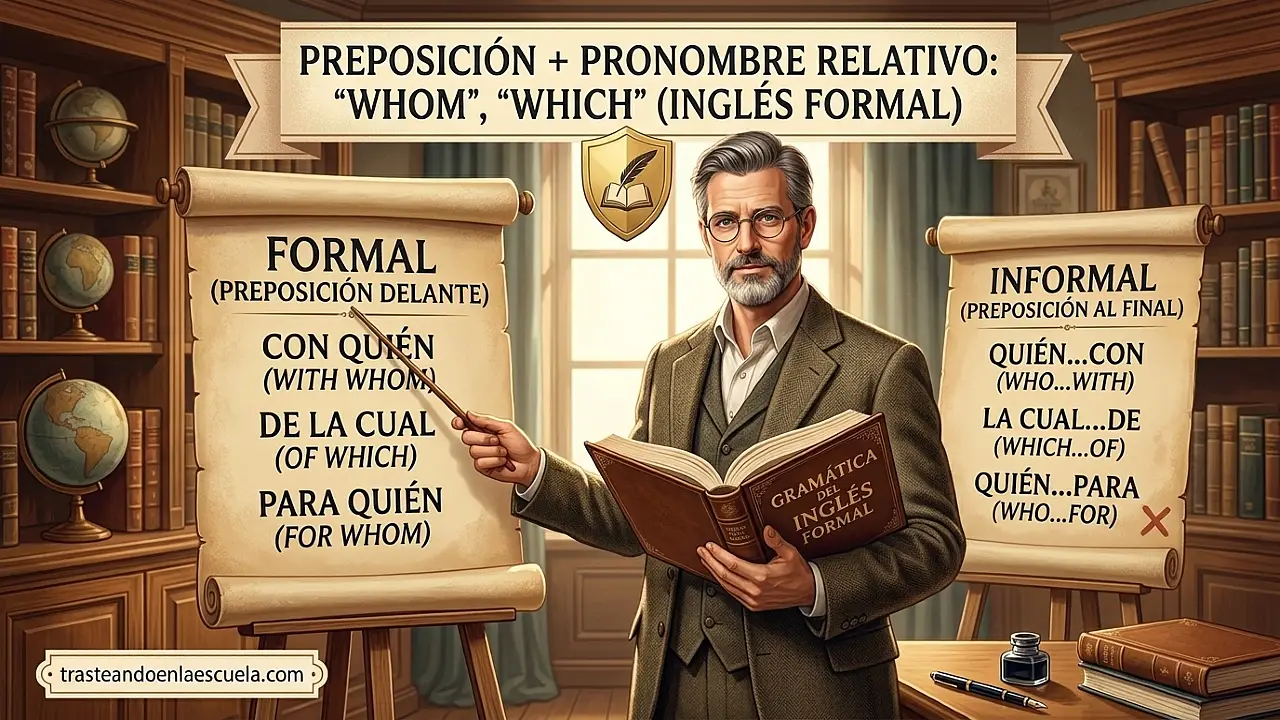
- Preposición + pronombre → formal: to whom, in which, etc.
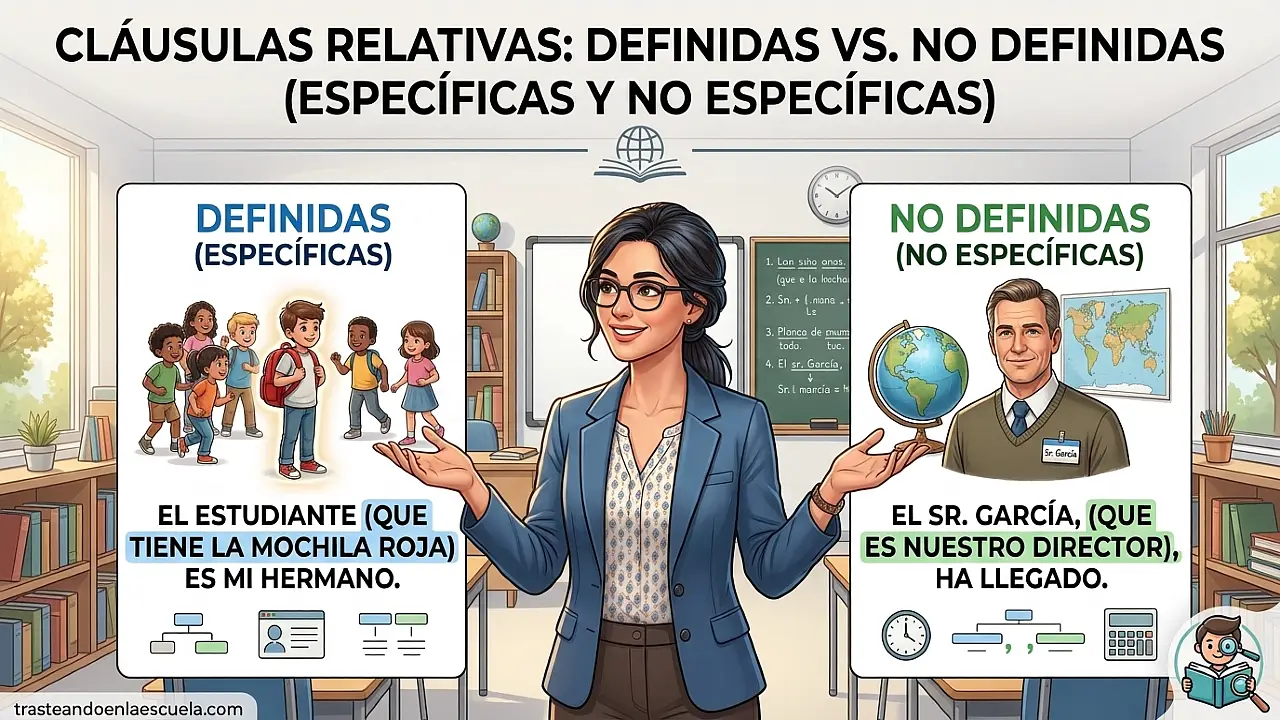
- Defining → sin comas, información esencial
- Non-defining → con comas, información extra, no se usa «that»
📚 Bloque 1: Elige el pronombre relativo correcto (Ejercicios 1-8)
Ejercicio 1
Completa con who, which, that, where, whose (puede haber más de una opción).
- The woman __________ lives next door is a musician.
- This is the park __________ we used to play as children.
- I have a neighbor __________ dog barks all night.
- The book __________ you lent me is on the table.
- Do you know anyone __________ can fix a computer?
- That’s the restaurant __________ we had our first date.
- The artist __________ paintings are very colorful is famous.
- She’s the person __________ I trust the most.
✅ Ver soluciones
- who/that (persona, sujeto)
- where (lugar)
- whose (posesión: el perro del vecino)
- which/that (cosa, objeto: me prestaste)
- who/that (persona, sujeto: puede arreglar)
- where (lugar: el restaurante donde)
- whose (posesión: las pinturas del artista)
- who/whom/that (persona, objeto: confío en ella → se puede omitir en informal)
Ejercicio 2
¿Cuál es la opción correcta? Elige a, b o c.
- The house ______ I grew up is for sale.
a) where b) which c) who - The man ______ car was stolen called the police.
a) who b) which c) whose - This is the film ______ I told you about.
a) who b) which c) whose - She’s the architect ______ designed this bridge.
a) which b) whose c) who - That’s the café ______ we met for coffee.
a) where b) which c) who
✅ Ver soluciones
- a) where (lugar)
- c) whose (posesión: el coche del hombre)
- b) which (cosa, objeto de «about»)
- c) who (persona que diseñó)
- a) where (lugar)
Ejercicio 3
Completa con who, which, where o whose. En algunos casos puede haber dos opciones.
- The girl __________ brother is in my class is very nice.
- This is the museum __________ we saw the Egyptian mummies.
- The laptop __________ I bought online arrived broken.
- Anyone __________ arrives first gets a prize.
- The company __________ products are eco-friendly is growing fast.
✅ Ver soluciones
- whose (el hermano de la chica)
- where (el museo donde vimos)
- which/that (objeto: compré)
- who (sujeto: llega primero)
- whose (los productos de la empresa)
Ejercicio 4
Decide si la oración es defining (D) o non-defining (ND). Añade comas donde sea necesario.
- My brother who lives in Barcelona is a chef.
- London which is the capital of the UK has many tourists.
- The students who pass the exam will get a certificate.
- My car which I bought in 2019 is still in good condition.
- The woman who called you is my aunt.
✅ Ver soluciones
- Defining (si tienes varios hermanos, especifica cuál) → My brother who lives in Barcelona is a chef. (sin comas)
- Non-defining → London, which is the capital of the UK, has many tourists.
- Defining → The students who pass the exam will get a certificate. (sin comas)
- Non-defining → My car, which I bought in 2019, is still in good condition.
- Defining (identifica qué mujer) → The woman who called you is my aunt. (sin comas)
Ejercicio 5
Corrige el error en cada oración (puede ser de pronombre, comas o estructura).
- The dog which barked all night is my neighbor’s.
- The man which I saw yesterday is a policeman.
- My sister, that lives in Madrid, is a doctor.
- This is the house where I live in.
- Whose car is this? (si es correcto, di «correcto»)
✅ Ver soluciones
- Correcta (which para animales es aceptable, también «that»)
- The man who/whom/that I saw yesterday is a policeman. (No «which» para personas)
- My sister, who lives in Madrid, is a doctor. (Non-defining no usa «that»)
- This is the house where I live. / This is the house in which I live. / This is the house I live in. (No mezclar «where» con «in»)
- Correcto (Whose para preguntar posesión)
Ejercicio 6
Omite el pronombre relativo si es posible. Si no, escribe «NO».
- The book that I bought yesterday is expensive.
- The woman who called you is my mother.
- The movie which we saw was boring.
- The student who won the prize is my friend.
- The house that has a red door is mine.
✅ Ver soluciones
- SÍ se omite → The book I bought yesterday is expensive.
- NO (sujeto: «who called»)
- SÍ se omite → The movie we saw was boring.
- NO (sujeto: «who won»)
- NO (sujeto: «that has»)
Ejercicio 7
Traduce al inglés usando el pronombre relativo adecuado.
- El hombre que me ayudó es mi vecino.
- Este es el parque donde jugaba de niño.
- Tengo una amiga cuyo padre es ingeniero.
- La película que vimos anoche era muy larga.
- ¿Conoces a alguien que hable francés?
✅ Ver soluciones
- The man who/that helped me is my neighbor.
- This is the park where I used to play as a child.
- I have a friend whose father is an engineer.
- The movie which/that we saw last night was very long.
- Do you know anyone who speaks French?
Ejercicio 8
Une las dos oraciones usando un pronombre relativo.
- I have a neighbor. He plays the trumpet every night.
- We visited a city. The city has beautiful beaches.
- She is the scientist. Her discovery changed medicine.
- This is the café. We had our first date here.
- The book is on the table. You recommended the book to me.
✅ Ver soluciones
- I have a neighbor who/that plays the trumpet every night.
- We visited a city which/that has beautiful beaches.
- She is the scientist whose discovery changed medicine.
- This is the café where we had our first date.
- The book which/that you recommended to me is on the table. (o «The book you recommended to me…»)
📚 Bloque 2: Defining vs Non-defining (Ejercicios 9-13)
Ejercicio 9
Añade comas donde sea necesario para convertir la oración en non-defining. Si ya es defining, escribe «defining».
- My mother who is 65 years old still works.
- The students who study hard pass the exam.
- My phone which I dropped yesterday is broken.
- Paris which is the capital of France is beautiful.
- The man who lives next door is friendly.
✅ Ver soluciones
- My mother, who is 65 years old, still works. (Non-defining, se añaden comas)
- Defining (sin comas, información esencial)
- My phone, which I dropped yesterday, is broken. (Non-defining)
- Paris, which is the capital of France, is beautiful. (Non-defining)
- Defining (identifica qué hombre)
Ejercicio 10
Explica la diferencia de significado entre estas dos oraciones:
- My colleagues who work hard get a bonus.
- My colleagues, who work hard, get a bonus.
✅ Ver solución
Oración a (defining): Solo los colegas que trabajan duro reciben bono. Hay colegas que no trabajan duro y no reciben bono.
Oración b (non-defining): Todos los colegas trabajan duro (información adicional), y todos reciben bono.
Ejercicio 11
Elige la opción correcta (defining o non-defining según el contexto).
- (Tengo varios hermanos) My brother ______ lives in London is a doctor.
a) , who , b) who - (Solo tengo un coche) My car ______ is red needs a wash.
a) , which , b) which - (Hay varias candidatas) The candidate ______ speaks French has an advantage.
a) , who , b) who
✅ Ver soluciones
- b) who (defining, sin comas: especifica cuál de mis hermanos)
- a) , which , (non-defining, con comas: solo un coche, información extra)
- b) who (defining, sin comas: identifica qué candidata)
Ejercicio 12
Corrige los errores en las non-defining clauses.
- My neighbor that is a teacher helped me.
- My phone, that I bought last year, is slow.
- Madrid, where is the capital of Spain, has many museums.
- My sister, who she lives in New York, is a lawyer.
✅ Ver soluciones
- My neighbor , who is a teacher, helped me. (Non-defining necesita comas y «who», no «that»)
- My phone, which I bought last year, is slow. (No «that» en non-defining)
- Madrid, which is the capital of Spain, has many museums. (Where no funciona como sujeto; «which» es sujeto)
- My sister, who lives in New York, is a lawyer. (Sin «she», el pronombre ya es «who»)
Ejercicio 13
Reescribe las siguientes oraciones convirtiendo las defining en non-defining (añade información extra inventada).
- The man who lives next door is friendly. (Añade: «tiene 50 años»)
- The book that is on the table is mine. (Añade: «lo compré ayer»)
✅ Ver soluciones (ejemplo)
- The man, who is 50 years old, lives next door and is friendly. / My neighbor, who is 50, is friendly. (Mejor: The man who lives next door, who is 50 years old, is friendly. Pero cuidado con dos cláusulas. Una opción limpia: The man next door, who is 50, is friendly.)
- The book, which I bought yesterday, is on the table and it’s mine. / The book on the table, which I bought yesterday, is mine.
📚 Bloque 3: Omisión del pronombre (Ejercicios 14-18)
Ejercicio 14
Tacha el pronombre relativo si se puede omitir. Si no, escríbelo de nuevo.
- The movie that we watched was scary.
- The woman who called you is my aunt.
- The cake which I baked was delicious.
- The student that won the race got a medal.
- The house that has a blue door belongs to Mary.
✅ Ver soluciones
- The movie
thatwe watched was scary. (se omite) - The woman who called you is my aunt. (no se omite)
- The cake
whichI baked was delicious. (se omite) - The student that/who won the race got a medal. (no se omite)
- The house that/which has a blue door belongs to Mary. (no se omite)
Ejercicio 15
Escribe la versión con el pronombre omitido (si es posible).
- This is the restaurant that she recommended.
- The artist who painted this picture is famous.
- He’s the man whom I met yesterday.
- The laptop which he bought is very fast.
- Anyone who arrives late will miss the start.
✅ Ver soluciones
- This is the restaurant she recommended.
- No se puede omitir (The artist painted… sería incorrecto)
- He’s the man I met yesterday. (Se omite «whom»)
- The laptop he bought is very fast.
- No se puede omitir (Anyone arrives late… incorrecto)
Ejercicio 16
¿Cuál es la opción correcta (con o sin pronombre)?
- The book ______ I read was excellent.
a) that b) ∅ (omitir) c) both - The man ______ lives next door is kind.
a) who b) ∅ c) both - The hotel ______ we stayed at was cheap.
a) that b) ∅ c) both - The car ______ is parked outside is mine.
a) which b) ∅ c) both
✅ Ver soluciones
- c) both (se puede omitir o usar «that»)
- a) who (no se puede omitir porque es sujeto)
- c) both (se puede omitir o usar «that/which»)
- a) which (no se puede omitir, es sujeto)
Ejercicio 17
Corrige las oraciones donde se ha omitido incorrectamente el pronombre.
- The woman called me is my teacher.
- The book is on the table is mine.
- The people we met at the party were friendly. (¿Correcta?)
- Anyone wants to join must sign here.
✅ Ver soluciones
- The woman who called me is my teacher.
- The book that/which is on the table is mine.
- Correcta (se omite «whom/who» porque es objeto: we met)
- Anyone who wants to join must sign here.
Ejercicio 18
Completa con «who», «which», «that» o «∅» (si se puede omitir).
- The man __________ I spoke to is my boss.
- The woman __________ lives next door is a nurse.
- The pizza __________ we ordered was delicious.
- The book __________ has a red cover is mine.
- The student __________ answer was correct won a prize.
✅ Ver soluciones
- ∅ (I spoke to → objeto, se omite)
- who/that (sujeto, no se omite)
- ∅ (we ordered → objeto)
- which/that (sujeto: has a red cover)
- whose (posesión, no se omite)
📚 Bloque 4: Preposición + whom/which (Ejercicios 19-23)
Ejercicio 19
Reescribe las oraciones en estilo formal (preposición + whom/which).
- The woman I spoke to is a doctor.
- The hotel we stayed at was cheap.
- The company she works for is international.
- The friend I went with is John.
- The topic they talked about was interesting.
✅ Ver soluciones
- The woman to whom I spoke is a doctor.
- The hotel at which we stayed was cheap.
- The company for which she works is international.
- The friend with whom I went is John.
- The topic about which they talked was interesting.
Ejercicio 20
Convierte las oraciones formales a estilo informal (preposición al final, omitiendo el pronombre si es posible).
- The candidate for whom we voted won.
- The problem to which you referred is solved.
- The organization to which I donate helps children.
- The person from whom I received the email is my assistant.
✅ Ver soluciones
- The candidate we voted for won.
- The problem you referred to is solved.
- The organization I donate to helps children.
- The person I received the email from is my assistant.
Ejercicio 21
Completa con la preposición adecuada + whom/which.
- This is the school __________ I studied.
- The professor __________ I spoke is very kind.
- The book __________ I learned so much is out of print.
- The cause __________ she fought was just.
✅ Ver soluciones
- This is the school in which / at which I studied.
- The professor to whom I spoke is very kind.
- The book from which I learned so much is out of print.
- The cause for which she fought was just.
Ejercicio 22
Elige la opción correcta para un contexto formal.
- The manager ______ I reported resigned.
a) who b) to whom c) whom - The report ______ you referred is missing.
a) which b) to which c) that - The committee ______ she is a member meets monthly.
a) of which b) which c) of whom
✅ Ver soluciones
- b) to whom (formal: reported to)
- b) to which (formal: referred to)
- a) of which (she is a member of the committee → of which)
Ejercicio 23
Corrige los errores en estas oraciones formales.
- The person to who I sent the email is on vacation.
- The company for that she works is based in Madrid.
- The topic of which we spoke was confidential.
✅ Ver soluciones
- The person to whom I sent the email is on vacation.
- The company for which she works is based in Madrid.
- The topic about which we spoke was confidential. (O «of which» es posible pero menos común: «the topic of which we spoke» sería extraño; normalmente «about which»)
📚 Bloque 5: Ejercicios de traducción y transformación (Ejercicios 24-27)
Ejercicio 24
Traduce al inglés usando la estructura formal (preposición + pronombre) o informal según se indique.
- (Formal) El informe al que te referiste es muy importante.
- (Informal) La persona con la que hablé es mi vecino.
- (Formal) La empresa para la que trabajo está en Barcelona.
- (Informal) La película de la que me hablaste es genial.
✅ Ver soluciones
- The report to which you referred is very important.
- The person I spoke to is my neighbor. (Informal, con preposición al final y omisión)
- The company for which I work is in Barcelona.
- The movie you told me about is great. (Informal, omitiendo pronombre y preposición al final)
Ejercicio 25
Escribe una oración de relativo para cada situación.
- Necesitas identificar a una profesora que enseña historia.
- Quieres añadir información extra sobre tu coche (que es rojo, pero ya saben qué coche es).
- Hablas de un amigo cuyo perro se escapó.
- Preguntas por un lugar donde se pueda comer bien.
✅ Ver soluciones (ejemplos)
- That’s the teacher who/that teaches history. (Defining)
- My car, which is red, is parked outside. (Non-defining)
- I have a friend whose dog ran away.
- Do you know a restaurant where we can eat well?
Ejercicio 26 (extra)
Completa el texto con pronombres relativos u omisión (∅).
«Yesterday I met a man ______ works at the library. He showed me a book ______ I had been looking for for months. The library, ______ is very old, has a section ______ you can find rare editions. The man, ______ name I forgot, was very kind. He also told me about an author ______ books are very valuable. It was a great day.»
✅ Ver solución
«Yesterday I met a man who/that works at the library. He showed me a book ∅ / that/which I had been looking for for months. The library, which is very old, has a section where you can find rare editions. The man, whose name I forgot, was very kind. He also told me about an author whose books are very valuable. It was a great day.»
Ejercicio 27 (extra)
Identifica y corrige los 8 errores en este párrafo:
«My brother which lives in Paris, that is a beautiful city, is a chef. The restaurant where he works in is very famous. The clients which he serves are usually tourists. He has a sous-chef whose help him a lot. The recipes that he created they are innovative. Anyone wants to eat there needs a reservation.»
✅ Ver solución
Versión corregida:
«My brother who lives in Paris, which is a beautiful city, is a chef. The restaurant where he works in is very famous. The clients whom/who he serves are usually tourists. He has a sous-chef who helps him a lot. The recipes that he created they are are innovative. Anyone who wants to eat there needs a reservation.»
Errores: 1) which lives → who lives; 2) that is a beautiful city en non-defining necesita «which», no «that»; 3) where he works in → sobra «in» (where ya incluye la preposición); 4) which he serves → «which» para personas es incorrecto, usar «whom/who»; 5) whose help → «whose» es posesión, aquí necesita «who»; 6) help → debe ser «helps»; 7) they are → sobra «they are» (el sujeto ya es «that he created»); 8) Anyone wants → falta «who».
📊 Tabla de autoevaluación
| Ejercicios | Tema | ✅ Correctos / Total |
|---|---|---|
| 1-8 | Pronombres relativos básicos | ___ / 8 |
| 9-13 | Defining vs non-defining | ___ / 5 |
| 14-18 | Omisión del pronombre | ___ / 5 |
| 19-23 | Preposición + whom/which | ___ / 5 |
| 24-27 | Traducción y transformación | ___ / 4 |
🎯 Recomendación: Si has acertado menos del 70% en alguna sección, revisa el post correspondiente de la serie antes de seguir practicando. La práctica constante es la clave para interiorizar estas estructuras.
🌍 Recursos adicionales
📚 Serie completa: Oraciones de relativo en inglés
- Las oraciones de relativo: who, which, that, where, whose – Los pronombres básicos.
- Relative clauses: defining vs non-defining – Diferencia entre especificativas y explicativas.
- Cuándo omitir el pronombre relativo – Reglas de omisión.
- Preposición + pronombre relativo: whom, which – El nivel formal.
- Ejercicios de oraciones de relativo resueltos – ¡Estás aquí! Más de 25 ejercicios.
🏆 Reto final: Vuelve a realizar todos los ejercicios en una semana sin mirar las soluciones. Anota tu porcentaje de aciertos. Si superas el 90%, ¡has dominado las oraciones de relativo en inglés!






Publicar comentario