Preposición + pronombre relativo: whom, which (formal English)
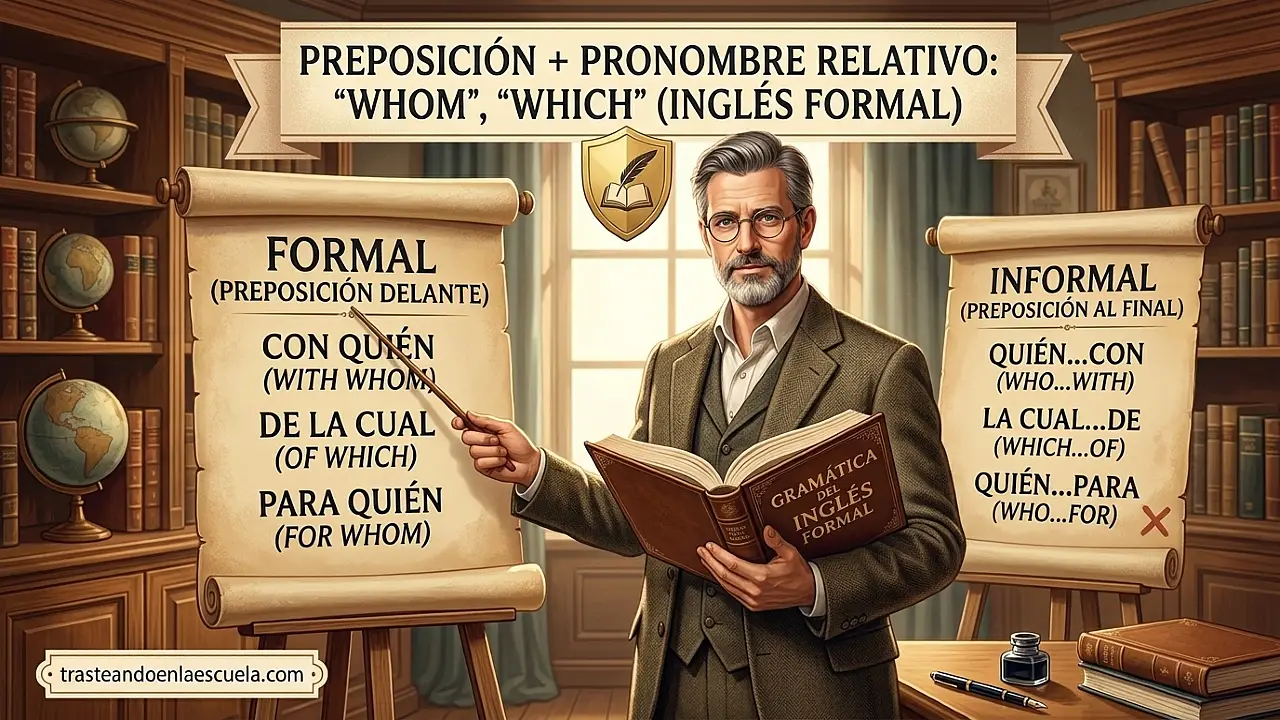
Preposición + pronombre relativo: el toque formal del inglés
En inglés cotidiano decimos «The person I spoke to» (omitimos el pronombre y la preposición va al final). Pero en contextos formales (escritos académicos, negocios, cartas oficiales) se utiliza una estructura más elegante: preposición + pronombre relativo (to whom, for which, in which, etc.). Aprender esta estructura te permitirá entender textos complejos y escribir con un registro más alto.
🎯 En este post aprenderás: Las reglas de la preposición delante del pronombre relativo, el uso de whom para personas y which para cosas, la diferencia con el estilo informal, cuándo usar whose con preposición, ejemplos对比ados, errores típicos y 5 ejercicios prácticos.
🔍 Estilo formal vs informal: dos formas de decir lo mismo
⚖️ La posición de la preposición cambia el registro
En inglés, cuando el pronombre relativo es objeto de una preposición, tienes dos opciones:
- Informal / cotidiano: Preposición al final + pronombre omitido (o «that»). Ej: «The house I live in is old.»
- Formal / escrito: Preposición al principio + pronombre relativo (whom/which). Ej: «The house in which I live is old.»
La versión formal es más común en documentos oficiales, artículos académicos, literatura y exámenes como el IELTS, TOEFL o Cambridge.
[Antecedente] + Preposición + whom/which + [sujeto] + [verbo] …
👔 La analogía del traje y las zapatillas
La estructura informal (preposición al final, omitir pronombre) es como ir en zapatillas deportivas: cómoda, rápida, para el día a día. La estructura formal (preposición + whom/which) es como ponerse un traje: más elegante, apropiada para ocasiones especiales (ensayos, cartas formales, presentaciones). Ambas son correctas, pero debes saber cuándo usar cada una.
📊 Tabla comparativa: informal vs formal
| Uso | Informal (preposición al final) | Formal (preposición + whom/which) |
|---|---|---|
| Personas | The woman I spoke to is my boss. | The woman to whom I spoke is my boss. |
| Cosas | The hotel we stayed at was cheap. | The hotel at which we stayed was cheap. |
| Lugar (where) | The office I work in is big. | The office in which I work is big. |
| Tiempo (when) | The day I was born was sunny. | The day on which I was born was sunny. |
👤 Uso de whom (personas, objeto formal)
🎯 ¿Cuándo usar whom?
Whom es el pronombre relativo para personas cuando funciona como objeto (directo o de preposición). En el estilo informal, usamos «who» o lo omitimos. En el estilo formal, usamos «whom» especialmente cuando va después de una preposición.
📘 Estructura: preposición + whom
- To whom → a quien / para quien
- With whom → con quien
- For whom → para quien
- From whom → de quien
- About whom → sobre quien
- Formal: The manager to whom you sent the email will reply soon. (El gerente a quien enviaste el correo responderá pronto.)
- Informal: The manager (who/that) you sent the email to will reply soon.
- Formal: She is the colleague with whom I share my office. (Ella es la compañera con quien comparto mi oficina.)
- Informal: She is the colleague (who/that) I share my office with.
- Formal: The artist from whom I bought this painting is famous. (El artista de quien compré esta pintura es famoso.)
- Formal: There’s the person about whom everyone is talking. (Ahí está la persona sobre quien todos hablan.)
📌 Nota: En inglés moderno, «whom» está desapareciendo en el habla cotidiana, pero sigue siendo muy importante en escritos formales y exámenes. Si alguna vez dudas, en contextos informales puedes usar «who» o omitir. Pero cuando veas una preposición delante, el pronombre correcto es «whom» para personas.
📦 Uso de which (cosas, con preposición)
🎯 ¿Cuándo usar which con preposición?
Para cosas, animales o ideas, usamos which después de una preposición. No se puede usar «that» en este caso. Tampoco se puede omitir el pronombre porque la preposición está delante.
📘 Estructura: preposición + which
- In which → en el cual / en la cual
- For which → por el cual / para el cual
- On which → sobre el cual / en el cual (superficie)
- With which → con el cual
- Through which → a través del cual
- During which → durante el cual
- Of which → del cual (cuyo, para cosas)
- Formal: This is the company for which I work. (Esta es la empresa para la cual trabajo.)
Informal: This is the company I work for. - Formal: The document to which you referred is missing. (El documento al cual te referiste falta.)
Informal: The document you referred to is missing. - Formal: The box in which I found the treasure was old. (La caja en la cual encontré el tesoro era vieja.)
- Formal: The topic about which we spoke is confidential. (El tema sobre el cual hablamos es confidencial.)
- Formal: The year in which I graduated was 2010. (El año en el cual me gradué fue 2010.)
⚠️ Importante: Después de una preposición, nunca se usa «that». «The company for that I work» es incorrecto. Siempre «which» para cosas, y «whom» para personas.
📍 Where vs in which (lugares)
Cuando hablamos de lugares, podemos usar where (informal o neutral) o in which / at which (formal).
| Estilo | Ejemplo |
|---|---|
| Informal / neutral | This is the café where we met. |
| Formal | This is the café in which we met. |
| Muy formal (con preposición específica) | This is the café at which we met. |
- The hotel where we stayed = The hotel in which we stayed = The hotel at which we stayed.
- The office where I work = The office in which I work.
🔗 Whose con preposición (posesión formal)
Cuando «whose» (cuyo) va acompañado de preposición, la estructura cambia. Es menos común, pero posible en formal.
- Normal: The writer whose books are bestsellers lives here.
- Con preposición formal: The writer of whose books we have read many lives here. (El escritor de cuyos libros hemos leído muchos vive aquí.)
- Con preposición: The company the CEO of which resigned is in trouble. (La empresa cuyo CEO renunció está en problemas.) → Alternativa a «whose».
💡 Alternativa común: En lugar de «the book the author of which is famous», es más natural decir «the book whose author is famous». La estructura «preposición + which» para expresar posesión es muy formal.
📋 Tabla de preposiciones comunes con pronombres relativos
| Preposición | Uso típico | Ejemplo con whom/which |
|---|---|---|
| to | dirección, destinatario | The person to whom I sent the letter. |
| for | propósito, beneficio | The company for which she works. |
| with | compañía, instrumento | The friend with whom I traveled. |
| about | tema, asunto | The topic about which we argued. |
| in | lugar, tiempo | The city in which I live. / The year in which I was born. |
| on | superficie, fecha | The table on which the book rests. / The day on which we met. |
| from | origen, procedencia | The country from which she came. |
| of | posesión, pertenencia | The book the cover of which is red. |
| at | lugar específico, hora | The restaurant at which we ate. / The time at which we arrived. |
❌ Errores comunes con preposición + pronombre relativo
| Error | Ejemplo incorrecto | Corrección |
|---|---|---|
| Usar that después de preposición | The company for that I work is big. | The company for which I work is big. / The company I work for is big. |
| Usar who después de preposición (en formal) | The woman to who I spoke is my boss. | The woman to whom I spoke is my boss. (formal) / The woman I spoke to is my boss. (informal) |
| Poner la preposición al final en contexto formal | The document which you referred to is lost. (correcto informal, pero inadecuado en un ensayo formal) | The document to which you referred is lost. (formal) |
| Olvidar que «where» y «when» ya incluyen preposición | The city in where I live is large. | The city where I live is large. / The city in which I live is large. |
| Usar whom como sujeto | Who is coming? (whom solo como objeto) |
🧪 5 Ejercicios prácticos
Ejercicio 1: Reescribe las oraciones en estilo formal moviendo la preposición delante del pronombre relativo. Usa «whom» para personas y «which» para cosas.
- The woman I spoke to is a doctor.
- The hotel we stayed at was luxurious.
- The colleague I work with is very efficient.
- The topic they argued about was politics.
- The company she applied for has closed.
✅ Ver solución
- The woman to whom I spoke is a doctor.
- The hotel at which we stayed was luxurious. (o «in which»)
- The colleague with whom I work is very efficient.
- The topic about which they argued was politics.
- The company for which she applied has closed.
Ejercicio 2: Completa con la preposición correcta + whom/which.
- The manager __________ I reported resigned yesterday. (report to)
- The book __________ I learned so much is on the shelf. (learn from)
- The person __________ you received the email is my assistant. (receive from)
- The project __________ she is responsible is behind schedule. (responsible for)
- The cause __________ he fought was just. (fight for)
✅ Ver solución
- The manager to whom I reported resigned yesterday.
- The book from which I learned so much is on the shelf.
- The person from whom you received the email is my assistant.
- The project for which she is responsible is behind schedule.
- The cause for which he fought was just.
Ejercicio 3: Convierte las siguientes oraciones formales a estilo informal (preposición al final, omitiendo el pronombre si es posible).
- This is the house in which I grew up.
- The candidate for whom we voted won the election.
- The problem about which we were talking has been solved.
- The organization to which I donate is very transparent.
- The friend with whom I went to the concert is here.
✅ Ver solución
- This is the house I grew up in.
- The candidate we voted for won the election.
- The problem we were talking about has been solved.
- The organization I donate to is very transparent.
- The friend I went to the concert with is here.
Ejercicio 4: Elige la opción correcta (formal o informal según contexto).
- (In a formal email) The consultant ______ we hired is excellent.
a) who / b) to whom / c) whom - (In a conversation) That’s the guy ______ I told you about.
a) about whom / b) who / c) ∅ (omitir) - (In an academic essay) The theory ______ he referred is outdated.
a) which / b) to which / c) that - (Casual speech) The restaurant ______ we ate was cheap.
a) at which / b) where / c) in which - (Legal document) The parties ______ the agreement was signed are bound.
a) by whom / b) who / c) that
✅ Ver solución
- b) to whom (formal: «the consultant to whom we hired» es raro; mejor «whom we hired» sin preposición, pero la opción más formal correcta sería «whom». Sin embargo, «to whom» no funciona con «hire». Revisemos: «hire» no lleva preposición. Mejor opción: «whom we hired». Pero como no está, la más cercana es «whom». En todo caso, la respuesta correcta es «whom». Asumimos c) whom.
- c) ∅ (omitir: «the guy I told you about»)
- b) to which (the theory to which he referred)
- b) where (informal, natural)
- a) by whom (formal: «the parties by whom the agreement was signed»)
Ejercicio 5: Traduce al inglés usando la estructura formal (preposición + whom/which).
- La mujer a quien llamé es mi hermana.
- La empresa para la cual trabajo es internacional.
- El tema sobre el cual hablamos es interesante.
- El hotel en el cual nos alojamos era barato.
- El escritor del cual admiro los libros ganó un premio.
✅ Ver solución
- The woman to whom I called is my sister. (Aunque «call» no lleva «to»? En inglés «call someone» no lleva preposición, sería «whom I called». Pero si la frase original tiene «a quien llamé», es «whom I called». Mejor: The woman whom I called is my sister. Sin preposición. Para usar «to whom» necesitaríamos «speak to». Ajustamos: La mujer a la que llamé = The woman whom I called.
- The company for which I work is international.
- The topic about which we spoke is interesting.
- The hotel in which we stayed was cheap.
- The writer of whose books I admire won a prize. (Estructura: the writer of whose books = el escritor de cuyos libros)
🌍 Aplicaciones en la vida real
📝 En escritos académicos y ensayos
- Usa «preposición + which/whom» para sonar más formal y preciso.
- Ejemplo: «The period during which the Industrial Revolution occurred saw massive social changes.»
💼 En negocios y cartas formales
- «To whom it may concern» (A quien corresponda) es una frase fija muy común.
- «The client for whom we prepared the proposal approved it.»
📖 En literatura y textos legales
- Abundan estas estructuras. Ejemplo: «The manner in which he conducted himself was unusual.»
📖 Resumen: cuándo usar preposición + pronombre relativo
🎯 Decisión rápida
🔹 ¿Contexto formal (ensayo, examen, carta, artículo)? → Usa preposición + whom/which.
🔹 ¿Contexto informal (conversación, email a un amigo)? → Preposición al final, omite pronombre.
🔹 ¿Dudas? En la duda, la forma informal es siempre aceptable, pero la formal demuestra mayor nivel.
📚 Serie completa: Oraciones de relativo en inglés
- Las oraciones de relativo: who, which, that, where, whose – Los pronombres básicos.
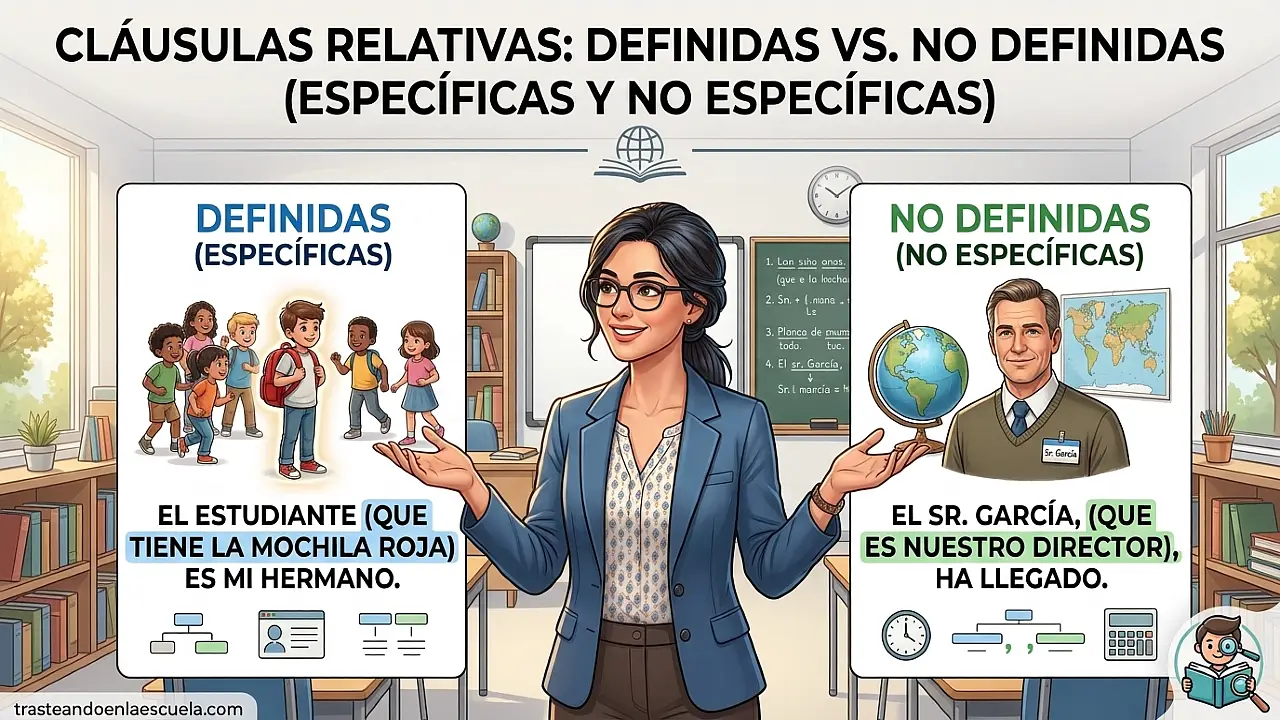
- Relative clauses: defining vs non-defining – Diferencia entre especificativas y explicativas.
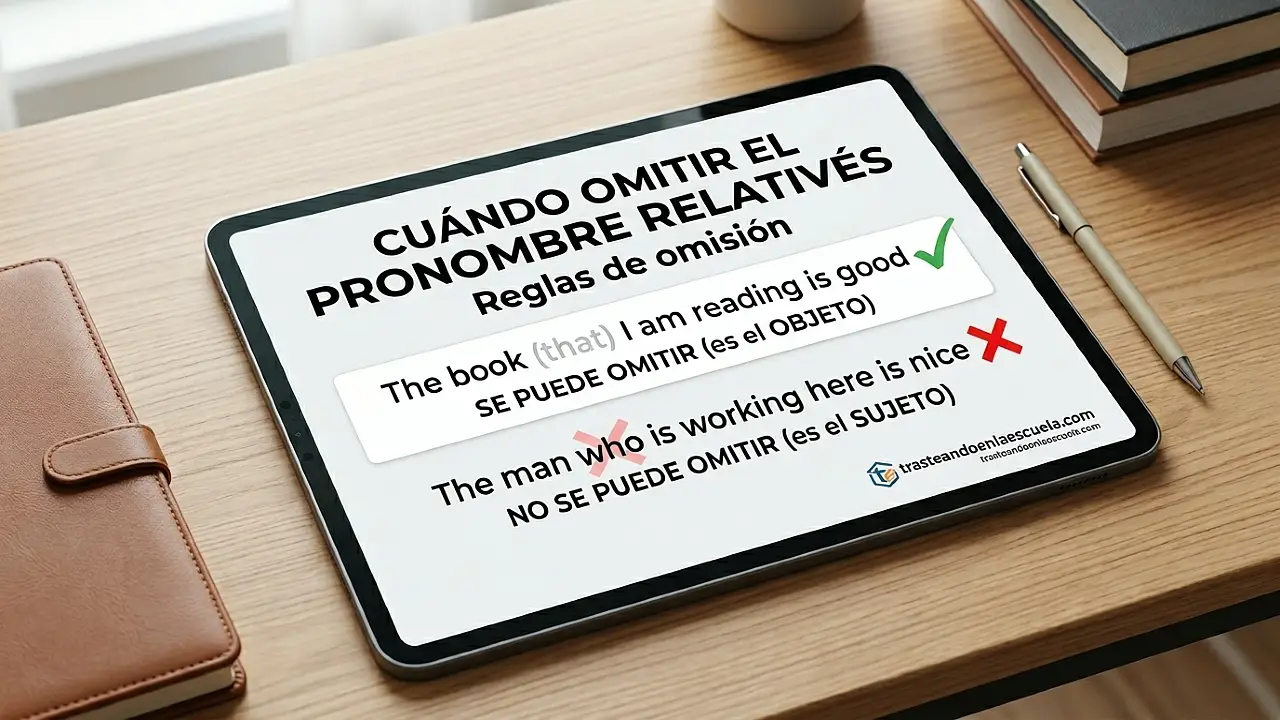
- Cuándo omitir el pronombre relativo – Reglas de omisión.
- Preposición + pronombre relativo: whom, which – ¡Estás aquí!
- Ejercicios de oraciones de relativo resueltos – Más de 25 ejercicios para practicar todo.
🏆 Reto formal: Reescribe un párrafo de un email informal que hayas escrito recientemente usando las estructuras formales de preposición + whom/which. Compáralo con el original. Notarás la diferencia de registro.










Publicar comentario