Cuándo omitir el pronombre relativo en inglés (omission rules)
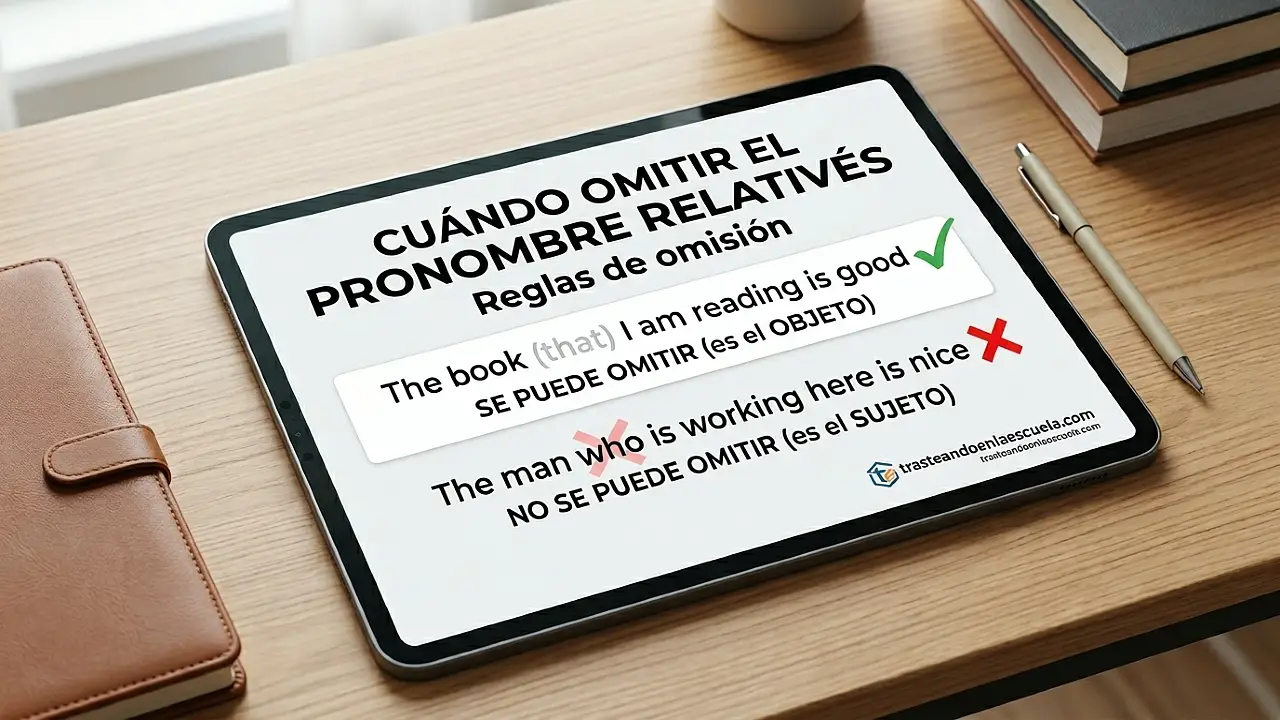
Omisión del pronombre relativo: haz tu inglés más natural
¿Has notado que los nativos a veces dicen «The book I read» en lugar de «The book that I read»? Eso es porque en inglés se puede omitir el pronombre relativo (who, which, that) en ciertas situaciones. Esta omisión es muy común y hará que tu inglés suene mucho más fluido y menos robótico. Pero cuidado: no siempre se puede omitir. Aprender las reglas te evitará errores.
🎯 En este post aprenderás: La regla básica para omitir pronombres relativos (cuando son objeto en defining clauses), cuándo NO se puede omitir (cuando son sujeto), ejemplos对比ados, diferencias con non-defining clauses, errores típicos y 5 ejercicios prácticos.
🔍 ¿Se puede omitir el pronombre relativo?
⚙️ La regla de oro: objeto sí, sujeto no
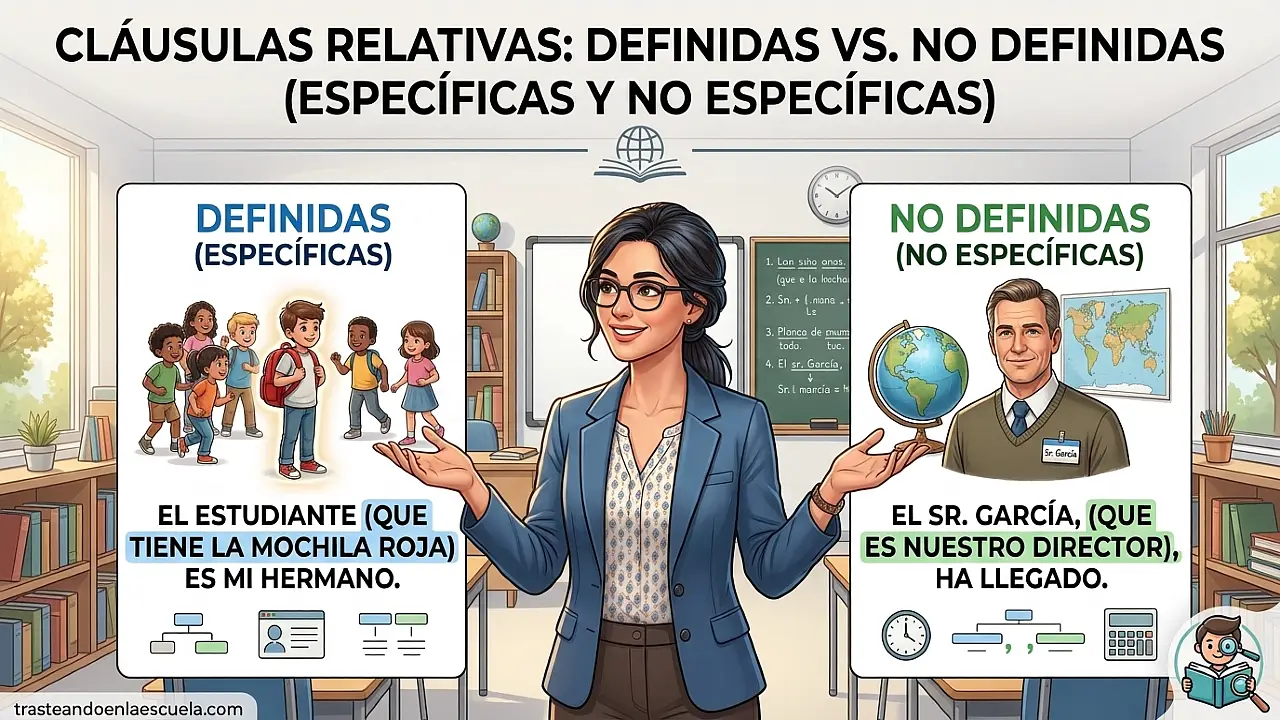
En inglés, puedes omitir el pronombre relativo (who, which, that) únicamente cuando este NO es el sujeto de la cláusula de relativo, es decir, cuando funciona como objeto (directo o de preposición). Esto solo ocurre en defining relative clauses (sin comas). En non-defining clauses (con comas) nunca se omite.
Sujeto + verbo + (pronombre relativo como objeto) + sujeto de la cláusula + verbo…
⬇️ OMISIÓN POSIBLE ⬇️
«The book (that) I read was good.»
🎧 La analogía del teléfono
Imagina que el pronombre relativo es como la palabra «que» en español. En español también a veces la omitimos: «El libro (que) me prestaste es bueno.» En inglés es similar: cuando el pronombre no es el que realiza la acción, puedes «silenciarlo». Pero si el pronombre es quien hace la acción (sujeto), no puedes eliminarlo porque entonces la frase se rompe.
📊 Tabla comparativa: omisión SÍ / NO
| Función del pronombre | ¿Se puede omitir? | Ejemplo con pronombre | Ejemplo omitido |
|---|---|---|---|
| SUJETO (el pronombre hace la acción) | ❌ NO | The man who called you is here. | |
| OBJETO DIRECTO (el pronombre recibe la acción) | ✅ SÍ | The man (who/whom/that) you called is here. | The man you called is here. ✔️ |
| OBJETO DE PREPOSICIÓN (preposición + pronombre) | ✅ SÍ (si la preposición va al final) | The house (which/that) she lives in is big. | The house she lives in is big. ✔️ |
| POSESIÓN (whose) | ❌ NO | The man whose car was stolen called police. | |
| WHERE (lugar) | ❌ NO (normalmente) | The park where we met is beautiful. |
💡 Prueba fácil: Si detrás del pronombre relativo viene inmediatamente un verbo (sin otro sujeto), el pronombre es sujeto → NO se puede omitir. Si viene un sujeto (nombre o pronombre personal) y luego un verbo, el pronombre es objeto → SÍ se puede omitir.
✅ Cuándo SÍ se puede omitir (objeto)
🎯 Caso 1: El pronombre es objeto directo
Estructura: … [sustantivo] + (pronombre objeto) + [sujeto de la cláusula] + [verbo] …
- Con pronombre: This is the movie that I told you about. → Omitido: This is the movie I told you about. ✔️
- Con pronombre: She’s the woman who I met at the conference. → Omitido: She’s the woman I met at the conference. ✔️
- Con pronombre: The cake which we baked was delicious. → Omitido: The cake we baked was delicious. ✔️
- Con pronombre: I found the keys that you lost. → Omitido: I found the keys you lost. ✔️
- Con pronombre: Anyone whom you invite is welcome. → Omitido: Anyone you invite is welcome. ✔️ (formal)
🎯 Caso 2: El pronombre es objeto de preposición (y la preposición va al final)
Estructura: … [sustantivo] + (pronombre) + [sujeto] + [verbo] + [preposición] …
- Con pronombre: The company which she works for is great. → Omitido: The company she works for is great. ✔️
- Con pronombre: The hotel that we stayed at was cheap. → Omitido: The hotel we stayed at was cheap. ✔️
- Con pronombre: The people who I spoke to were friendly. → Omitido: The people I spoke to were friendly. ✔️
- Con pronombre: Is this the book which you were looking for? → Omitido: Is this the book you were looking for? ✔️
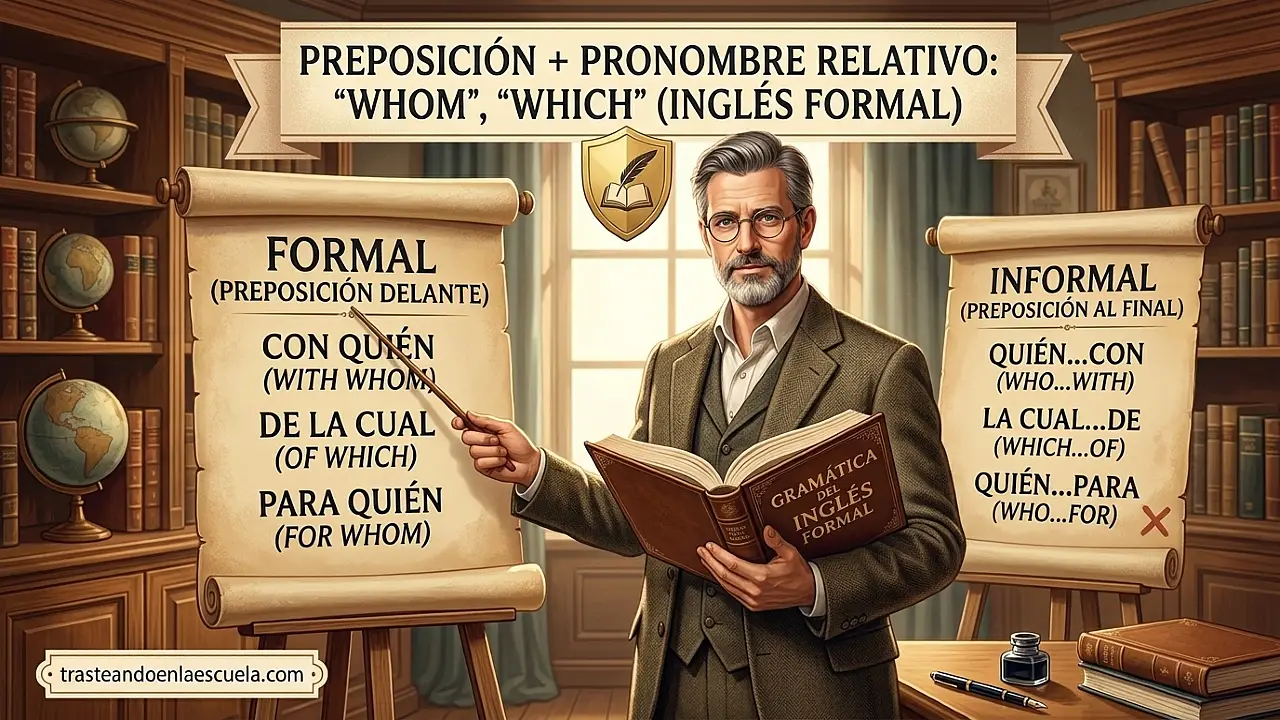
Nota: Si la preposición va delante del pronombre (estilo muy formal), no se puede omitir. Ejemplo: «The company for which she works is great.» Aquí «for which» no se puede omitir porque la preposición está antes.
🎯 Caso 3: El pronombre es objeto en oraciones con verbos como «think», «believe», «say» (estructuras complejas)
- The man who they thought was guilty turned out innocent. → Aquí «who» es sujeto de «was», no objeto. No se omite. Pero si es objeto: The man (who/that) they accused is here. → Se omite: The man they accused is here.
❌ Cuándo NO se puede omitir (sujeto)
🎯 El pronombre es el sujeto de la cláusula
Estructura: … [sustantivo] + pronombre sujeto + [verbo] … (sin otro sujeto entre medias)
- Incorrecto si se omite:
The woman called you is my aunt.(Parece que «the woman called» significa que la mujer llamó, pero se pierde el sentido de relativo). Correcto: The woman who called you is my aunt. ✔️ - Incorrecto:
I have a friend speaks five languages.Correcto: I have a friend who speaks five languages. ✔️ - Incorrecto:
The car is parked outside is mine.Correcto: The car which/that is parked outside is mine. ✔️ - Incorrecto:
Anyone arrives late will be punished.Correcto: Anyone who arrives late will be punished. ✔️
⚠️ Atención: El error de omitir un pronombre sujeto es muy común entre estudiantes. Recuerda: si la cláusula de relativo no tiene otro sujeto explícito (nombre o pronombre como I, you, he, they), el pronombre relativo es necesario.
🔄 Comparativa: sujeto vs objeto (mismo verbo, diferente significado)
PRONOMBRE SUJETO (NO se omite)
The student who cheated failed the exam.
👉 El estudiante que hizo trampa (el estudiante realizó la acción de hacer trampa) suspendió. No se puede omitir «who».
PRONOMBRE OBJETO (SÍ se omite)
The student (who/whom/that) the teacher caught cheating failed.
👉 El estudiante al que el profesor pilló haciendo trampa suspendió. Se puede omitir: «The student the teacher caught cheating failed.»
📌 Omisión en diferentes pronombres
| Pronombre | ¿Se puede omitir? | Condiciones | Ejemplo |
|---|---|---|---|
| who (personas) | ✅ Sí (como objeto) ❌ No (como sujeto) |
Si hay otro sujeto después: «the man (who) I saw» → se omite. «the man who saw me» → no se omite. | ✔️ «The man I saw» ❌ «The man saw me» (necesita who) |
| which (cosas) | ✅ Sí (como objeto) ❌ No (como sujeto) |
Misma regla: «the book (which) I read» → sí; «the book which is on the table» → no. | ✔️ «The book I read» ❌ «The book is on the table» |
| that (personas/cosas) | ✅ Sí (como objeto) ❌ No (como sujeto) |
Idéntico a who/which. | ✔️ «The movie we saw» ❌ «The movie was boring» |
| whom (personas, objeto formal) | ✅ Sí (siempre objeto, casi siempre se omite en inglés moderno) | Se prefiere omitir o usar who. | «The woman (whom) you met» → «The woman you met» |
| whose | ❌ No | Indica posesión, esencial. | «The man whose car…» (no se puede omitir) |
| where | ❌ Generalmente no (pero se puede reemplazar) | Se puede cambiar por «which» + preposición y entonces omitir. | «The park where we met» → «The park we met at» (omisión indirecta) |
⚠️ Errores comunes al omitir
| Error | Ejemplo incorrecto | Corrección | Explicación |
|---|---|---|---|
| Omitir pronombre sujeto | The man who called me is my boss. | No hay otro sujeto, el pronombre es sujeto. | |
| Omitir en non-defining clause | My brother, who lives in London, is a doctor. | Non-defining requiere pronombre explícito. | |
| Omitir whose | The woman whose car was stolen… | Whose es posesión y no se omite. | |
| Omitir when la preposición va delante | The company for which she works is great. / The company she works for is great. | Si la preposición está delante, no se puede omitir; se debe reordenar. |
🧪 5 Ejercicios prácticos
Ejercicio 1: ¿Se puede omitir el pronombre relativo? Responde SÍ o NO.
- The laptop that I bought yesterday is fast.
- The student who won the prize is my friend.
- The movie which we watched was scary.
- The woman who lives next door is kind.
- The car (that) he drives is expensive.
✅ Ver solución
- SÍ (objeto: «I bought» → sujeto «I», el pronombre es objeto)
- NO (sujeto: «who won» → no hay otro sujeto, «who» es sujeto)
- SÍ (objeto: «we watched» → sujeto «we»)
- NO (sujeto: «who lives» → no hay otro sujeto)
- SÍ (ya está omitido en el ejemplo, pero es objeto: «he drives»)
Ejercicio 2: Omite el pronombre relativo si es posible. Si no, escribe «NO OMITIR».
- The book that she recommended was excellent.
- The artist who painted this picture is famous.
- The hotel which we stayed at was cheap.
- Anyone who arrives late will miss the introduction.
- The film (that) we saw last night was boring.
✅ Ver solución
- The book she recommended was excellent. (Omitido)
- NO OMITIR (The artist who painted…) → sujeto
- The hotel we stayed at was cheap. (Omitido)
- NO OMITIR (Anyone who arrives…) → sujeto
- The film we saw last night was boring. (Omitido)
Ejercicio 3: Reescribe las oraciones eliminando el pronombre cuando sea posible y ajustando la preposición si es necesario.
- This is the house in which I grew up.
- She is the woman to whom I sent the email.
- The company for which he works is multinational.
- The chair on which you are sitting is broken.
- The topic about which we spoke was interesting.
✅ Ver solución
- This is the house I grew up in. (Se omite «which», la preposición «in» va al final)
- She is the woman I sent the email to. (Se omite «whom», «to» al final)
- The company he works for is multinational.
- The chair you are sitting on is broken.
- The topic we spoke about was interesting.
Ejercicio 4: Corrige los errores de omisión en estas oraciones (algunas son correctas, otras no).
- The cake you baked is delicious. (¿Correcta?)
- The man called the police is my neighbor.
- She has a friend speaks three languages.
- The restaurant we ate at was expensive.
- Anyone wants to join must sign here.
✅ Ver solución
- Correcta (se omite «that/which» porque es objeto: you baked)
- Incorrecta → The man who called the police is my neighbor. (sujeto)
- Incorrecta → She has a friend who speaks three languages. (sujeto)
- Correcta (omisión de «which/that»: we ate at)
- Incorrecta → Anyone who wants to join must sign here. (sujeto)
Ejercicio 5: Completa con el pronombre adecuado si es necesario, o escribe «Ø» si se puede omitir.
- The woman __________ lives next door is a doctor.
- The book __________ I borrowed from you is on the table.
- Is this the hotel __________ you stayed at?
- The student __________ answer was correct won a prize.
- The car __________ he bought is very fast.
✅ Ver solución
- who (sujeto, no se omite)
- Ø (objeto: I borrowed → se omite)
- Ø (objeto de preposición: you stayed at → se omite)
- whose (posesión, no se omite)
- Ø (objeto: he bought → se omite)
🌍 Aplicación en el inglés real
📢 En conversaciones cotidianas
- Omisión constante: Los nativos omiten el pronombre objeto casi siempre. «The movie we saw», «The guy I met», «The place we went».
- Con preposiciones: Siempre ponen la preposición al final y omiten: «The person I was talking to», «The house she lives in».
✍️ En escritura formal
- La omisión es aceptable, pero a veces se prefiere incluir el pronombre para mayor claridad.
- En contextos muy formales (académicos, legales), se evita la omisión y se usan estructuras como «preposición + which/whom».
📖 Resumen visual: ¿omitir o no omitir?
🎯 Decisión en 3 pasos
1️⃣ ¿Es una defining clause (sin comas)?
🔹 NO (non-defining) → NUNCA omitir
🔹 SÍ → ir al paso 2
2️⃣ ¿El pronombre relativo es sujeto de su cláusula?
🔹 SÍ → NO omitir
🔹 NO (es objeto) → ir al paso 3
3️⃣ ¿La preposición está delante del pronombre?
🔹 SÍ → reordena la frase o no omitas
🔹 NO → PUEDES omitir (y en inglés cotidiano, hazlo)
📚 Serie completa: Oraciones de relativo en inglés
- Las oraciones de relativo: who, which, that, where, whose – Los pronombres básicos.
- Relative clauses: defining vs non-defining – Diferencia entre especificativas y explicativas.
- Cuándo omitir el pronombre relativo – ¡Estás aquí!
- Preposición + pronombre relativo: whom, which – El nivel más formal.
- Ejercicios de oraciones de relativo resueltos – Más de 25 ejercicios para practicar todo.
🏆 Reto práctico: Toma un texto en inglés (noticia, blog, email) y subraya todos los pronombres relativos. Decide cuáles se pueden omitir según las reglas. Reescribe el texto omitiéndolos. Verás cómo suena más natural y fluido.








Publicar comentario