Bored vs Boring: ¿estás aburrido o eres aburrido?
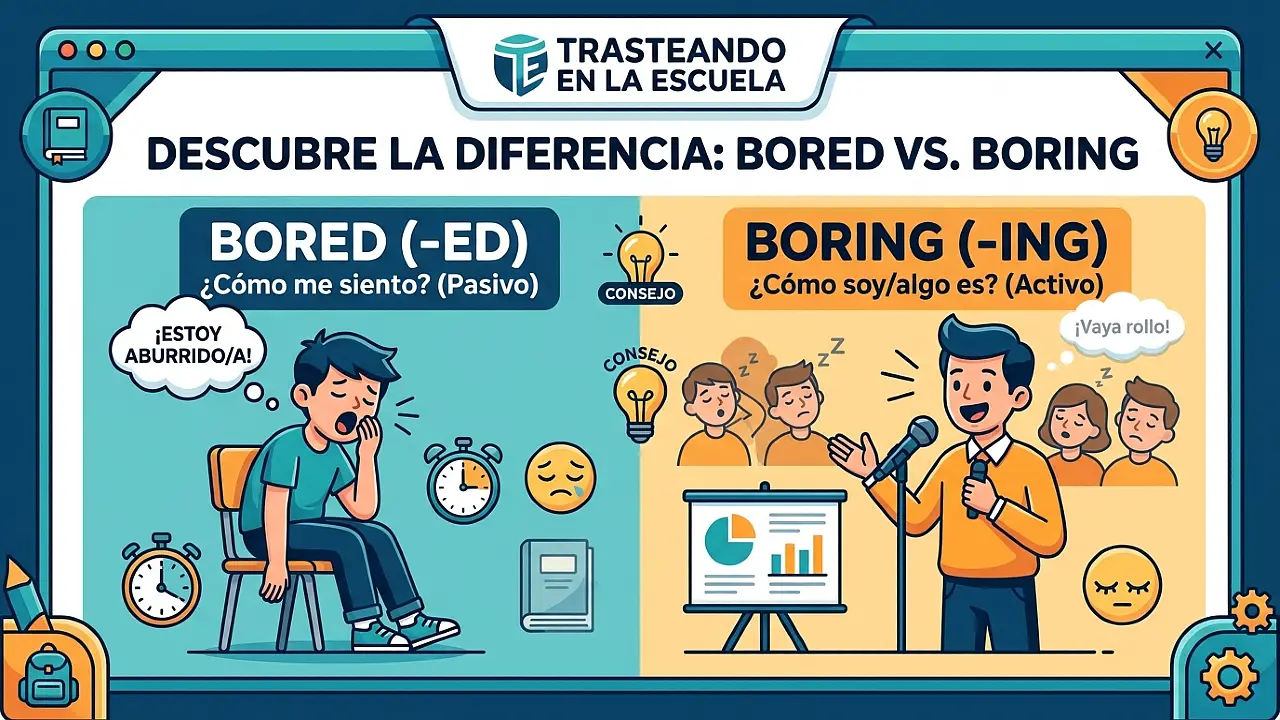
Bored vs Boring: ¿te aburres o aburres a los demás?
Imagina que estás en una cita y quieres decir: «Me estoy aburriendo». Dices: «I am very boring». ¡Oh, no! Acabas de decirle a tu cita que eres una persona aburrida, que provocas aburrimiento en los demás. El error es sutil pero importante: bored es cómo te sientes tú (aburrido), boring es cómo es algo o alguien que causa aburrimiento (aburrido/aburridor).
🎯 En este post aprenderás: La diferencia clave entre bored y boring, cuándo usar cada uno, ejemplos en contexto, sinónimos para enriquecer tu vocabulario, expresiones útiles y ejercicios para que nunca más cometas este error en una conversación importante.
🔍 Bored vs Boring: la regla de oro
📖 ¿Cómo te sientes? ¿O cómo es?
BORED (-ed): Describe el sentimiento de una persona que no tiene interés en lo que está haciendo o escuchando. Significa «aburrido» (como emoción).
BORING (-ing): Describe una cualidad de algo o alguien que causa aburrimiento. Significa «aburrido» o «aburridor» (como característica).
💡 La regla más sencilla del mundo:
- BORED = «Me siento aburrido» → emoción interna.
- BORING = «Esto es aburrido» → cualidad externa.
Pregúntate: ¿Estoy hablando de mi estado emocional o de la cualidad de algo?
😞 BORED (-ed)
Significado: Aburrido/a (cómo se siente alguien)
- «I am bored.» (Estoy aburrido.)
- «The students look bored.» (Los alumnos parecen aburridos.)
- «I get bored easily.» (Me aburro fácilmente.)
Sujeto persona + to be/get/feel + bored + with/by
😑 BORING (-ing)
Significado: Aburrido/a, aburridor/a (que causa aburrimiento)
- «This movie is boring.» (Esta película es aburrida.)
- «He is a boring speaker.» (Es un orador aburrido.)
- «My job is boring.» (Mi trabajo es aburrido.)
Sujeto (cosa/persona) + to be + boring
📊 Tabla comparativa detallada
| BORED (-ed) | BORING (-ing) | |
|---|---|---|
| ¿Qué expresa? | Emoción, estado de ánimo | Cualidad, característica |
| ¿Quién/qué? | Personas (o animales conscientes) | Cosas, actividades, personas (como causa) |
| Traducción al español | «Aburrido» (el que siente aburrimiento) | «Aburrido», «aburridor» (el que causa aburrimiento) |
| Pregunta asociada | «¿Cómo te sientes?» | «¿Cómo es?» |
| Preposiciones comunes | Bored with / bored of / bored by | Boring to (a veces) |
🎯 Usos detallados con ejemplos
📌 Bored: cómo expresar que te sientes aburrido
Estructuras comunes:
- To be bored — estar aburrido
- To get bored — aburrirse (volverse aburrido)
- To feel bored — sentirse aburrido
- Bored with / of / by + sustantivo/gerundio
Ejemplos:
- I’m bored. Let’s do something fun. (Estoy aburrido. Hagamos algo divertido.)
- She gets bored easily in long meetings. (Se aburre fácilmente en reuniones largas.)
- The children were bored with the game after an hour. (Los niños se aburrieron del juego después de una hora.)
- I’m bored of eating the same thing every day. (Estoy aburrido de comer lo mismo todos los días.)
- He felt bored during the lecture. (Se sintió aburrido durante la conferencia.)
- I’m so bored that I could fall asleep. (Estoy tan aburrido que podría quedarme dormido.)
- Are you bored with your current job? (¿Estás aburrido de tu trabajo actual?)
⚠️ Nota: «Bored of» es muy común en inglés británico hablado. «Bored with» es aceptado en ambos lados del Atlántico. «Bored by» es más formal.
📌 Boring: cómo describir lo que causa aburrimiento
Estructuras comunes:
- To be boring — ser aburrido/aburridor
- To find something boring — encontrar algo aburrido
- Boring + sustantivo — adjetivo antes del nombre
Ejemplos:
- This TV show is so boring. (Este programa de TV es tan aburrido.)
- He gave a boring speech that lasted two hours. (Dio un discurso aburrido que duró dos horas.)
- I find golf boring to watch. (Me parece aburrido ver golf.)
- It’s boring to wait in long lines. (Es aburrido esperar en filas largas.)
- My math class is incredibly boring. (Mi clase de matemáticas es increíblemente aburrida.)
- What a boring party! (¡Qué fiesta tan aburrida!)
- She thinks history is boring, but I disagree. (Ella piensa que la historia es aburrida, pero yo no estoy de acuerdo.)
🔄 La misma persona: ¿bored o boring?
📌 Una persona puede ser BORED y también BORING
Sí, una misma persona puede sentirse aburrida (bored) y además ser aburrida para los demás (boring). No es contradictorio.
Ejemplo:
- «I’m so bored right now. There’s nothing to do. But maybe I’m also boring because I never have any interesting ideas for activities.»
- «He was bored at the party because he didn’t know anyone. But his quiet attitude made him seem boring to others.»
El matiz importante:
- Bored = su experiencia personal (aburrimiento interno)
- Boring = cómo lo perciben los demás (falta de interés que genera)
📝 Sinónimos para enriquecer tu vocabulario
📚 Palabras más avanzadas para evitar repeticiones
| En lugar de BORED | En lugar de BORING |
|---|---|
| Tired of — cansado de «I’m tired of this routine.» |
Dull — soso, sin gracia «a dull presentation» |
| Fed up with — harto de «I’m fed up with waiting.» |
Monotonous — monótono «a monotonous voice» |
| Weary — cansado, hastiado «weary of the constant arguments» |
Mundane — mundano, sin interés «mundane daily tasks» |
| Uninterested — desinteresado «He seemed uninterested.» |
Tedious — tedioso «a tedious journey» |
| Restless — inquieto (por aburrimiento) «The children grew restless.» |
Commonplace — común y corriente «a commonplace story» |
💡 Diferencia clave: «Uninterested» (desinteresado) no es exactamente lo mismo que «bored». Puedes no estar interesado en algo sin necesariamente estar aburrido. «Bored» implica una sensación negativa de falta de estímulo.
🎭 Expresiones idiomáticas con «bore» y «boring»
- «It bores me to tears» — Me aburre hasta las lágrimas (muchísimo).
«This lecture bores me to tears.» - «Bore someone to death» — Aburrir a alguien mortalmente.
«He bored us to death with his stories.» - «A crashing bore» — Una persona extremadamente aburrida (coloquial británico).
«Don’t invite him; he’s a crashing bore.» - «Bored stiff» — Aburridísimo, muy aburrido.
«I was bored stiff during the ceremony.» - «Same old, same old» — Lo mismo de siempre (respuesta cuando alguien pregunta y todo es aburrido).
«How’s work?» – «Same old, same old.»
❌ Errores comunes
| Error | Explicación | Corrección |
|---|---|---|
| «I am boring.» | Estás diciendo que eres una persona que aburre a los demás. | «I am bored.» (Estoy aburrido/a — sentimiento) |
| «This class is bored.» | Una clase (cosa) no puede sentir aburrimiento. | «This class is boring.» |
| «I’m boring of this.» | «Boring» no se usa con preposición «of». Es «bored of». | «I’m bored of this.» |
| «She is very boring with her job.» | Una persona aburrida (cualidad) no va seguida de «with». | «She is very bored with her job.» (aburrida del trabajo) o «Her job is very boring.» |
| «I get boring easily.» | «Get boring» significa volverse aburrido (cualidad). | «I get bored easily.» (Me aburro fácilmente) |
🧪 5 Ejercicios prácticos
Ejercicio 1: Completa con «bored» o «boring»
- This movie is so ______. I want to leave.
- The students were ______ during the long assembly.
- I find watching golf extremely ______.
- She’s ______ with her daily routine.
- What a ______ book! Nothing ever happens.
- Are you ______? Let’s play a game.
- He told a ______ story that lasted an hour.
- I get ______ when I have nothing to do.
- The lecture was ______, so I almost fell asleep.
- My dog gets ______ when I leave him alone all day.
✅ Ver solución
- This movie is so boring.
- The students were bored during the long assembly.
- I find watching golf extremely boring.
- She’s bored with her daily routine.
- What a boring book!
- Are you bored? Let’s play a game.
- He told a boring story that lasted an hour.
- I get bored when I have nothing to do.
- The lecture was boring.
- My dog gets bored when I leave him alone all day.
Ejercicio 2: Traduce al inglés
- Estoy aburrido de esta conversación.
- Esta clase es muy aburrida.
- ¿Te aburres fácilmente?
- Mi trabajo es aburrido y monótono.
- Me sentí aburrido durante todo el viaje.
✅ Ver solución
- I’m bored with/of this conversation.
- This class is very boring.
- Do you get bored easily?
- My job is boring and monotonous.
- I felt bored during the whole trip.
Ejercicio 3: Corrige los errores
- I am very boring in this meeting.
- The teacher is bored, so the students don’t listen.
- She gets boring when she’s alone.
- This video game is so bored.
- He’s boring of his job.
✅ Ver solución
- ❌ I am very boring in this meeting. → I am very bored in this meeting.
- ❌ The teacher is bored… → Si quieres decir que el profesor causa aburrimiento: The teacher is boring… Si quieres decir que el profesor se siente aburrido, la frase está bien pero no explica por qué los alumnos no escuchan.
- ❌ She gets boring… → She gets bored when she’s alone.
- ❌ This video game is so bored. → This video game is so boring.
- ❌ He’s boring of his job. → He’s bored of/with his job.
Ejercicio 4: Elige la opción correcta
- I find history (bored / boring).
- The children were (bored / boring) after two hours in the car.
- He is such a (bored / boring) person to talk to.
- I’m (bored / boring) of eating the same thing every day.
- This puzzle is (bored / boring). I already solved it.
✅ Ver solución
- I find history boring.
- The children were bored after two hours in the car.
- He is such a boring person to talk to.
- I’m bored of eating the same thing every day.
- This puzzle is boring. I already solved it.
Ejercicio 5: Escribe respuestas personales
Responde a estas preguntas con frases completas usando «bored» o «boring».
- What do you do when you feel bored?
- What is the most boring movie you’ve ever seen?
- Do you get bored easily? Why or why not?
- What’s something that most people find boring but you enjoy?
- Is there any subject at school that you find boring?
✅ Ver ejemplos de respuestas
- a. «When I feel bored, I usually watch a movie or call a friend.»
- b. «The most boring movie I’ve ever seen is ‘The English Patient’ because it’s so slow.»
- c. «Yes, I get bored easily if I’m not challenged. I need to stay busy.»
- d. «Most people find watching chess boring, but I really enjoy it.»
- e. «I find memorizing dates in history class boring. I prefer learning about causes and effects.»
📚 Adjetivos terminados en -ed vs -ing
Continúa aprendiendo con el resto de la serie:
- Interested vs interesting – El primer par de la serie.
- Bored vs boring – ¡Estás aquí!
- Excited vs exciting – Emoción vs emocionante.
- Tired vs tiring – Cansado vs agotador.
- 50 adjetivos -ed/-ing lista – La guía completa.
Para seguir practicando inglés, visita también nuestras guías sobre adjetivos de personalidad y adjetivos descriptivos.
🏆 Reto de la semana: Esta semana, cada vez que escuches o digas la palabra «aburrido» en español, pregúntate: ¿Estoy hablando de cómo me siento (bored) o de cómo es algo/alguien (boring)? Escribe 10 frases en inglés combinando bored y boring en contextos diferentes. Por ejemplo: «I’m bored with this boring TV show.» ¡Verás cómo dominas la diferencia en pocos días!



Publicar comentario