Interested vs Interesting: la diferencia clave que cambiará tu inglés
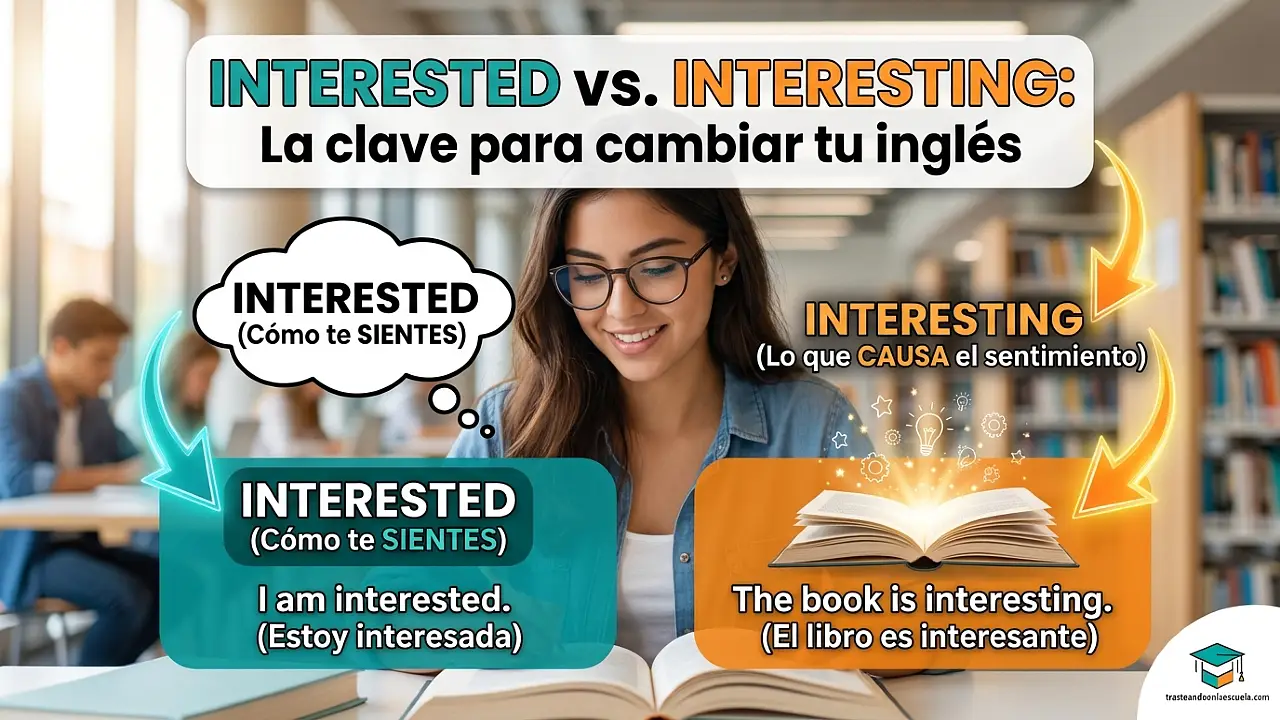
Interested vs Interesting: ¿tú cómo te sientes?
¿Alguna vez has dicho «I am very interesting in history» cuando querías decir que la historia te interesa? ¡Es un error muy común! La diferencia entre interested y interesting es una de las confusiones más frecuentes entre los estudiantes de inglés, pero también una de las más fáciles de solucionar. Un pequeño cambio en la terminación (-ed vs -ing) cambia por completo el significado: habla de cómo te sientes o de cómo es algo o alguien.
🎯 En este post aprenderás: La regla de oro de los adjetivos -ed vs -ing, cuándo usar «interested» y cuándo «interesting», ejemplos prácticos en contexto, errores comunes que debes evitar y ejercicios para que nunca más los confundas.
🔍 La regla de oro: emoción vs causa
📖 La diferencia en una frase
-ED: El adjetivo terminado en -ed expresa cómo se siente una persona. Es una emoción o estado interno.
-ING: El adjetivo terminado en -ing expresa qué causa esa emoción. Describe la cualidad de algo o alguien.
Ejemplo básico:
- I am interested in history. (Yo me siento interesado → emoción)
- History is interesting. (La historia causa interés → cualidad)
💡 Regla mnemotécnica infalible:
- -ED = Emoción / Experiencia / Estado (para personas y, a veces, animales)
- -ING = Causa / Característica / Cualidad (para cosas, situaciones, personas que causan una reacción)
Pregúntate: ¿Estoy describiendo un sentimiento (-ed) o una cualidad que causa un sentimiento (-ing)?
😊 INTERESTED (-ed)
Significado: Interesado/a (cómo se siente alguien)
- «She is interested in art.»
- «I’m very interested in your proposal.»
- «The students were interested in the lesson.»
Sujeto → persona + interested + in + objeto
🎯 INTERESTING (-ing)
Significado: Interesante (causa interés)
- «Art is very interesting.»
- «Your proposal sounds interesting.»
- «The lesson was interesting.»
Sujeto (cosa/persona) + interesting
📊 Tabla comparativa completa
| INTERESTED (-ed) | INTERESTING (-ing) | |
|---|---|---|
| ¿Qué expresa? | Una emoción o sentimiento | Una cualidad o característica |
| ¿Quién lo siente o tiene? | Normalmente personas (o animales) | Cosas, situaciones, personas (como causa) |
| Pregunta clave | «¿Cómo se siente?» | «¿Cómo es?» |
| Ejemplos | I am interested. She feels interested. |
It is interesting. The movie was interesting. |
| Preposición común | Interested in (algo/alguien) | Interesting to (alguien) a veces |
🎯 Usos detallados con ejemplos
📌 Interested: para expresar interés personal
Estructura:
- Persona + to be + interested + in + sustantivo/gerundio
- Persona + to be + interested + in + [verb in -ing]
Ejemplos:
- I am interested in learning Japanese. (Estoy interesado en aprender japonés.)
- She is interested in photography. (Ella está interesada en la fotografía.)
- Are you interested in coming to the party? (¿Te interesaría venir a la fiesta?)
- They were very interested in what the speaker had to say. (Estaban muy interesados en lo que el orador tenía que decir.)
- My son is interested in dinosaurs. (Mi hijo está interesado en los dinosaurios.)
- I’m not interested in politics. (No me interesa la política.)
⚠️ Ojo: «Interested» va siempre seguido de la preposición «in», no «on» ni «about».
📌 Interesting: para describir lo que causa interés
Estructura:
- Sustantivo + to be + interesting
- It + is + interesting + to + verbo
- It + is + interesting + that + frase
Ejemplos:
- This book is very interesting. (Este libro es muy interesante.)
- It’s interesting to see how things have changed. (Es interesante ver cómo han cambiado las cosas.)
- She told me an interesting story. (Me contó una historia interesante.)
- What an interesting idea! (¡Qué idea tan interesante!)
- The documentary about space was extremely interesting. (El documental sobre el espacio fue extremadamente interesante.)
- I find physics very interesting. (La física me parece muy interesante.)
⚠️ Ojo: «Interesting» puede usarse antes del sustantivo (attributive position): «an interesting movie».
🔄 La misma persona puede ser de ambas maneras
📌 Una persona puede ser INTERESTED y también INTERESTING
Una misma persona puede sentirse interesada en algo (interesada = interested) y además ser alguien que despierta interés en los demás (interesante = interesting).
Ejemplo:
- «My friend Maria is interested in ancient history. She reads a lot about it. Also, she is very interesting to talk to because she knows so many fascinating facts.»
- «I am interested in this conversation because you are a very interesting person.»
En la primera frase, interested describe su interés (emoción). Interesting describe su cualidad de despertar interés en otros.
❌ Errores comunes
| Error | Explicación | Corrección |
|---|---|---|
| «I am interesting in music.» | «Interesting» describe cualidades, no emociones personales. | «I am interested in music.» |
| «The class is interested.» | Una clase (cosa) no puede sentirse interesada. Causa interés. | «The class is interesting.» |
| «I’m interested on art.» | La preposición correcta es «in», no «on». | «I’m interested in art.» |
| «Are you interesting in coming?» | Confusión entre -ed e -ing. | «Are you interested in coming?» |
| «She is very interesting in her job.» | Una persona interesante (cualidad) no va seguida de «in». | «She is very interesting.» o «She is very interested in her job.» (dos significados distintos) |
🔧 Ejercicios prácticos
Ejercicio 1: Completa con «interested» o «interesting»
- I am very ______ in learning to play the guitar.
- This documentary about the ocean is very ______.
- Are you ______ in joining us for dinner?
- She told me an ______ story about her trip to Japan.
- He’s not ______ in sports at all.
- What an ______ magazine! I want to read it.
- The students were ______ in the teacher’s explanation.
- I find this topic extremely ______.
- My grandfather is ______ in genealogy and has traced our family tree.
- It’s always ______ to learn about other cultures.
✅ Ver solución
- I am very interested in learning to play the guitar.
- This documentary about the ocean is very interesting.
- Are you interested in joining us for dinner?
- She told me an interesting story about her trip to Japan.
- He’s not interested in sports at all.
- What an interesting magazine! I want to read it.
- The students were interested in the teacher’s explanation.
- I find this topic extremely interesting.
- My grandfather is interested in genealogy and has traced our family tree.
- It’s always interesting to learn about other cultures.
Ejercicio 2: Traduce al inglés
- Estoy interesado en la ciencia ficción.
- Esta película es muy interesante.
- ¿Te interesaría venir al concierto?
- Me pareció muy interesante su conferencia.
- No estoy interesado en discutir sobre esto.
✅ Ver solución
- I am interested in science fiction.
- This movie is very interesting.
- Are you interested in coming to the concert?
- I found his/her lecture very interesting. o His/Her lecture was very interesting to me.
- I’m not interested in arguing about this.
Ejercicio 3: Corrige los errores en estas frases
- I am very interesting in photography.
- The book was so interested that I couldn’t put it down.
- Are you interesting in going to the museum?
- She is interested on learning French.
- What a interested idea!
✅ Ver solución
- ❌ I am very interesting in photography. → I am very interested in photography.
- ❌ The book was so interested… → The book was so interesting…
- ❌ Are you interesting in going… → Are you interested in going…
- ❌ She is interested on learning French. → She is interested in learning French.
- ❌ What a interested idea! → What an interesting idea!
Ejercicio 4: Escribe dos frases diferentes con cada palabra
Escribe una frase con «interested» y otra con «interesting» para cada tema:
- Tu hobby favorito
- Una película que viste recientemente
- Un libro que leíste
- Tu trabajo o estudios
✅ Ver ejemplos de respuestas
- Hobby: «I am interested in playing chess. Chess is a very interesting game.»
- Película: «I was very interested in the plot of Inception. The movie was extremely interesting.»
- Libro: «I’m interested in historical novels. ‘The Name of the Rose’ is a very interesting book.»
- Trabajo: «I’m interested in web development. It’s an interesting field with many challenges.»
Ejercicio 5: Completa el diálogo
Completa con interested / interesting / interested in / interesting to
Anna: What do you think about this documentary?
Tom: It’s very ______! I’m really ______ the topic of climate change.
Anna: Me too. I find it ______ how much the planet has changed.
Tom: Are you ______ watching the next episode?
Anna: Definitely! It’s one of the most ______ shows I’ve seen.
✅ Ver solución
Anna: What do you think about this documentary?
Tom: It’s very interesting! I’m really interested in the topic of climate change.
Anna: Me too. I find it interesting how much the planet has changed.
Tom: Are you interested in watching the next episode?
Anna: Definitely! It’s one of the most interesting shows I’ve seen.
📚 Adjetivos terminados en -ed vs -ing
Este es el primero de una serie sobre los pares -ed/-ing más comunes en inglés:
- Interested vs interesting – ¡Estás aquí!
- Bored vs boring – Aburrido vs aburridor.
- Excited vs exciting – Emocionado vs emocionante.
- Tired vs tiring – Cansado vs agotador.
- 50 adjetivos -ed/-ing lista – La guía completa con todos los pares.
Para seguir practicando inglés, visita también nuestros posts sobre adjetivos de personalidad y falsos amigos.
🏆 Reto de la semana: Durante los próximos 7 días, cada vez que uses los verbos «interest», «bore», «excite», «tire» (o sus adjetivos), pregúntate: ¿Estoy describiendo un sentimiento mío (-ed) o una cualidad de algo/alguien (-ing)? Escribe 5 frases cada día usando correctamente «interested» e «interesting» en contextos diferentes. Al final de la semana, la diferencia será automática.



Publicar comentario