Its vs It’s: diferencias, ejemplos y ejercicios
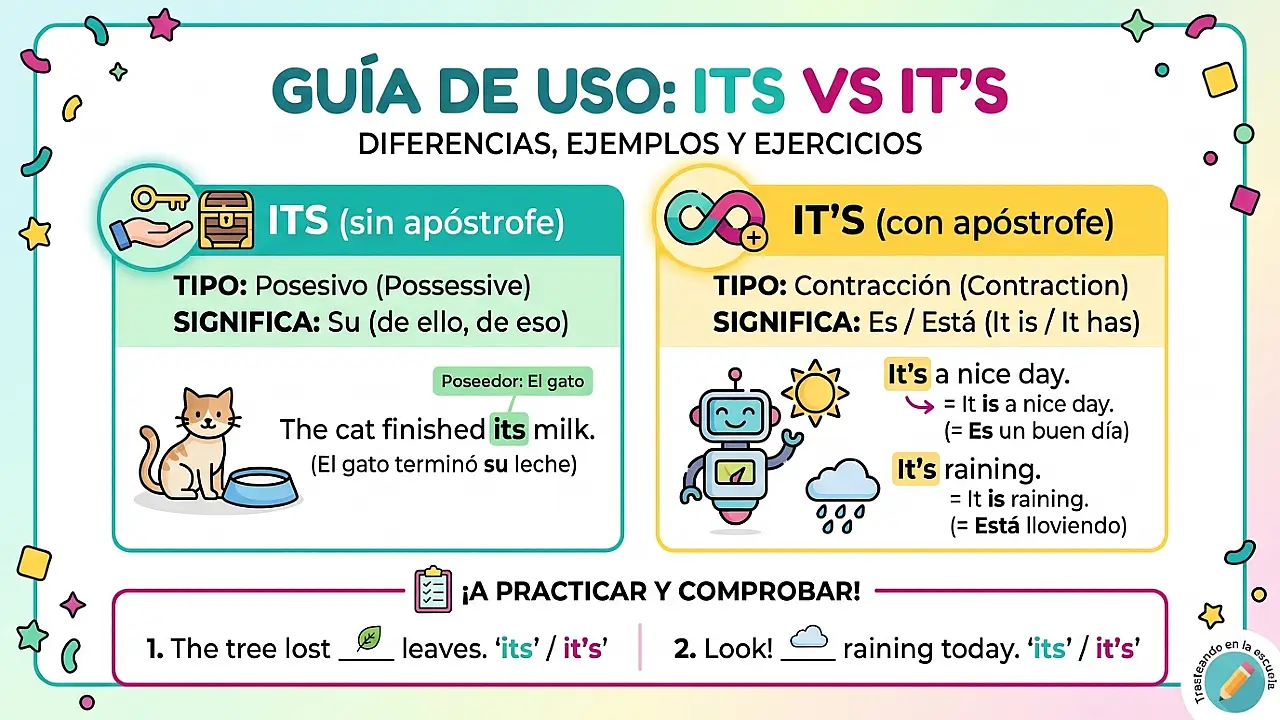
Its vs It’s: la guía definitiva para no confundirlos nunca
Its y it’s son dos palabras que suenan EXACTAMENTE igual en inglés (se pronuncian /ɪts/). Pero se escriben diferente y significan cosas completamente distintas. Es uno de los errores más comunes, incluso en periódicos y libros publicados. ¿La razón? La regla normal de los posesivos en inglés usa apóstrofe (John’s car, the dog’s tail), pero ITS es la excepción.
🎯 En este post aprenderás: La diferencia entre ITS (su / de él/ella/ello, posesivo) y IT’S (it is / it has, contracción). Incluye ejemplos, trucos para recordar cada uno, ejercicios prácticos y la regla de oro del apóstrofe.
🔗 Este post es parte de nuestro cluster de homophones. No te pierdas there, their, they’re, your vs you’re, to, too, two y la lista completa de homophones en PDF.
🔊 ¿Por qué son tan confusos?
🎵 La gran excepción de los posesivos en inglés
En inglés, normalmente usamos apóstrofe + s para formar el posesivo:
- John → John’s car (el coche de John)
- The dog → the dog’s tail (la cola del perro)
- My mother → my mother’s house (la casa de mi madre)
Pero con el pronombre «it», el posesivo NO lleva apóstrofe. Es its, no «it’s». ¡Esa es la trampa! La mayoría de la gente aplica la regla general y escribe «it’s» como posesivo, pero eso es incorrecto.
🔊 /ɪts/ → two different meanings: possessive vs contraction
🐾 ITS: posesión (su / de él/ella/ello)
📌 ITS
ITS es un adjetivo posesivo (o pronombre posesivo). Significa «su» (de él, de ella, de ello). Indica que algo pertenece a una cosa, animal o entidad sin género específico.
- Se usa con sustantivos: its + [objeto poseído].
- NO lleva apóstrofe (¡esta es la clave!).
- Es para la tercera persona del singular neutro (it).
🐕 ITS = SU (DE ÉL/ELLA/ELLO)
Ejemplos:
«The cat licked its paw.»
(El gato lamió su pata).
«The company lost its best employee.»
(La empresa perdió a su mejor empleado).
«The tree has lost its leaves.»
(El árbol ha perdido sus hojas).
«Every book has its own story.»
(Cada libro tiene su propia historia).
🆚 Comparación con otros posesivos
My = mi
Your = tu
His = su (de él)
Her = su (de ella)
Its = su (de ello – cosa/animal)
Our = nuestro
Their = su (de ellos)
Ejemplo: «The dog wagged its tail.» (El perro movió su cola).
🧠 Truco para recordar ITS: ITS NO tiene apóstrofe. Piensa en «his» y «hers» —tampoco llevan apóstrofe. Los posesivos en inglés NUNCA llevan apóstrofe (my, your, his, her, its, our, their). El apóstrofe es solo para las contracciones (it’s = it is).
⚠️ ERROR COMÚN: Escribir «it’s» cuando se quiere decir «its» (posesivo). Ejemplo incorrecto: ❌ «The dog wagged it’s tail.» Correcto: ✅ «The dog wagged its tail.»
📝 IT’S: contracción (it is / it has)
📌 IT’S
IT’S es la contracción de «it is» (es / está) o «it has» (ha / tiene). Siempre lleva apóstrofe para indicar que se han eliminado letras.
- It’s = It is (la mayoría de los casos)
- It’s = It has (en tiempos perfectos)
📝 IT’S = IT IS
Significado: Es / Está
«It’s a beautiful day.»
(Es un día precioso).
«It’s raining outside.»
(Está lloviendo fuera).
«I think it’s time to go.»
(Creo que es hora de irnos).
«Do you know what it’s like?»
(¿Sabes cómo es?)
📝 IT’S = IT HAS
Significado: Ha / Tiene (en verbos compuestos)
«It’s been a long time.»
(Ha pasado mucho tiempo).
«It’s got a new engine.»
(Tiene un motor nuevo).
«It’s happened again!»
(Ha ocurrido otra vez).
✂️ DESCOMPOSICIÓN
It’s = It is / It has
It is → It’s (la «i» de «is» desaparece)
It has → It’s (la «ha» desaparece)
Ejemplos de otras contracciones:
I am → I’m
You are → You’re
He is → He’s
She is → She’s
We are → We’re
They are → They’re
🧠 Truco para recordar IT’S: El apóstrofe siempre señala una contracción. Pregúntate: ¿puedo reemplazar «it’s» por «it is» o «it has»? Si la respuesta es SÍ, entonces es it’s. Si no, necesitas its (posesivo).
⚠️ ERROR COMÚN: Escribir «its» cuando se necesita «it’s». Ejemplo incorrecto: ❌ «Its raining outside.» Correcto: ✅ «It’s raining outside.»
📊 Tabla comparativa: ITS vs IT’S
| Palabra | Tipo | Significado | Ejemplo | ¿Contiene apóstrofe? |
|---|---|---|---|---|
| ITS | Adjetivo posesivo | Su / De él/ella/ello (pertenencia) | The cat ate its food. | ❌ No |
| IT’S | Contracción (it is / it has) | Es / Está / Ha | It’s a beautiful cat. | ✅ Sí (‘) |
🔍 Ejemplos en contexto (para ver la diferencia)
📖 Frases combinadas
- It’s amazing how a dog shows its love for its owner.
(Es increíble cómo un perro muestra su amor por su dueño). - The company announced its new policy, and it’s going to affect everyone.
(La empresa anunció su nueva política, y va a afectar a todos). - It’s clear that the plant needs water because its leaves are dry.
(Está claro que la planta necesita agua porque sus hojas están secas). - The phone has its own charger, but it’s not working.
(El teléfono tiene su propio cargador, pero no está funcionando). - It’s been a long time since the cat lost its collar.
(Ha pasado mucho tiempo desde que el gato perdió su collar).
✨ LA REGLA DE ORO DEL APÓSTROFE
Si puedes reemplazar la palabra por «it is» o «it has» → usa IT’S
Si no → usa ITS (posesivo)
¡Así de simple! Esta regla funciona el 100% de las veces.
🎯 La prueba del apóstrofe (funciona siempre)
✨ TRUCO DEFINITIVO: LA PRUEBA DEL APÓSTROFE
Si tienes dudas entre ITS y IT’S, haz esta prueba infalible:
- STEP 1: Escribe la frase en tu cabeza con «it is» o «it has» en lugar de la palabra dudosa.
- STEP 2: ¿La frase sigue teniendo sentido gramatical?
- STEP 3: Si SÍ → la palabra correcta es IT’S (con apóstrofe).
- STEP 4: Si NO → la palabra correcta es ITS (posesivo, sin apóstrofe).
🔍 Ejemplo 1 de la prueba
Frase dudosa: «_____ going to rain today.»
Paso 1: Reemplazamos con «it is»: «It is going to rain today.» → ✅ Tiene sentido.
Resultado: La palabra correcta es IT’S: «It’s going to rain today.»
🔍 Ejemplo 2 de la prueba
Frase dudosa: «The dog wagged _____ tail.»
Paso 1: Reemplazamos con «it is»: «The dog wagged it is tail.» → ❌ No tiene sentido.
Resultado: La palabra correcta es ITS: «The dog wagged its tail.»
🔍 Ejemplo 3 de la prueba (con «it has»)
Frase dudosa: «_____ been a great year.»
Paso 1: Reemplazamos con «it has»: «It has been a great year.» → ✅ Tiene sentido.
Resultado: La palabra correcta es IT’S: «It’s been a great year.» (it’s = it has)
📝 Ejercicios prácticos
Ejercicio 1: Completa con ITS o IT’S
- The cat is cleaning __________ paws.
- __________ going to be a long day.
- The company needs to improve __________ customer service.
- __________ been a pleasure working with you.
- The tree lost __________ leaves in autumn.
- I think __________ time to leave now.
- Every country has __________ own traditions.
- __________ raining cats and dogs outside!
- The dog knows __________ owner very well.
- __________ not easy to learn a new language.
✅ Ver soluciones
- The cat is cleaning its paws.
- It’s going to be a long day.
- The company needs to improve its customer service.
- It’s been a pleasure working with you.
- The tree lost its leaves in autumn.
- I think it’s time to leave now.
- Every country has its own traditions.
- It’s raining cats and dogs outside!
- The dog knows its owner very well.
- It’s not easy to learn a new language.
Ejercicio 2: Elige la opción correcta
- (Its / It’s) a beautiful day, isn’t it?
- The company announced (its / it’s) annual results yesterday.
- I can’t believe (its / it’s) already December.
- The car lost (its / it’s) right mirror in the accident.
- (Its / It’s) important to drink enough water.
- The baby is learning to hold (its / it’s) own bottle.
- (Its / It’s) been three years since we last met.
- Look at the bird! (Its / It’s) building a nest.
- The phone has (its / it’s) own fingerprint sensor.
- (Its / It’s) not what you think.
✅ Ver soluciones
- It’s a beautiful day, isn’t it?
- The company announced its annual results yesterday.
- I can’t believe it’s already December.
- The car lost its right mirror in the accident.
- It’s important to drink enough water.
- The baby is learning to hold its own bottle.
- It’s been three years since we last met.
- Look at the bird! It’s building a nest.
- The phone has its own fingerprint sensor.
- It’s not what you think.
Ejercicio 3: Corrige los errores en las siguientes frases
- The dog lost it’s collar in the park.
- Its going to be a great party.
- The company needs to improve it’s image.
- Its been a long time since I saw you.
- The tree is shedding it’s leaves.
- Its not fair to blame him.
- The phone has it’s own charger.
- Its a bird! Its a plane! Its Superman!
- The cat knows it’s name.
- I think its time to go home.
✅ Ver soluciones
- The dog lost its collar in the park.
- It’s going to be a great party.
- The company needs to improve its image.
- It’s been a long time since I saw you.
- The tree is shedding its leaves.
- It’s not fair to blame him.
- The phone has its own charger.
- It’s a bird! It’s a plane! It’s Superman!
- The cat knows its name.
- I think it’s time to go home.
Ejercicio 4: Traduce al inglés
- El perro movió su cola.
- Es un día soleado.
- La empresa perdió a su mejor cliente.
- Ha sido un año increíble.
- Cada país tiene su propia cultura.
- Está lloviendo otra vez.
- El gato bebió su leche.
- No es fácil decir adiós.
- El teléfono tiene su propia batería.
- Ha pasado mucho tiempo.
✅ Ver soluciones
- The dog wagged its tail.
- It’s a sunny day.
- The company lost its best customer.
- It’s been an incredible year.
- Every country has its own culture.
- It’s raining again.
- The cat drank its milk.
- It’s not easy to say goodbye.
- The phone has its own battery.
- It’s been a long time.
Ejercicio 5: Escribe 5 frases originales combinando ITS y IT’S
Crea 5 frases que incluyan its y it’s en la misma oración (o en oraciones relacionadas).
✅ Ver ejemplos de respuestas
- It’s amazing how a plant knows how to grow toward its light source.
- The car is great, but it’s not worth its high price.
- It’s clear that the dog loves its new toy.
- The company announced its new CEO, and it’s big news in the industry.
- It’s been a while since the cat lost its favorite blanket.
📊 Errores comunes y cómo evitarlos
| Error típico | Causa | Cómo evitarlo |
|---|---|---|
| Escribir «it’s» como posesivo | Aplicar la regla general de posesivos (apóstrofe + s) | Recuerda: los posesivos NUNCA llevan apóstrofe (my, your, his, her, its, our, their) |
| Escribir «its» en lugar de «it’s» | Olvidar el apóstrofe en la contracción | Prueba: ¿puedo decir «it is» o «it has»? → it’s |
| Confundir en la escritura rápida | Ambas suenan igual | Siempre haz la prueba mental de «it is» / «it has» |
💬 Frases famosas con ITS y IT’S
- «It’s not the size of the dog in the fight, it’s the size of the fight in the dog.» – Mark Twain
(No es el tamaño del perro en la pelea, es el tamaño de la pelea en el perro). - «It’s a beautiful day. Don’t let it get away.» – U2
(Es un día precioso. No dejes que se escape). - Every dog has its day. (Cada perro tiene su día / Todo el mundo tiene su momento de gloria).
- «It’s been a hard day’s night.» – The Beatles
(Ha sido una noche de un día duro).
🎯 Resumen visual final
✅ ITS
= Posesión
≈ HIS, HER, OUR, THEIR
«The dog wagged its tail.»
❌ NO lleva apóstrofe
✅ IT’S
= IT IS / IT HAS
≈ Es / Está / Ha
«It’s a beautiful day.»
✅ Lleva apóstrofe (contracción)
📚 Otros homophones que debes conocer
🔗 Serie completa de homophones en Trasteando en la Escuela
Ahora que dominas its y it’s, continúa con los siguientes:
- There, their, they’re – El trío más famoso de homophones.
- Your vs You’re – Diferencia entre «tu» y «tú eres».
- 📌 This post: Its vs It’s – ¡Estás aquí!
- To, Too, Two – Dirección, también y el número 2.
- 50 homophones lista y PDF – Descarga la lista completa de homophones en inglés.
🏆 RETO FINAL: Escribe un pequeño párrafo (4-5 líneas) sobre una mascota o un objeto que te guste. Usa correctamente its e it’s al menos dos veces cada uno. Luego, aplica la prueba de «it is» / «it has» para verificar que usaste bien «it’s». ¡Comparte tu resultado en los comentarios!

Publicar comentario