There, their, they’re: diferencias, ejemplos y ejercicios
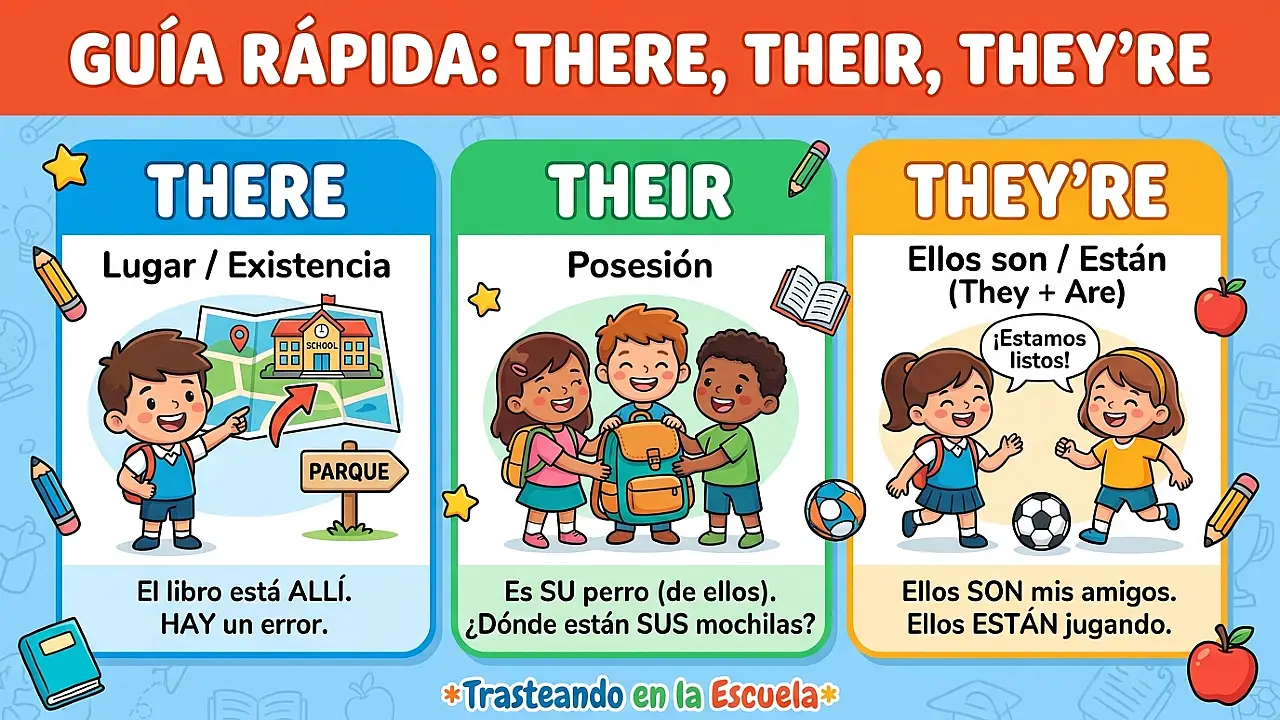
There, their, they’re: la guía definitiva para no confundirlos nunca
There, their, they’re son tres palabras que suenan EXACTAMENTE igual en inglés (todas se pronuncian /ðeər/ o /ðer/ dependiendo del acento). Pero se escriben diferente y significan cosas completamente distintas. Son el error de escritura más común entre estudiantes de inglés… ¡y también entre nativos!
🎯 En este post aprenderás: La diferencia entre THERE (allí / hay), THEIR (su / de ellos) y THEY’RE (ellos son / ellos están). Incluye ejemplos, trucos para recordar cada uno y ejercicios para practicar.
🔗 Este post es parte de nuestro cluster de homophones. No te pierdas your vs you’re, its vs it’s, to, too, two y la lista completa de homophones en PDF.
🔊 ¿Por qué se confunden tanto?
🎵 Homophones: palabras que suenan igual
Los homophones (homófonos) son palabras que se pronuncian igual pero tienen diferente significado y ortografía. En español tenemos ejemplos como «bello» y «vello», o «casa» y «caza». En inglés, there, their, they’re son el caso más famoso y problemático.
🔊 /ðeər/ → three different meanings
📍 THERE: el más versátil (allí / hay)
📌 THERE
THERE tiene tres usos principales:
- Lugar: significa «allí» o «ahí» (indica posición).
- Existencia: «there is / there are» = «hay».
- Introducir temas: «there’s something I want to tell you».
📍 THERE = LUGAR
Significado: Allí, ahí, en ese lugar.
«The book is there on the table.»
(El libro está allí sobre la mesa).
«Let’s go there tomorrow.»
(Vamos allí mañana).
Pregunta típica: «Where is it?» → «It’s there!»
🔍 THERE = EXISTENCIA
Significado: Hay / Existe (there is/there are).
«There is a cat in the garden.»
(Hay un gato en el jardín).
«There are many students in class.»
(Hay muchos estudiantes en clase).
Estructura: There + to be + sujeto
💬 THERE = INTRODUCTOR
Significado: Se usa para empezar frases.
«There’s something I need to tell you.»
(Hay algo que necesito decirte).
«There comes a time when…»
(Llega un momento en que…).
🧠 Truco para recordar THERE: Contiene la palabra «HERE» (aquí). «There» es el opuesto: «there» = «there» (allí). También piensa en la «T» de «T» de «allí» no funciona bien. Mejor: THERE tiene una «H» como «aHí» o tiene «ERE» como en «donde está la ESTRELLA» (star). En realidad, el truco más simple: THERE tiene la palabra «HERE» dentro → si no es «aquí», es «allí».
👥 THEIR: posesión (de ellos / su)
📌 THEIR
THEIR es un adjetivo posesivo. Significa «su» (de ellos) o «de ellos». Indica que algo pertenece a un grupo de personas o cosas.
- Se usa con sustantivos: their + [objeto poseído].
- Es para tercera persona del plural (they).
👨👩👧👦 THEIR = DE ELLOS
Ejemplos:
«Their house is very big.»
(Su casa es muy grande).
«The children forgot their homework.»
(Los niños olvidaron su tarea).
«Their dog is friendly.»
(Su perro es amigable).
🆚 Comparación con otros posesivos
My = mi
Your = tu
His = su (de él)
Her = su (de ella)
Its = su (de cosa/animal)
Our = nuestro
Their = su (de ellos)
🧠 Truco para recordar THEIR: Contiene la palabra «HEIR» (heredero). Los herederos reciben su herencia. También: THEIR termina en «IR» como «su» no termina en nada… pero el truco más simple: THEIR tiene «HEIR» (heredero) → lo que es de ellos.
⚠️ ERROR COMÚN: Escribir «there» cuando se quiere decir «their». Ejemplo incorrecto: ❌ «There car is red.» Correcto: ✅ «Their car is red.»
📝 THEY’RE: contracción (ellos son / ellos están)
📌 THEY’RE
THEY’RE es la contracción de «they are» (ellos son / ellos están). Es la única de las tres que lleva apóstrofe (‘) para indicar que se ha eliminado una letra (la «a» de «are»).
📝 THEY’RE = THEY ARE
Ejemplos:
«They’re coming to the party.»
(Ellos vienen a la fiesta).
«They’re very happy together.»
(Ellos son muy felices juntos).
«I think they’re lost.»
(Creo que ellos están perdidos).
✂️ DESCOMPOSICIÓN
They’re = They + are
They are → They’re
La «a» de «are» se reemplaza por apóstrofe.
Ejemplo: «They are friends» = «They’re friends».
🧠 Truco para recordar THEY’RE: El apóstrofe indica una letra faltante. Pregúntate: ¿puedo reemplazar «they’re» por «they are»? Si la respuesta es SÍ, entonces es they’re. Si no, necesitas there o their.
⚠️ ERROR COMÚN: Escribir «there» o «their» cuando se necesita «they’re». Ejemplo incorrecto: ❌ «There going to the store.» Correcto: ✅ «They’re going to the store.»
📊 Tabla comparativa: THERE vs THEIR vs THEY’RE
| Palabra | Tipo | Significado | Ejemplo | ¿Contiene apóstrofe? |
|---|---|---|---|---|
| THERE | Adverbio / Pronombre existencial | Allí / Ahí / Hay | The store is there. / There is a solution. | ❌ No |
| THEIR | Adjetivo posesivo | Su (de ellos) / De ellos | Their car is new. | ❌ No |
| THEY’RE | Contracción (they + are) | Ellos son / Ellos están | They’re my best friends. | ✅ Sí (‘) |
🔍 Ejemplos en contexto (para ver la diferencia)
📖 Ejemplos combinados
- They’re going to their house, which is there on the corner.
(Ellos van a su casa, que está allí en la esquina). - I told them that there’s a problem with their reservation, but they’re not listening.
(Les dije que hay un problema con su reserva, pero ellos no están escuchando). - There are many reasons why they’re happy with their new home.
(Hay muchas razones por las que ellos están felices con su nueva casa). - Put the books over there. They’re not in their correct place.
(Pon los libros allí. No están en su lugar correcto).
📝 Ejercicios prácticos
Ejercicio 1: Completa con THERE, THEIR o THEY’RE
- __________ going to the cinema later.
- Is __________ a bank near here?
- The students forgot __________ homework again.
- Look over __________! That’s the Eiffel Tower.
- __________ very excited about the trip.
- __________ dog is always barking at night.
- I think __________ lost. Let’s help __________.
- __________ are three cookies left on the plate.
- __________ coming to visit __________ grandparents tomorrow.
- Put your shoes __________, next to the door.
✅ Ver soluciones
- They’re going to the cinema later.
- Is there a bank near here?
- The students forgot their homework again.
- Look over there! That’s the Eiffel Tower.
- They’re very excited about the trip.
- Their dog is always barking at night.
- I think they’re lost. Let’s help them.
- There are three cookies left on the plate.
- They’re coming to visit their grandparents tomorrow.
- Put your shoes there, next to the door.
Ejercicio 2: Elige la opción correcta
- (There / Their / They’re) is a spider on the wall! li>(There / Their / They’re) car broke down on the highway.
- I don’t know where (there / their / they’re) going after school.
- Let’s sit over (there / their / they’re) by the window.
- The children ate all (there / their / they’re) vegetables.
- (There / Their / They’re) my best friends from college.
- Is (there / their / they’re) any milk in the fridge?
- I love (there / their / they’re) new song!
- Look at those clouds. I think (there / their / they’re) going to rain.
- (There / Their / They’re) are 24 hours in a day.
✅ Ver soluciones
- There is a spider on the wall!
- Their car broke down on the highway.
- I don’t know where they’re going after school.
- Let’s sit over there by the window.
- The children ate all their vegetables.
- They’re my best friends from college.
- Is there any milk in the fridge?
- I love their new song!
- Look at those clouds. I think they’re going to rain.
- There are 24 hours in a day.
Ejercicio 3: Corrige los errores en las siguientes frases
- Their going to the beach this weekend.
- There dog is very friendly.
- I think they’re is a mistake in the report.
- Put the keys over they’re on the table.
- The teachers forgot there umbrellas.
- Do you know if their coming to the party?
- There are many reasons to visit Paris.
- They’re house is the blue one on the corner.
- I wonder if there happy with the results.
- Their is no way to know for sure.
✅ Ver soluciones
- They’re / They are going to the beach this weekend.
- Their dog is very friendly.
- I think there is a mistake in the report.
- Put the keys over there on the table.
- The teachers forgot their umbrellas.
- Do you know if they’re coming to the party?
- ✅ There are many reasons to visit Paris. (Correcta)
- Their house is the blue one on the corner.
- I wonder if they’re happy with the results.
- There is no way to know for sure.
Ejercicio 4: Traduce al inglés
- Allí hay un supermercado.
- Su perro (de ellos) es muy ruidoso.
- Ellos son mis vecinos.
- ¿Hay alguna farmacia cerca?
- Ellos están en su casa.
- Pon las llaves allí, encima de la mesa.
- Sus hijos (de ellos) son muy educados.
- Ellos van a llegar tarde.
- No hay ningún problema.
- Creo que ellos están perdidos.
✅ Ver soluciones
- There is a supermarket there. / There’s a supermarket.
- Their dog is very noisy.
- They’re my neighbours.
- Is there a pharmacy nearby?
- They’re at their house.
- Put the keys there, on the table.
- Their children are very polite.
- They’re going to be late.
- There is no problem.
- I think they’re lost.
Ejercicio 5: Escribe 5 frases originales combinando las tres palabras
Crea 5 frases que incluyan there, their Y they’re en la misma oración (o en 2-3 oraciones relacionadas).
✅ Ver ejemplos de respuestas
- They’re going to their favorite restaurant, which is there on Main Street.
- I know they’re excited because their parents are coming, and there will be a big celebration.
- There are only two cookies left, but they’re saving them for their little sister.
- Do you think they’re aware that there’s a mistake in their application?
- Look over there! They’re getting into their new car.
🎯 La prueba del apóstrofe: el mejor truco
✨ TRUCO DEFINITIVO: LA PRUEBA DEL APÓSTROFE
Si tienes dudas entre THERE, THEIR y THEY’RE, haz esta prueba:
- Pregunta 1: ¿Puedo reemplazar la palabra por «they are»? → SI = THEY’RE
- Pregunta 2: ¿Indica posesión (algo que pertenece a ellos)? → SI = THEIR
- Pregunta 3: Si no es ninguna de las anteriores → THERE
Ejemplo: «_____ going to the store.» ¿Puedo poner «they are»? → «They are going to the store» → ¡SÍ! Entonces es THEY’RE.
📊 Errores comunes y cómo evitarlos
| Error típico | Causa | Cómo evitarlo |
|---|---|---|
| Escribir «there» en lugar de «their» | Confundir lugar con posesión | Pregunta: ¿es algo suyo? → their |
| Escribir «their» en lugar de «they’re» | Olvidar el apóstrofe | Prueba: ¿puedo decir «they are»? → they’re |
| Escribir «they’re» en lugar de «there» | Poner apóstrofe donde no va | ¿Es «they are»? Si no, no puede ser they’re |
📚 Otros homophones que debes conocer
🔗 Serie completa de homophones en Trasteando en la Escuela
Ahora que dominas there, their, they’re, continúa con los siguientes:
- 📌 This post: There, their, they’re – ¡Estás aquí!
- Your vs You’re – Diferencia entre «tu» y «tú eres».
- Its vs It’s – El posesivo de «it» y su contracción.
- To, Too, Two – Dirección, también y el número 2.
- 50 homophones lista y PDF – Descarga la lista completa de homophones en inglés.
🏆 RETO FINAL: Escribe un pequeño párrafo (4-5 líneas) sobre tu día usando correctamente there, their y they’re al menos una vez cada uno. Léelelo a alguien o grábate. La pronunciación es idéntica, ¡así que el oyente tendrá que adivinar cuál usaste por el contexto!









Publicar comentario