Train station: vocabulario completo para viajar en tren en inglés
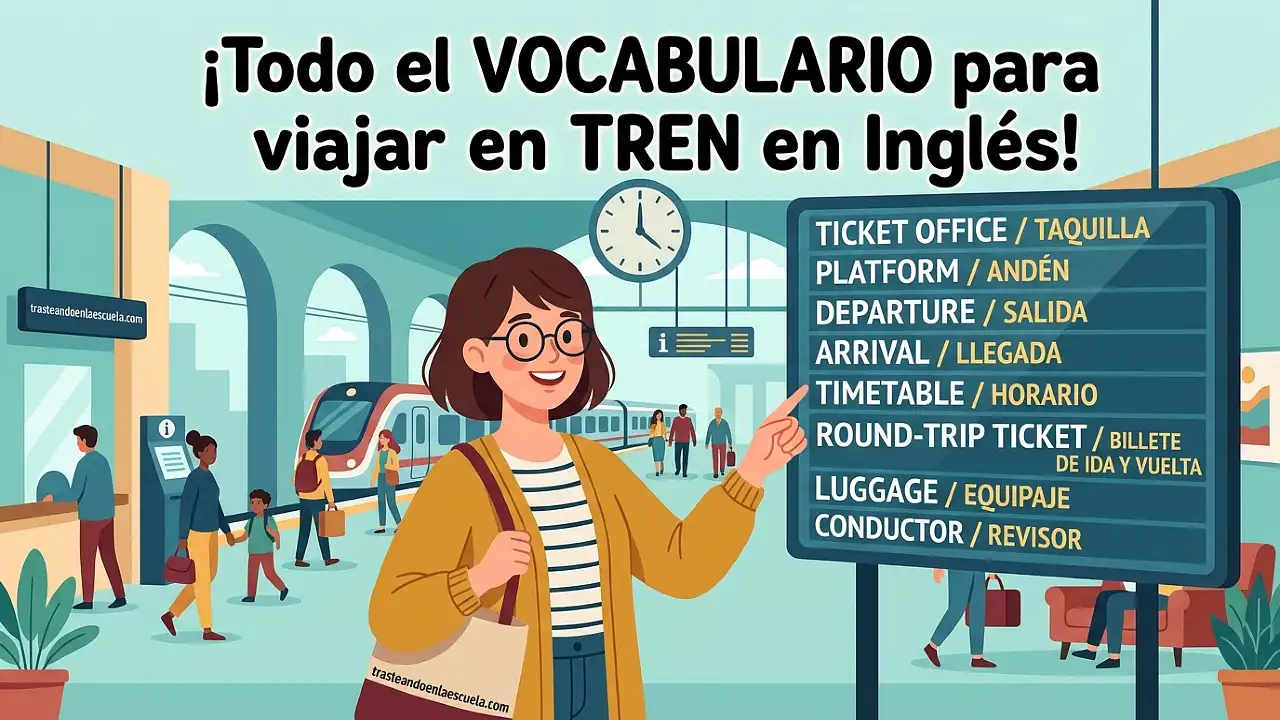
Train station: Tu guía completa para viajar en tren en inglés
Viajar en tren por Europa es una experiencia maravillosa: paisajes increíbles, comodidad y ciudades conectadas. Pero la aventura empieza en la estación, y si no entiendes los anuncios, las pantallas o no sabes cómo preguntar por tu andén, puedes perder tu tren. ¿Te ha pasado? No te preocupes más.
En este post aprenderás TODO el vocabulario y las frases que necesitas para moverte por cualquier estación de tren del mundo: desde comprar el billete hasta encontrar tu andén, entender los retrasos y pedir información.
🎯 En este post aprenderás: Tipos de tren (high-speed, regional, sleeper), partes de la estación (platform, concourse, ticket office), vocabulario del billete (single, return, open ticket), frases para preguntar horarios y andenes, diálogos reales en taquilla y en el andén, y 5 ejercicios interactivos.
🔍 Tipos de tren: ¿cuál vas a coger?
🚄 Clasificación de trenes en inglés
⚡ High-speed train
Tren de alta velocidad. Ejemplos: Eurostar, AVE, TGV, Frecciarossa.
Ejemplo: «The high-speed train from London to Paris takes just 2 hours and 15 minutes.»
🏙️ Regional / local train
Tren regional o de cercanías. Para distancias cortas, para en todas las estaciones.
Ejemplo: «Take the regional train to get to the small town.»
🛌 Night train / sleeper train
Tren nocturno con literas (sleeping berths). Ideal para ahorrar tiempo y hotel.
Ejemplo: «We took the night train from Vienna to Venice.»
🚇 Commuter train
Tren de cercanías (como Cercanías en España o S-Bahn en Alemania).
Ejemplo: «The commuter train connects the airport to the city center.»
📋 Partes de la estación de tren (train station)
| Español | English | Descripción |
|---|---|---|
| Estación de tren | Train station / railway station | El edificio principal |
| Vestíbulo principal | Main concourse / main hall | Área central con pantallas y tiendas |
| Andén | Platform | Donde se sube al tren (ej: platform 5) |
| Vía | Track | Los raíles (a veces se usa igual que platform) |
| Salida | Exit / way out | Para salir de la estación |
| Entrada | Entrance | Para entrar a la estación |
| Español | English | Descripción |
|---|---|---|
| Taquilla | Ticket office / booking office | Donde comprar billetes con personal |
| Máquina expendedora | Ticket machine / ticket vending machine | Compra automática de billetes |
| Ventanilla de información | Information desk | Para preguntar dudas |
| Torno / barrera | Ticket barrier / ticket gate | Donde escaneas el billete |
| Validador | Ticket validator | Máquina para sellar billetes sin hora fija |
| Español | English | Descripción |
|---|---|---|
| Andén 1 | Platform 1 / Track 1 | Número del andén |
| Cambio de andén | Platform change | Cuando el tren cambia de andén |
| Subir al tren | Board the train | Entrar al tren |
| Bajar del tren | Get off / alight | Salir del tren |
| Subir/ bajar escaleras | Stairs / escalator / elevator | Para cambiar de andén |
| Español | English | Descripción |
|---|---|---|
| Consigna | Left luggage / luggage storage | Guardar maletas por horas |
| Baños | Toilets / restrooms | Normalmente de pago |
| Cafetería | Café / refreshment stand | Para comprar comida y bebida |
| Sala de espera | Waiting room / lounge | Esperar con asientos cómodos |
| Oficina de objetos perdidos | Lost and found | Si olvidas algo en el tren |
🎟️ Tipos de billetes de tren (train tickets)
No todos los billetes son iguales. Elegir el correcto puede ahorrarte dinero y dolores de cabeza.
🎫 Single / one-way ticket
Billete de ida (solo un trayecto).
Ejemplo: «A single ticket to Manchester, please.»
🔄 Return / round-trip ticket
Billete de ida y vuelta (más económico que dos singles).
Ejemplo: «I’d like a return ticket to Edinburgh.»
📅 Open ticket / flexible ticket
Billete sin fecha fija (válido por cierto tiempo).
Ejemplo: «I need an open return ticket for up to one month.»
👥 Group ticket
Billete de grupo (descuento para 4+ personas).
Ejemplo: «We’re a group of 5. Is there a group discount?»
🧒 Child / youth ticket
Billete infantil o joven (descuento para menores de cierta edad).
Ejemplo: «My son is 12 years old. Does he need a child ticket?»
🎓 Student ticket
Billete de estudiante (con descuento, requiere identificación).
Ejemplo: «Do you offer student discounts with an ISIC card?»
💡 Diferencias importantes: En Reino Unido, «return ticket» significa ida y vuelta. En Estados Unidos se dice «round-trip ticket». En Europa continental, «single ticket» es billete sencillo. Además, muchos trenes de alta velocidad requieren reservation compulsory (reserva obligatoria), no basta con tener un billete general.
🕐 Horarios y pantallas de información
Las pantallas de la estación (departure boards) muestran información clave. Aprende a leerlas:
| Time | Train | Destination | Platform | Status |
|---|---|---|---|---|
| 10:15 | AVE 034 | Madrid Atocha | 3 | On time |
| 10:30 | Eurostar 9123 | Paris Gare du Nord | 7 | Boarding |
| 10:45 | Regional 452 | Valencia | 2 | Delayed 20 min |
| 11:00 | ICE 722 | Frankfurt Hbf | 5 | Cancelled |
📢 Vocabulario de las pantallas:
- On time – En hora / puntual
- Delayed / late – Retrasado
- Cancelled – Cancelado
- Boarding – Embarque / subida al tren (ya se puede entrar)
- Final call – Última llamada (el tren está a punto de salir)
- Platform change – Cambio de andén (¡corre!)
- From platform – Desde andén
- Calling at… – Para en… (lista de estaciones intermedias)
🎤 Diálogos reales en la estación de tren
You (Y): «Hello. I’d like to buy a ticket to Brighton, please.»
Clerk (C): «Single or return?»
Y: «Return, please. I’m coming back tomorrow.»
C: «That will be £45. Do you have a railcard?»
Y: «No, I don’t.»
C: «No problem. What time would you like to travel?»
Y: «The next train, please.»
C: «The next train to Brighton is at 10:30 AM from platform 4. Here’s your ticket. The return is open for one month.»
Y: «Thank you. Which platform do I need?»
C: «Platform 4. The train is on time. Have a good trip!»
🔑 Vocabulario clave: Railcard (tarjeta de descuento de tren en Reino Unido), open return (vuelta abierta/flexible).
You (Y): «Excuse me, could you tell me which platform the train to Manchester is on?»
Passerby (P): «I think it’s platform 8, but check the departure board to be sure.»
Y: «Thank you. And do you know if it’s on time?»
P: «I heard there’s a delay due to signal problems. It might be 15 minutes late.»
Y: «Oh, I see. Is there a waiting room near platform 8?»
P: «Yes, there’s a small lounge next to the coffee shop.»
Y: «Perfect. Thanks for your help!»
Announcement (A): «Attention passengers for the 11:45 service to Edinburgh. This train is now arriving at platform 6. Please stand behind the yellow line.»
You (Y) to another passenger: «Excuse me, is this the train to Edinburgh?»
Passenger: «Yes, it is. It says ‘Edinburgh’ on the front of the train.»
Y: «Great. Does this carriage have luggage space?»
Passenger: «Yes, at the end of each carriage. There are also overhead racks.»
Y: «Thank you. Do you know if this train has a dining car?»
Passenger: «I think so. Carriage 4 has a café.»
Y: «Perfect. Enjoy your trip!»
🛄 En el tren: vagones, asientos y servicios
Una vez dentro del tren, necesitas más vocabulario para encontrar tu asiento, guardar el equipaje o ir al baño.
| Español | English | Ejemplo |
|---|---|---|
| Vagón | Carriage / coach / car | «The dining carriage is at the front.» |
| Asiento reservado | Reserved seat | «I have a reserved seat in carriage B, seat 24.» |
| Asiento libre | Unreserved seat / free seat | «This seat is free. You can sit here.» |
| Ventana | Window seat | «I prefer a window seat to see the landscape.» |
| Pasillo | Aisle seat | «An aisle seat is better for stretching your legs.» |
| Portaequipajes superior | Overhead rack / luggage rack | «Put your small bag on the overhead rack.» |
| Zona de equipaje grande | Luggage area / baggage storage | «Large suitcases go in the luggage area near the doors.» |
| Baño | Toilet / restroom | «The toilet is at the end of the carriage.» |
| Servicio de comedor | Dining car / restaurant car / buffet car | «Let’s get a coffee at the buffet car.» |
| Revisor | Ticket inspector / conductor | «The conductor will check your ticket.» |
📊 Tabla resumen: Las 40 palabras imprescindibles del tren
| Español | English | Frase de ejemplo |
|---|---|---|
| Billete | Ticket | «I lost my ticket. Can I buy a new one?» |
| Ida | Single / one-way | «A single ticket to Bristol, please.» |
| Ida y vuelta | Return / round-trip | «How much is a return ticket to Oxford?» |
| Andén | Platform | «The train to Cardiff leaves from platform 2.» |
| Vía | Track | «The train is on track 7.» |
| Horario | Timetable / schedule | «Where can I find the train timetable?» |
| Retraso | Delay | «There is a 30-minute delay due to engineering works.» |
| Cancelado | Cancelled | «The 8:15 train has been cancelled.» |
| Puntual | On time | «The train is on time today.» |
| Transbordo | Transfer / change | «You need to change trains at Birmingham.» |
| Conexión | Connection | «I have a 10-minute connection in York.» |
| Estación | Station / stop | «The next stop is Manchester Piccadilly.» |
| Ventana de información | Information desk | «Ask at the information desk for help.» |
| Máquina de billetes | Ticket machine | «The ticket machine only takes cards.» |
| Descuento | Discount | «Do you have a discount for seniors?» |
| Primera clase | First class | «First class tickets include a free drink.» |
| Segunda clase | Standard class / second class | «Standard class is perfectly comfortable.» |
| Litera | Berth / sleeper | «I booked a sleeper berth on the night train.» |
| Suplemento | Supplement / surcharge | «There is a small supplement for high-speed trains.» |
| Ventana de embarque | Ticket barrier | «Scan your ticket at the barrier.» |
🧪 5 Ejercicios prácticos para dominar el vocabulario del tren
Ejercicio 1: Elige la palabra correcta
Completa con: platform / return / single / delayed / ticket machine
- I need a ___________ ticket to London because I’m not coming back.
- The train is ___________ by 15 minutes due to bad weather.
- Which ___________ does the train to Edinburgh leave from?
- The ___________ isn’t working. I’ll have to buy my ticket at the office.
- I’d like a ___________ ticket. I’ll come back tomorrow.
✅ Ver solución
- single
- delayed
- platform
- ticket machine
- return
Ejercicio 2: Traduce las siguientes frases al inglés
- ¿De qué andén sale el tren para Liverpool?
- ¿Este tren para en todas las estaciones?
- ¿Dónde puedo guardar mi maleta grande?
- ¿Hay descuento para estudiantes?
- El tren tiene 20 minutos de retraso.
✅ Ver solución
- Which platform does the train to Liverpool leave from?
- Does this train stop at all stations?
- Where can I store my large suitcase?
- Is there a student discount?
- The train is 20 minutes late / delayed.
Ejercicio 3: ¿Verdadero o falso?
- «Single ticket» significa billete de ida y vuelta.
- «Platform» es el andén donde subes al tren.
- «Delayed» significa que el tren está en hora.
- «Ticket barrier» es la máquina expendedora de billetes.
- «Left luggage» es un servicio para guardar maletas.
✅ Ver solución
- Falso – Single ticket es solo ida. Return es ida y vuelta.
- Verdadero
- Falso – Delayed significa retrasado. On time significa en hora.
- Falso – Ticket barrier es el torno. Ticket machine es la máquina.
- Verdadero – Left luggage / luggage storage es consigna.
Ejercicio 4: Ordena el diálogo en la taquilla
- Clerk: «Single or return?»
- You: «Thank you. Which platform?»
- You: «Return, please. I’m coming back next week.»
- Clerk: «Platform 5. The train is on time. Have a good trip!»
- Clerk: «That will be £35.»
- You: «Hello. A ticket to Cambridge, please.»
✅ Ver solución
Orden correcto: (6) – (1) – (3) – (5) – (2) – (4)
Ejercicio 5: Completa el texto con las palabras del recuadro
Palabras: ticket / platform / delayed / carriage / overhead rack / conductor / connection
Yesterday I took the train from London to Edinburgh. I bought my ____________ online. When I arrived at the station, I checked the departure board. My train was ____________ by 10 minutes, so I waited on ____________ 9. When the train arrived, I found my ____________ and put my small bag on the ____________. The ____________ checked my ticket during the journey. I had a short ____________ in York, but I made it on time.
✅ Ver solución
Yesterday I took the train from London to Edinburgh. I bought my ticket online. When I arrived at the station, I checked the departure board. My train was delayed by 10 minutes, so I waited on platform 9. When the train arrived, I found my carriage and put my small bag on the overhead rack. The conductor checked my ticket during the journey. I had a short connection in York, but I made it on time.
✅ Checklist antes de subir al tren
- Ticket impreso o en el móvil (y comprobado que es para el día correcto)
- Saber el número de andén (platform) y la hora de salida
- Confirmar si el tren para en tu estación (directo o con transbordo)
- Llevar algo de comida/agua (no todos los trenes tienen buffet car)
- Cargador de móvil (algunos trenes tienen enchufes)
- Número de reserva de asiento (si aplica)
📚 Sigue preparando tu viaje
Ya dominas el tren. Ahora completa tu preparación para viajar:
- Airport: vocabulario completo del aeropuerto – Para vuelos internacionales.
- Hotel: reservas y check-in – Dónde dormir sin estrés.
- Frases para turistas: guía de conversación – Para hablar con locales.
- Visitas turísticas: cómo preguntar y entender – Disfruta de cada ciudad.
- Pedir y dar direcciones en inglés – Para encontrar la estación.






Publicar comentario