Tourist phrases: 100+ frases esenciales para turistas en inglés
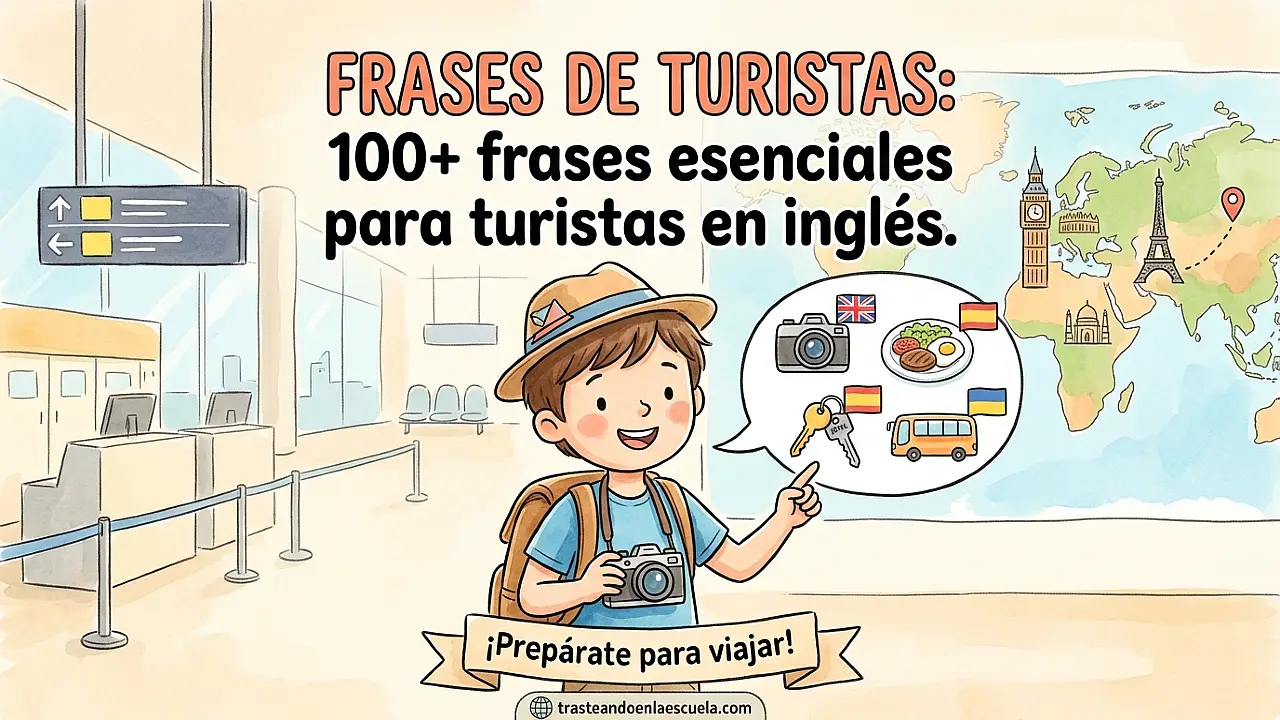
Tourist phrases: 100+ frases esenciales para sobrevivir como turista en inglés
Llegas a Londres, Nueva York o Dublín. Estás emocionado, pero de repente te das cuenta de que no sabes cómo pedir una mesa en un restaurante, preguntar dónde está el baño o pedir ayuda en una emergencia. La barrera del idioma puede convertir unas vacaciones soñadas en una fuente de estrés constante.
Pero no te preocupes: he recopilado las 100 frases más útiles para turistas, organizadas por situaciones reales. No necesitas un nivel avanzado. Con estas frases, podrás comer, comprar, moverte y pedir ayuda en cualquier país de habla inglesa.
🎯 En este post aprenderás: Frases para el aeropuerto y transporte, en el restaurante y cafetería, de compras, para emergencias, en el hotel, para pedir direcciones, diálogos completos y 5 ejercicios interactivos.
🔍 Frases de cortesía: la base de todo
💬 Las palabras mágicas
🙏 Saludos básicos
- Hello / Hi – Hola
- Good morning – Buenos días (hasta el mediodía)
- Good afternoon – Buenas tardes (12-18h)
- Good evening – Buenas noches (al llegar)
- Good night – Buenas noches (al irse a dormir)
🎩 Cortesía
- Please – Por favor
- Thank you / Thanks – Gracias
- You’re welcome – De nada
- Excuse me – Disculpe (para preguntar o pedir paso)
- I’m sorry – Lo siento
🤝 Presentaciones
- My name is… – Me llamo…
- Nice to meet you – Encantado/a de conocerte
- Where are you from? – ¿De dónde eres?
- I’m from Spain – Soy de España
🚕 Transporte y direcciones
Ya sea en taxi, autobús, metro o preguntando a un peatón, estas frases te ayudarán a llegar a donde necesitas.
| Situación | Frases en inglés | Traducción |
|---|---|---|
| Pedir direcciones | «Excuse me, where is the nearest tube station?» «How do I get to the British Museum?» «Is it far from here?» «Can you show me on the map?» |
«Disculpe, ¿dónde está la estación de metro más cercana?» «¿Cómo llego al Museo Británico?» «¿Está lejos de aquí?» «¿Puede mostrarme en el mapa?» |
| En el taxi | «Could you take me to this address, please?» «How much will it cost to get to the airport?» «Please turn left/right here.» «Keep the change.» |
«¿Podría llevarme a esta dirección, por favor?» «¿Cuánto costará ir al aeropuerto?» «Gire a la izquierda/derecha aquí, por favor.» «Quédese con el cambio.» |
| En el autobús / metro | «Which bus goes to the city center?» «How many stops until Oxford Street?» «Do I need to change buses?» «Is this seat taken?» |
«¿Qué autobús va al centro?» «¿Cuántas paradas faltan para Oxford Street?» «¿Necesito cambiar de autobús?» «¿Este asiento está ocupado?» |
🍽️ En el restaurante y cafetería
Comer fuera es una de las mejores partes de viajar. Con estas frases podrás pedir como un profesional.
📝 Para entrar y pedir mesa
- «A table for two, please.»
- «Do you have a free table?»
- «I have a reservation under the name García.»
- «How long is the wait?»
🍽️ Pedir comida
- «Can I see the menu, please?»
- «What do you recommend?»
- «I’d like the steak, please.»
- «Does this dish contain nuts/gluten?»
🥤 Bebidas
- «A glass of water, please.»
- «I’d like a cappuccino.»
- «What beers do you have on tap?»
- «The bill, please.» (check, please en US)
⚠️ Problemas y alergias
- «I’m allergic to seafood.»
- «This is not what I ordered.»
- «Can I have this to go?» (para llevar)
- «Is service charge included?»
🍕 Diálogo completo en un restaurante:
You: «Good evening. A table for two, please.»
Waiter: «Of course. Follow me. Here’s your menu. Can I get you any drinks to start?»
You: «Yes, a glass of red wine and a sparkling water, please.»
Waiter: «Are you ready to order?»
You: «I’d like the pasta carbonara, please. Does it contain cream?»
Waiter: «No, it’s traditional with eggs and cheese.»
You: «Perfect. And for my friend, the grilled salmon.»
Waiter: «Excellent. Would you like dessert?»
You: «No, just the bill, please. And can we have it to go? We’re in a hurry.»
Waiter: «Sure. I’ll bring it right away.»
🛍️ De compras (Shopping)
¿Quieres comprar recuerdos, ropa o simplemente mirar? Aquí tienes las frases clave.
| Frases en inglés | Traducción |
|---|---|
| «How much is this?» «How much does this cost?» | «¿Cuánto cuesta esto?» |
| «Do you have this in a different size/color?» | «¿Tiene esto en otra talla/color?» |
| «Can I try it on?» «Where is the fitting room?» | «¿Puedo probármelo?» «¿Dónde está el probador?» |
| «I’m just looking, thank you.» | «Solo estoy mirando, gracias.» |
| «Do you accept credit cards?» «Can I pay by card?» | «¿Aceptan tarjetas de crédito?» «¿Puedo pagar con tarjeta?» |
| «Is there a discount if I buy two?» | «¿Hay descuento si compro dos?» |
| «Can I have a receipt, please?» | «¿Puede darme un recibo, por favor?» |
| «I’m looking for a souvenir.» | «Busco un recuerdo.» |
💡 Propina de compras: En muchos países de habla inglesa (especialmente EE. UU. y Canadá), el precio que ves no incluye impuestos (tax). Te añadirán un sales tax del 5-10% en la caja. Pregunta: «Does the price include tax?»
🏨 En el hotel (repaso y ampliación)
Aunque ya vimos el hotel en detalle, aquí tienes un resumen de las frases más importantes para cualquier turista.
🛎️ Check-in
- «I have a reservation.»
- «Could I have a room with a view?»
- «What time is breakfast?»
- «Is Wi-Fi free?»
🛏️ Durante la estancia
- «Could I have extra towels, please?»
- «The air conditioning isn’t working.»
- «Can you recommend a good restaurant nearby?»
- «What time is check-out?»
🧾 Check-out
- «I’d like to check out, please.»
- «Can I see the final bill?»
- «Could you call a taxi for me?»
- «Can I leave my luggage here for a few hours?»
🚨 Emergencias y problemas
Nadie quiere pensar en emergencias durante un viaje, pero es mejor estar preparado. Guarda estas frases en tu memoria.
🚑 Emergencias médicas
- «I need a doctor.» – Necesito un médico.
- «Call an ambulance, please.» – Llame una ambulancia, por favor.
- «Where is the nearest hospital?» – ¿Dónde está el hospital más cercano?
- «I’ve lost my passport.» – He perdido mi pasaporte.
- «I’ve been robbed.» – Me han robado.
- «Help me, please!» – ¡Ayúdeme, por favor!
🏛️ En la farmacia
- «I have a headache / stomachache / fever.» – Tengo dolor de cabeza / estómago / fiebre.
- «Do you have something for a cold?» – ¿Tiene algo para el resfriado?
- «I need a prescription.» – Necesito una receta.
- «Is there an English-speaking pharmacist?» – ¿Hay un farmacéutico que hable inglés?
📞 Números de emergencia por país
- Reino Unido: 999 o 112
- EE. UU. y Canadá: 911
- Australia: 000
- Unión Europea (general): 112 (funciona en todos los países de la UE)
🗣️ Frases útiles para cualquier situación
📱 Frase del día (haz clic para una nueva)
📋 Tabla resumen: 50 frases rápidas por categorías
| Categoría | Frases |
|---|---|
| Cortesía | «Please / Thank you / Excuse me / I’m sorry / You’re welcome» |
| Direcciones | «Where is…? / How do I get to…? / Is it far? / Turn left/right / Go straight» |
| Restaurante | «A table for two / The menu, please / What do you recommend? / The bill, please» |
| Compras | «How much? / Do you have a different size? / Can I try it on? / I’m just looking» |
| Hotel | «I have a reservation / Check-in / Check-out / Wi-Fi password / Wake-up call» |
| Emergencias | «I need a doctor / Call an ambulance / I’ve lost my passport / Help me» |
🎤 Diálogos completos para practicar
You: «Excuse me, could you tell me how to get to the National Gallery?»
Local: «Sure. It’s about a 10-minute walk from here. Go straight down this street, then turn left at the second traffic light.»
You: «Is it far?»
Local: «No, it’s very close. You’ll see a big building with columns. That’s the National Gallery.»
You: «Thank you so much! And is there a good café nearby?»
Local: «Yes, there’s a nice one called ‘The Gallery Café’ right next to the museum.»
You: «Perfect. Thanks again!»
You: «Excuse me, do you have this shirt in a medium?»
Shop assistant: «Let me check in the back. Yes, here’s a medium. Would you like to try it on?»
You: «Yes, please. Where is the fitting room?»
Shop assistant: «It’s at the back, to your left.»
(After trying it on)
You: «It fits perfectly. How much is it?»
Shop assistant: «That’s $45. Would you like to pay by card or cash?»
You: «Card, please. Can I have a receipt?»
Shop assistant: «Of course. Here’s your receipt. Have a nice day!»
You: «Hello. I have a terrible headache. Do you have something for it?»
Pharmacist: «Yes, we have ibuprofen and paracetamol. Are you allergic to any medication?»
You: «No, I’m not. I’ll take the ibuprofen, please.»
Pharmacist: «Here you are. Take one or two every 6 to 8 hours. Do you need anything else?»
You: «Actually, I also have a sore throat. Do you have lozenges?»
Pharmacist: «Yes, these are very good. Suck on one every 4 hours.»
You: «Thank you very much. How much is that in total?»
Pharmacist: «That will be £12.50.»
🧪 5 Ejercicios prácticos para dominar las frases de turista
Ejercicio 1: Elige la frase correcta para cada situación
- Quieres pedir la cuenta en un restaurante: ______
- Necesitas que el camarero sepa que no puedes comer marisco: ______
- Te has perdido y quieres pedir ayuda: ______
- Quieres probarte una camiseta en una tienda: ______
- Has perdido tu pasaporte: ______
Opciones: «I’m lost. Can you help me?» / «The bill, please.» / «Can I try it on?» / «I’m allergic to seafood.» / «I’ve lost my passport.»
✅ Ver solución
- «The bill, please.»
- «I’m allergic to seafood.»
- «I’m lost. Can you help me?»
- «Can I try it on?»
- «I’ve lost my passport.»
Ejercicio 2: Traduce las siguientes frases al inglés
- ¿A qué hora abre el museo?
- ¿Podría llamar a un taxi para mí?
- ¿Aceptan tarjetas de crédito?
- ¿Dónde está el baño?
- Necesito un médico.
✅ Ver solución
- What time does the museum open?
- Could you call a taxi for me?
- Do you accept credit cards?
- Where is the bathroom?
- I need a doctor.
Ejercicio 3: Completa las frases con la palabra que falta
- Excuse me, how do I __________ to the train station? (get / go / arrive)
- A table __________ two, please. (for / of / to)
- Could you speak more __________, please? (slow / slowly / slower)
- I’m just __________, thank you. (looking / seeing / watching)
- What time is __________? (check-out / checkout / check out)
✅ Ver solución
- get («how do I get to…»)
- for («a table for two»)
- slowly («speak more slowly»)
- looking («I’m just looking»)
- check-out («what time is check-out?»)
Ejercicio 4: Ordena las palabras para formar la frase correcta
- the / is / station / Where / nearest / tube / ?
- recommend / you / What / do / ?
- have / passport / lost / my / I / .
- bill / please / the / , / .
- a / have / reservation / I / .
✅ Ver solución
- Where is the nearest tube station?
- What do you recommend?
- I have lost my passport.
- The bill, please.
- I have a reservation.
Ejercicio 5: Elige la respuesta más adecuada para cada pregunta
- «How much is this?» → a) «Yes, please.» b) «It’s $25.» c) «You’re welcome.»
- «Do you have a reservation?» → a) «Yes, I do.» b) «The bill, please.» c) «Turn left.»
- «What do you recommend?» → a) «I’m just looking.» b) «The steak is excellent.» c) «Where is the bathroom?»
- «Could you help me?» → a) «Of course.» b) «I’m sorry.» c) «Good morning.»
- «Is service charge included?» → a) «Yes, it is.» b) «A table for two.» c) «I’m allergic to nuts.»
✅ Ver solución
- b) «It’s $25.»
- a) «Yes, I do.»
- b) «The steak is excellent.»
- a) «Of course.»
- a) «Yes, it is.»
✅ Checklist del turista preparado
- Saber decir «please» y «thank you» (la cortesía abre todas las puertas)
- Tener a mano en el móvil las frases de emergencia (aunque no tengas internet)
- Llevar una tarjeta con la dirección de tu hotel en el idioma local
- Aprender «Do you speak Spanish?» por si acaso
- No tener miedo a equivocarse: los nativos aprecian que intentes hablar su idioma
📚 Completa tu preparación para viajar
Sigue aprendiendo inglés para viajar con estos posts relacionados:
- Airport: vocabulario completo del aeropuerto – Llegada y salida sin estrés.
- Hotel: reservas y check-in – Dónde dormir con confianza.
- Estación de tren: vocabulario esencial – Muévete en tren por Europa.
- Visitas turísticas: cómo preguntar y entender – Disfruta de los monumentos.
- Restaurante: cómo pedir comida en inglés – Para no pasar hambre.
🌟 Consejo final: La mejor manera de aprender estas frases es practicarlas en voz alta antes de viajar. Grábate, escúchate y corrígete. Cuando llegues a tu destino, notarás que muchas de ellas salen de forma natural. ¡Bon voyage!



Publicar comentario