For, Since, Already, Yet, Ever, Never: guía con ejemplos
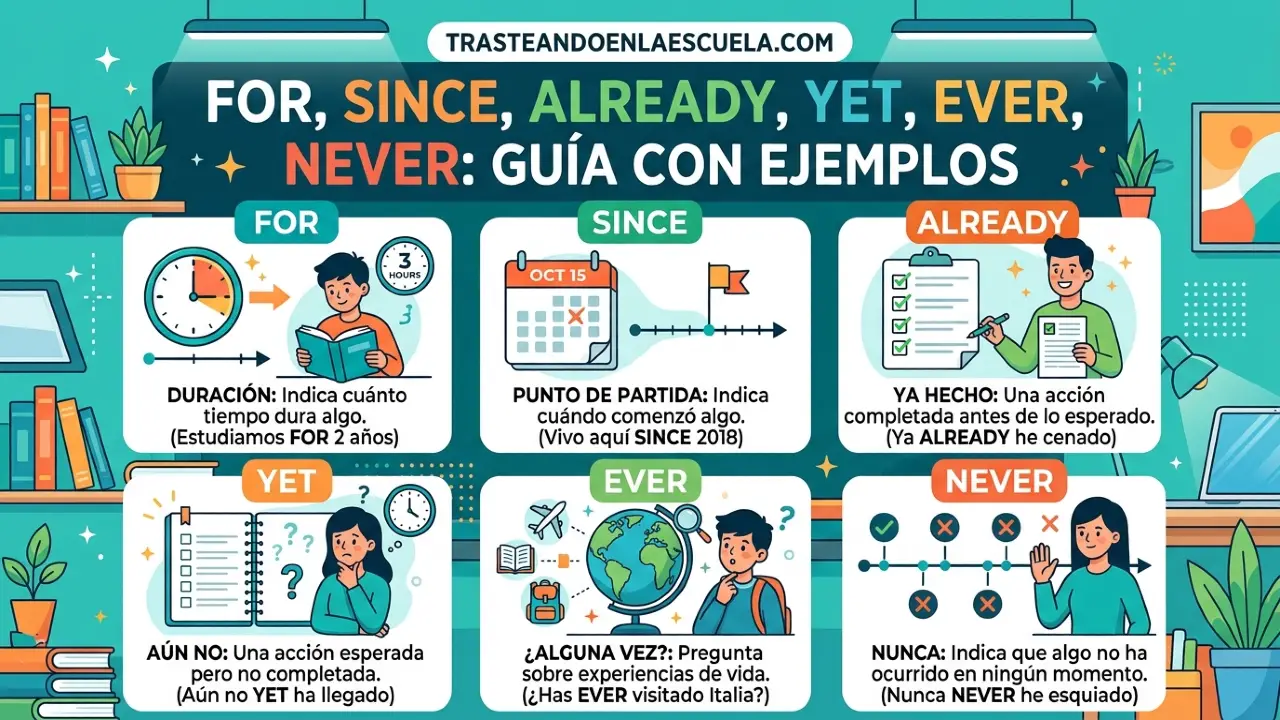
For, Since, Already, Yet, Ever, Never: Las palabras clave del Present Perfect
El Present Perfect raramente viaja solo. Siempre va acompañado de pequeños marcadores que le dan significado: ¿cuánto tiempo? (for, since), ¿cuándo? (already, yet), o si ha ocurrido alguna vez (ever, never). Dominar estas palabras es el último paso para usar el Present Perfect como un nativo.
🎯 En este post aprenderás: El significado y uso de cada uno de estos 6 marcadores, su posición exacta en la oración, ejemplos prácticos y ejercicios para no volver a confundirlos.
🔍 Los 6 marcadores explicados
1. FOR (durante / por)
Uso: Indica la duración de la acción. Se usa con un período de tiempo (años, horas, días).
Ejemplos:
- I have lived here for 10 years. (He vivido aquí durante 10 años.)
- She has been sleeping for two hours. (Ella ha estado durmiendo durante dos horas.)
Pregunta: How long have you worked here? – For three months.
2. SINCE (desde)
Uso: Indica el punto de inicio de la acción. Se usa con un momento concreto (ayer, 2005, las 5, que te conocí).
Ejemplos:
- I have lived here since 2014. (He vivido aquí desde 2014.)
- She has been sleeping since 2 pm. (Ella ha estado durmiendo desde las 2.)
- We haven’t seen each other since we left school. (No nos hemos visto desde que dejamos el colegio.)
3. ALREADY (ya)
Uso: Indica que una acción ya ha ocurrido, a menudo antes de lo esperado. Se usa en oraciones afirmativas.
Posición: Entre el auxiliar (have/has) y el participio. También puede ir al final para dar énfasis.
Ejemplos:
- I have already eaten. (Ya he comido.)
- She has already finished her homework. (Ella ya ha terminado sus deberes.)
- A: Don’t forget to call him. B: I’ve called him already. (Ya le he llamado.)
4. YET (todavía / ya)
Uso: Se usa para preguntar si una acción ya ha ocurrido, o para decir que todavía no ha ocurrido. Se coloca al final de la oración.
Ejemplos (negativa):
- I haven’t finished yet. (Todavía no he terminado.)
- She hasn’t arrived yet. (Ella no ha llegado todavía.)
Ejemplos (pregunta):
- Have you finished yet? (¿Ya has terminado?)
- Has she arrived yet? (¿Ya ha llegado ella?)
5. EVER (alguna vez)
Uso: Se usa en preguntas para preguntar sobre experiencias de vida. Significa «en algún momento de tu vida hasta ahora».
Posición: Entre el sujeto y el participio.
Ejemplos:
- Have you ever been to Japan? (¿Has estado alguna vez en Japón?)
- Has she ever tried sushi? (¿Ha probado ella el sushi alguna vez?)
- Is this the best cake you have ever eaten? (¿Es esta la mejor tarta que has comido nunca?)
6. NEVER (nunca)
Uso: Es la forma negativa de «ever». Significa que en ningún momento de tu vida has hecho algo.
Posición: Entre el auxiliar (have/has) y el participio.
Importante: En inglés, solo se usa una negación. No se dice «I haven’t never», se dice «I have never».
Ejemplos:
- I have never been to Japan. (Nunca he estado en Japón.)
- She has never tried sushi. (Ella nunca ha probado el sushi.)
- They have never seen that movie. (Ellos nunca han visto esa película.)
+ período
+ punto
Afirmación (+)
Negativa (?) / Pregunta
Pregunta (?)
Negativa (+ verbo)
📊 Tabla de posiciones en la oración
| Palabra | Tipo de oración | Posición | Ejemplo |
|---|---|---|---|
| FOR / SINCE | Afirmativa, Negativa, Pregunta | Al final (normalmente) | I’ve lived here for years. |
| ALREADY | Afirmativa | Entre have/has y participio (o final) | I’ve already done it. |
| YET | Negativa / Pregunta | Al final | I haven’t done it yet. |
| EVER | Pregunta | Entre sujeto y participio | Have you ever been? |
| NEVER | Afirmativa (con sentido negativo) | Entre have/has y participio | I have never been. |
🧪 5 Ejercicios para dominarlos
Ejercicio 1: Completa con For o Since
- I have been waiting _______________ 9 am.
- They have lived here _______________ a long time.
- She has worked at this company _______________ 2018.
- We haven’t seen each other _______________ last Christmas.
- He has been sleeping _______________ three hours.
✅ Ver solución
- I have been waiting since 9 am. (Hora concreta)
- They have lived here for a long time. (Período)
- She has worked at this company since 2018. (Año concreto)
- We haven’t seen each other since last Christmas. (Evento concreto)
- He has been sleeping for three hours. (Período)
Ejercicio 2: Completa con Already o Yet
- Have you finished your homework _______________?
- I’ve _______________ seen that film. It was great.
- She hasn’t called me _______________.
- We have _______________ booked our hotel for the trip.
- Has the train arrived _______________?
✅ Ver solución
- Have you finished your homework yet?
- I’ve already seen that film. It was great.
- She hasn’t called me yet.
- We have already booked our hotel for the trip.
- Has the train arrived yet?
Ejercicio 3: Completa con Ever o Never
- Have you _______________ tried Italian food?
- I have _______________ been to Australia. I’d love to go.
- She has _______________ driven a car. She’s scared.
- Is this the best pizza you have _______________ eaten?
- He has _______________ told a lie. He’s very honest.
✅ Ver solución
- Have you ever tried Italian food?
- I have never been to Australia. I’d love to go.
- She has never driven a car. She’s scared.
- Is this the best pizza you have ever eaten?
- He has never told a lie. He’s very honest.
Ejercicio 4: Elige la opción correcta
- I haven’t seen him _______________ (since / for) Monday.
- We have _______________ (already / yet) finished the project.
- Have you _______________ (ever / never) been to a rock concert?
- She’s _______________ (already / yet) eaten lunch.
- They have lived here _______________ (since / for) ten years.
✅ Ver solución
- I haven’t seen him since Monday.
- We have already finished the project.
- Have you ever been to a rock concert?
- She’s already eaten lunch.
- They have lived here for ten years.
Ejercicio 5: Traduce las frases al inglés
- ¿Has terminado ya? – No, todavía no.
- Nunca he probado el sushi.
- Vivo en Madrid desde 2015.
- Ya he visto esa película.
- ¿Has estado alguna vez en París?
✅ Ver solución
- Have you finished yet? – No, I haven’t finished yet. / Not yet.
- I have never tried sushi.
- I have lived in Madrid since 2015.
- I have already seen that movie.
- Have you ever been to Paris?
📚 Serie completa: Present Perfect
- Present Perfect: guía completa – Empieza desde el principio.
- Present Perfect vs Past Simple – La comparación básica.
- Present Perfect Continuous: usos y estructura – La forma continua.
- For, Since, Already, Yet, Ever, Never – ¡Estás aquí!
- Ejercicios present perfect con soluciones – Para practicar todo junto.
🎯 Truco visual: Imagina una línea de tiempo. Since es el punto de inicio. For es la distancia desde ese punto hasta ahora. Already es una marca de que algo pasó antes de lo esperado. Yet es un interrogante al final de la línea preguntando si algo ha pasado. Ever es un interrogante que recorre toda la línea de vida. Never es una X que dice que nada ha ocurrido en esa línea.






Publicar comentario