Third Conditional: usos, estructura y ejemplos en inglés
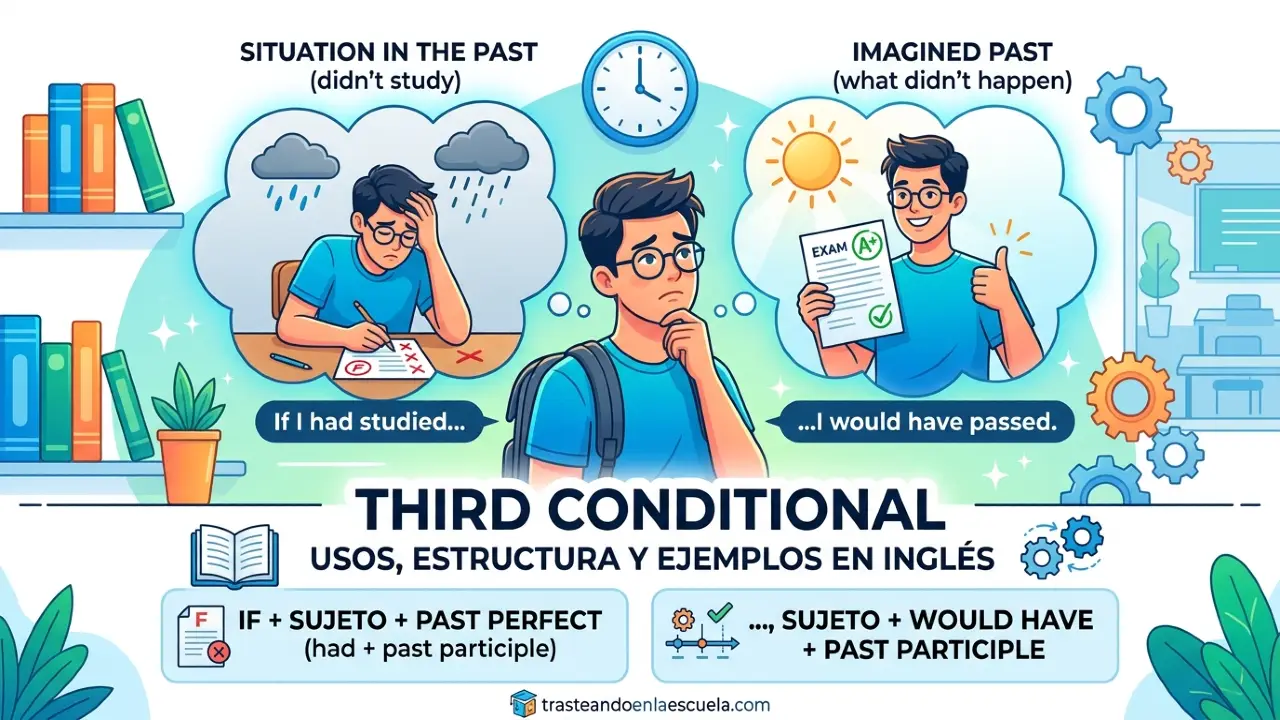
Third Conditional: El condicional del «y si hubiera…»
¿Alguna vez has pensado «y si hubiera estudiado más», «si no hubiera dicho eso» o «si hubiera llegado antes»? Todos tenemos arrepentimientos, críticas del pasado y situaciones que ya no podemos cambiar. Para expresar exactamente eso en inglés, existe el Third Conditional (tercer condicional). Es el condicional que nos permite viajar mentalmente al pasado e imaginar cómo podrían haber sido las cosas de otra manera.
🎯 En este post aprenderás: La estructura del tercer condicional (If + Past Perfect, would have + participio pasado), cuándo usarlo (arrepentimientos, críticas, alivio por cosas que no pasaron), la pronunciación de las contracciones (I’d have, I would’ve), la diferencia clave con el segundo condicional, y más de 25 ejemplos con ejercicios prácticos.
🔍 ¿Qué es el Third Conditional?
🔄 La fórmula de lo que pudo ser y no fue
IF + SUJETO + HAD + PARTICIPIO , SUJETO + WOULD HAVE + PARTICIPIO
Traducción: SI + [hubiera/hubiese + participio], [habría + participio]
Significado: Si hubiera ocurrido X en el pasado, entonces habría ocurrido Y (pero nada de esto ocurrió realmente).
📅 Línea temporal del Third Conditional
PASADO REAL → PRESENTE (ARREPENTIMIENTO)
If I had studied (pero NO estudié) | I would have passed the exam (pero NO aprobé).
La condición y el resultado son IMPOSIBLES porque el pasado ya ocurrió.
Analogía de la máquina del tiempo: El tercer condicional es como tener una máquina del tiempo mental. No puedes cambiar el pasado, pero puedes imaginar cómo sería diferente si hubieras hecho algo distinto. «If I had left earlier, I wouldn’t have missed the train.» (Si hubiera salido antes, no habría perdido el tren).
🎬 La analogía del «what if…» en las películas
🎞️ CONDICIÓN (pasado irreal)
- Español: Si hubiera aceptado el papel…
- Inglés: If I had accepted the role…
- Tiempo verbal: Past Perfect (had + participio)
- Realidad: No acepté el papel
🏆 RESULTADO (pasado imaginario)
- Español: …habría ganado un Oscar.
- Inglés: …I would have won an Oscar.
- Tiempo verbal: would have + participio
- Realidad: No gané el Oscar
Todo ocurre en nuestra imaginación, porque el pasado ya está escrito.
📋 Estructura detallada del Third Conditional
🎯 Fórmula general
🔨 Construcción paso a paso
1. La cláusula condicional (la condición irreal en el pasado)
- Siempre comienza con If (si).
- El verbo va en Past Perfect (had + participio pasado).
- Describe una acción que NO ocurrió en el pasado.
- Se puede contraer: I’d, you’d, he’d, she’d, we’d, they’d.
- Ejemplo: If I had studied medicine… (Si hubiera estudiado medicina…)
2. La cláusula principal (el resultado irreal en el pasado)
- Expresa la consecuencia imaginaria en el pasado.
- Se forma con would have + participio pasado.
- Se puede contraer: I’d have, you’d have, o I would’ve, you would’ve.
- También se pueden usar could have (habría podido) o might have (podría haber quizá).
- Si la condición va primero, se separa con una coma.
- Ejemplo: …I would have been a doctor. (…habría sido médico.)
✍️ Ejemplos de estructura
If + had + participio, + would have + participio.
If I had known the answer, I would have told you.
(Si hubiera sabido la respuesta, te habría dicho.)
Resultado + if + had + participio.
I would have told you if I had known the answer.
(Te habría dicho si hubiera sabido la respuesta.)
📢 Contracciones y pronunciación
| Forma completa | Contracción escrita | Pronunciación (coloquial) |
|---|---|---|
| I had studied | I’d studied | Aid stud-ied |
| I would have gone | I’d have gone / I would’ve gone | I-dav gon / I-wuda-v gon |
| You would have seen | You’d have seen / You would’ve seen | Yudav seen / Yu-wuda-v seen |
| They would not have come | They wouldn’t have come | They-wudent-av cam |
⚠️ Puntos clave sobre la estructura
| Regla | Correcto | Incorrecto |
|---|---|---|
| Past Perfect en la condición | If I had seen him… | If I saw him… (eso es 2º condicional) |
| NO «would have» en la cláusula if | If I had known, I would have gone. | If I would have known, I would have gone. |
| «Would have» + participio en resultado | I would have called you. | I would called you. |
| Coma solo si «If» va primero | If I had seen you, I would have said hi. I would have said hi if I had seen you. |
If I had seen you I would have said hi. (sin coma) |
| Forma negativa | If I hadn’t forgotten my keys, I wouldn’t have been locked out. | If I not had forgotten… |
💡 Truco para recordar: El tercer condicional siempre habla del pasado. Piensa en «had» (pasado perfecto) + «would have» (pasado imaginario). Si ves «had» y «have» juntos, probablemente es third conditional: «If I had known, I would have acted differently.»
🌍 Usos del Third Conditional
1️⃣ Arrepentimientos (cosas que nos gustaría haber hecho diferente)
El uso más común es expresar arrepentimiento por acciones pasadas o por cosas que no hicimos.
😔 Ejemplos de arrepentimientos:
- If I had studied harder, I would have passed the exam. (Si hubiera estudiado más, habría aprobado el examen.)
- I would have told her the truth if I had known she was upset. (Le habría dicho la verdad si hubiera sabido que estaba molesta.)
- If we had left earlier, we wouldn’t have missed the flight. (Si hubiéramos salido antes, no habríamos perdido el vuelo.)
- She would have become a doctor if she had finished medical school. (Ella se habría convertido en doctora si hubiera terminado la facultad de medicina.)
2️⃣ Críticas constructivas (o no tan constructivas) sobre el pasado
Para señalar errores pasados de otros (o de nosotros mismos) y cómo podrían haberse evitado.
👆 Ejemplos de críticas:
- If you had listened to my advice, you wouldn’t have made that mistake. (Si hubieras escuchado mi consejo, no habrías cometido ese error.)
- You could have avoided the traffic if you had taken the subway. (Podrías haber evitado el tráfico si hubieras tomado el metro.)
- If they had invested in that company, they would have made a fortune. (Si hubieran invertido en esa empresa, habrían hecho una fortuna.)
- He wouldn’t have lost his job if he hadn’t been so careless. (No habría perdido su trabajo si no hubiera sido tan descuidado.)
3️⃣ Alivio por cosas que NO ocurrieron
También podemos usar el tercer condicional para expresar alivio de que algo malo no sucedió gracias a una acción.
😅 Ejemplos de alivio:
- If I hadn’t taken my umbrella, I would have gotten soaked. (Si no hubiera llevado mi paraguas, me habría empapado.)
- We would have crashed if you hadn’t braked in time. (Habríamos chocado si no hubieras frenado a tiempo.)
- She would have missed the party if I hadn’t reminded her. (Ella se habría perdido la fiesta si no le hubiera recordado.)
- If the doctor hadn’t arrived quickly, the patient would have died. (Si el doctor no hubiera llegado rápido, el paciente habría muerto.)
4️⃣ Explicar resultados pasados (causa-efecto en pasado)
Para explicar por qué ocurrió algo en el pasado, imaginando cómo sería diferente si la causa hubiera sido otra.
🔍 Ejemplos explicativos:
- The cake would have been better if you had added more sugar. (El pastel habría estado mejor si hubieras añadido más azúcar.)
- If the weather had been nice, we would have had the party in the garden. (Si el tiempo hubiera sido bueno, habríamos tenido la fiesta en el jardín.)
- The team would have won if the goalkeeper hadn’t been injured. (El equipo habría ganado si el portero no se hubiera lesionado.)
- If I had known it was your birthday, I would have bought you a present. (Si hubiera sabido que era tu cumpleaños, te habría comprado un regalo.)
🔄 Variaciones: «Could have» y «Might have» en Third Conditional
Al igual que en el segundo condicional, podemos usar «could have» (habría podido) y «might have» (podría haber) en lugar de «would have» para matizar el significado.
| Modal | Significado | Ejemplo |
|---|---|---|
| Would have | Resultado seguro en el pasado imaginario | If I had seen her, I would have said hello. (seguro que lo habría hecho) |
| Could have | Habilidad o posibilidad en el pasado | If I had studied, I could have passed. (habría tenido la capacidad) |
| Might have | Posibilidad incierta en el pasado | If I had invited him, he might have come. (quizá habría venido, no es seguro) |
📝 Ejemplos con modales:
- If we had saved more money, we could have bought a house. (Si hubiéramos ahorrado más dinero, habríamos podido comprar una casa.)
- She could have become a famous singer if she had continued singing. (Ella habría podido convertirse en una cantante famosa si hubiera seguido cantando.)
- If you had asked me, I might have helped you. (Si me hubieras preguntado, podría haberte ayudado – quizá, no estoy seguro.)
- The accident might have been avoided if the driver had been more careful. (El accidente podría haberse evitado si el conductor hubiera sido más cuidadoso.)
📊 Comparación: Second vs Third Conditional
| Aspecto | Second Conditional | Third Conditional |
|---|---|---|
| Estructura | If + Past Simple, would + infinitivo | If + Past Perfect, would have + participio |
| Tiempo real | Presente o Futuro (imaginario) | Pasado (ya ocurrió o no ocurrió) |
| Posibilidad | Todavía podría ocurrir (aunque improbable) | Imposible, el pasado no se puede cambiar |
| Ejemplo | If I won the lottery, I would travel. (aún puedo ganarla) | If I had won the lottery, I would have traveled. (ya no la gané, el sorteo pasó) |
| Pregunta clave | ¿Es algo que aún podría pasar? | ¿Es algo que ya no puede cambiar? |
| Uso típico | Sueños, consejos, situaciones hipotéticas | Arrepentimientos, críticas de algo ya pasado |
🎯 Truco para diferenciarlos: Si puedes añadir «ahora» o «en el futuro», es segundo condicional. Si puedes añadir «ayer» o «la semana pasada», es tercer condicional. Ejemplo: «If I had money…» (ahora – 2nd) vs «If I had had money…» (ayer – 3rd).
🧪 5 Ejercicios prácticos para dominar el Third Conditional
Ejercicio 1: Completa las oraciones
Completa las siguientes oraciones con la forma correcta del verbo entre paréntesis.
- If I __________ (know) you were coming, I __________ (bake) a cake.
- She __________ (not/get) lost if she __________ (take) a map.
- If we __________ (arrive) earlier, we __________ (get) better seats.
- He __________ (pass) the driving test if he __________ (practice) more.
- If you __________ (tell) me the truth, I __________ (not/be) angry.
✅ Ver solución
- If I had known you were coming, I would have baked a cake.
- She wouldn’t have gotten lost if she had taken a map.
- If we had arrived earlier, we would have gotten better seats.
- He would have passed the driving test if he had practiced more.
- If you had told me the truth, I wouldn’t have been angry.
Recuerda: Condición = Past Perfect (had + participio). Resultado = would have + participio.
Ejercicio 2: Elige la opción correcta
Selecciona la opción que completa correctamente cada oración.
- If I __________ you were sick, I would have visited you.
a) knew / b) had known / c) have known - We would have won the match if the referee __________ fair.
a) had been / b) would have been / c) was - If she had studied more, she __________ the exam.
a) would pass / b) would have passed / c) passed - I __________ you if I had known it was your birthday.
a) would have called / b) would call / c) called - If they hadn’t missed the bus, they __________ late for work.
a) wouldn’t be / b) wouldn’t have been / c) weren’t
✅ Ver solución
- b) had known – If I had known you were sick, I would have visited you.
- a) had been – We would have won the match if the referee had been fair.
- b) would have passed – If she had studied more, she would have passed the exam.
- a) would have called – I would have called you if I had known it was your birthday.
- b) wouldn’t have been – If they hadn’t missed the bus, they wouldn’t have been late for work.
Ejercicio 3: Reordena las palabras
Ordena las palabras para formar oraciones correctas en tercer condicional.
- if / i / had / would / have / seen / i / you / said / hello
- she / if / the / job / would / have / applied / she / got / had
- we / if / had / wouldn’t / the / train / have / we / missed / run
- you / if / had / what / done / would / have / you / seen / the / accident
- i / if / had / been / would / have / you / i / done / the / same
✅ Ver solución
- I would have said hello if I had seen you. / If I had seen you, I would have said hello.
- She would have got the job if she had applied. / If she had applied, she would have got the job.
- We wouldn’t have missed the train if we had run. / If we had run, we wouldn’t have missed the train.
- What would you have done if you had seen the accident?
- If I had been you, I would have done the same.
Nota: «If I had been you» es la forma correcta en tercer condicional, equivalente a «If I were you» en segundo condicional.
Ejercicio 4: Traduce al inglés
Traduce las siguientes oraciones al inglés usando el tercer condicional.
- Si hubiera sabido que necesitabas ayuda, te habría ayudado.
- No habría comprado este coche si hubiera sabido que era tan caro de mantener.
- Si hubiéramos salido a tiempo, no habríamos perdido el avión.
- ¿Qué habrías hecho si te hubieras encontrado un millón de euros?
- Ella habría sido una gran actriz si hubiera seguido actuando.
✅ Ver solución
- If I had known you needed help, I would have helped you.
- I wouldn’t have bought this car if I had known it was so expensive to maintain.
- If we had left on time, we wouldn’t have missed the plane.
- What would you have done if you had found a million euros?
- She would have been a great actress if she had continued acting.
Nota: «Mantener» un coche se dice «maintain».
Ejercicio 5: Completa con tus propias ideas
Completa las siguientes oraciones de manera lógica usando el tercer condicional.
- If I had been born in a different country, ____________________.
- I would have learned to play the guitar if ____________________.
- If I hadn’t met my best friend, ____________________.
- My life would have been very different if ____________________.
- What would you have done if ____________________ last year?
✅ Ver soluciones de ejemplo
Posibles respuestas:
- If I had been born in a different country, I would have spoken a different language.
- I would have learned to play the guitar if I had had more free time as a child.
- If I hadn’t met my best friend, my school years would have been much lonelier.
- My life would have been very different if I had chosen a different career.
- What would you have done if you had failed your final exams last year?
❌ Errores comunes con el Third Conditional
| Error | Ejemplo incorrecto | Corrección | Explicación |
|---|---|---|---|
| Usar «would have» en la condición | If I would have known, I would have gone. | If I had known, I would have gone. | NUNCA uses «would have» después de «if». |
| Olvidar el «have» en el resultado | I would gone if I had known. | I would have gone if I had known. | El resultado necesita «would have» + participio. |
| Usar Past Simple en la condición | If I knew, I would have told you. | If I had known, I would have told you. | Past Simple es para 2º condicional (presente). |
| Confundir con Second Conditional | If I had known, I would tell you. | If I had known, I would have told you. | Mezcla de pasado perfecto con «would» simple. |
| Olvidar el participio correcto | If I had saw him, I would have spoken. | If I had seen him, I would have spoken. | «Saw» es pasado simple, el participio es «seen». |
| Orden incorrecto en preguntas | If you had known, what you would have done? | What would you have done if you had known? | En preguntas, «would» va al principio. |
🌍 Aplicaciones en la vida real
💭 En conversaciones cotidianas
- Arrepentimientos personales: «I shouldn’t have eaten so much. If I hadn’t, I wouldn’t feel so sick now.» (aunque esto es mixto)
- Hablando de oportunidades perdidas: «If I had bought Bitcoin in 2010, I’d be a millionaire now.»
- Recordando errores: «If we had booked earlier, we would have gotten a discount.»
- Alivio: «If you hadn’t reminded me, I would have forgotten the meeting.»
🎓 En el ámbito académico y profesional
- Análisis de casos: «If the company had invested more in R&D, it would have remained competitive.»
- Evaluación de proyectos: «The project would have succeeded if we had had more time.»
- Lecciones aprendidas: «If we had followed the safety protocols, the accident wouldn’t have happened.»
- Entrevistas de trabajo: «Tell me about a time when you made a mistake. What would you have done differently?»
📚 En literatura y narrativa
- Novelas de ficción: Explorando realidades alternativas y «qué hubiera pasado si…».
- Biografías: Reflexiones sobre momentos clave en la vida de una persona.
- Películas: Escenas de personajes imaginando cómo sería su vida si hubieran tomado otras decisiones.
- Historia: «What would have happened if the Allies had lost WWII?» (ejercicios históricos hipotéticos).
📖 Glosario de términos
| Término | Definición | Ejemplo |
|---|---|---|
| Third Conditional | Estructura para situaciones pasadas irreales | If I had seen you, I would have said hi. |
| Past Perfect | Tiempo verbal: had + participio pasado | had gone, had seen, had eaten |
| Regret | Sentimiento de arrepentimiento por algo pasado | I regret not studying more. |
| Criticism | Señalar errores pasados de otros | You should have called me. |
| Relief | Alivio por algo que no ocurrió | I’m glad I didn’t go. |
| Would have | Resultado imaginario en el pasado | I would have come |
| Could have | Habilidad o posibilidad pasada no realizada | I could have helped |
| Might have | Posibilidad incierta en el pasado | It might have rained |
| Unreal past | Pasado imaginario, contrario a lo que ocurrió | If I had been born rich… |
📚 Serie completa: Condicionales en Inglés
Domina todos los condicionales con nuestra serie completa:
- Conditional Zero – Hechos y verdades universales.
- First Conditional – Situaciones reales y posibles.
- Second Conditional – Hipotéticos e imaginarios.
- Third Conditional – ¡Estás aquí! Arrepentimientos y situaciones pasadas.
- Mixed Conditionals – Combinaciones de tiempos.
🔍 Reto para tu día a día: Esta semana, cada vez que pienses en algo que pasó y desearías que hubiera sido diferente, fórzate a expresarlo en inglés con el tercer condicional. Por ejemplo: «If I had woken up earlier, I wouldn’t have been late.» También cuando algo salga bien por poco: «If I hadn’t taken that shortcut, I would have missed the train.» ¡En una semana dominarás los arrepentimientos en inglés!





Publicar comentario