Go through, go over, go ahead: diferencias, usos y ejemplos
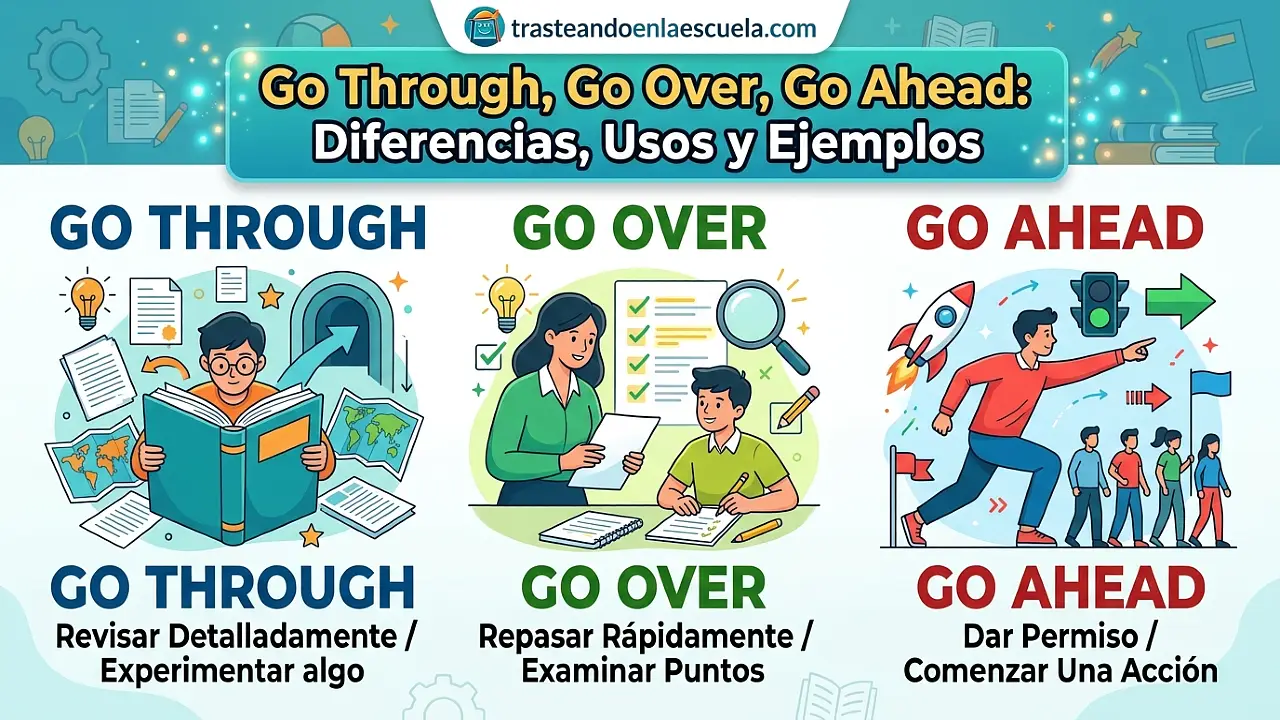
Go through, go over, go ahead: domina estos tres phrasal verbs esenciales
Si estás estudiando inglés a nivel intermedio o avanzado, seguro te has encontrado con go through, go over y go ahead. A simple vista parecen similares, pero cada uno tiene significados y usos muy distintos. En esta guía completa vas a aprender cuándo usar cada uno, sus estructuras gramaticales, más de 35 ejemplos prácticos y 5 ejercicios para consolidar lo aprendido.
🎯 En este post aprenderás: Los significados principales de cada phrasal verb, cómo diferenciarlos en contexto, errores comunes que debes evitar, expresiones idiomáticas relacionadas y aplicaciones reales en conversaciones, trabajo y exámenes oficiales como el Cambridge B2 First o C1 Advanced.
🔍 ¿Por qué es importante dominar estos tres phrasal verbs?
Go through, go over y go ahead son phrasal verbs de alta frecuencia en inglés. Aparecen constantemente en reuniones de trabajo, conversaciones informales, series de televisión y exámenes oficiales. Dominarlos te ayudará a sonar más natural y a entender mejor a los nativos.
💡 La clave está en recordar: through implica un proceso interno o atravesar algo, over sugiere repaso o revisión, y ahead significa avanzar o proceder. Con esta idea base será más fácil recordar sus usos.
📖 Go through: significados, estructura y ejemplos
🔍 GO THROUGH (inseparable)
Estructura: go through + objeto (siempre van juntos, no se separan)
Significados principales:
- 1. Revisar o examinar minuciosamente: analizar algo con atención, como documentos, información o pertenencias.
- 2. Experimentar o atravesar una situación difícil: pasar por un momento complicado, emocional o físico.
- 3. Atravesar un lugar físico: cruzar un túnel, una ciudad, un bosque, etc.
- 4. Ser aprobado o aceptado (formal): una ley, una propuesta, una solicitud que es aceptada.
- 5. Consumir o gastar algo completamente (coloquial): usar todo un recurso.
📌 Ejemplos detallados:
- We need to go through the contract before signing anything. → Necesitamos revisar el contrato antes de firmar nada.
- She’s going through a divorce right now; it’s very hard for her. → Ella está atravesando un divorcio en este momento; es muy difícil para ella.
- The train goes through three tunnels on its way to the coast. → El tren atraviesa tres túneles en su camino a la costa.
- The new law finally went through after months of debate. → La nueva ley finalmente fue aprobada después de meses de debate.
- We went through all the wine at the party. → Nos terminamos todo el vino en la fiesta.
- I need to go through my emails before the meeting. → Necesito revisar mis correos antes de la reunión.
📖 Go over: significados, estructura y ejemplos
✍️ GO OVER (puede ser separable o inseparable según el significado)
Estructura: go over + objeto (generalmente inseparable cuando significa repasar)
Significados principales:
- 1. Repasar, revisar o estudiar algo: examinar detalles, lecciones, instrucciones.
- 2. Ser bien recibido o tener éxito: cómo reacciona la audiencia ante algo (presentación, chiste, idea).
- 3. Ir a un lugar (generalmente cercano): visitar a alguien o desplazarse.
- 4. Limpiar o inspeccionar a fondo: revisar algo en busca de errores o suciedad.
- 5. Exceder un límite (go over the limit): sobrepasar un tope establecido.
📌 Ejemplos detallados:
- Let’s go over the presentation one more time before the meeting. → Repasemos la presentación una vez más antes de la reunión.
- His speech went over very well with the audience. → Su discurso fue muy bien recibido por el público.
- I’m going to go over to my neighbor’s house to borrow some sugar. → Voy a pasar a casa de mi vecino a pedir azúcar.
- The cleaning staff went over the entire building. → El personal de limpieza revisó todo el edificio.
- Don’t go over the speed limit or you’ll get a ticket. → No superes el límite de velocidad o te multarán.
- We need to go over the budget again. → Necesitamos revisar el presupuesto otra vez.
📖 Go ahead: significados, estructura y ejemplos
🚦 GO AHEAD (inseparable, intransitivo o con objeto indirecto)
Estructura: go ahead (sin objeto) o go ahead with + objeto
Significados principales:
- 1. Proceder, dar permiso o adelante: autorizar que algo comience o continúe.
- 2. Adelantarse en una fila o posición: tomar la delantera.
- 3. Suceder según lo planeado: un evento que se lleva a cabo.
- 4. Hacer algo sin esperar: actuar sin dudar.
- 5. Tomar la iniciativa: empezar algo sin necesidad de permiso explícito.
📌 Ejemplos detallados:
- Can I start the presentation? — Yes, go ahead. → ¿Puedo empezar la presentación? — Sí, adelante.
- The company decided to go ahead with the expansion plan. → La empresa decidió seguir adelante con el plan de expansión.
- You can go ahead of me in the queue; you only have one item. → Puedes adelantarte en la fila; solo llevas un artículo.
- The concert will go ahead despite the rain. → El concierto se realizará a pesar de la lluvia.
- I’m going to go ahead and book the tickets. → Voy a proceder a reservar los billetes.
- Feel free to go ahead without me; I’ll catch up later. → Siéntete libre de seguir sin mí; te alcanzaré más tarde.
⚖️ Tabla comparativa: diferencias clave
| Phrasal verb | Idea central | Uso típico | Ejemplo rápido |
|---|---|---|---|
| go through | atravesar / revisar a fondo / experimentar | documentos, situaciones difíciles, lugares | Go through the report. |
| go over | repasar / ser recibido / visitar | estudio, presentaciones, límites | Go over the notes. |
| go ahead | proceder / adelantar / dar permiso | acciones futuras, autorizaciones | Go ahead and start. |
🎯 Truco mnemotécnico visual
GO THROUGH → imagina una flecha atravesando un túnel (revisión interna o experiencia).
GO OVER → imagina una flecha pasando por encima de un libro (repaso superficial o superior).
GO AHEAD → imagina una flecha hacia adelante con una bandera verde (permiso y avance).
🌍 Aplicaciones en contextos reales
💼 En el entorno laboral
- Before we go ahead with the project, we must go through the budget carefully.
- Let’s go over the client’s feedback one more time.
- The proposal finally went through after three rounds of revisions.
- How did the presentation go over with the stakeholders?
- We need to go through the terms and conditions before signing.
🎓 En el ámbito académico
- We’ll go over the exam structure before the test.
- She went through all the past papers to prepare.
- The teacher said we could go ahead with our research projects.
- His thesis didn’t go through because of methodological issues.
- Let’s go over the key concepts one more time.
🗣️ En conversaciones cotidianas
- I’m going through old photos from our trip.
- Why don’t you go over to Sarah’s house and ask her?
- Feel free to go ahead without me; I’ll catch up.
- He’s going through a lot lately; be patient with him.
- I’ll go over to the store quickly.
⚠️ Errores comunes y cómo evitarlos
| Error frecuente | Explicación | Corrección |
|---|---|---|
| Usar «go over» cuando se necesita «go through» para experiencias difíciles | She is going over a hard time ❌ | She is going through a hard time. ✅ |
| Usar «go through» para repasar superficialmente | Let’s go through the summary quickly (puede ser aceptable pero suena a revisión profunda) | Let’s go over the summary quickly. ✅ |
| Olvidar «with» después de go ahead | We decided to go ahead the plan. ❌ | We decided to go ahead with the plan. ✅ |
| Confundir «go over» (repasar) con «go over to» (visitar) | Contexto incorrecto puede causar ambigüedad | Go over the lesson vs Go over to his house → presta atención a la preposición. |
| Usar «go through» cuando se quiere decir «aprobar» sin objeto | The law went through es correcto, pero a veces falta contexto | Asegúrate de que el contexto indique aprobación formal. |
📚 Expresiones idiomáticas relacionadas
- Go through the roof: subir drásticamente (precios, enfado). Prices have gone through the roof.
- Go over someone’s head: saltarse a un superior. He went over his boss’s head to complain.
- Go through the motions: hacer algo mecánicamente, sin entusiasmo. After the loss, he just went through the motions.
- Go ahead and do something: expresión coloquial para animar a actuar. Go ahead and ask her!
- Go overboard: exagerar, pasarse. Don’t go overboard with the decorations.
🧪 5 ejercicios prácticos para dominar go through, go over y go ahead
📝 Ejercicio 1: Completa con el phrasal verb correcto (go through / go over / go ahead)
- Before the exam, I always ______________ all my notes to refresh my memory.
- The project was finally approved, so we can ______________ with the next phase.
- She’s ______________ a very difficult period after losing her job.
- Could you please ______________ this report and check for any errors?
- The meeting will ______________ as scheduled, even if the manager is late.
✅ Ver soluciones
📝 Ejercicio 2: Elige la opción correcta según el contexto
- The train goes through / goes over the mountain by a long tunnel.
- His joke didn’t go through / go over well with the boss.
- We need to go through / go ahead the terms of the contract in detail.
- If you want to start the presentation, please go through / go ahead.
- After the accident, he went through / went over a long recovery process.
✅ Ver soluciones
📝 Ejercicio 3: Traduce las siguientes frases al inglés usando los phrasal verbs correctos
- Voy a repasar mis apuntes antes del examen.
- ¿Puedo proceder con la instalación del software?
- Ella está atravesando una situación familiar complicada.
- La nueva ley fue aprobada después de mucho debate.
- Tu idea fue muy bien recibida por el equipo.
✅ Ver soluciones
b) Can I go ahead with the software installation?
c) She’s going through a complicated family situation.
d) The new law went through after a lot of debate.
e) Your idea went over very well with the team.
📝 Ejercicio 4: Identifica si el phrasal verb es go through, go over o go ahead y explica el significado
- We need to go through the application process step by step.
- The CEO gave us permission to go ahead with the merger.
- Let’s go over the itinerary one last time.
- He went through all his savings during the trip.
- The proposal went through without any objections.
✅ Ver soluciones
b) go ahead = proceder con el plan.
c) go over = repasar el itinerario.
d) went through = consumió / gastó todos sus ahorros.
e) went through = fue aprobada.
📝 Ejercicio 5: Escribe una frase original con cada phrasal verb en el contexto dado
- go through (experimentar una situación difícil): ______________
- go over (repasar lecciones): ______________
- go ahead (dar permiso para comenzar): ______________
- go through (revisar documentos): ______________
- go over (ser bien recibido): ______________
✅ Ver ejemplos de respuestas válidas
b) I always go over the vocabulary before a test.
c) The teacher said we could go ahead with the project.
d) The lawyer went through the contract carefully.
e) Her speech went over brilliantly with the audience.
📊 Ejercicio integrador: mini diálogos con los tres phrasal verbs
Diálogo 1 (oficina):
A: Have you had time to go through the quarterly report?
B: Not yet, but I’ll go over it this afternoon. Can we go ahead with the meeting anyway?
A: Yes, let’s go ahead. We can discuss the highlights.
Diálogo 2 (entre amigos):
A: I heard you’re going through a lot with your new job. How’s it going?
B: It’s tough, but I’m learning. I need to go over the training materials again.
A: Don’t worry, you’ll go ahead quickly. You’re a fast learner.
🎓 Consejos para memorizar y practicar
📌 Estrategias efectivas:
- Crea historias cortas: escribe un párrafo que incluya los tres phrasal verbs. Ejemplo: I need to go through my emails, then go over the presentation, and finally go ahead with the client call.
- Escucha música y series: anota cada vez que escuches «go through», «go over» o «go ahead». Los nativos los usan constantemente.
- Practica en voz alta: graba tus propias frases y compáralas con ejemplos nativos.
- Usa tarjetas (flashcards): escribe el phrasal verb en un lado y 3 significados con ejemplos en el reverso.
- Haz shadowing: repite en voz alta diálogos de series donde aparezcan estos phrasal verbs.
📖 Glosario rápido
| Término | Definición |
|---|---|
| Go through | revisar minuciosamente, experimentar, atravesar, ser aprobado, consumir. |
| Go over | repasar, ser bien recibido, visitar, inspeccionar, exceder. |
| Go ahead | proceder, adelantarse, dar permiso, realizarse. |
| Inseparable phrasal verb | el verbo y la partícula no pueden separarse con el objeto. |
📚 Serie completa: Phrasal verbs con GO en Trasteandoenlaescuela
Continúa aprendiendo todos los phrasal verbs con GO:
- Go on, go off, go out: significados y ejemplos
- Go through, go over, go ahead — ¡Estás aquí!
- Go up, go down, go back: movimientos y cambios
- Go for vs go with: diferencias clave
- Descarga la lista completa de 40 phrasal verbs con GO (PDF)
🔗 Otros recursos recomendados
🏆 Reto final: Durante los próximos 3 días, usa cada uno de estos phrasal verbs al menos dos veces al día en conversaciones reales o escritas. Verás cómo dejan de ser confusos y se convierten en parte natural de tu inglés.






Publicar comentario