First Conditional: usos, estructura y ejemplos en inglés
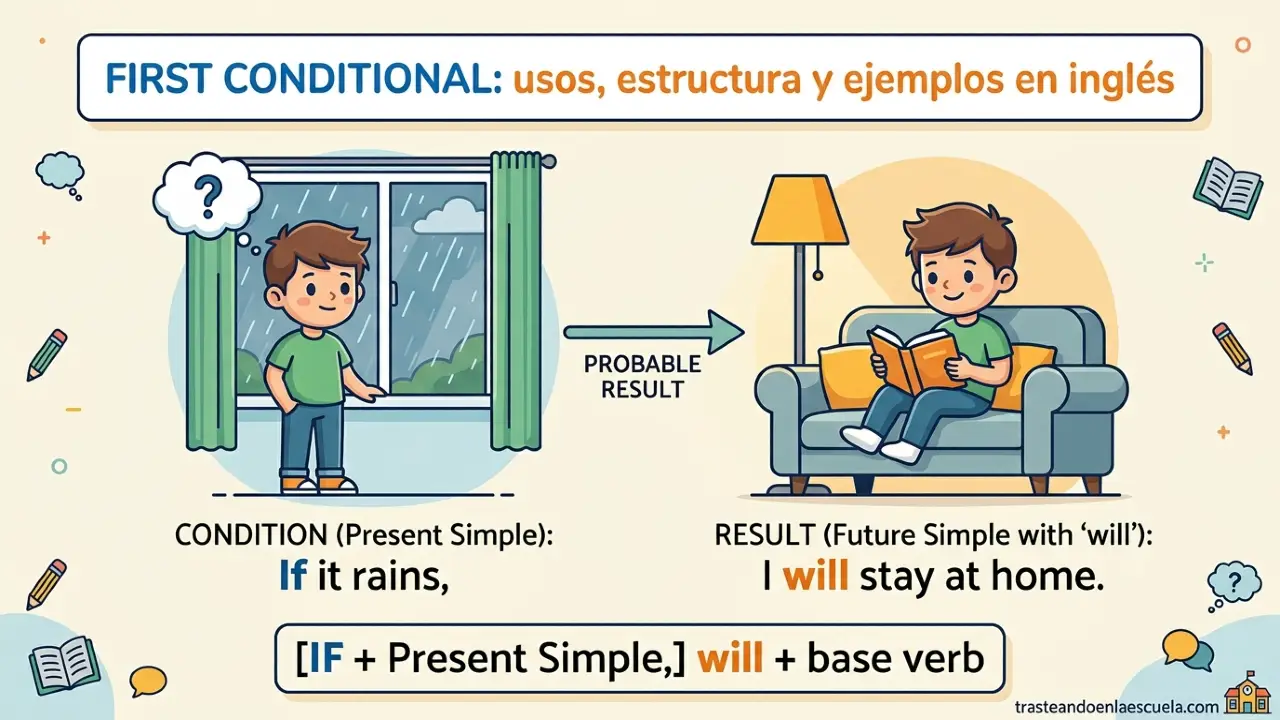
First Conditional: El condicional de lo posible
¿Cómo hablas en inglés de tus planes para mañana? ¿De lo que harás si consigues ese trabajo? ¿De las consecuencias de no estudiar para el examen? Para todas esas situaciones posibles y reales en el futuro, el inglés utiliza el First Conditional (primer condicional). Es el puente entre el presente y un futuro que realmente puede suceder.
🎯 En este post aprenderás: La estructura del primer condicional (If + Present Simple, will + infinitivo), cuándo usarlo (situaciones reales, promesas, advertencias, planes), las variaciones con modales (can, must, might), la diferencia clave con el condicional cero, y más de 25 ejemplos con ejercicios prácticos.
🔍 ¿Qué es el First Conditional?
🌱 La fórmula de lo posible
IF + SUJETO + VERBO (Presente Simple) , SUJETO + WILL + VERBO (Infinitivo)
Traducción: SI + [condición en presente], [resultado en futuro]
Significado: Si ocurre esta condición (ahora o en el futuro), entonces este resultado es probable en el futuro.
Analogía de la reserva de restaurante: «If I book a table, we will have dinner there.» (Si reservo mesa, cenaremos allí). Reservar es posible, y la consecuencia (cenar) es un plan futuro real, no imaginario.
☔ La analogía del pronóstico del tiempo
🌧️ CONDICIÓN
- Español: Si llueve mañana…
- Inglés: If it rains tomorrow…
- Tiempo verbal: Present Simple (aunque sea futuro)
- Naturaleza: Condición posible (50% de probabilidad)
🏠 RESULTADO
- Español: …nos quedaremos en casa.
- Inglés: …we will stay at home.
- Tiempo verbal: will + infinitivo
- Naturaleza: Plan futuro basado en la condición
No es 100% seguro como el condicional cero, pero es un plan real y posible.
📋 Estructura detallada del First Conditional
🎯 Fórmula general
🔨 Construcción paso a paso
1. La cláusula condicional (la condición posible)
- Siempre comienza con If (si).
- El verbo va en Present Simple, aunque se refiera al futuro.
- ¡NUNCA uses «will» en esta cláusula!
- Ejemplo: If I have time… (Si tengo tiempo…)
2. La cláusula principal (el resultado futuro)
- Expresa la consecuencia futura si se cumple la condición.
- Se forma con will + verbo en infinitivo (sin «to»).
- También se pueden usar modales como can, might, must, should.
- Si la condición va primero, se separa con una coma.
- Ejemplo: …I will call you. (…te llamaré.)
✍️ Ejemplos de estructura
If + condición, + will + resultado.
If you study hard, you will pass the exam.
(Si estudias mucho, aprobarás el examen.)
Resultado + if + condición.
You will pass the exam if you study hard.
(Aprobarás el examen si estudias mucho.)
⚠️ Puntos clave sobre la estructura
| Regla | Correcto | Incorrecto |
|---|---|---|
| NO «will» en la cláusula if | If it rains, we will stay home. | If it will rain, we will stay home. |
| Coma solo si «If» va primero | If you come, we will eat together. We will eat together if you come. |
If you come we will eat together. (sin coma) |
| Contracciones comunes | I’ll, you’ll, he’ll, she’ll, it’ll, we’ll, they’ll | — |
| Forma negativa | If you don’t hurry, you won’t arrive on time. | If you not hurry, you not will arrive. |
| Preguntas | Will you call me if you arrive late? | If you arrive late, will you call me? (válido pero menos común) |
💡 Truco mental: En la cláusula con «if», piensa en español: decimos «Si tengo tiempo, iré«, no «Si tendré tiempo, iré». En inglés es igual: «If I have time, I will go«. ¡Mantén el «will» solo para el resultado!
🌍 Usos del First Conditional
1️⃣ Situaciones reales y posibles en el futuro
El uso principal del primer condicional es para hablar de situaciones que tienen una probabilidad real de ocurrir.
📅 Ejemplos de situaciones cotidianas:
- If it is sunny tomorrow, we will go to the beach. (Si mañana hace sol, iremos a la playa.)
- If I get the job, I will celebrate with my family. (Si consigo el trabajo, lo celebraré con mi familia.)
- She will be happy if you come to her party. (Ella estará feliz si vienes a su fiesta.)
- If they arrive early, we will have dinner together. (Si llegan temprano, cenaremos juntos.)
2️⃣ Promesas y ofrecimientos
Usamos el primer condicional para hacer promesas que dependen de una condición.
🤝 Ejemplos de promesas:
- If you help me with the dishes, I will buy you ice cream. (Si me ayudas con los platos, te compraré un helado.)
- I will call you if I hear any news. (Te llamaré si sé algo.)
- If you finish your homework, you can watch TV. (Si terminas la tarea, puedes ver la tele – con «can»)
- We will help you move if you need us. (Te ayudaremos a mudarte si nos necesitas.)
3️⃣ Advertencias y amenazas
También es muy común para advertir sobre las consecuencias de ciertas acciones.
⚠️ Ejemplos de advertencias:
- If you don’t wear a coat, you will catch a cold. (Si no llevas abrigo, te resfriarás.)
- If you touch that wire, you will get an electric shock. (Si tocas ese cable, te dará una descarga.)
- You will lose your job if you keep arriving late. (Perderás tu trabajo si sigues llegando tarde.)
- If he doesn’t apologize, she won’t forgive him. (Si no se disculpa, ella no lo perdonará.)
4️⃣ Planes y negociaciones
Ideal para discutir planes que dependen de ciertas condiciones.
🗓️ Ejemplos de planes:
- If we leave now, we will arrive before dark. (Si salimos ahora, llegaremos antes de que oscurezca.)
- We will book the hotel if you find a cheap flight. (Reservaremos el hotel si encuentras un vuelo barato.)
- If the restaurant is full, we will try another one. (Si el restaurante está lleno, probaremos otro.)
- What will we do if it rains on the wedding day? (¿Qué haremos si llueve el día de la boda?)
🔄 Variaciones del First Conditional
Uso de modales en lugar de «will»
Podemos usar otros verbos modales para matizar el significado del resultado.
| Modal | Significado | Ejemplo |
|---|---|---|
| Can | Habilidad o permiso | If you finish early, you can leave. (puedes irte) |
| Might/May | Posibilidad (menos segura que will) | If it rains, we might stay home. (quizá nos quedemos) |
| Must/Have to | Obligación | If you want to pass, you must study. (debes estudiar) |
| Should | Consejo | If you feel tired, you should rest. (deberías descansar) |
📝 Ejemplos con modales:
- If you visit London, you should see the Tower. (Si visitas Londres, deberías ver la Torre.)
- If the light turns red, you must stop. (Si la luz se pone roja, debes parar.)
- She might come to the party if she finishes work early. (Ella quizá venga a la fiesta si termina el trabajo temprano.)
- If you have a ticket, you can enter for free. (Si tienes entrada, puedes entrar gratis.)
📊 Comparación: Zero vs First Conditional
| Aspecto | Conditional Zero | First Conditional |
|---|---|---|
| Estructura | If + Present Simple, Present Simple | If + Present Simple, will + infinitivo |
| Probabilidad | 100% (siempre cierto) | Posible (real, pero no 100% seguro) |
| Tiempo | Atemporal (siempre) | Futuro |
| Ejemplo | If you heat ice, it melts. | If it rains tomorrow, we will stay home. |
| Pregunta clave | ¿Ocurre siempre? | ¿Es un plan futuro posible? |
| Uso típico | Hechos científicos, hábitos | Planes, promesas, advertencias |
🎯 Truco para diferenciarlos: Si puedes añadir «siempre» a la oración y tiene sentido, es Zero Conditional. Ejemplo: «If it rains, the grass gets wet» (siempre que llueve, la hierba se moja). Si hablas de una ocasión específica en el futuro, es First Conditional: «If it rains tomorrow, we will cancel the picnic».
🧪 5 Ejercicios prácticos para dominar el First Conditional
Ejercicio 1: Completa las oraciones
Completa las siguientes oraciones con la forma correcta del verbo entre paréntesis.
- If it __________ (rain) tomorrow, we __________ (cancel) the match.
- She __________ (be) late if she __________ (not/hurry).
- If you __________ (eat) too much sugar, you __________ (have) health problems.
- They __________ (go) to the party if they __________ (be) invited.
- If I __________ (see) Mary, I __________ (tell) her the news.
✅ Ver solución
- If it rains tomorrow, we will cancel the match.
- She will be late if she doesn’t hurry.
- If you eat too much sugar, you will have health problems.
- They will go to the party if they are invited.
- If I see Mary, I will tell her the news.
Recuerda: En la condición usamos Present Simple, en el resultado usamos will + infinitivo.
Ejercicio 2: Elige la opción correcta
Selecciona la opción que completa correctamente cada oración.
- If we __________ now, we will arrive on time.
a) will leave / b) leave / c) left - You will pass the exam if you __________ hard.
a) study / b) will study / c) studied - If she doesn’t apologize, he __________ her again.
a) won’t call / b) doesn’t call / c) wouldn’t call - If it’s sunny tomorrow, we __________ to the park.
a) go / b) will go / c) went - What __________ if you miss the bus?
a) you will do / b) will you do / c) do you do
✅ Ver solución
- b) leave – If we leave now, we will arrive on time.
- a) study – You will pass the exam if you study hard.
- a) won’t call – If she doesn’t apologize, he won’t call her again.
- b) will go – If it’s sunny tomorrow, we will go to the park.
- b) will you do – What will you do if you miss the bus?
Nota: En preguntas, «will» va antes del sujeto en la cláusula principal.
Ejercicio 3: Reordena las palabras
Ordena las palabras para formar oraciones correctas en primer condicional.
- if / you / will / be / late / don’t / you / hurry
- she / will / if / the / job / get / she / applies
- we / if / will / the / train / catch / run / we
- you / if / will / what / do / lose / you / your / phone
- he / happy / if / be / will / his / team / wins
✅ Ver solución
- You will be late if you don’t hurry.
- She will get the job if she applies. / If she applies, she will get the job.
- We will catch the train if we run. / If we run, we will catch the train.
- What will you do if you lose your phone?
- He will be happy if his team wins. / If his team wins, he will be happy.
Ejercicio 4: Traduce al inglés
Traduce las siguientes oraciones al inglés usando el primer condicional.
- Si ahorras dinero, podrás comprar un coche.
- Te llamaré si llego tarde.
- Si no estudias, no aprobarás el examen.
- ¿Qué harás si pierdes el vuelo?
- Ella se enfadará si no la invitamos.
✅ Ver solución
- If you save money, you will be able to buy a car. (o …you can buy a car)
- I will call you if I arrive late.
- If you don’t study, you won’t pass the exam.
- What will you do if you miss the flight?
- She will be angry if we don’t invite her.
Nota: «Enfadarse» puede ser «get angry» o «be angry». Ambas son correctas.
Ejercicio 5: Completa con tus propias ideas
Completa las siguientes oraciones de manera lógica usando el primer condicional.
- If I have free time this weekend, ____________________.
- ____________________ if it rains on Saturday.
- If I don’t finish my homework, ____________________.
- My parents will be happy if ____________________.
- What will you do if ____________________?
✅ Ver soluciones de ejemplo
Posibles respuestas:
- If I have free time this weekend, I will visit my grandparents.
- We will cancel the picnic if it rains on Saturday.
- If I don’t finish my homework, the teacher will be angry.
- My parents will be happy if I pass all my exams.
- What will you do if you win the lottery?
❌ Errores comunes con el First Conditional
| Error | Ejemplo incorrecto | Corrección | Explicación |
|---|---|---|---|
| Poner «will» en la condición | If it will rain, we will stay home. | If it rains, we will stay home. | NUNCA uses «will» después de «if» en primer condicional. |
| Olvidar «will» en el resultado | If you study, you pass the exam. | If you study, you will pass the exam. | Sin «will» parece condicional cero (siempre cierto). |
| Usar «would» | If I have time, I would go. | If I have time, I will go. | «Would» es para situaciones imaginarias (2º condicional). |
| Confundir con Zero Conditional | If it rains tomorrow, it makes the grass wet. | If it rains tomorrow, it will make the grass wet. | Es una situación futura específica, no una verdad universal. |
| Olvidar la -s en 3ª persona | If she arrive late, she will miss the start. | If she arrives late, she will miss the start. | Present Simple necesita -s para he/she/it. |
| Orden incorrecto en preguntas | If you see John, you will tell him? | Will you tell John if you see him? | En preguntas, «will» va al principio. |
🌍 Aplicaciones en la vida real
💼 En el trabajo y entrevistas
- Negociaciones: «If you offer me the job, I will start next month.»
- Planes de proyecto: «If we finish early, we will have more time for testing.»
- Compromisos: «I will send the report by Friday if I get the data tomorrow.»
🎓 En el ámbito académico
- Consecuencias académicas: «If you don’t submit the assignment, you will fail the course.»
- Planificación: «If I get a scholarship, I will study abroad.»
- Compromisos con compañeros: «If you explain this topic to me, I will help you with math.»
🏠 En la vida cotidiana
- Planes sociales: «If the weather is nice, we will have a barbecue.»
- Compras: «If this jacket goes on sale, I will buy it.»
- Salud: «If you take this medicine, you will feel better tomorrow.»
- Tecnología: «If you click this link, you will download the file.»
📖 Glosario de términos
| Término | Definición | Ejemplo |
|---|---|---|
| First Conditional | Estructura para situaciones reales y posibles en futuro | If it rains, we will stay home. |
| Real situation | Situación que tiene probabilidad real de ocurrir | Getting a job, weather forecast |
| Future result | Consecuencia que ocurrirá en el futuro si se cumple condición | We will celebrate |
| Promise | Compromiso de hacer algo bajo cierta condición | I will buy you ice cream if… |
| Warning | Advertencia sobre consecuencias negativas | You will get sick if… |
| Modal verb | Verbo que modifica el significado (can, might, must) | You can go if… |
| Contraction | Forma abreviada de will (I’ll, you’ll, etc.) | I’ll call you |
| If-clause | La parte de la oración que comienza con if | If you study… |
| Main clause | La parte que expresa el resultado principal | …you will pass |
📚 Serie completa: Condicionales en Inglés
Domina todos los condicionales con nuestra serie completa:
- Conditional Zero – Hechos y verdades universales.
- First Conditional – ¡Estás aquí! Situaciones reales y posibles.
- Second Conditional – Hipotéticos e imaginarios.
- Third Conditional – Arrepentimientos y situaciones pasadas.
- Mixed Conditionals – Combinaciones de tiempos.
🔍 Reto para tu día a día: Durante esta semana, cada vez que hagas un plan o una promesa, fíjate si puedes expresarlo en inglés con el primer condicional. Por ejemplo: «If I finish work early on Friday, I will meet you for coffee.» Anota 5 ejemplos reales de tu vida y tendrás dominado el First Conditional.

Publicar comentario