Ejercicios de orden de adjetivos en inglés (PDF incluido)
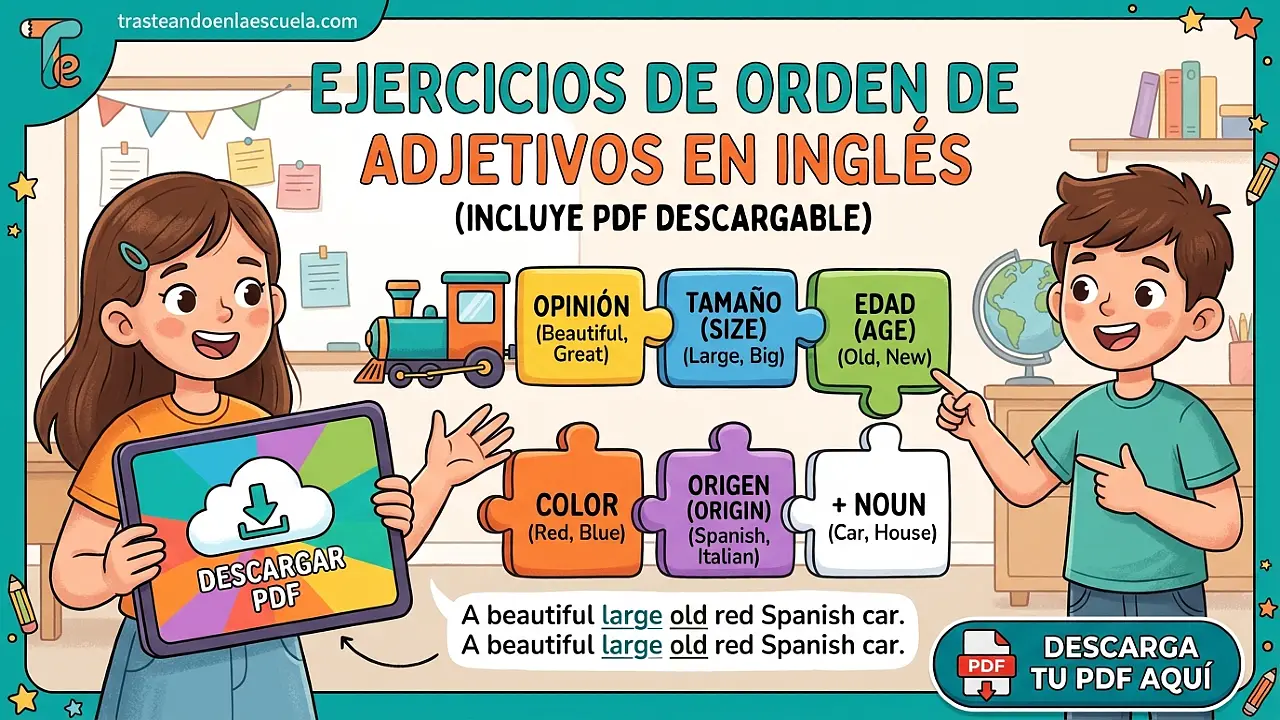
Ejercicios de orden de adjetivos en inglés
Después de estudiar las reglas OSASCOMP, ver los ejemplos prácticos y aprender sobre la posición de los adjetivos, es hora de poner a prueba lo que has aprendido. Este cuaderno de ejercicios contiene más de 50 actividades diseñadas para que domines el orden de los adjetivos para siempre.
🎯 En este post encontrarás: Ejercicios de ordenar adjetivos según OSASCOMP, completar frases, corregir errores, elegir la opción correcta, traducir al inglés y diferenciar posición atributiva vs predicativa. Todas las soluciones están incluidas al final de cada ejercicio para que puedas autocorregirte.
🔗 Antes de empezar: Si aún no has repasado las reglas, te recomiendo visitar la guía de reglas OSASCOMP y los ejemplos prácticos.
📊 6 Bloques de ejercicios | Más de 50 actividades | Soluciones incluidas
📋 Bloque 1: Ordena los adjetivos según OSASCOMP
Ejercicio 1.1: Coloca los adjetivos en el orden correcto
- a (beautiful / old / small) house → ____________________
- a (red / new / sports) car → ____________________
- a (French / delicious / old) wine → ____________________
- a (leather / black / big) bag → ____________________
- a (round / wooden / small) table → ____________________
- an (interesting / ancient / Spanish) book → ____________________
- a (cotton / white / lovely) shirt → ____________________
- a (metal / large / round) box → ____________________
- a (young / tall / handsome) man → ____________________
- a (plastic / blue / cheap) pen → ____________________
✅ Ver soluciones
- a beautiful small old house
- a new red sports car
- a delicious old French wine
- a big black leather bag
- a small round wooden table
- an interesting ancient Spanish book
- a lovely white cotton shirt
- a large round metal box
- a handsome tall young man
- a cheap blue plastic pen
Ejercicio 1.2: Ordena los adjetivos (nivel intermedio)
- a (big / Italian / red / sports) car → ____________________
- a (beautiful / wooden / small / round) box → ____________________
- a (delicious / French / hot / old) soup → ____________________
- a (black / leather / elegant / Italian) jacket → ____________________
- a (modern / glass / large / square) building → ____________________
- a (pretty / little / old / Spanish) village → ____________________
- a (blue / Chinese / silk / beautiful) dress → ____________________
- a (metal / heavy / round / small) container → ____________________
- an (interesting / new / English / historical) novel → ____________________
- a (wooden / antique / round / lovely) table → ____________________
✅ Ver soluciones
- a big red Italian sports car
- a beautiful small round wooden box
- a delicious hot old French soup
- an elegant black Italian leather jacket
- a large square modern glass building
- a pretty little old Spanish village
- a beautiful blue Chinese silk dress
- a small heavy round metal container
- an interesting new English historical novel
- a lovely old round wooden table (o lovely round old wooden)
📋 Bloque 2: Completa las frases con el adjetivo en la posición correcta
Ejercicio 2.1: Coloca el adjetivo entre paréntesis en la posición correcta
- She has a ________ house. (beautiful / big / old)
- He bought a ________ car. (new / red / sports)
- We need a ________ table. (round / wooden / small)
- She wore a ________ dress. (white / cotton / lovely)
- They visited a ________ castle. (ancient / Scottish / large)
- I ate a ________ soup. (delicious / Spanish / hot)
- He is a ________ man. (tall / young / handsome)
- She has a ________ bag. (leather / black / Italian)
- They live in a ________ house. (old / white / big)
- I read an ________ book. (interesting / old / French)
✅ Ver soluciones
- She has a beautiful big old house.
- He bought a new red sports car.
- We need a small round wooden table.
- She wore a lovely white cotton dress.
- They visited a large ancient Scottish castle.
- I ate a delicious hot Spanish soup.
- He is a handsome tall young man.
- She has a black Italian leather bag (o beautiful black Italian leather).
- They live in a big old white house.
- I read an interesting old French book.
Ejercicio 2.2: Escribe la frase completa con los adjetivos en orden
- house / beautiful / old / small → ____________________
- car / sports / red / new → ____________________
- wine / French / delicious / old → ____________________
- bag / leather / black / big → ____________________
- table / wooden / round / small → ____________________
- book / Spanish / interesting / ancient → ____________________
- shirt / white / cotton / lovely → ____________________
- box / metal / round / large → ____________________
- man / tall / young / handsome → ____________________
- pen / blue / plastic / cheap → ____________________
✅ Ver soluciones
- a beautiful small old house
- a new red sports car
- a delicious old French wine
- a big black leather bag
- a small round wooden table
- an interesting ancient Spanish book
- a lovely white cotton shirt
- a large round metal box
- a handsome tall young man
- a cheap blue plastic pen
📋 Bloque 3: Corrige los errores en las frases
Ejercicio 3.1: Cada frase contiene un error de orden de adjetivos. Reescríbela correctamente.
- She lives in a red big house. → ____________________
- He drives a sports red new car. → ____________________
- We ate a Spanish delicious soup. → ____________________
- She bought a leather black bag. → ____________________
- They have a wooden round small table. → ____________________
- I read a French old interesting book. → ____________________
- She wore a cotton white lovely shirt. → ____________________
- He gave me a metal round box. → ____________________
- She married a young tall handsome man. → ____________________
- I need a blue cheap plastic pen. → ____________________
✅ Ver soluciones
- She lives in a big red house.
- He drives a new red sports car.
- We ate a delicious Spanish soup.
- She bought a black leather bag.
- They have a small round wooden table.
- I read an interesting old French book.
- She wore a lovely white cotton shirt.
- He gave me a round metal box. (o large round metal box)
- She married a handsome tall young man.
- I need a cheap blue plastic pen.
Ejercicio 3.2: Corrige los errores en estas frases más complejas
- They bought a leather Italian beautiful bag. → ____________________
- We visited a wooden old big church. → ____________________
- She has a cotton white nice dress. → ____________________
- He ordered a French red delicious wine. → ____________________
- They live in a modern glass large building. → ____________________
- She received a gold Spanish antique necklace. → ____________________
- I found a metal round small old box. → ____________________
- He is a French young talented artist. → ____________________
- She wore a leather black elegant jacket. → ____________________
- We ate a hot delicious Mexican soup. → ____________________
✅ Ver soluciones
- They bought a beautiful Italian leather bag.
- We visited a big old wooden church.
- She has a nice white cotton dress.
- He ordered a delicious French red wine.
- They live in a large modern glass building.
- She received an antique Spanish gold necklace.
- I found a small old round metal box.
- He is a talented young French artist.
- She wore an elegant black leather jacket.
- We ate a delicious hot Mexican soup.
📋 Bloque 4: Elige la opción correcta
Ejercicio 4.1: Selecciona la opción con el orden correcto
- a) a red big car b) a big red car c) a car big red
- a) a beautiful old house b) an old beautiful house c) a house beautiful old
- a) a leather black bag b) a bag black leather c) a black leather bag
- a) a Spanish delicious wine b) a delicious Spanish wine c) a wine delicious Spanish
- a) a round small wooden table b) a small round wooden table c) a wooden small round table
- a) a new sports red car b) a red new sports car c) a new red sports car
- a) a lovely white cotton shirt b) a cotton white lovely shirt c) a white lovely cotton shirt
- a) a large round metal box b) a metal round large box c) a round large metal box
- a) a handsome tall young man b) a young tall handsome man c) a tall handsome young man
- a) a cheap blue plastic pen b) a blue cheap plastic pen c) a plastic blue cheap pen
✅ Ver soluciones
- b) a big red car
- a) a beautiful old house
- c) a black leather bag
- b) a delicious Spanish wine
- b) a small round wooden table
- c) a new red sports car
- a) a lovely white cotton shirt
- a) a large round metal box
- a) a handsome tall young man
- a) a cheap blue plastic pen
📋 Bloque 5: Atributivo vs Predicativo
Ejercicio 5.1: ¿Atributivo (antes del sustantivo) o predicativo (después del verbo)?
- a beautiful flower → __________
- The flower is beautiful → __________
- an old house → __________
- The house seems old → __________
- The food smells delicious → __________
- delicious food → __________
- She looks happy → __________
- a happy child → __________
- The man is tall → __________
- a tall man → __________
✅ Ver soluciones
- a beautiful flower → Atributivo
- The flower is beautiful → Predicativo
- an old house → Atributivo
- The house seems old → Predicativo
- The food smells delicious → Predicativo
- delicious food → Atributivo
- She looks happy → Predicativo
- a happy child → Atributivo
- The man is tall → Predicativo
- a tall man → Atributivo
Ejercicio 5.2: Adjetivos especiales (predicativos)
Corrige los errores. Recuerda: asleep, alive, afraid, alone, ashamed, alike son SOLO predicativos.
- an asleep baby → ____________________
- an alive fish → ____________________
- an afraid girl → ____________________
- an alone man → ____________________
- an ashamed student → ____________________
- alike twins → ____________________
✅ Ver soluciones
- a sleeping baby (o «The baby is asleep»)
- a living fish (o «The fish is alive»)
- a scared girl (o «The girl is afraid»)
- a lonely man o a man alone (o «The man is alone»)
- an embarrassed student (o «The student is ashamed»)
- similar twins (o «The twins are alike»)
📋 Bloque 6: Adjetivos que cambian de significado según su posición
Ejercicio 6.1: Explica la diferencia de significado
- «a certain person» vs «I am certain»
- «the late president» vs «I am late»
- «an old friend» vs «my friend is old»
- «a heavy smoker» vs «the box is heavy»
- «a light sleeper» vs «the bag is light»
✅ Ver soluciones
- «a certain person» = una persona indeterminada (cierta persona). «I am certain» = estoy seguro (tengo certidumbre).
- «the late president» = el difunto presidente (fallecido). «I am late» = llego tarde (retrasado).
- «an old friend» = un viejo amigo (de muchos años de amistad). «my friend is old» = mi amigo es viejo (mayor de edad).
- «a heavy smoker» = un fumador empedernido (fuma mucho, no es pesado físicamente). «the box is heavy» = la caja es pesada (peso físico).
- «a light sleeper» = una persona que duerme ligero (se despierta fácilmente). «the bag is light» = la bolsa es ligera (poco peso).
Ejercicio 6.2: Elige el significado correcto según el contexto
- «A certain person called you.» ¿Qué significa?
a) Una persona segura te llamó. b) Una persona indeterminada te llamó. c) Una persona confiable te llamó. - «The late president gave a speech.» ¿Qué significa?
a) El presidente llegó tarde. b) El presidente fallecido. c) El presidente actual. - «He’s an old friend.» ¿Qué significa?
a) Es un amigo mayor de edad. b) Es un amigo desde hace muchos años. c) Es un amigo viejo (en mal estado). - «She’s a heavy drinker.» ¿Qué significa?
a) Bebe mucho alcohol. b) Es una persona pesada. c) Bebe con pesadez. - «I’m light sleeper.» ¿Qué significa?
a) Duermo poco peso. b) Me despierto fácilmente. c) Duermo con luz.
✅ Ver soluciones
- b) Una persona indeterminada te llamó.
- b) El presidente fallecido.
- b) Es un amigo desde hace muchos años.
- a) Bebe mucho alcohol.
- b) Me despierto fácilmente.
📋 Bloque 7: Traducción inversa (español → inglés)
Ejercicio 7.1: Traduce al inglés con el orden correcto de adjetivos
- Una bonita casa pequeña y antigua. → ____________________
- Un coche deportivo rojo nuevo. → ____________________
- Una mesa redonda de madera pequeña. → ____________________
- Una sopa española caliente deliciosa. → ____________________
- Un hombre joven alto y guapo. → ____________________
- Algo especial. → ____________________
- Nada importante. → ____________________
- El presidente electo. → ____________________
- Cierta persona me llamó. → ____________________
- El niño está dormido. → ____________________
✅ Ver soluciones
- a beautiful small old house
- a new red sports car
- a small round wooden table
- a delicious hot Spanish soup
- a handsome tall young man
- something special
- nothing important
- the President elect
- A certain person called me
- The baby is asleep
📋 Bloque 8: Mini test final (20 preguntas)
Test exprés de orden de adjetivos
- Orden correcto: a (beautiful / old / small) house → ____________
- Orden correcto: a (sports / red / new) car → ____________
- Orden correcto: a (leather / black / big) bag → ____________
- ¿Atributivo o predicativo? «The house is big» → __________
- ¿Atributivo o predicativo? «a big house» → __________
- Corrige: «a red big car» → __________
- Corrige: «a leather Italian beautiful bag» → __________
- Traduce: «algo interesante» → __________
- Traduce: «el presidente electo» → __________
- ¿Qué significa «a late president»? → __________
- ¿Qué significa «I am late»? → __________
- ¿Qué adjetivo es solo predicativo? (alive / main / only) → __________
- ¿Qué adjetivo es solo atributivo? (asleep / main / afraid) → __________
- Completa: «a (round / wooden / small) table» → __________
- Completa: «a (French / delicious / old) wine» → __________
- Completa: «a (cotton / white / lovely) shirt» → __________
- Completa: «a (metal / large / round) box» → __________
- Completa: «a (young / tall / handsome) man» → __________
- Elige la correcta: a) a red new car b) a new red car c) a car new red
- Elige la correcta: a) a leather black bag b) a black leather bag c) a bag leather black
✅ Ver soluciones
- beautiful small old
- new red sports
- big black leather
- Predicativo
- Atributivo
- a big red car
- a beautiful Italian leather bag
- something interesting
- the President elect
- el difunto presidente
- llego tarde
- alive
- main
- small round wooden
- delicious old French
- lovely white cotton
- large round metal
- handsome tall young
- b) a new red car
- b) a black leather bag
📊 Tabla de resultados y recomendaciones
📈 Evalúa tu nivel
- 90-100% (45-50 aciertos): 🏆 ¡Excelente! Dominas el orden de los adjetivos.
- 70-85% (35-42 aciertos): ✅ ¡Muy bien! Repasa algún bloque específico.
- 50-65% (25-32 aciertos): 📚 Necesitas repasar las reglas OSASCOMP.
- Menos de 50% (menos de 25 aciertos): 🔄 Estudia las reglas básicas y vuelve a intentarlo.
📚 Otros temas sobre adjetivos en inglés
🔗 Serie completa sobre el orden de los adjetivos
- Orden correcto de los adjetivos (reglas OSASCOMP) – La teoría completa.
- Ejemplos de orden de adjetivos – Más de 50 ejemplos prácticos.
- Adjetivos antes vs después del sustantivo – Atributivo vs predicativo.
- 📌 This post: Ejercicios de orden de adjetivos – ¡Estás aquí!
- Lista de adjetivos por categoría – Descarga la lista completa organizada.
🏆 RETO FINAL: Crea un párrafo de 3-4 frases describiendo tu habitación o tu casa usando al menos 10 adjetivos diferentes en el orden correcto (según OSASCOMP). Escribe el párrafo en los comentarios y lo corregiremos entre todos.







Publicar comentario