Size adjectives: todos los adjetivos para expresar tamaño en inglés
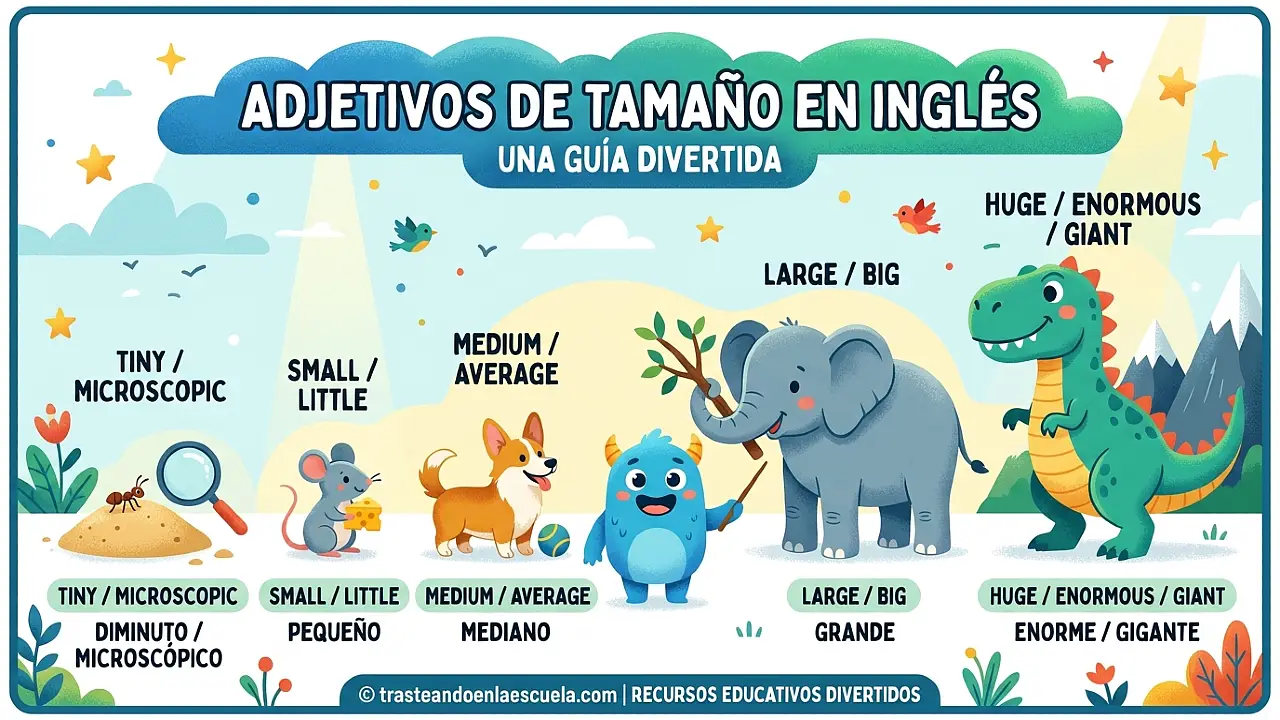
Size Adjectives: de lo minúsculo a lo descomunal en inglés
¿Sabes expresar en inglés la diferencia entre «tiny» y «small»? ¿O entre «huge» y «enormous»? Los size adjectives (adjetivos de tamaño) son fundamentales para describir cualquier objeto, persona o lugar. Sin ellos, no podrías pedir una taza pequeña de café, decir que tu ciudad es enorme o describir a un perro minúsculo. Y lo mejor: ¡hay muchísimos matices para explorar!
🎯 En este post aprenderás: Todos los adjetivos de tamaño en inglés, desde los más pequeños (tiny, small) hasta los más grandes (gigantic, colossal), la escala de intensidad, cómo formar comparativos y superlativos, expresiones idiomáticas con «size», y ejercicios prácticos para dominarlos.
🔍 ¿Qué son los size adjectives?
📖 Definiendo el tamaño
Los size adjectives describen las dimensiones de un objeto, persona, animal o lugar: qué tan grande o pequeño es. Son esenciales para casi cualquier descripción y existen en diferentes grados de intensidad.
Ejemplos básicos:
- a big house (una casa grande)
- a small dog (un perro pequeño)
- a tiny insect (un insecto minúsculo)
- a huge building (un edificio enorme)
💡 Dato clave: Los adjetivos de tamaño suelen colocarse antes del sustantivo (attributive position) o después del verbo «to be» (predicative position). También suelen ir al principio de la secuencia OSASCOMP (Opinion → Size → Age…). Por ejemplo: «a beautiful big old house» (Opinión + Tamaño + Edad).
📊 Escala completa de adjetivos de tamaño
📉 Para objetos PEQUEÑOS (de menos a más pequeño)
🔽 Escala descendente de tamaño
Medium / Average (mediano/promedio) → Small (pequeño) → Little (pequeño, a menudo con cariño) → Petite (menudo, para personas) → Tiny (minúsculo) → Minute (pronunciado /maiˈnut/ – diminuto) → Microscopic (microscópico)
📝 Adjetivos para tamaños PEQUEÑOS
📈 Para objetos GRANDES (de menos a más grande)
🔼 Escala ascendente de tamaño
Medium / Average (mediano) → Big (grande) → Large (grande – más formal) → Huge (enorme) → Enormous (enorme) → Gigantic (gigantesco) → Colossal (colosal) → Immense (inmenso) → Massive (masivo) → Boundless / Limitless (sin límites)
📝 Adjetivos para tamaños GRANDES
| Adjetivo | Significado | Matiz | Ejemplo |
|---|---|---|---|
| Big | Grande | El más común (uso general) | «She has a big smile.» |
| Large | Grande (más formal) | Más formal que «big» | «The company made a large investment.» |
| Great | Grande (a menudo con significado figurado) | Tamaño o importancia | «The Great Wall of China» |
| Huge | Enorme | Más grande que big/large | «They live in a huge mansion.» |
| Enormous | Enorme | Similar a huge | «An enormous whale appeared.» |
| Gigantic | Gigantesco | Énfasis en lo descomunal | «A gigantic statue stands in the square.» |
| Colossal | Colosal | Muy formal, tamaño abrumador | «The project was a colossal failure.» |
| Immense | Inmenso | Difícil de medir | «The universe is immense.» |
| Massive | Masivo, enorme | Énfasis en peso o volumen | «A massive rock blocked the road.» |
📊 Tabla de intensidad comparativa
| Tamaño en español | Adjetivo en inglés | Comparativo | Superlativo |
|---|---|---|---|
| Minúsculo | Tiny | Tinier | The tiniest |
| Pequeño | Small | Smaller | The smallest |
| Mediano | Medium | – (less common) | – |
| Grande | Big | Bigger | The biggest |
| Grande (formal) | Large | Larger | The largest |
| Enorme | Huge | Huger | The hugest |
| Gigantesco | Gigantic | More gigantic | The most gigantic |
💡 Regla de los comparativos: Los adjetivos cortos (1-2 sílabas) añaden -er / -est (small → smaller → smallest). Los adjetivos largos (3+ sílabas) usan more / most (enormous → more enormous → most enormous) o less / least (less enormous, least enormous).
🎯 Diferencias clave entre adjetivos similares
BIG vs LARGE
Big es más común en inglés hablado y coloquial. Large es más formal y se usa más en inglés escrito.
- «She has a big family.» (coloquial)
- «The company has a large number of employees.» (formal)
SMALL vs LITTLE
Small es objetivo y neutral. Little es más subjetivo y a menudo añade un matiz afectivo o de pequeñez adoración.
- «a small car» (un coche pequeño – objetivo)
- «a little house in the woods» (una casita en el bosque – con cariño)
HUGE vs ENORMOUS vs GIGANTIC
Son casi sinónimos, pero gigantic sugiere algo mucho más grande que la escala normal. Enormous es muy grande, huge es el más común.
- «I have a huge appetite.» (común)
- «The building was enormous.» (énfasis)
- «That’s a gigantic waste of time.» (figurado)
🔧 Adjetivos de tamaño para personas y objetos específicos
👤 Para personas
| Adjetivo | Significado | Ejemplo |
|---|---|---|
| Tall | Alto (altura) | «He is tall and thin.» |
| Short | Bajo | «She is short for her age.» |
| Medium height | Estatura media | «I’m of medium height.» |
| Slim / Slender | Delgado | «She has a slender figure.» |
| Petite | Pequeña y menuda (mujeres) | «She is petite, only 1.50m.» |
🏠 Para objetos cotidianos
| Objeto | Tamaño pequeño | Tamaño grande |
|---|---|---|
| Teléfono | compact, small | large-screen, huge |
| Café | small, tall (Starbucks) | large, venti, grande |
| Habitación | tiny, cramped | spacious, huge, massive |
🌍 Expresiones idiomáticas con «size» y adjetivos de tamaño
📚 Frases hechas muy útiles
- «That’s a big deal» — Eso es muy importante (no literalmente grande).
- «To make it big» — Tener éxito, volverse famoso.
«He moved to Hollywood to make it big.» - «Big shot» — Persona importante / pez gordo.
«He thinks he’s a big shot now.» - «Small talk» — Charla trivial / conversación ligera.
«I hate making small talk at parties.» - «A big mouth» — Lengua larga / persona que habla demasiado.
«Don’t tell him any secrets. He has a big mouth.» - «Small world» — El mundo es un pañuelo.
«You know my cousin? Small world!» - «Giant step / giant leap» — Gran avance.
«That’s a giant step for mankind.» - «Tiny minority» — Minoría muy pequeña.
«Only a tiny minority of people complain.»
⚖️ Comparativos y superlativos especiales
📈 Palabras irregulares y matices
| Adjetivo | Comparativo | Superlativo | Nota |
|---|---|---|---|
| Small | Smaller | The smallest | Regular |
| Little | Less / Lesser | The least | «Little» tiene formas irregulares como cuantificador |
| Big | Bigger | The biggest | Dobla la ‘g’ |
| Large | Larger | The largest | Regular |
| Huge | Huger | The hugest | Regular (menos común «more huge») |
💡 Diferencia de uso: En inglés hablado, se prefiere «bigger» y «biggest». En inglés escrito y formal, se usa más «larger» y «largest» para tamaños. Para enfatizar mucho, se usan «more enormous» o «most enormous» (aunque suene redundante).
🧪 5 Ejercicios prácticos
Ejercicio 1: Elige el adjetivo de tamaño adecuado
- An ant is ______. (tiny / huge)
- An elephant is ______. (small / enormous)
- My phone fits in my pocket. It’s very ______. (compact / gigantic)
- Their new house has 20 rooms. It’s ______. (tiny / huge)
- She only weighs 45 kilos. She is very ______. (petite / colossal)
✅ Ver solución
- An ant is tiny.
- An elephant is enormous (o huge).
- It’s very compact (o small).
- It’s huge (o enormous, gigantic).
- She is very petite (o small).
Ejercicio 2: Escribe el comparativo o superlativo
- My house is ______ (big) than yours.
- This is ______ (small) phone in the store.
- That’s the ______ (large) pizza I’ve ever seen!
- Your dog is ______ (tiny) than mine.
- This problem is ______ (huge) than we thought.
✅ Ver solución
- My house is bigger than yours.
- This is the smallest phone in the store.
- That’s the largest pizza I’ve ever seen!
- Your dog is tinier than mine.
- This problem is huger / more huge than we thought. (más natural: «bigger»)
Ejercicio 3: Traduce al inglés
- Un coche pequeño
- Un edificio gigantesco
- Una porción minúscula
- Tienen un jardín enorme
- Vivo en una ciudad de tamaño mediano
✅ Ver solución
- A small car (o a little car)
- A gigantic building (o a huge/enormous building)
- A tiny portion (o a minute portion)
- They have a huge / enormous garden.
- I live in a medium-sized city.
Ejercicio 4: Completa con la expresión idiomática correcta
Usa las expresiones: a big deal, small talk, a big mouth, small world, make it big
- I hate making ______ at parties. I prefer deep conversations.
- Don’t tell him your secret. He has ______.
- You know my cousin? Wow, ______!
- It’s not ______. Don’t worry about it.
- He moved to London to ______ as an actor.
✅ Ver solución
- I hate making small talk at parties.
- He has a big mouth.
- Wow, small world!
- It’s not a big deal.
- He moved to London to make it big as an actor.
Ejercicio 5: Escribe una descripción usando adjetivos de tamaño
Describe tu habitación, tu casa o tu ciudad usando al menos 5 adjetivos de tamaño diferentes.
✅ Ver ejemplo de respuesta
Ejemplo: «My bedroom is not very big. It’s actually quite small and compact. I have a tiny desk in the corner where I study. The window is small, so the room is a bit dark. However, the closet is surprisingly large — it’s almost as huge as the bed! The building where I live is medium-sized, not too large and not too small. My city is enormous, with gigantic skyscrapers and massive shopping malls. But my favorite place is a tiny coffee shop in a little alley. It’s small but very cozy.»
📚 Clúster 46: Adjetivos básicos en inglés
Completa tu aprendizaje con el resto de posts de esta serie:
- Descriptive adjectives: lista – La guía general de adjetivos descriptivos.
- Personality adjectives: cómo eres – Tu carácter en inglés.
- Appearance adjectives: físico – Cómo describir la apariencia.
- Size adjectives: grande, pequeño – ¡Estás aquí!
- Color adjectives: colores – Próximamente: todos los colores en inglés.
Para seguir practicando, visita también nuestras guías de gramática inglesa y matemáticas.
🏆 Reto de la semana: Esta semana, cada vez que veas un objeto, pregúntate: «How would I describe its size in English?» y trata de encontrar el adjetivo más preciso. Por ejemplo, una hormiga no es solo «small», es «tiny» o «minute». Un rascacielos no es solo «big», es «gigantic» o «colossal». Crea tu propia escala visual con 10 niveles de tamaño y escribe al menos 3 ejemplos para cada nivel. Verás cómo tu vocabulario se amplía notablemente.



Publicar comentario